Archaeological Museum of Rhodes: Ancient Treasures Inside a Medieval Masterpiece
Housed in the 15th-century Hospital of the Knights, the Archaeological Museum of Rhodes brings together artifacts spanning the Archaic to Roman periods, including celebrated Hellenistic marble statues and intricate floor mosaics. It is one of the most historically layered museum experiences in the Aegean, where the building itself is as compelling as the collection inside.
Quick Facts
- Location
- Megalou Alexandrou Square (Great Alexander Square), Rhodes Old Town, 85100
- Getting There
- Walk from any Old Town gate; closest is the D'Amboise Gate or St. Paul's Gate. No direct bus into the walled city.
- Time Needed
- 1.5 to 2.5 hours for a thorough visit; 45–60 minutes for a focused pass
- Cost
- €10 standard admission; reduced rates for EU seniors and students; free first Sunday Nov–Mar
- Best for
- History enthusiasts, architecture lovers, travelers seeking shelter from midday heat
Two Buildings in One: The Hospital That Became a Museum
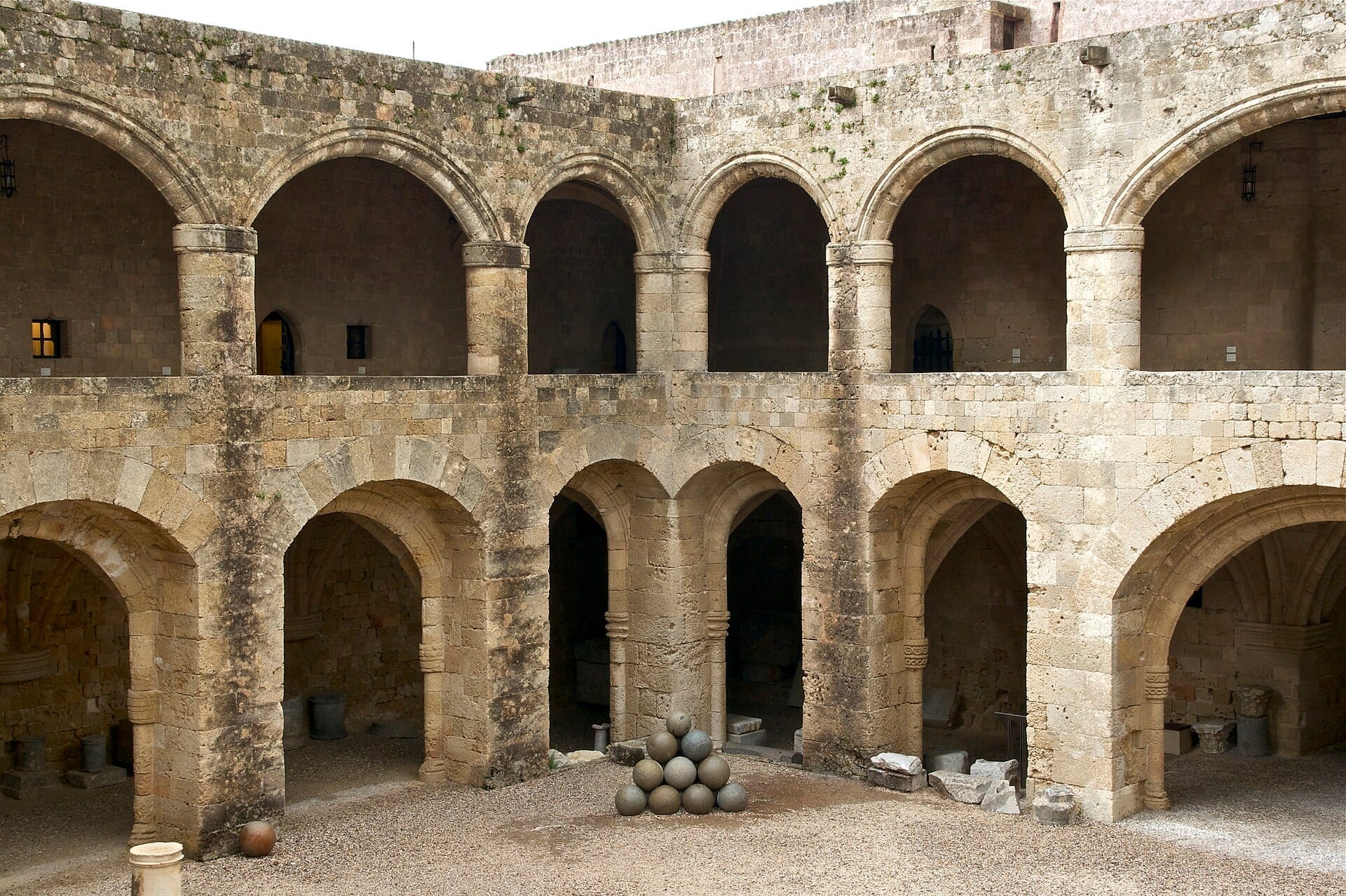
The Archaeological Museum of Rhodes occupies the former Hospital of the Knights of Saint John, a two-storey Gothic structure construction begun in 1440 under Grand Master Jean de Lastic and completed in the time of Grand Master d'Aubusson (1476-1503). When it operated as a hospital, this building was one of the most sophisticated medical facilities in the medieval Mediterranean, with a great hall capable of housing dozens of patients in vaulted stone bays. The Knights carved coats of arms above doorways, and those heraldic carvings are still visible on the facade today. The institution was converted into a museum in 1914 and has functioned as such ever since, making it one of the earliest purpose-repurposed medieval structures in Greece.
The result is an unusual double experience: visitors absorb both the physical grandeur of a Knights' Hospitaller building and the ancient collection housed within it. The interior courtyard, open to the sky, is paved in stone and surrounded by carved arcades. Entering from the main gateway on Megalou Alexandrou Square, you pass through a vestibule where the scale of the building becomes immediately apparent. The stone smells faintly damp in the morning, cool even in summer, and the contrast with the heat outside is immediate and welcome.
💡 Local tip
Arrive as close to opening time as possible (opening time) to have the courtyard and ground-floor halls largely to yourself. By 10:30, tour groups fill the main gallery, and the narrow staircases can become crowded.
The Collection: What You Will Actually See
The museum's holdings span roughly three millennia, from prehistoric Aegean artifacts through Archaic, Classical, Hellenistic, and into the Roman period. The collection draws primarily from excavations at three ancient Rhodian cities: Ialyssos on the northwest coast, Kamiros on the west, and Lindos in the south. Together these cities formed the Rhodian federation that built much of the island's classical wealth before the city of Rhodes itself was founded in 408 BCE.
On the ground floor, the Lapidary Garden displays large architectural fragments, inscriptions, and sarcophagi arranged around the courtyard. Stone reliefs lean against ancient walls; funerary stelae carry carved portraits of Rhodian citizens from the 4th and 3rd centuries BCE. This outdoor section rewards slow walking: many pieces are unlabeled in English, but the visual quality of the carving compensates. The tactile roughness of unpolished limestone against the smooth finish of worked marble is noticeable at close range.
Upstairs in the Great Hall, the collection's prestige pieces are displayed. The most photographed work is the small marble Aphrodite of Rhodes, a Hellenistic figure emerging from the sea, rendered with an intimacy unusual for stone sculpture. Nearby, a sleeping Maenad and several grave stelae from Kamiros demonstrate the technical range of Rhodian workshops. The hall's vaulted ceiling, the same space where medieval patients once lay in beds along the walls, frames the collection with an architectural drama no custom-built museum could replicate. For a broader context of Rhodes' ancient geography, the Knights of Rhodes history guide provides useful background on the medieval layer of the building itself.
The Prehistoric and Epigraphical collections occupy separate rooms with their own seasonal schedules (see below). The prehistoric section includes Mycenaean pottery and bronze objects recovered from chamber tombs at Ialyssos, some dating to the late Bronze Age (circa 1600–1100 BCE). The epigraphical room holds stone-inscribed decrees, public contracts, and honorary texts: dry material for casual visitors, but genuinely significant for anyone interested in ancient civic life.
Tickets & tours
Hand-picked options from our booking partner. Prices are indicative; availability and final rates are confirmed when you complete your booking.
Sunset catamaran cruise with dinner in Rhodes
From 70 €Instant confirmationFree cancellation3-Hour All Inclusive Sun and Sea Swimming Cruise in Rhodes
From 55 €Instant confirmationFree cancellationRhodes Sunset Cruise with Greek BBQ and Unlimited Drinks
From 65 €Instant confirmationFree cancellationHigh-Speed Boat Trip to Rhodes Town from Kolympia Harbour
From 40 €Instant confirmationFree cancellation
Navigating the Seasonal Schedules
Opening hours vary significantly by season, and some parts of the museum have independent sub-schedules that catch visitors off guard. In summer (1 April to 31 October), the main museum is open daily, with last entry 20 minutes before close. However, the Prehistoric and Epigraphical collections have limited days.
In winter (1 November to 31 March), the museum operates with closures. The Prehistoric and Epigraphical rooms have limited access. The museum shuts on major Greek public holidays including 1 January, 25 March, Easter Sunday, and 25 and 26 December. The first Sunday of every month from November through March offers free admission. Confirm current hours by phone (+30 22413 65257) or via the official website before planning your day around this visit.
⚠️ What to skip
If you specifically want to see the Prehistoric collection, plan your visit for a Monday, Wednesday, Friday, or Sunday during summer. Arriving on a Tuesday expecting to see everything will leave you with a partial visit.
How the Experience Changes Through the Day
The morning hours, especially in the first hour after opening, belong to independent travelers and serious visitors. The courtyard light at 08:30 is angled and soft, catching the relief carvings on the facade in ways that flatten by midday. Photography of architectural details is considerably easier in this window. The stone floors are cool, the halls quiet, and you can stand in front of the Aphrodite of Rhodes without anyone blocking your sightline.
By mid-morning, organized tour groups arrive in waves, typically between 10:00 and 12:00. The Great Hall narrows perceptually when 20 people crowd around a single exhibit. Audio from multiple guides overlapping in different languages creates a low-grade noise floor that undermines the contemplative quality of the space. If you find yourself in this window, move to the courtyard or the upper terrace, which most groups bypass. The lapidary garden typically stays quieter throughout the day.
The afternoon, particularly from 14:00 to 16:00, sees a second wave tied to cruise ship schedules. From 17:00 onward in summer, the museum quiets again as day-trippers head back to their ships. This late-afternoon slot is excellent for a second, slower pass through the main hall if you have already done a morning visit. The light through the upper windows shifts warmer and the building takes on a different quality entirely.
Getting There and Moving Around the Old Town
The museum sits on Megalou Alexandrou Square in the heart of Rhodes Old Town, a short walk from the Street of the Knights (Ippoton), which runs directly from the Palace of the Grand Master down toward the museum entrance. No vehicles enter the medieval city, so all access is on foot. From the New Town, the closest pedestrian entry points are the Freedom Gate near the commercial harbor or the D'Amboise Gate to the north. From either, the museum is roughly a 10-minute walk through the Old Town lanes.
The museum is adjacent to the Street of the Knights, making it a natural pairing for a morning in the medieval quarter. Many visitors combine it with the Palace of the Grand Master a few hundred meters away, though be aware that visiting both in a single morning is ambitious if you plan to give each proper attention. Comfortable walking shoes are non-negotiable: the Old Town's cobblestones are uneven and polished smooth by centuries of foot traffic.
Accessibility within the museum is reasonably well-considered for a medieval building: a ramp, a lift, tactile materials for visually impaired visitors, and an adapted toilet are all available. That said, the courtyard cobblestones and some threshold transitions require care for wheelchair users. The Great Hall upstairs is lift-accessible.
Photography, Practical Gear, and What to Expect Inside
Photography is generally permitted throughout the museum without flash, though policies can be updated, so confirm at the ticket desk. The interior lighting in the Great Hall is dim relative to natural light, and the contrast between the bright courtyard and the vaulted interior creates exposure challenges for smartphone cameras. A camera with manual exposure control will produce significantly better results. Tripods are unlikely to be permitted and would be impractical in the crowd flow anyway.
Bring a light layer even in summer: the ground-floor halls and courtyard corridors stay cooler than the street temperature. There is no café or snack service inside the museum. Water can be purchased just outside the entrance, and several shaded tavernas near the museum square make reasonable spots for a post-visit coffee. If you want to extend your day with broader cultural context, the Rhodes medieval Old Town guide maps out the full medieval quarter in sequence.
Honest Assessment: Is It Worth Your Time?
The Archaeological Museum of Rhodes is a genuinely strong regional museum, not merely a box to tick. The Hellenistic sculpture collection alone justifies the visit for anyone with interest in ancient art. The building adds a layer of historical density that separates this from standard white-cube museum experiences. However, English-language labeling is inconsistent: some rooms have detailed bilingual panels while others have minimal or no English text. Visitors without prior knowledge of Greek archaeology may find certain sections less rewarding.
Travelers who prioritize beaches, restaurants, and nightlife over cultural institutions will likely find 45 minutes sufficient and feel no need to return. Those who would genuinely rather be at one of the island's many beaches on a hot July afternoon should acknowledge that honestly before spending two hours indoors. The museum is also not a good fit for families with young children under eight or so, as there is little interactive content and the layout demands patient, slow movement.
For context on how this fits into a broader itinerary, the Rhodes 3-day itinerary places the museum appropriately within a first-morning Old Town circuit that does not try to do too much in a single session.
Insider Tips
- The first Sunday of some months offers free admission. If your dates align, this is the obvious moment to visit without paying the €10 fee.
- The upper terrace accessible from the Great Hall level offers a rooftop view over the medieval city's roofscape that almost no one seeks out. It takes less than two minutes to find and is almost always empty.
- The lapidary garden in the courtyard is underlit in most guidebooks. Spend at least 20 minutes there before going upstairs: the funerary reliefs are among the museum's most personal artifacts and tend to get rushed.
- If English labeling frustrates you, download the free Greek Ministry of Culture Odysseus app before entering. It provides supplementary information on many state museum collections.
- Confirm the sub-schedule of the Prehistoric and Epigraphical rooms before your visit if those collections are a priority. The main museum being open does not guarantee these satellite rooms are accessible.
Who Is Archaeological Museum of Rhodes For?
- Travelers with genuine interest in Hellenistic and ancient Greek sculpture and archaeology
- Architecture enthusiasts who want to experience a functioning medieval hospital repurposed across centuries
- Visitors seeking a cool, shaded escape during the intense midday heat of a summer Rhodes itinerary
- History-focused travelers combining the museum with the Street of the Knights and the Palace of the Grand Master in a single Old Town morning
- Off-season visitors in October or November who want substantive cultural content when many beach-oriented attractions are quieter or closed
Nearby Attractions
Other things to see while in Rhodes Old Town:
- Hammam Turkish Baths
Built in 1558 during the Ottoman occupation, the Great Hamam is the sole surviving bathhouse within Rhodes' UNESCO-listed Medieval Town. Currently closed to the public but recently restored, it remains one of the most architecturally distinctive buildings in Arionos Square, worth understanding in context before you arrive.
- Harbour Gates
The Harbour Gates mark the medieval boundary between Mandraki Harbour and the walled city built by the Knights of Saint John. Free to visit at any hour, they are the most atmospheric entry point into Rhodes Old Town, framing a view that has barely changed in six centuries.
- Palace of the Grand Master of the Knights of Rhodes
The Palace of the Grand Master of the Knights of Rhodes is the most architecturally commanding structure in the medieval city. Built in the early 14th century and dramatically restored under Italian rule, it anchors the northwestern corner of the Old Town with towers, colonnaded courtyards, and a permanent collection that spans antiquity to the Ottoman period.
- Rhodes Port (Commercial Harbour)
The Rhodes Commercial Harbour, officially known as Akandia Port (Λιμάνι Ακανδίας), is the island's main gateway for passenger ferries, cargo vessels, and cruise ships. Whether you're arriving from Piraeus, island-hopping through the Dodecanese, or watching the daily rhythm of a working Greek port, this is where Rhodes begins.