The Harbour Gates of Rhodes: Where the Knights' City Meets the Sea
The Harbour Gates mark the medieval boundary between Mandraki Harbour and the walled city built by the Knights of Saint John. Free to visit at any hour, they are the most atmospheric entry point into Rhodes Old Town, framing a view that has barely changed in six centuries.
Quick Facts
- Location
- Mandraki Harbour entrance, Rhodes Old Town, 851 00, Greece
- Getting There
- 10-15 min walk from Rhodes Port; taxi from Rhodes Airport (14 km, approx. 20 min)
- Time Needed
- 15-30 minutes at the gates; combine with a 1-2 hour Old Town walk
- Cost
- Free — open 24/7, no ticket required
- Best for
- History enthusiasts, photographers, cruise day-trippers, first-time visitors to Rhodes Old Town
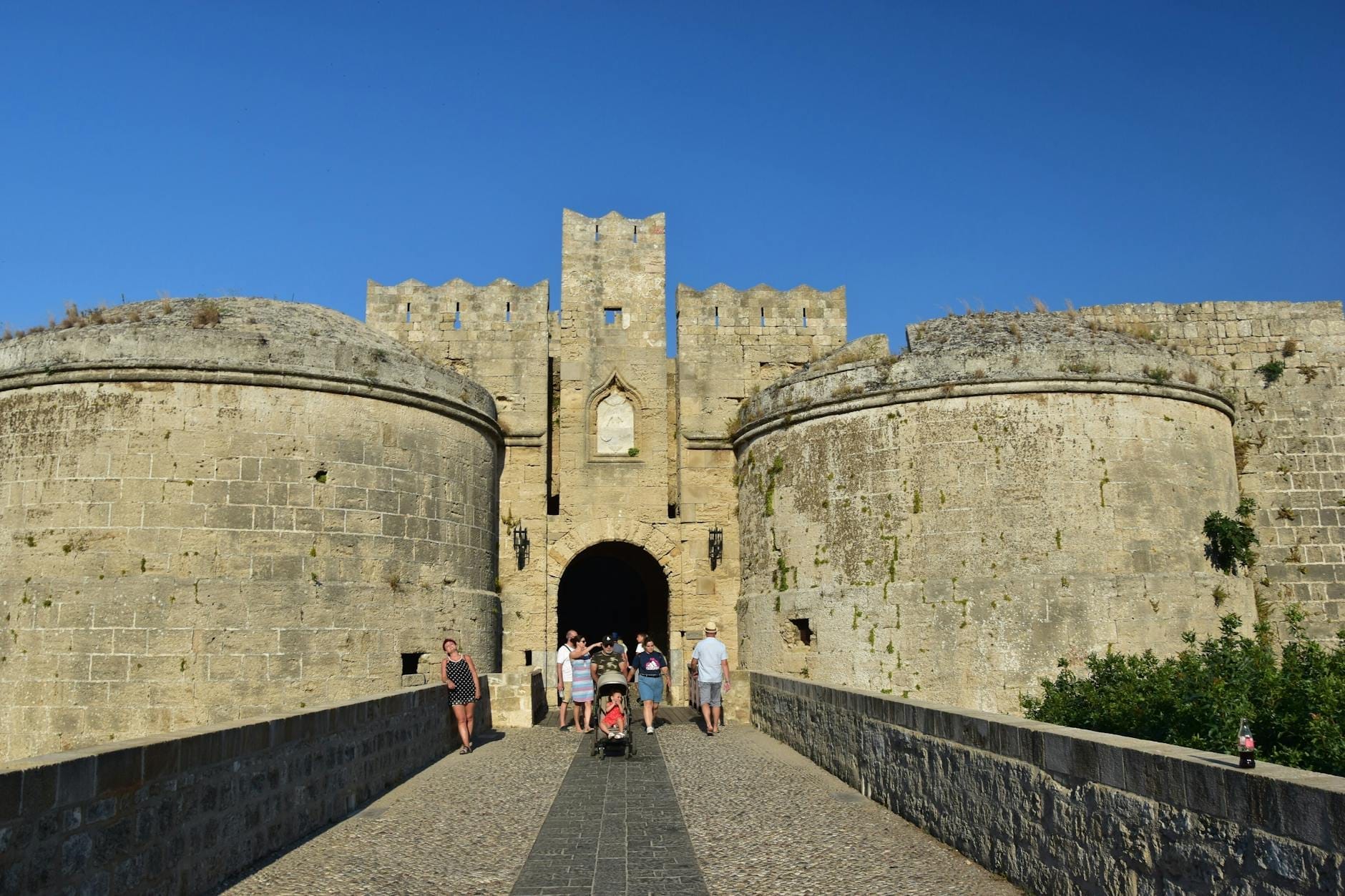
What the Harbour Gates Actually Are
The Harbour Gates of Rhodes, known in Greek as Πύλες του Λιμανιού (Píles tou Limaniú), are a set of fortified medieval gateways that once controlled movement between the port of Mandraki and the walled city of the Knights of Saint John. They form part of one of the most complete surviving medieval fortification systems in Europe, a roughly 5-kilometre circuit of walls and towers constructed and continuously upgraded by the Knights between the early 14th century and their expulsion by Ottoman forces in 1522. The entire Medieval City of Rhodes, walls included, has been a UNESCO World Heritage Site since 1988.
Unlike a museum or a castle that requires a ticket and a set visiting window, the Harbour Gates are simply there. They stand at the northern edge of the Old Town, where the medieval stonework meets the open quayside of Mandraki, and they are accessible at any hour without charge. That accessibility is part of what makes them worth seeking out deliberately rather than stumbling past.
💡 Local tip
Arrive just before sunrise or in the last 30 minutes of daylight. The low-angle light turns the honey-coloured limestone almost amber, and the harbour is quiet enough that you can hear the water against the stone without competition from foot traffic.
The History Behind the Stone
The Knights of Saint John, a military-religious order also known as the Hospitallers, took control of Rhodes in 1309 and almost immediately began fortifying the city against naval attack. The harbour gates were a critical element of that defence: controlling who entered and left by sea was as important as the land-facing towers and moats. The gates were not decorative; they were operational military infrastructure, reinforced repeatedly over two centuries as siege technology evolved.
The Knights organised themselves into national groupings called Langues, each responsible for defending a specific section of the walls. The layered construction visible in the stonework today reflects multiple phases of building and repair, particularly after the two major Ottoman sieges of 1480 and 1522. For a fuller account of the order and its presence across Rhodes, the Knights of Rhodes history guide covers the political and military context in detail.
After the Ottoman conquest in 1522, the gates continued to function as harbour access points under new administration, which is part of why they survived intact. Centuries of practical use, rather than deliberate preservation, kept them standing. The coats of arms of various Grand Masters can still be found carved into the stonework nearby, weathered but legible to anyone who stops to look.
Tickets & tours
Hand-picked options from our booking partner. Prices are indicative; availability and final rates are confirmed when you complete your booking.
High-Speed Boat Trip to Rhodes Town from Kolympia Harbour
From 40 €Instant confirmationFree cancellationSunset catamaran cruise with dinner in Rhodes
From 70 €Instant confirmationFree cancellation3-Hour All Inclusive Sun and Sea Swimming Cruise in Rhodes
From 55 €Instant confirmationFree cancellationRhodes Sunset Cruise with Greek BBQ and Unlimited Drinks
From 65 €Instant confirmationFree cancellation
Arriving at the Gates: What You Actually See
Walking north along the harbour front from the main Rhodes port, the medieval walls begin to dominate the skyline well before you reach the gates themselves. The stonework rises steeply from the quayside, punctuated by towers, and the scale becomes apparent only when you are close enough to see people standing beside the arched openings. The gates frame a compressed view of the Old Town's interior: narrow lanes, Ottoman-era minarets in the middle distance, and the upper structure of the Palace of the Grand Master visible further in.
The immediate surroundings at the Mandraki end are practical and slightly scruffy in the way that genuine working harbours tend to be. Fishing boats sit alongside tourist excursion vessels. The windmills of Mandraki, three restored examples of an original row of around a dozen, stand on the mole to the northeast. At the tip of that same mole, the Fort of St Nicholas is visible across the water, completing a harbour entrance that has looked broadly similar for five hundred years.
The gate arches themselves are wide enough for small carts historically, and now for foot traffic moving in both directions. The stone underfoot transitions from modern harbour paving to worn medieval cobblestone as you pass through, a physical register of the boundary you are crossing. Inside, the temperature drops noticeably in warm months, and the ambient noise of the harbour cuts off almost immediately.
When to Visit and How Light Changes the Experience
The Harbour Gates face roughly northwest, which means morning light falls on the harbour side and afternoon light illuminates the interior stonework of the Old Town facing the gates. For photography, the golden hour before sunset is the most productive window: the warm light hits the carved stone directly, shadows define the texture of the masonry, and the harbour activity adds foreground interest without overwhelming the frame.
Midday in July and August brings cruise-ship crowds. Rhodes receives well over a million cruise passengers annually, and many are deposited at the port within walking distance of the gates. Between roughly 10:00 and 15:00 in peak summer, the area directly around the harbour entry points can feel congested. If you are combining the gates with a walk through the Old Town, the Street of the Knights and other interior landmarks will be similarly crowded at the same hours. Arriving before 09:00 or after 17:00 transforms the atmosphere entirely.
⚠️ What to skip
The cobblestone surfaces inside the Old Town are uneven and can be slippery when wet. The harbour gates themselves are relatively flat, but anyone with limited mobility should be aware that exploring beyond the immediate gateway requires navigating stepped and irregular terrain.
Practical Walkthrough: Getting There and Moving On
The gates sit at the northern edge of Rhodes Old Town, directly accessible from the Mandraki Harbour waterfront. From the main commercial port where larger ferries and cruise ships dock, the walk is 10 to 15 minutes along the harbour front. There is no public transport required and no admission to pay at any point.
From Rhodes Airport (14 km southwest of the city), a taxi takes approximately 20 minutes and costs in the region of €25 to €30, though fares should be confirmed at the time of travel. Public buses connect the airport to central Rhodes, from where the harbour is a short walk. For full transport options across the island, the getting around Rhodes guide covers all the practical details.
Once through the gates, the natural continuation is deeper into the Old Town. The main commercial street of Sokratous runs roughly parallel to the walls further south, lined with shops and cafes. The Palace of the Grand Master is a 10-minute walk inland and merits a separate visit on its own terms. The Archaeological Museum is similarly close. Neither requires significant advance planning, though both charge admission and have set opening hours that vary seasonally.
ℹ️ Good to know
There is no single 'Harbour Gate' — the medieval fortifications include several gate openings along the harbour-facing walls. The main ceremonial gateway is the most photographed and most easily located, but exploring the stretch of wall on either side reveals smaller arched openings and details that most visitors walk past without stopping.
Who Should Temper Their Expectations
If you are visiting Rhodes primarily for beaches or nightlife, the Harbour Gates are worth a glance as you pass rather than a dedicated journey. The gates do not tell their own story without some background knowledge; without context, they read as old stone archways, impressive in scale but not immediately legible. Travellers who have no interest in medieval history or fortification architecture may find the experience brief and unremarkable unless they are combining it with a broader walk through the Old Town.
Families with young children may find the location works better as a transitional moment, passing through the gates on the way to something else rather than stopping extensively. The gates are on the route to several more immediately engaging attractions for children, including the harbour windmills and the waterfront. For a fuller picture of what works well for families across the island, the Rhodes with kids guide offers more focused recommendations.
Connecting the Gates to the Larger Old Town Circuit
The Harbour Gates are most rewarding when treated as a starting point rather than a destination. A structured walk through the Old Town beginning here and moving through the medieval street grid toward the Palace of the Grand Master covers the full range of what the Knights' city has to offer, from street-level texture to the grandest surviving civic architecture. The Rhodes Old Town walking tour guide maps a logical route that uses the Harbour Gates as its natural entry point.
The gates also provide a useful orientation anchor. Mandraki Harbour and the sea are on one side; the medieval city is on the other. Every street inside the walls eventually connects back to this northern edge, which makes the harbour gates a reliable place to reorient if the Old Town's deliberately irregular street pattern causes confusion. Medieval planners were not working from a grid.
Insider Tips
- Look for carved heraldic shields and coats of arms embedded in the stonework of the walls on either side of the main gate arch. These belong to various Grand Masters of the Knights and are easy to miss if you walk through without looking up and sideways.
- The stretch of harbour wall between the main gate and the Fort of St Nicholas is walkable and largely uncrowded even at peak times. It offers a perspective on the fortifications that the gate itself does not, showing the sheer scale of the defensive circuit from the outside.
- If you want a photograph of the gate arch without people in frame, aim for the half-hour immediately after sunrise on any day of the week. The harbour is active with fishing boats at that hour but foot traffic through the gates is minimal.
- The gates are on the official UNESCO Medieval City perimeter. Standing outside and looking at the full wall section gives a clearer sense of the fortification's military logic than standing inside does. Step back toward the water for the wider view.
- In October and November, after the main tourist season, the gates and surrounding harbour area have a quieter, more local character. Café tables are less crowded, light quality is softer, and the whole Old Town perimeter is easier to walk without stopping every few metres.
Who Is Harbour Gates For?
- First-time visitors to Rhodes wanting a dramatic entry point into the Old Town
- History and architecture enthusiasts interested in medieval military fortification
- Photographers looking for textured stonework and harbour light combinations
- Cruise passengers with limited time who want to cover the key visual landmark quickly
- Walkers planning a full circuit of the Old Town walls
Nearby Attractions
Other things to see while in Rhodes Old Town:
- Archaeological Museum of Rhodes
Housed in the 15th-century Hospital of the Knights, the Archaeological Museum of Rhodes brings together artifacts spanning the Archaic to Roman periods, including celebrated Hellenistic marble statues and intricate floor mosaics. It is one of the most historically layered museum experiences in the Aegean, where the building itself is as compelling as the collection inside.
- Hammam Turkish Baths
Built in 1558 during the Ottoman occupation, the Great Hamam is the sole surviving bathhouse within Rhodes' UNESCO-listed Medieval Town. Currently closed to the public but recently restored, it remains one of the most architecturally distinctive buildings in Arionos Square, worth understanding in context before you arrive.
- Palace of the Grand Master of the Knights of Rhodes
The Palace of the Grand Master of the Knights of Rhodes is the most architecturally commanding structure in the medieval city. Built in the early 14th century and dramatically restored under Italian rule, it anchors the northwestern corner of the Old Town with towers, colonnaded courtyards, and a permanent collection that spans antiquity to the Ottoman period.
- Rhodes Port (Commercial Harbour)
The Rhodes Commercial Harbour, officially known as Akandia Port (Λιμάνι Ακανδίας), is the island's main gateway for passenger ferries, cargo vessels, and cruise ships. Whether you're arriving from Piraeus, island-hopping through the Dodecanese, or watching the daily rhythm of a working Greek port, this is where Rhodes begins.