Fort of St Nicholas, Rhodes: The Sentinel of Mandraki Harbour
Standing at the tip of Mandraki Harbour's breakwater, the Fort of St Nicholas is a 15th-century Knights Hospitaller fortress that has guarded the northern approach to Rhodes for over 550 years. Free to visit from the exterior; currently under restoration with limited access, it offers some of the most photogenic views on the island, framing the medieval Old Town against the open Aegean.
Quick Facts
- Location
- End of Mandraki Harbour pier, Rhodes 851 00 (1–1.5 km from Old Town gates)
- Getting There
- 10–15 min walk north along the waterfront from Mandraki; local buses stop near the harbour
- Time Needed
- 30–60 minutes for the pier walk and exterior
- Cost
- Free — open-access exterior site, no ticket required (under restoration)
- Best for
- History enthusiasts, photographers, evening walkers, couples
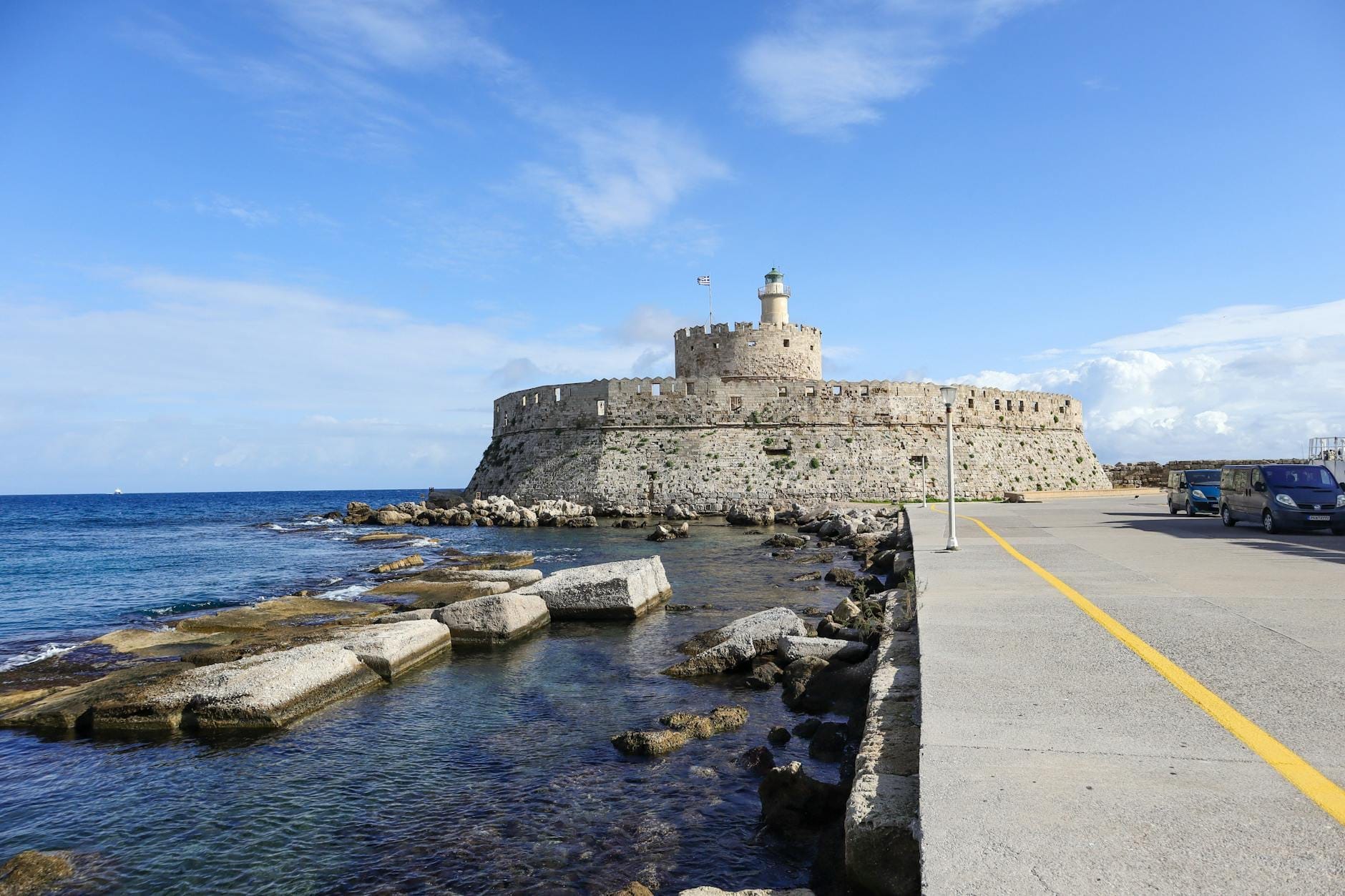
What Is the Fort of St Nicholas?
The Fort of St Nicholas (Φρούριο Αγίου Νικολάου) is a medieval coastal fortress that anchors the northern breakwater of Mandraki Harbour in Rhodes City. Constructed between 1464 and 1467 by the Knights Hospitaller, the military order that governed Rhodes for over two centuries, it was the first significant defensive response to increasing Ottoman naval pressure in the eastern Mediterranean. Today it doubles as a working lighthouse and stands as one of the most recognizable silhouettes on the Rhodes waterfront.
It sits in Rhodes New Town, just north of the medieval walls, and is easily combined with a stroll along Mandraki Harbour. The walk out along the breakwater is part of the experience, not just a means to reach the fort.
💡 Local tip
The fort is currently under restoration; interior and potentially exterior access is limited. The experience here is the walk along the pier, the exterior architecture, and the panoramic harbour views. Plan accordingly — this is not a museum visit but an atmospheric outdoor landmark.
A Short History Worth Knowing
The Knights Hospitaller, formally the Order of Saint John of Jerusalem, built the fort to defend the mouth of Mandraki Harbour against Ottoman galleys. The construction dates place it firmly in the reign of Grand Master Pedro Raimundo Zacosta, with later reinforcements carried out around 1520 under Grand Master Fabrizio del Carretto following Ottoman siege attempts. Del Carretto's additions thickened the walls, deepened the moat on the landward side, and added the round tower profile that gives the fort its distinctive appearance today.
The fort also houses a small chapel dedicated to Saint Nicholas, patron saint of sailors, which underscores the structure's dual role as both a military installation and a spiritual landmark for the seafaring community. The site is frequently associated with the legendary Colossus of Rhodes — ancient accounts suggest the famous bronze statue may have stood near the harbour entrance, though no confirmed archaeological evidence places it at this exact spot.
The fort survived the Ottoman conquest of Rhodes in 1522 and continued to function as a defensive and navigational structure through the Ottoman period and later under Italian administration in the 20th century. The lighthouse remains operational, though now automated.
Tickets & tours
Hand-picked options from our booking partner. Prices are indicative; availability and final rates are confirmed when you complete your booking.
Sunset catamaran cruise with dinner in Rhodes
From 70 €Instant confirmationFree cancellation3-Hour All Inclusive Sun and Sea Swimming Cruise in Rhodes
From 55 €Instant confirmationFree cancellationRhodes Sunset Cruise with Greek BBQ and Unlimited Drinks
From 65 €Instant confirmationFree cancellationPalace of the Grand Master Ticket and Audio Tour by App
From 30 €Instant confirmation
The Walk Out: What to Expect Step by Step
From the main Mandraki waterfront, the breakwater pier extends roughly 300 meters into the harbour. The walk itself is flat and paved, with low stone balustrades on either side. As you move further along, the ambient noise of the port — engines idling, water lapping against the hulls of excursion boats — gradually softens and the wind picks up. There is almost no shade on the pier, which matters more than visitors tend to anticipate.
At the fort's base, the round tower looms noticeably larger than it looks from the shore. The stone is warm limestone, weathered unevenly, with patches of pale grey and ochre. You cannot enter the structure, but you can walk completely around its accessible perimeter. The seaward side offers unobstructed views across the Aegean toward the Turkish coast on clear days, and a direct sightline back toward the three windmills that line the pier behind you.
Those three windmills, standing at the base of the breakwater, are themselves worth pausing for. They are among the most photographed features in Rhodes City and provide useful foreground context when shooting back toward the Palace of the Grand Master and the medieval skyline.
How the Experience Changes by Time of Day
Early morning, between 7 and 9 am, the pier is almost empty. The light is low and directional, hitting the fort's limestone from the east and turning the stone a warm amber. Fishing boats are still returning from overnight runs, and the harbour smells of salt and diesel. This is by far the best time for photography.
By late morning and into the afternoon, the pier fills with a steady procession of tourists, joggers, and locals walking dogs. The sun is overhead and harsh, flattening the fort's texture and making it far less photogenic. The breakwater has no shade, so midday visits in summer can be genuinely uncomfortable. Temperatures regularly exceed 35°C from June to August.
Sunset changes the dynamic again. The fort silhouettes sharply against the western sky, and the lighthouse beam begins its rotation as dusk falls. Couples and groups gather at the end of the pier for this reason, and it can feel quite romantic despite the number of people. The wind off the water in the evening is reliably cooler than the town behind you.
⚠️ What to skip
There is no shade on the breakwater pier at any point. In summer, bring water, wear sunscreen, and consider timing your visit before 9 am or after 6 pm. The walk to and from the fort is exposed the entire way.
Photography and Practical Notes
The Fort of St Nicholas is one of the most photographically versatile landmarks in Rhodes City. For a guide to making the most of it, see the Rhodes photography guide — it covers angles, timing, and gear for the harbour area specifically.
From a photographic standpoint, the three windmills in the foreground and the fort in the background is the classic composition. Standing at the base of the pier and shooting along the breakwater works best in morning light. For tighter shots of the fort itself, a short telephoto (70–100mm equivalent) compresses the perspective nicely and emphasizes the scale of the walls relative to the lighthouse.
Accessibility is good along the pier surface, which is smooth and level. However, the far end of the pier near the fort base has uneven stone sections and low barriers, so visitors with mobility limitations should assess conditions on arrival. The fort interior, including any steps to higher levels, is not accessible to the public.
Fitting It Into Your Rhodes Itinerary
The fort works best as part of a broader harbour walk rather than a standalone destination. Start at the harbour gates at the southern end of Mandraki, walk the full length of the waterfront, continue along the breakwater to the fort, and return via the same pier. The whole loop takes 60 to 90 minutes at a relaxed pace and requires almost no planning.
Combine it with the Archaeological Museum of Rhodes or a walk up through the Street of the Knights for a morning that covers both the medieval city and the harbour. If you are visiting for a week or more, the fort is natural filler for an early morning before breakfast, or an evening after dinner when the harbour lights are on.
Visitors expecting a museum-style interior, guided tours, or interpretive signage will be disappointed. The attraction here is almost entirely spatial and atmospheric: the walk, the view, the architecture from outside, and the sense of standing at the edge of a working port with six centuries of history behind it. If that does not sound like enough, your time is probably better spent elsewhere.
Who This Attraction Suits and Who It Does Not
The Fort of St Nicholas rewards those who are genuinely interested in medieval military architecture, harbour atmospherics, or photography. It also suits walkers who enjoy waterfront promenades and are happy to let a view do the talking. It is free, accessible on foot, and requires no advance planning whatsoever.
It is not suitable for visitors who need interior access, exhibitions, or guided interpretation to feel a site is worthwhile. Families with very young children will find the long exposed pier walk tedious in hot weather. Anyone with significant mobility challenges should note the uneven stones near the fort base. And in winter, when the harbour can be rough and the pier slick with spray, the walk is less pleasant than any photograph suggests.
Insider Tips
- Arrive before 8 am in summer for the best light, no crowds, and cooler temperatures. The fort in early morning amber light looks dramatically different from the flat midday version most visitors see.
- The lighthouse is still operational. If you are staying somewhere with a harbour view, you can watch the beam sweep at night without making the walk at all.
- The three windmills at the base of the breakwater are frequently framed with the fort in the background. Position yourself close to the windmills for depth in your compositions rather than standing at the fort and shooting back.
- There is no official signage explaining the fort's history on-site. Read up beforehand — or pair the visit with the Archaeological Museum, which provides strong context for the Knights Hospitaller period on the island.
- In shoulder season (October and May), the pier walk is genuinely pleasant at almost any time of day. The crowds thin considerably compared to July and August, and the sea light is often softer and more interesting.
Who Is Fort of St Nicholas For?
- History enthusiasts interested in the Knights Hospitaller and medieval Rhodes
- Photographers wanting harbour and skyline compositions at golden hour
- Walkers looking for a scenic waterfront circuit without cost or logistics
- Couples seeking an atmospheric evening walk along the breakwater
- Travellers building a full day around the New Town and Mandraki area
Nearby Attractions
Other things to see while in Rhodes New Town:
- Acropolis of Rhodes
Perched on Monte Smith hill 3 km southwest of the city center, the Acropolis of Rhodes is an open-air archaeological site dating to the 5th century BC. It holds the partially reconstructed Temple of Apollo, a 210-meter Hellenistic stadium, an odeon, and broad views over the Aegean. Entry is free, crowds are light, and the site rewards visitors with a genuinely atmospheric sense of ancient Rhodes that the medieval Old Town cannot offer.
- Ancient Stadium of Rhodes
The Ancient Stadium of Rhodes sits on Monte Smith Hill, part of the larger Acropolis of Rhodes complex. Dating to the 3rd century BC, this restored Hellenistic track once hosted the Haleion Games in honor of Helios. Entry is free, the views are exceptional, and the site is far less crowded than the medieval attractions in the city below.
- Colossus of Rhodes (Historical Site)
One of the Seven Wonders of the Ancient World, the Colossus of Rhodes was a 33-metre bronze statue of the sun god Helios, built to celebrate a famous military victory. No physical trace survives today, but understanding its story transforms how you see the harbour, the city, and Rhodes itself.
- Elli Beach
Elli Beach stretches 400 metres along the northern tip of Rhodes Town, sitting between Mandraki Harbour and the Rhodes Aquarium. With free entry, water sports, beach bars, and clear Aegean water, it serves as the island's urban beach hub. It is not a desert island escape, but for convenience and character, few beaches in the city come close.