Mandraki Harbour: Rhodes' Ancient Port and the Legend of the Colossus
Mandraki Harbour is the historic heart of Rhodes' waterfront, where bronze deer statues stand guard at the entrance once said to have been straddled by one of the Seven Wonders of the Ancient World. Free to explore, open around the clock, and lined with Italian-era architecture and departing excursion boats, it offers more depth than a first glance suggests.
Quick Facts
- Location
- Central Rhodes city, adjacent to Rhodes New Town and the northern tip of the Old Town walls
- Getting There
- 10-minute walk from Rhodes Old Town gates; taxis available from the city centre; no direct bus stop at the harbour entrance
- Time Needed
- 45 minutes to 1.5 hours for a full waterfront walk; longer if boarding excursion boats
- Cost
- Free public access; berthing fees for boat owners; excursion boats charge separately
- Best for
- History lovers, photographers, morning walkers, and travellers catching day trips to Symi or Lindos
What Mandraki Harbour Actually Is
Mandraki Harbour (Greek: Λιμάνι Μανδρακίου) is the oldest and most historically significant of Rhodes' three main harbours. Curving along the northeastern edge of Rhodes city, it separates the Italian-built New Town to the west from the open Aegean to the east. The marina today accommodates private yachts, small fishing vessels, and the excursion boats that run daily routes to Symi and Lindos. But strip away the tourist infrastructure and you are standing at a site with over 2,300 years of continuous maritime history.
The harbour is public, open 24 hours, and free to enter. There are no gates, no ticket booths, no queues. You simply walk down to the water. That accessibility is part of what makes it worth understanding properly before you arrive, because without context, it can look like a pleasant but unremarkable marina.
💡 Local tip
Arrive before 9am if you want the waterfront promenade to yourself. By mid-morning, excursion boats are loading and the quayside fills quickly with departing day-trippers.
The Colossus Connection: Separating Fact from Legend
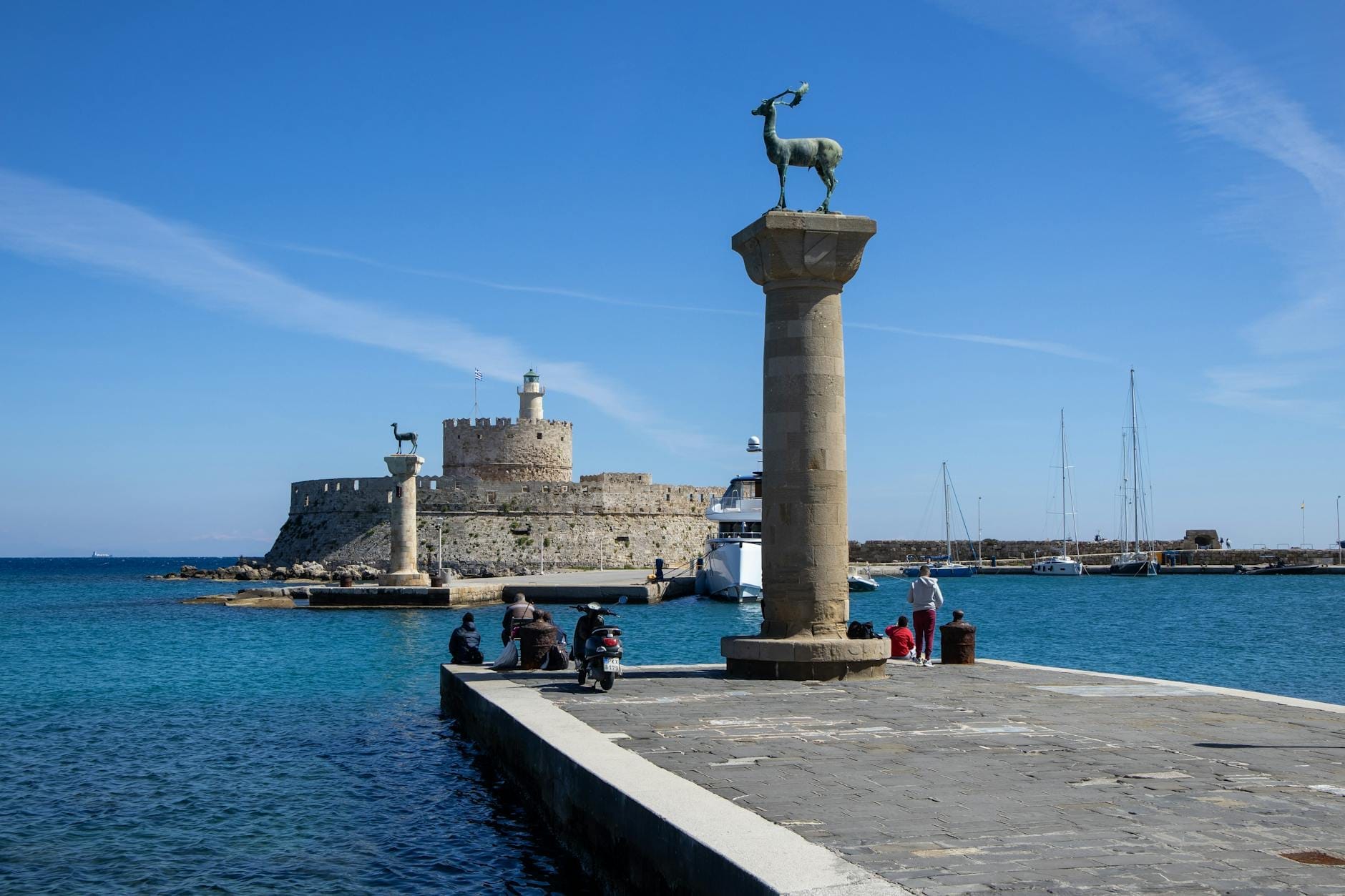
Two tall columns stand at the harbour entrance, each topped with a bronze deer, the Elaphoi, symbols of Rhodes. These columns mark the spot traditionally associated with the Colossus of Rhodes, the giant bronze statue of the sun god Helios constructed around 280 BC to celebrate the island's successful defence against a siege by Demetrius Poliorcetes. The Colossus stood for roughly 54 years before being toppled by an earthquake in 226 BC.
The popular image of the Colossus straddling the harbour entrance with ships passing between its legs is almost certainly a Renaissance-era invention with no basis in ancient sources. No ancient text describes it in that position. What is confirmed is that it was one of the tallest statues of the ancient world, estimated at around 33 metres, and that it stood somewhere near the harbour. For a deeper look at what historians actually know about the statue and its legacy, the Colossus of Rhodes guide covers the archaeology and mythology in full.
The bronze deer that now crown the columns were placed there in the 20th century during the Italian administration of the Dodecanese. They are a considered piece of civic symbolism: deer have been sacred to Rhodes since antiquity, used historically to control the island's snake population. Even in this small detail, the harbour layers history upon history.
Tickets & tours
Hand-picked options from our booking partner. Prices are indicative; availability and final rates are confirmed when you complete your booking.
High-Speed Boat Trip to Rhodes Town from Kolympia Harbour
From 40 €Instant confirmationFree cancellationSunset catamaran cruise with dinner in Rhodes
From 70 €Instant confirmationFree cancellation3-Hour All Inclusive Sun and Sea Swimming Cruise in Rhodes
From 55 €Instant confirmationFree cancellationRhodes Sunset Cruise with Greek BBQ and Unlimited Drinks
From 65 €Instant confirmationFree cancellation
The Architecture Framing the Waterfront
The buildings lining the inland side of Mandraki are not medieval Greek, they are Italian rationalist architecture from the early 20th century. When Italy administered the Dodecanese (1912 to 1943), they undertook an ambitious urban redesign of Rhodes New Town, building a series of imposing public structures along the harbour front that blend Venetian Gothic, Moorish, and fascist rationalist elements in an unusual and often striking combination.
Among the most notable structures are the Governor's Palace, a large arcaded building with Venetian Gothic detailing, and the Church of the Annunciation, which echoes the style of St John's Church in the Old Town. The covered market hall, the post office, and the town hall complete this administrative ensemble. Together they form one of the more coherent examples of Italian colonial architecture in the Mediterranean. The Governor's Palace is worth a closer look if you have any interest in the period.
At the far northern tip of the harbour, the Fort of St Nicholas occupies a small promontory. Built by the Knights of St John in the 15th century, it now serves as a lighthouse. Its round tower is visible from most of the promenade and provides a useful focal point for photography at dusk, when the warm light catches the pale stone.
How the Harbour Changes Through the Day
Early morning, around 6 to 8am, is genuinely different. The fishing boats that use the inner section of the harbour return or prepare for departure, and the smell of diesel and salt water is sharp. A few local cafes near the market hall open early, and you can have coffee while watching the working port operate before the tourist layer arrives.
By 9 to 10am, the excursion boats start boarding. The quayside becomes loud and organised chaos: boarding cards, guides with flags, vendors selling snacks. If you are not taking an excursion, this is actually a good time to observe the operation from a distance, but the promenade itself becomes crowded. The boat departures thin out by around 10:30am, and the harbour quiets again briefly before the general foot traffic of the day builds.
Evenings are the most atmospheric time for a casual visit. After 7pm in summer, the light drops behind the New Town buildings and the water takes on a flat, silver quality. The excursion boats have returned and sit quietly at their moorings. Locals walk the promenade in a slow, unhurried way that contrasts sharply with the midday rush. The Fort of St Nicholas begins to glow as its lighthouse function activates.
ℹ️ Good to know
If you are planning to take a day trip to Symi or Lindos by boat, departure times are typically between 9am and 10am. Tickets are sold on the quayside in the days before, or directly on the morning of travel. Check schedules seasonally, as frequency drops significantly outside peak summer months.
Practical Walkthrough: Making the Most of a Visit
The full promenade walk from the southern end of the harbour near the Old Town walls to the northern tip at the Fort of St Nicholas is roughly 800 metres and takes about 15 to 20 minutes at a leisurely pace. The surface is paved and mostly flat, making it accessible for pushchairs and most mobility needs, though there are some uneven sections near the older quayside edges.
On the landward side, the covered market (Nea Agora) is worth entering briefly. It is a horseshoe-shaped building with a small interior courtyard and stalls selling local produce, souvenirs, and basic supplies. It is also one of the few places near the harbour where you can buy water and snacks at non-inflated prices. The Rhodes Aquarium sits at the very northern tip of the peninsula, a short walk from the fort, and is a practical add-on if you are travelling with children.
Photography is best in the first and last hours of daylight. The entrance columns with the deer statues are ideally lit in the morning from the east. The Italian-era buildings photograph well in the late afternoon when the light falls directly on their facades. The fort at dusk, with its lighthouse beam beginning to operate, offers a strong silhouette composition.
⚠️ What to skip
The open quayside has no railings in several sections. Take care with young children near the water's edge, particularly in the early morning when the surface can be slippery from condensation.
Context: Where Mandraki Sits in Rhodes
Mandraki is the natural meeting point between the medieval city and the modern town. The Old Town's northern walls are visible from the harbour's southern end, and the two are connected by a short walk through the Harbour Gates. For anyone following a structured itinerary, the harbour makes a logical start or end point for a day that also includes the Palace of the Grand Master and the Street of the Knights within the walled city.
The harbour is also the primary departure point for boat excursions around the island and to nearby islands. Day trips to Symi Island are among the most popular, with the small colour-washed port town offering a strong contrast to Rhodes city. Lindos by boat is another option, arriving via Saint Paul's Bay before landing near the village.
Travellers who find the harbour underwhelming are usually those who walked its length in 20 minutes without knowing what they were looking at. The harbour does not perform for you. Its interest is cumulative: the history of the site, the architectural layers, the working port beneath the tourist surface. Those who engage with that context consistently find it more rewarding than expected.
Insider Tips
- The inner section of the harbour, where smaller fishing boats moor, is often overlooked by visitors who stay on the main promenade. Walk around to the protected inner quay in the early morning for a quieter, more authentic glimpse of the working port.
- The covered market building (Nea Agora) has a rooftop that was historically accessible. Access varies, but the exterior arcade is worth walking through regardless for the architecture and a less-inflated food and drink stop.
- For the cleanest photograph of the entrance columns with the bronze deer, position yourself at the water level near the outer breakwater looking back toward the harbour mouth. This angle eliminates most of the tourist infrastructure from the frame.
- If you are departing on an excursion boat, arrive at least 30 minutes before the advertised departure time. The quayside can become genuinely difficult to navigate when multiple boats are loading simultaneously and staff directions are competing.
- The Fort of St Nicholas is not regularly open to the public as an interior attraction, but the walk to the tip of the breakwater gives you the best panoramic view of both the harbour and the Old Town walls from the sea side, a perspective most visitors miss.
Who Is Mandraki Harbour For?
- History travellers who want to stand at the site linked to one of the Seven Wonders of the Ancient World
- Architecture enthusiasts interested in Italian colonial urban design of the early 20th century
- Early risers who want a quiet waterfront walk before the day-trip crowds arrive
- Travellers using the harbour as a departure point for boat excursions to Symi, Lindos, or other coastal destinations
- Photographers working in golden-hour light, particularly at dusk when the fort lighthouse activates
Nearby Attractions
Other things to see while in Rhodes New Town:
- Acropolis of Rhodes
Perched on Monte Smith hill 3 km southwest of the city center, the Acropolis of Rhodes is an open-air archaeological site dating to the 5th century BC. It holds the partially reconstructed Temple of Apollo, a 210-meter Hellenistic stadium, an odeon, and broad views over the Aegean. Entry is free, crowds are light, and the site rewards visitors with a genuinely atmospheric sense of ancient Rhodes that the medieval Old Town cannot offer.
- Ancient Stadium of Rhodes
The Ancient Stadium of Rhodes sits on Monte Smith Hill, part of the larger Acropolis of Rhodes complex. Dating to the 3rd century BC, this restored Hellenistic track once hosted the Haleion Games in honor of Helios. Entry is free, the views are exceptional, and the site is far less crowded than the medieval attractions in the city below.
- Colossus of Rhodes (Historical Site)
One of the Seven Wonders of the Ancient World, the Colossus of Rhodes was a 33-metre bronze statue of the sun god Helios, built to celebrate a famous military victory. No physical trace survives today, but understanding its story transforms how you see the harbour, the city, and Rhodes itself.
- Elli Beach
Elli Beach stretches 400 metres along the northern tip of Rhodes Town, sitting between Mandraki Harbour and the Rhodes Aquarium. With free entry, water sports, beach bars, and clear Aegean water, it serves as the island's urban beach hub. It is not a desert island escape, but for convenience and character, few beaches in the city come close.