Acropolis of Rhodes: The Ancient Hill That Predates the Old Town
Perched on Monte Smith hill 3 km southwest of the city center, the Acropolis of Rhodes is an open-air archaeological site dating to the 5th century BC. It holds the partially reconstructed Temple of Apollo, a 210-meter Hellenistic stadium, an odeon, and broad views over the Aegean. Entry is free, crowds are light, and the site rewards visitors with a genuinely atmospheric sense of ancient Rhodes that the medieval Old Town cannot offer.
Quick Facts
- Location
- Monte Smith Hill, 3 km southwest of Rhodes city center
- Getting There
- Taxi from Old Town (~10 min); local bus; or 40-min uphill walk from the city center
- Time Needed
- 1 to 2 hours
- Cost
- Free (open outdoor archaeological site)
- Best for
- History enthusiasts, photographers, early-morning walkers, and anyone wanting quiet ruins away from the crowds
What the Acropolis of Rhodes Actually Is
The Acropolis of Rhodes (Ακρόπολη της Ρόδου) sits on Monte Smith, a low limestone hill that rises gently from the western edge of the modern city. Unlike the famous Athenian Acropolis, this one was never heavily fortified. It was a civic and religious high point: a place where the citizens of ancient Rhodes gathered to worship, compete athletically, and look out over the sea lanes that made their city one of the wealthiest trading ports of the ancient Mediterranean world.
The city of Rhodes itself was founded in 408 BC through a process the Greeks called synoikismos, a deliberate merging of the island's three older city-states: Kamiros, Ialysos, and Lindos. The new capital was planned on a grid layout attributed to Hippodamos of Miletus. The acropolis was laid out as the ceremonial heart of that new city, with its major monuments constructed largely during the Hellenistic period, from the 3rd to the 2nd century BC.
Today the site covers roughly 12,500 square meters of excavated and partially restored structures. Italian archaeologists began systematic work here after 1912 and continued through 1945. Greek archaeological teams took over after the war and have continued excavation ever since, though much of the hill remains unexcavated.
ℹ️ Good to know
The site is open-air and freely accessible. There are no ticket booths, no set closing time, and no audio guides on site. Bring water, wear flat shoes, and download any reference material before you arrive.
The Monuments: What You Will Actually See
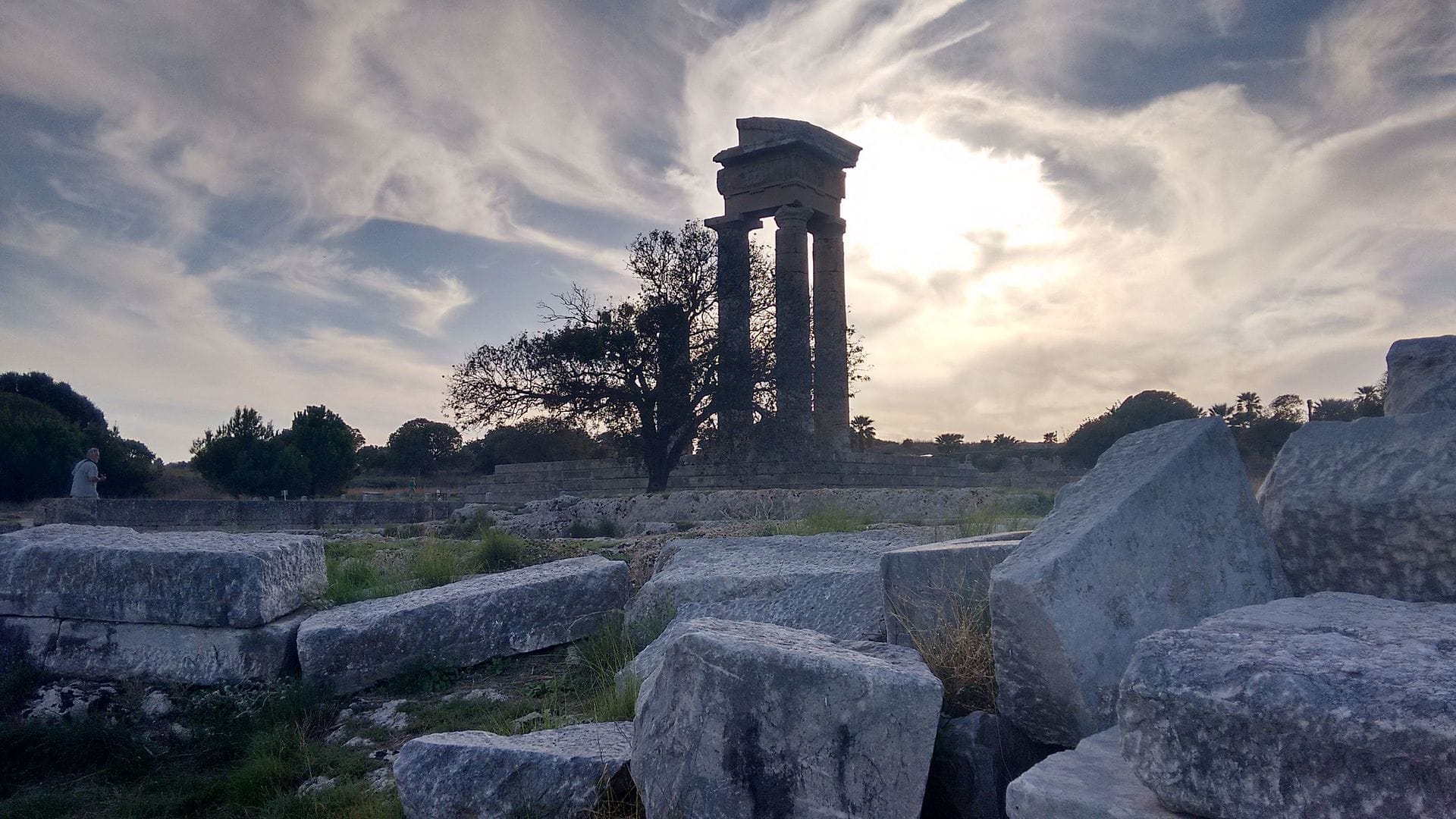
The most photographed structure is the partially reconstructed Temple of Apollo Pythios. Four columns with their entablature have been re-erected, and they catch the light in a way that makes even a brief visit feel significant. The temple dates to the Hellenistic period and was one of the most important sanctuaries on the hill. A second temple on the site, dedicated to Athena Polias and Zeus Polieus, is represented today mainly by foundations.
Below the temples, the ancient stadium is one of the best-preserved examples in the Aegean. Running approximately 210 meters in length, it has been partially restored and retains several rows of carved stone seating on its southern side. You can walk the full length of the track and get a concrete sense of the scale of ancient athletic competitions. The stadium is quiet enough that you will rarely share it with more than a handful of other visitors.
Adjacent to the stadium is a small odeon, a semi-circular theater with restored stone seating. It could hold around 800 spectators and was used for musical performances and public lectures. The restoration work is modest but effective, and the odeon is occasionally used for performances today. A gymnasium complex lies nearby, though its remains are fragmentary and require some imagination to interpret.
The acropolis does not tell the story of the Knights of St. John or the Ottoman centuries that define the Rhodes Old Town experience. It predates all of that by roughly a millennium. If you want the medieval layer of Rhodes, the Palace of the Grand Master and the Street of the Knights serve that purpose well. The acropolis is where you come to understand the city's earlier, and in some ways more significant, ancient identity.
Tickets & tours
Hand-picked options from our booking partner. Prices are indicative; availability and final rates are confirmed when you complete your booking.
Lindos 7 springs oasis and Acropolis tour from Rhodes
From 28 €Instant confirmationFree cancellationSunset catamaran cruise with dinner in Rhodes
From 70 €Instant confirmationFree cancellation3-Hour All Inclusive Sun and Sea Swimming Cruise in Rhodes
From 55 €Instant confirmationFree cancellationRhodes Sunset Cruise with Greek BBQ and Unlimited Drinks
From 65 €Instant confirmationFree cancellation
How the Site Changes Through the Day
Arrive before 9am and you will likely have the hill almost entirely to yourself. The light at that hour falls at a low angle across the temple columns, creating long shadows on the stone and illuminating the texture of the limestone in a way that midday sun flattens completely. The air is cooler, the city noise below is muted, and the occasional distant sound of a fishing boat engine carries up from the coast.
By mid-morning, especially in June through August, the temperature on the exposed hilltop climbs quickly. There is almost no shade on the central archaeological zone. The stone paths radiate heat, and the walk between monuments becomes uncomfortable without water. This is when tour groups tend to arrive, though even in peak season the acropolis never reaches the density of more famous Greek sites.
Late afternoon, roughly two hours before sunset, is the second-best window. The heat eases, the light turns amber, and the view west over the water becomes genuinely striking. Rhodes sits at approximately 36 degrees north latitude, and from Monte Smith the Aegean stretches toward the Turkish coast in one direction and open sea in the other. The city below, with the domes and minarets of the old town visible to the northeast, looks its best at this hour.
💡 Local tip
For photography, the Temple of Apollo columns photograph best from the southeast in morning light. Bring a polarizing filter if you are shooting the sea view, as midday glare off the water can be intense.
Getting There and Practical Logistics
Monte Smith is about 3 kilometers southwest of the city center. The most reliable option is a taxi, which takes around 10 minutes from the Old Town and costs only a few euros. Local buses do serve the general area, but schedules are infrequent and stops are not directly at the archaeological site entrance. If you are comfortable with uphill walking on road surfaces, the walk from the new town takes around 40 minutes and passes through quiet residential streets.
The terrain on the site itself is uneven. Paths between monuments are unpaved or roughly paved with stone, and several sections involve noticeable gradients. The site is not well-suited for wheelchairs or strollers. Visitors with mobility limitations will find access to the lower stadium area more manageable than the upper temple zone.
If you are planning a broader day in Rhodes that covers multiple historical layers, the acropolis pairs naturally with a late-morning visit to the Archaeological Museum of Rhodes in the Old Town, which holds many of the small finds excavated from Monte Smith and provides essential context for what you have just seen.
Honest Appraisal: Worth Your Time?
The Acropolis of Rhodes is not a spectacular ruin in the way that the Acropolis of Lindos is. There is no sheer cliff, no dramatic approach, and the monuments here are modest in their current state. Visitors expecting a Parthenon-scale experience will be underwhelmed.
What the site offers instead is something rarer on Rhodes: genuine quiet, free access, and a well-preserved ancient stadium that most visitors to the island never see. For anyone who has already covered the medieval Old Town and wants to step further back in time, Monte Smith delivers. It is also a legitimate viewpoint, and if you are working through a 3-day Rhodes itinerary, fitting in an early-morning acropolis visit before the heat arrives is an efficient use of time.
Who should skip it: travelers with only one day on Rhodes who are prioritizing beaches or the Old Town, visitors with significant mobility limitations, and anyone whose primary interest is Byzantine or medieval history rather than ancient Greek archaeology.
Context: Ancient Rhodes and Its Place in the Mediterranean
At its height in the 3rd and 2nd centuries BC, Rhodes was one of the most powerful independent city-states in the eastern Mediterranean. Its navy policed Aegean sea routes, its school of rhetoric was renowned throughout the Greek world, and its art workshops produced sculpture exported across the region. The city's famous Colossus, erected around 280 BC and destroyed by earthquake in 226 BC, stood as a symbol of this prosperity.
The acropolis was the religious and cultural centerpiece of that flourishing city. To understand why Rhodes mattered in antiquity, and what it looked like before the Knights arrived in 1309, the hill of Monte Smith is the most direct physical evidence available. The Colossus of Rhodes may no longer exist, but the stadium where ancient Rhodians competed still does, and you can walk its full length for free on any morning of the year.
Insider Tips
- The four reconstructed columns of the Temple of Apollo are the most photogenic element on the hill. Position yourself to the southeast at ground level for a composition that includes the columns against the open sky without modern city structures in the background.
- Combine this visit with the Archaeological Museum of Rhodes in the Old Town on the same day. The museum holds pottery, sculpture, and coin finds from Monte Smith that make the site's ruins significantly more legible.
- The hill is a popular spot for Rhodes residents who come for evening walks and exercise, especially in spring and autumn. If you visit at dusk, you will experience the site as locals do, with families, joggers, and dog walkers sharing the paths around the ruins.
- There are no facilities on site: no toilets, no cafe, no shade structures. A 500ml bottle of water is the minimum you should carry, a full liter in summer.
- The stadium's restored seating on the south side is comfortable to sit on and makes a surprisingly good picnic spot if you time your visit for mid-morning before the heat peaks.
Who Is Acropolis of Rhodes For?
- Ancient history enthusiasts who want to see Rhodes beyond its medieval layer
- Photographers seeking architectural subjects away from crowds
- Early-morning walkers who want a quiet start to a full day of sightseeing
- Travelers on a budget who want a substantive cultural experience at no cost
- Repeat visitors to Rhodes who have already covered the main Old Town attractions
Nearby Attractions
Other things to see while in Rhodes New Town:
- Ancient Stadium of Rhodes
The Ancient Stadium of Rhodes sits on Monte Smith Hill, part of the larger Acropolis of Rhodes complex. Dating to the 3rd century BC, this restored Hellenistic track once hosted the Haleion Games in honor of Helios. Entry is free, the views are exceptional, and the site is far less crowded than the medieval attractions in the city below.
- Colossus of Rhodes (Historical Site)
One of the Seven Wonders of the Ancient World, the Colossus of Rhodes was a 33-metre bronze statue of the sun god Helios, built to celebrate a famous military victory. No physical trace survives today, but understanding its story transforms how you see the harbour, the city, and Rhodes itself.
- Elli Beach
Elli Beach stretches 400 metres along the northern tip of Rhodes Town, sitting between Mandraki Harbour and the Rhodes Aquarium. With free entry, water sports, beach bars, and clear Aegean water, it serves as the island's urban beach hub. It is not a desert island escape, but for convenience and character, few beaches in the city come close.
- Fort of St Nicholas
Standing at the tip of Mandraki Harbour's breakwater, the Fort of St Nicholas is a 15th-century Knights Hospitaller fortress that has guarded the northern approach to Rhodes for over 550 years. Free to visit from the exterior; currently under restoration with limited access, it offers some of the most photogenic views on the island, framing the medieval Old Town against the open Aegean.