Street of the Knights (Odos Ippoton): Rhodes' Most Atmospheric Medieval Street
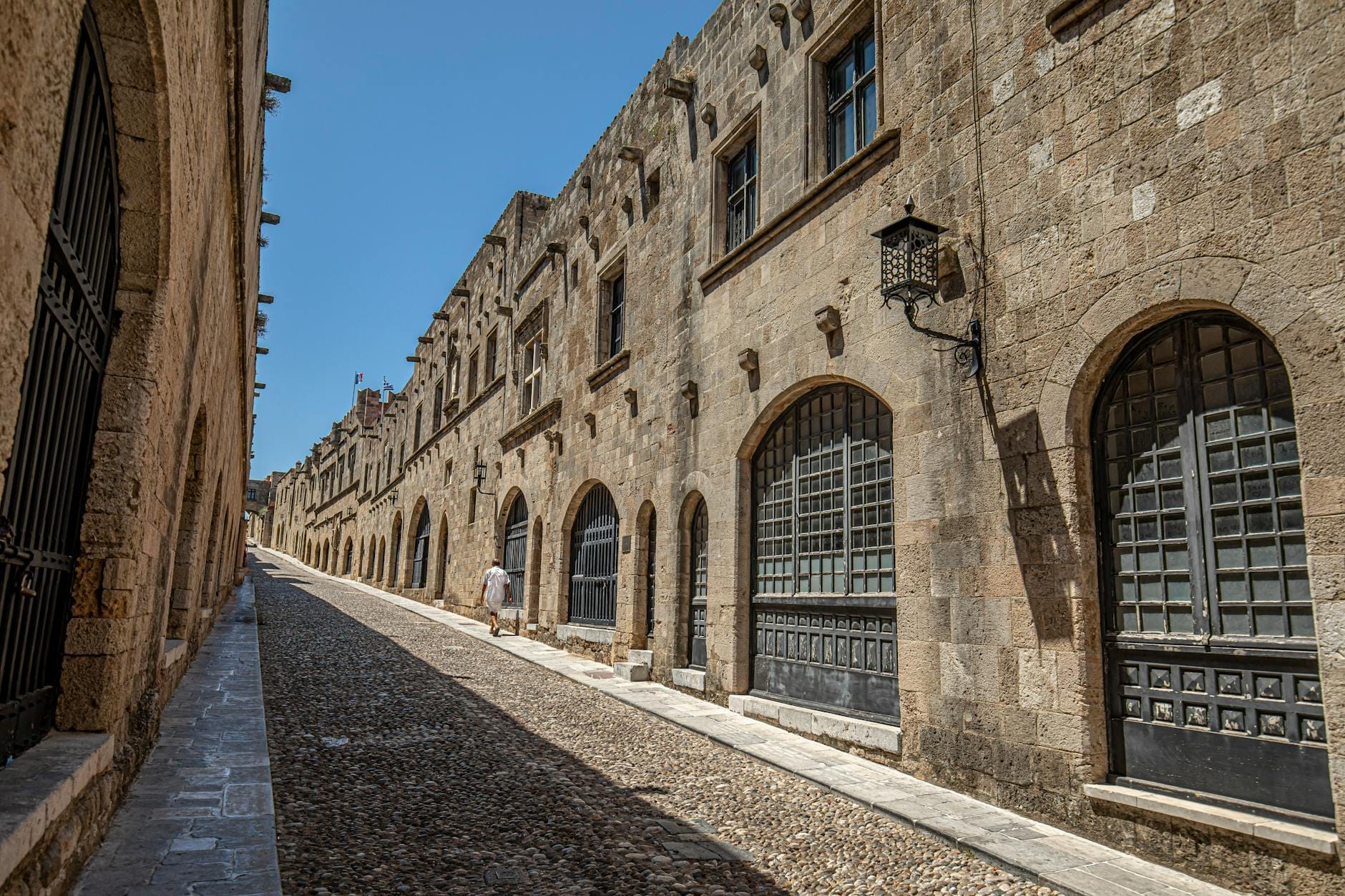
Odos Ippoton, the Street of the Knights, is a 14th-century cobblestone corridor lined with Gothic stone auberges built by the Knights Hospitaller. Free to walk and open around the clock, it connects the Archaeological Museum to the Palace of the Grand Master and stands as one of the most intact medieval streetscapes in Europe.
Quick Facts
- Location
- Ippoton, Rhodes Old Town (UNESCO World Heritage Site), 851 00 Rhodes, Greece
- Getting There
- Walk from the Harbour Gates into the Old Town; roughly 15 minutes on foot from Mandraki Harbour. No bus enters the medieval core.
- Time Needed
- 20–45 minutes for the street itself; allow 2–3 hours if combining with the Palace of the Grand Master and Archaeological Museum
- Cost
- Free (public street, open 24/7)
- Best for
- History lovers, architecture enthusiasts, photographers, medieval heritage seekers
What Is the Street of the Knights?
Odos Ippoton, known in English as the Street of the Knights, is arguably the most architecturally coherent medieval street surviving anywhere in Europe. Running roughly 200 metres through the heart of Rhodes Old Town, it climbs from the former Knights' Hospital (now the Archaeological Museum of Rhodes) up to the monumental entrance of the Palace of the Grand Master. Every building lining both sides of this corridor was constructed or significantly rebuilt by the Knights Hospitaller between the late 14th and early 16th centuries, and the result is a street that reads almost like a single unified monument rather than a collection of separate buildings.
The street sits within Rhodes Old Town, a UNESCO World Heritage Site that the Knights of St John fortified and governed from 1309 until the Ottoman conquest in 1522. That unbroken ownership explains the architectural consistency: there were no gaps in patronage, no fires that cleared half the street, no 19th-century redevelopment. What you see today is essentially what the Knights built, heavily restored by Italian administrators during the early 20th century but structurally faithful to the original form.
💡 Local tip
Wear flat, grippy shoes. The street's polished cobblestones become genuinely slippery after rain or even morning dew. Flip-flops are a real hazard here.
The Architecture: Auberges and the Seven Tongues
The Knights Hospitaller were an international military-religious order organised into seven national divisions called 'Tongues' (Langues): France, Auvergne, Provence, Spain, Italy, England, and Germany. Each Tongue maintained its own inn or residence, known as an auberge, along or near this street. Walking uphill from south to north, you pass façades decorated with Gothic arched doorways, carved heraldic shields, window tracery, and machicolated corbels that once served a genuine defensive purpose.
The Auberge of France, the largest and most ornate, sits on the left side roughly halfway up the street. Its carved facade includes the fleur-de-lis and the arms of various Grand Masters. The Auberge of Italy and the Auberge of Spain (partially fused into what became the Palace precinct) are equally detailed if you look closely at the stonework above doorways. Most auberges are not open to independent visitors inside, but the exteriors alone justify the walk. The buildings are made from the same warm honey-coloured limestone used throughout the Old Town, which gives the street a sense of tonal unity that photographs rarely capture fully.
If you want the full historical context before you walk, the Knights of Rhodes history guide is worth reading in advance. Understanding the Tongue system genuinely changes how you read the street's architecture.
Tickets & tours
Hand-picked options from our booking partner. Prices are indicative; availability and final rates are confirmed when you complete your booking.
Sunset catamaran cruise with dinner in Rhodes
From 70 €Instant confirmationFree cancellation3-Hour All Inclusive Sun and Sea Swimming Cruise in Rhodes
From 55 €Instant confirmationFree cancellationRhodes Sunset Cruise with Greek BBQ and Unlimited Drinks
From 65 €Instant confirmationFree cancellationPalace of the Grand Master Ticket and Audio Tour by App
From 30 €Instant confirmation
How the Street Changes by Time of Day
Early morning is a different experience entirely. Before 8:30am, the street is almost empty. The low-angle light from the east catches the relief carvings above the doorways in ways that afternoon sun completely flattens out. The stonework glows. You can stand in the middle of the road and hear almost nothing except pigeons and the distant sound of a delivery scooter somewhere in the labyrinth. This is the version of the street most photos in books show, and it takes genuine effort to replicate in high season.
By mid-morning, guided tour groups arrive in waves. The street is narrow enough that a single group of 25 people with a guide holding an umbrella effectively blocks it. Between roughly 10am and 1pm, and again from 3pm to 5pm in summer, foot traffic is at its densest. This is not necessarily a reason to avoid those hours, but manage expectations: you will be sharing the space, and stopping to study carvings will require patience.
Evening brings a quieter, more atmospheric version. The street has minimal artificial lighting, so after sunset the upper reaches near the Palace become quite dark. Carry a phone torch if you plan to examine the stonework. The lack of commercial activity on Odos Ippoton itself (no shops or cafes line the street) means there is no artificial glow from storefronts. In summer, the residual warmth from the stone at dusk is noticeable.
ℹ️ Good to know
The Street of the Knights is a public thoroughfare and open at all hours. There is no ticket, no gate, and no closing time. Access is only affected if a special event or filming blocks part of the road, which is rare but does occur.
Walking the Street: A Practical Sequence
Most visitors enter from the lower (southern) end, which puts the Archaeological Museum of Rhodes immediately to your right. This former Knights' Hospital is itself a Gothic masterpiece and worth an hour before or after the street walk. From its entrance, face north and the Street of the Knights begins as a gentle incline.
The right-hand (east) side of the street has the most significant auberge façades in its lower half. Pause at each doorway and look up: the heraldic carved panels above the arches are the most detailed stonework on the street. Some are partially worn, but enough detail survives to read the shields clearly. Move slowly. Most visitors rush this corridor in under ten minutes and miss the carved details entirely.
The street terminates at the entrance precinct of the Palace of the Grand Master, which charges a separate admission fee and is worth allowing 1 to 1.5 hours for. The transition from street level to the palace's towering gate is one of the more dramatic moments in the Old Town.
Photography: What Actually Works Here
For photographers, the Street of the Knights appears in practically every Rhodes travel guide, including the Rhodes photography guide. The challenge is making the image your own. The standard shot looking uphill toward the Palace gate with clean stone walls on both sides requires either early morning light or a very wide lens to avoid the inevitable tourist in frame.
What works better: shooting the carved detail above individual doorways with a telephoto lens in soft morning light; capturing the interplay of deep shadow and sharp sunlight in the arched passages that open off the main corridor; and shooting downhill from near the Palace gate to get the slight curve of the street and the Museum façade in the background. The texture of the limestone in raking light repays close attention. A polarising filter cuts the haze that builds by late morning.
⚠️ What to skip
Avoid midday light in summer. The overhead sun bleaches the stone flat and creates harsh shadows in the archways. The same scene at 7am or 6pm looks completely different.
Accessibility and Honest Limitations
The Street of the Knights is not accessible for wheelchair users or anyone with significant mobility difficulties. The cobblestones are uneven, worn smooth by centuries of foot traffic, and the gradient is continuous from the lower to the upper end. There is no ramp or alternative path. This is a genuine limitation, not a minor inconvenience. For travellers with pushchairs, narrow cobblestone streets throughout the Old Town compound the difficulty.
The street itself also offers no shade. In July and August, midday temperatures in Rhodes regularly exceed 32°C, and the stone walls radiate additional heat. If you visit in high summer, early morning is not just aesthetically preferable: it is physically more comfortable. Bring water.
One honest note on expectations: the Street of the Knights is genuinely impressive as a piece of preserved medieval urbanism, but it is short. Some visitors arrive after considerable anticipation and find themselves at the top of the hill in twelve minutes, wondering if they missed something. The answer is usually yes: slow down, look up, and read the stonework. The reward is proportional to the attention you bring.
Insider Tips
- The carved heraldic panels above the doorways are the real spectacle, but most visitors never look up. Spend time studying the stonework above each arch, especially on the east side of the street in the lower half.
- Visit on a weekday morning in shoulder season (May or October) if you want to experience the street close to empty. High summer weekends can feel like a bottleneck, especially when multiple guided tours converge.
- The alleyways branching off the main corridor lead into quieter residential sections of the Knights' Quarter. These unmarked passages are part of the same 14th-century urban grid and are significantly less trafficked.
- Combine the street walk with the Palace of the Grand Master (paid admission) at the top and the Archaeological Museum at the bottom. Doing all three in sequence gives the most complete picture of the Knights' presence in Rhodes without doubling back.
- The Italian-era restorations of the 1930s, though sometimes criticised by purists for over-precision, are worth knowing about. Much of what looks pristinely medieval was reconstructed or re-carved during the Italian administration of the Dodecanese. This does not diminish the experience but gives it honest context.
Who Is Street of the Knights For?
- Medieval history and crusader heritage enthusiasts
- Architecture and Gothic stonework admirers
- Photographers seeking dramatic, textured streetscapes
- Travellers doing a structured Old Town walking tour
- Visitors pairing the street with the Palace of the Grand Master and Archaeological Museum
Nearby Attractions
Other things to see while in Rhodes Old Town:
- Archaeological Museum of Rhodes
Housed in the 15th-century Hospital of the Knights, the Archaeological Museum of Rhodes brings together artifacts spanning the Archaic to Roman periods, including celebrated Hellenistic marble statues and intricate floor mosaics. It is one of the most historically layered museum experiences in the Aegean, where the building itself is as compelling as the collection inside.
- Hammam Turkish Baths
Built in 1558 during the Ottoman occupation, the Great Hamam is the sole surviving bathhouse within Rhodes' UNESCO-listed Medieval Town. Currently closed to the public but recently restored, it remains one of the most architecturally distinctive buildings in Arionos Square, worth understanding in context before you arrive.
- Harbour Gates
The Harbour Gates mark the medieval boundary between Mandraki Harbour and the walled city built by the Knights of Saint John. Free to visit at any hour, they are the most atmospheric entry point into Rhodes Old Town, framing a view that has barely changed in six centuries.
- Palace of the Grand Master of the Knights of Rhodes
The Palace of the Grand Master of the Knights of Rhodes is the most architecturally commanding structure in the medieval city. Built in the early 14th century and dramatically restored under Italian rule, it anchors the northwestern corner of the Old Town with towers, colonnaded courtyards, and a permanent collection that spans antiquity to the Ottoman period.