Ancient Stadium of Rhodes: A Hellenistic Track Still Worth the Climb
The Ancient Stadium of Rhodes sits on Monte Smith Hill, part of the larger Acropolis of Rhodes complex. Dating to the 3rd century BC, this restored Hellenistic track once hosted the Haleion Games in honor of Helios. Entry is free, the views are exceptional, and the site is far less crowded than the medieval attractions in the city below.
Quick Facts
- Location
- Monte Smith Hill, Acropolis of Rhodes, Rhodes Town (approx. 2-3 km southwest of the Old Town)
- Getting There
- 20-30 min walk from Rhodes Old Town, or take a taxi. Local buses serve the area; verify current routes on arrival.
- Time Needed
- 45-90 minutes, including the surrounding acropolis complex
- Cost
- Free entry
- Best for
- History enthusiasts, photography, quiet morning walks, families with older children
What the Ancient Stadium of Rhodes Actually Is
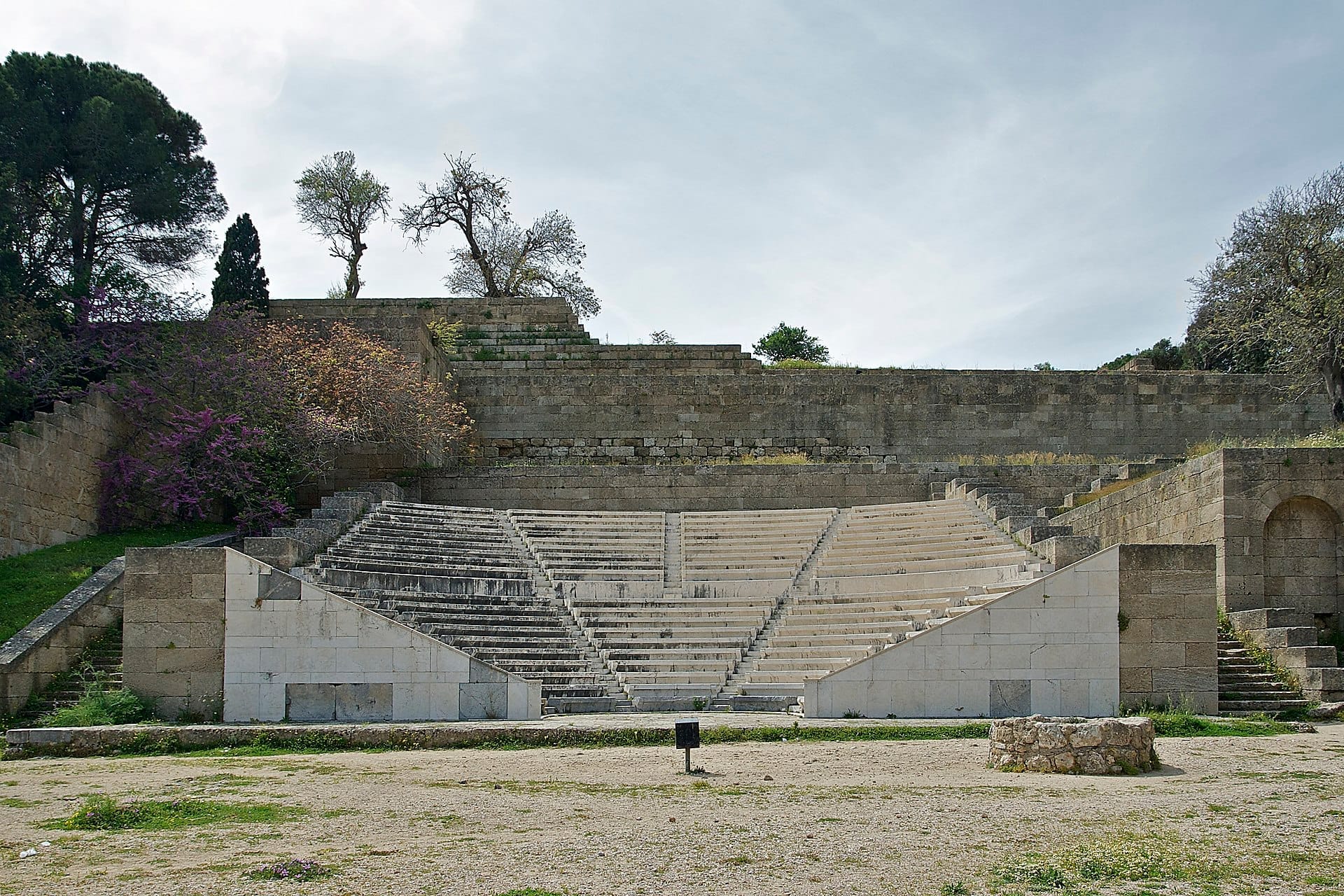
The Ancient Stadium of Rhodes is a partially restored Hellenistic athletic track built in the 3rd or 2nd century BC, located on the western slope of Monte Smith Hill as part of the broader Acropolis of Rhodes complex. It stretches approximately 210 meters from north to south, a length corresponding to roughly 600 ancient feet, and is one of the few surviving ancient stadia in the Greek island world.
The stadium was not merely a local sports ground. It hosted the Haleion Games, a multi-disciplinary festival held in honor of Helios, the sun god and divine patron of Rhodes, featuring athletic competitions, musical contests, and equestrian events. The quadrennial version of these games carried prestige comparable to other Panhellenic festivals of the era.
In terms of preservation, the stadium is partially reconstructed: the sphendone (the distinctive curved southern end), some rows of stone seating, the proedries (reserved seats for officials), and the stone starting apparatus, or hysplex, are all visible. For a fuller picture of the archaeology behind this site, the Acropolis of Rhodes page covers the entire hilltop complex in detail.
💡 Local tip
Visit early in the morning, ideally before 9:30am. The site is open to the sky with limited shade, and by midday in summer temperatures on the exposed hillside can exceed 35°C. The light is also better for photography before 10am.
The Experience: What You See, Smell, and Hear
The approach to the stadium sets the tone. From the road below, a stone path winds upward through scrub pine and wild thyme, and by the time you reach the track level, you can already see the deep blue of the Aegean to the west. The air carries the faintly resinous smell common to Greek hillside sites in summer, and the soundscape is mostly wind and distant birdsong, a marked contrast to the stone corridors of the medieval Old Town.
The track itself is wider and more open than most visitors expect. The stone starting blocks remain in situ at the northern end, worn smooth by centuries, and standing at them while looking down the length of the track gives an immediate, physical sense of scale. The seating rows curve around the sphendone at the southern end, and while only a portion of the original cavea survives, enough remains to read the shape of the ancient crowd.
At dusk, the stadium takes on a different quality. The low western light catches the limestone at a shallow angle and deepens the texture of the stone. The site is not officially lit at night, so late-afternoon visits are the practical limit. In the cooler months of October and November, the colors of the surrounding vegetation shift and the air is clearer, making autumn arguably the best time for a considered visit to this site.
Tickets & tours
Hand-picked options from our booking partner. Prices are indicative; availability and final rates are confirmed when you complete your booking.
Sunset catamaran cruise with dinner in Rhodes
From 70 €Instant confirmationFree cancellation3-Hour All Inclusive Sun and Sea Swimming Cruise in Rhodes
From 55 €Instant confirmationFree cancellationRhodes Sunset Cruise with Greek BBQ and Unlimited Drinks
From 65 €Instant confirmationFree cancellationHigh-Speed Boat Trip to Rhodes Town from Kolympia Harbour
From 40 €Instant confirmationFree cancellation
Historical and Cultural Context
The city of Rhodes was founded in 407 BC through the synoikism (unification) of three earlier Rhodian cities: Ialyssos, Kamiros, and Lindos. It was planned on a Hippodamian grid and grew rapidly into one of the most influential maritime powers of the Hellenistic world. The stadium was constructed during this period of prosperity, when Rhodes controlled significant trade routes and maintained diplomatic relationships with major powers including Rome and Egypt.
The Haleion Games held here placed Rhodes on the map of Greek athletic culture. While not ranked among the four great Panhellenic games (Olympia, Delphi, Isthmia, Nemea), the festival drew regional competitors and reflected Rhodes' economic confidence. The stadium's location on the acropolis, adjacent to the Temple of Apollo and the ancient odeon, was deliberate: these were civic and religious spaces, not merely entertainment venues.
The site was excavated and partially reconstructed in the 20th century by Italian archaeologists during the Italian occupation of the Dodecanese (1912-1943). That intervention, while contested by some heritage scholars, is responsible for the legibility of the site today. If the medieval layer of Rhodian history interests you more, the Knights of Rhodes history guide covers the island's later transformation in depth.
Navigating the Site: A Practical Walkthrough
The stadium is accessed via the road to Monte Smith (also written Monti Smith), named after the British Admiral Sir Sidney Smith who used the hill as a lookout post during the Napoleonic Wars, a layer of history entirely separate from the ancient structures. The road is signposted from the western edge of Rhodes New Town.
Once on the hill, the stadium is the most immediately accessible structure. Follow the path past the reconstructed odeon (a small semicircular theatre) and you will reach the northern end of the track within a few minutes. The full perimeter walk of the track takes about ten minutes at a relaxed pace. After the stadium, most visitors continue uphill to the Temple of Apollo columns and the hilltop viewpoint, which adds another 15-20 minutes.
There are no cafes, kiosks, or restrooms on site. Bring water, especially in summer. Footwear with grip is advisable: the stone paths are smooth in places and the slope is real. There is no entrance gate or ticket booth; the site is open-air and freely accessible during daylight hours.
⚠️ What to skip
The terrain is uneven throughout and involves steps and sloped pathways. Wheelchair access is not practicable at this site. Visitors with significant mobility limitations should be aware before making the trip uphill.
Photography and Views
Monte Smith Hill is one of the better vantage points in Rhodes Town for sea views, and the stadium occupies a section of hillside that looks directly toward the western coast of the island and across to the Turkish mainland on clear days. The combination of ancient stonework in the foreground and deep water behind it is genuinely photogenic. For broader context on shooting Rhodes' archaeological sites, the Rhodes photography guide covers timing, locations, and technique.
For the stadium itself, the best angles are from the southern sphendone looking north (you get the full length of the track) and from track level at the starting blocks looking south (the curved end frames naturally). Avoid shooting in the harsh overhead light between 11am and 3pm in summer; the white limestone washes out completely.
Who This Suits and Who Should Skip It
The Ancient Stadium of Rhodes works well for travelers with a genuine interest in classical antiquity, those who want a physical site rather than a museum display, and anyone who appreciates archaeological atmosphere over perfect reconstruction. It also suits visitors looking for a free, relatively quiet experience away from the more heavily trafficked sights of the medieval city.
Families with younger children can enjoy the open space of the track, and the walk to the hill is manageable. For a broader day combining ancient and medieval Rhodes, consider pairing this with the Palace of the Grand Master in the Old Town, which offers well-labelled exhibits and complete accessibility. Travelers who are only in Rhodes for one or two days and are primarily interested in beaches or nightlife will likely find the stadium a lower priority; the setting is evocative but the remains are partial and require some archaeological imagination to fully appreciate.
If you want to put the ancient world of Rhodes into wider context before visiting, the Archaeological Museum of Rhodes in the Old Town houses artefacts from the site and should ideally be visited first or in combination.
Insider Tips
- The odeon (small theatre) just below the stadium is often overlooked. It seats fewer than 200 and is one of the most intact ancient performance spaces in the Dodecanese. Spend five minutes there before heading to the track.
- The hilltop path continues past the stadium and the Temple of Apollo to a flat open area at the summit. On a clear day you can see the Turkish coast of Anatolia from here, less than 20 km away. Most visitors stop at the stadium and miss this entirely.
- The site is completely open at night but unlit and unguarded. A sunrise visit, approached from town on foot, gives you the stadium in golden light with almost no other visitors. Bring a torch for the path.
- Monte Smith is a popular evening walking spot for Rhodes locals, particularly families. If you arrive at dusk on a weekday, you will share the hill with residents rather than tour groups, which gives the site a different, more lived-in atmosphere.
- There is a small residential neighborhood immediately below the acropolis hill. Walking down through these streets rather than retracing the main road adds ten minutes and passes a mix of Italian-era and modern Greek architecture that most visitors on standard itineraries never see.
Who Is Ancient Stadium of Rhodes For?
- History and archaeology enthusiasts who want tangible, open-air ancient sites
- Photographers looking for classical stonework with sea-view backdrops
- Walkers building a half-day circuit from Rhodes New Town
- Budget travelers: free entry, no booking required
- Visitors who want a quiet, crowd-free alternative to the medieval Old Town sights
Nearby Attractions
Other things to see while in Rhodes New Town:
- Acropolis of Rhodes
Perched on Monte Smith hill 3 km southwest of the city center, the Acropolis of Rhodes is an open-air archaeological site dating to the 5th century BC. It holds the partially reconstructed Temple of Apollo, a 210-meter Hellenistic stadium, an odeon, and broad views over the Aegean. Entry is free, crowds are light, and the site rewards visitors with a genuinely atmospheric sense of ancient Rhodes that the medieval Old Town cannot offer.
- Colossus of Rhodes (Historical Site)
One of the Seven Wonders of the Ancient World, the Colossus of Rhodes was a 33-metre bronze statue of the sun god Helios, built to celebrate a famous military victory. No physical trace survives today, but understanding its story transforms how you see the harbour, the city, and Rhodes itself.
- Elli Beach
Elli Beach stretches 400 metres along the northern tip of Rhodes Town, sitting between Mandraki Harbour and the Rhodes Aquarium. With free entry, water sports, beach bars, and clear Aegean water, it serves as the island's urban beach hub. It is not a desert island escape, but for convenience and character, few beaches in the city come close.
- Fort of St Nicholas
Standing at the tip of Mandraki Harbour's breakwater, the Fort of St Nicholas is a 15th-century Knights Hospitaller fortress that has guarded the northern approach to Rhodes for over 550 years. Free to visit from the exterior; currently under restoration with limited access, it offers some of the most photogenic views on the island, framing the medieval Old Town against the open Aegean.