Colossus of Rhodes: The Wonder That No Longer Stands
One of the Seven Wonders of the Ancient World, the Colossus of Rhodes was a 33-metre bronze statue of the sun god Helios, built to celebrate a famous military victory. No physical trace survives today, but understanding its story transforms how you see the harbour, the city, and Rhodes itself.
Quick Facts
- Location
- Mandraki Harbour area, Rhodes New Town (exact ancient site disputed)
- Getting There
- Walk from Rhodes Old Town's northern gates; local KTEL buses serve the harbour area
- Time Needed
- 30–60 minutes to walk the harbour and reflect on the historical context; pair with nearby sites for a half-day
- Cost
- Free — no managed site or admission fee exists; the Colossus itself is gone
- Best for
- History enthusiasts, archaeology lovers, and travellers who enjoy contextualising a place's ancient past
What the Colossus of Rhodes Actually Is (and Isn't)
Let's be direct from the start: the Colossus of Rhodes does not exist as a physical attraction. There is no statue to visit, no ruin to photograph, no ticket booth, and no reconstructed monument awaiting you at the harbour. What you are visiting — or more precisely, what you are imagining — is the site where one of the most celebrated structures of the ancient world once stood, for a remarkably brief period, before an earthquake brought it down roughly 54 years after its completion.
The Colossus was a colossal bronze statue of Helios, the Greek god of the sun and the patron deity of Rhodes. Ancient sources describe it as standing approximately 33 metres tall, placed on a white marble pedestal estimated at 15 metres. That combined height of around 48 metres would have made it clearly visible from approaching ships and would have dominated the landscape of the city in a way nothing in Rhodes today quite replicates. It was completed in 280 BC, having taken roughly twelve years to construct under the direction of the sculptor Chares of Lindos.
ℹ️ Good to know
The Colossus is confirmed as one of the original Seven Wonders of the Ancient World, listed by ancient authors including Antipater of Sidon. It is the only one of the Seven Wonders whose general location — Rhodes harbour — is agreed upon, even if the precise spot remains debated among archaeologists.
Why It Was Built: The Siege of 305 BC
The story behind the Colossus is as dramatic as the statue itself. In 305 BC, Demetrius I Poliorcetes, one of the successors of Alexander the Great, laid siege to the city of Rhodes with a massive fleet and an army reportedly numbering in the tens of thousands. He brought with him an extraordinary siege machine called the Helepolis, a nine-storey tower on wheels considered the most advanced piece of military engineering of the Hellenistic period. Despite the assault lasting a full year, Rhodes held out. Demetrius eventually withdrew, leaving behind his equipment and weapons.
The Rhodians sold the abandoned siege equipment and used the proceeds to fund the construction of the statue as a thanksgiving offering to Helios. This detail matters: the Colossus was not built as a vanity project or as a display of power. It was a religious monument, a monumental act of gratitude to the deity they credited with protecting their city. That context gives the statue a different weight than many travellers expect.
For deeper background on the military orders and civilisations that shaped Rhodes across the centuries, the Knights of Rhodes history guide provides useful context on how the island has repeatedly served as a geopolitical flashpoint in the eastern Mediterranean.
Tickets & tours
Hand-picked options from our booking partner. Prices are indicative; availability and final rates are confirmed when you complete your booking.
Sunset catamaran cruise with dinner in Rhodes
From 70 €Instant confirmationFree cancellation3-Hour All Inclusive Sun and Sea Swimming Cruise in Rhodes
From 55 €Instant confirmationFree cancellationRhodes Sunset Cruise with Greek BBQ and Unlimited Drinks
From 65 €Instant confirmationFree cancellationHigh-Speed Boat Trip to Rhodes Town from Kolympia Harbour
From 40 €Instant confirmationFree cancellation
Where It Stood: The Ongoing Debate
The most enduring question about the Colossus is also the simplest: where, exactly, was it? The popular image of the statue straddling the harbour entrance, with ships passing between its legs, is almost certainly wrong. Ancient sources do not support this configuration, and structural engineering analysis suggests a statue of that weight and height could not have stood with legs spread across an opening of that width. The straddling image likely originated with Renaissance-era illustrations created centuries after the statue was destroyed.
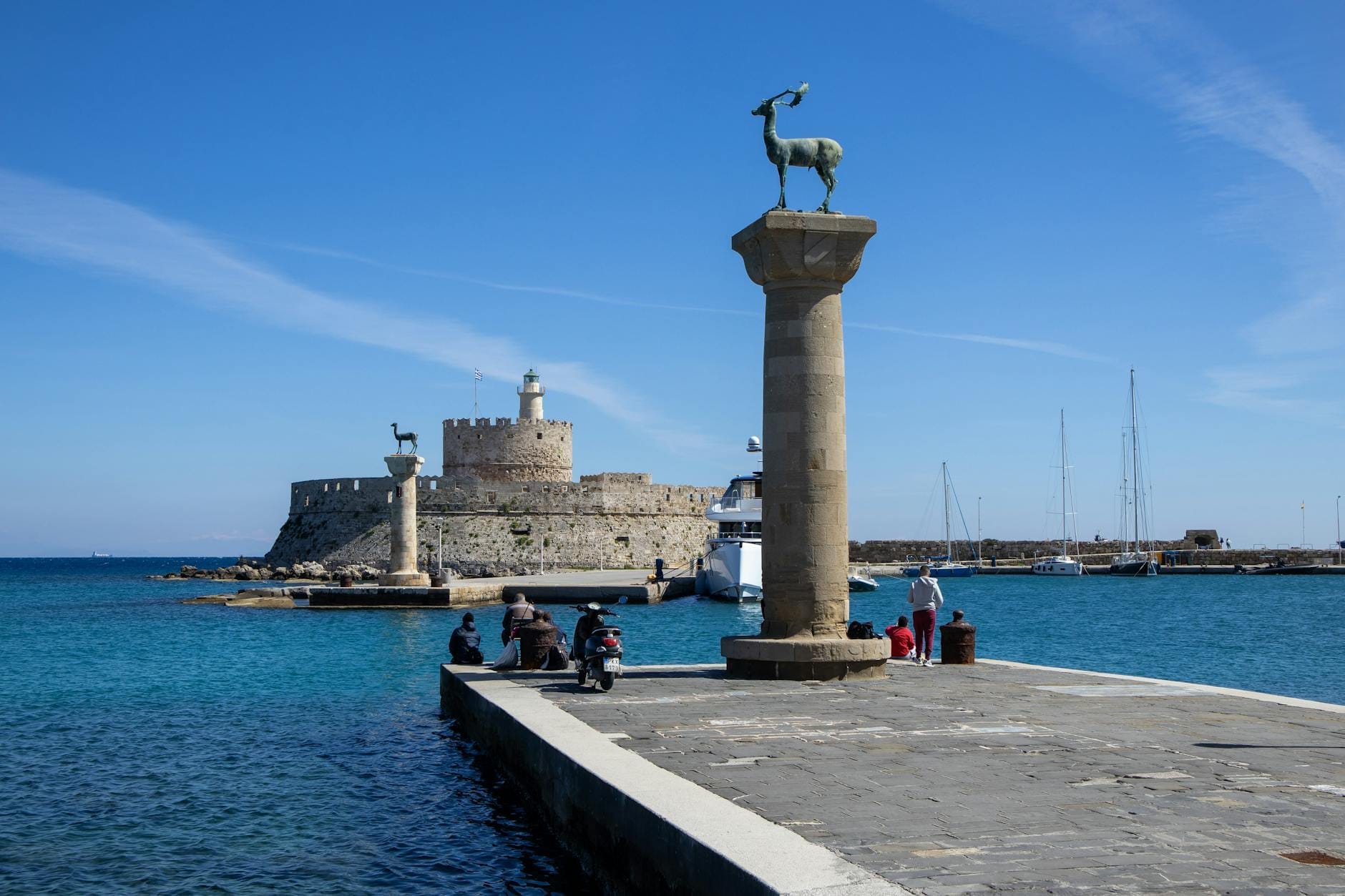
The most commonly cited locations are the Mandraki Harbour entrance, where two deer statues (a stag and a doe) now stand atop columns, and the nearby Acropolis hill of Rhodes. Some researchers have proposed the breakwater area between the Mandraki and commercial harbours. None of these sites has produced conclusive archaeological evidence. The deer columns at Mandraki are a 20th-century addition, but they stand as a symbolic marker where many visitors choose to pause and picture the original.
Mandraki Harbour itself is worth exploring as a destination in its own right. The area around the Mandraki Harbour includes the Fort of St Nicholas, windmills, and views back toward the walled city that give a strong sense of Rhodes' maritime geography across different historical periods.
⚠️ What to skip
Several online sources and some local tourist materials still depict the Colossus straddling the harbour mouth. This is a medieval myth with no basis in ancient sources. No ancient writer describes the statue in this configuration.
What Happened to It: Earthquake, Neglect, and Eventual Destruction
The Colossus stood for approximately 54 years before a powerful earthquake, believed to have struck around 226 BC, toppled it at the knees. Ancient accounts describe the statue lying broken but largely intact on the ground for centuries afterward — still considered a marvel even in ruins. The Roman writer Pliny the Elder, visiting in the first century AD, wrote that 'few men can clasp the thumb in their arms, and its fingers are larger than most statues.' The broken figure had become a spectacle in itself.
The statue's remains lay where they fell for nearly nine centuries. Then, in 653 or 654 AD, following the Arab conquest of Rhodes, the remaining bronze was reportedly sold to a Jewish merchant from Emesa (modern Homs, Syria), who required, according to the Byzantine chronicler Theophanes, 900 camels to transport the metal. Whether this account is entirely accurate is debated, but it marks the end of any material presence of the Colossus on Rhodes.
There have been periodic proposals to build a modern reconstruction or a new large-scale monument in the harbour area. As of the time of writing, no such project has been completed. Plans announced in 2008 and revisited in subsequent years have not resulted in any built structure.
How to Experience the Site Today
Visiting the 'site' of the Colossus is really an exercise in historical imagination rather than sightseeing in the conventional sense. The most rewarding approach is to walk the full length of Mandraki Harbour in the early morning, when the light is low and golden and the pier is relatively quiet. The deer columns at the harbour mouth give you a fixed point to stand and look outward toward the sea, thinking about the scale of what once stood here. At this hour, fishing boats are still moored in the inner harbour and the water carries the slight brine and diesel smell typical of a working Greek port.
From the pier, turn back and look at the skyline: the Palace of the Grand Master and the minarets of the Old Town are clearly visible. In antiquity, the harbour approach would have been dominated by the statue itself. That orientation, the act of arriving by sea and seeing the giant figure ahead of you, is something worth reconstructing mentally.
For visitors who want to ground the historical imagination with physical evidence, the Archaeological Museum of Rhodes in the Old Town holds artefacts from the Hellenistic period, including objects contemporary with the construction of the Colossus. It is the closest you can get to tangible evidence of the world in which the statue was built.
💡 Local tip
The best time to visit Mandraki Harbour for atmosphere is before 9am or after 6pm. Midday brings tour groups, cruise ship passengers, and heavy foot traffic that makes quiet reflection difficult. The evening light on the water, with the Fort of St Nicholas lit up to the north, is genuinely evocative.
Who Should and Shouldn't Make This a Priority
Travellers drawn to ancient history, mythology, or the story of the Seven Wonders will find the Colossus site thought-provoking and worth an hour of their time. The combination of the harbour walk, the symbolic deer columns, and the backdrop of the medieval city makes for a layered experience if you've done some reading beforehand.
Those who prefer their historical sites to offer something visible and concrete should manage expectations carefully. If you're expecting ruins, an excavated foundation, or any physical remnant of the statue, you will be disappointed. The Colossus of Rhodes has left no confirmed trace on the landscape. The site is, by its nature, about the absence of something extraordinary rather than its presence.
If you're building an itinerary around Rhodes' ancient history, pairing this with the Acropolis of Rhodes and the Temple of Apollo gives you a fuller picture of the Hellenistic city that built the Colossus. Both sites offer physical ruins and strong views over the modern city.
Insider Tips
- Read the Wikipedia article on the Colossus before you visit. Arriving with the key facts — height, construction timeline, the siege backstory, the earthquake — transforms the harbour walk from a pleasant stroll into a genuinely immersive experience.
- The deer statues atop the columns at the Mandraki Harbour entrance are a 20th-century addition. They are a photogenic stand-in, but treat them as symbolic rather than historically precise markers.
- Stand at the end of the Mandraki pier at low tide, facing the sea. The harbour mouth is roughly 400 meters wide at that point. The mental exercise of imagining a 48-metre statue visible from here puts the scale of the ancient wonder into perspective.
- Several cafes along the Mandraki promenade stock books about Rhodes' ancient history. If you're interested in the Hellenistic period, picking one up before touring the Archaeological Museum adds significant context.
- Reconstruction proposals resurface periodically in local news. If you see signage or hoardings near the harbour suggesting a new monument is planned, treat it with scepticism until confirmed by official municipal sources.
Who Is Colossus of Rhodes (Historical Site) For?
- Ancient history enthusiasts who understand and accept the site's intangible nature
- Travellers combining a full day in Rhodes New Town and Old Town, for whom the harbour walk is a natural starting point
- Photographers seeking the early-morning harbour light with the medieval skyline as a backdrop
- Classicists and students of the Hellenistic world who want to stand where one of the Seven Wonders once stood
- Families with older children who have studied the Seven Wonders and want a real-world anchor for what they've learned
Nearby Attractions
Other things to see while in Rhodes New Town:
- Acropolis of Rhodes
Perched on Monte Smith hill 3 km southwest of the city center, the Acropolis of Rhodes is an open-air archaeological site dating to the 5th century BC. It holds the partially reconstructed Temple of Apollo, a 210-meter Hellenistic stadium, an odeon, and broad views over the Aegean. Entry is free, crowds are light, and the site rewards visitors with a genuinely atmospheric sense of ancient Rhodes that the medieval Old Town cannot offer.
- Ancient Stadium of Rhodes
The Ancient Stadium of Rhodes sits on Monte Smith Hill, part of the larger Acropolis of Rhodes complex. Dating to the 3rd century BC, this restored Hellenistic track once hosted the Haleion Games in honor of Helios. Entry is free, the views are exceptional, and the site is far less crowded than the medieval attractions in the city below.
- Elli Beach
Elli Beach stretches 400 metres along the northern tip of Rhodes Town, sitting between Mandraki Harbour and the Rhodes Aquarium. With free entry, water sports, beach bars, and clear Aegean water, it serves as the island's urban beach hub. It is not a desert island escape, but for convenience and character, few beaches in the city come close.
- Fort of St Nicholas
Standing at the tip of Mandraki Harbour's breakwater, the Fort of St Nicholas is a 15th-century Knights Hospitaller fortress that has guarded the northern approach to Rhodes for over 550 years. Free to visit from the exterior; currently under restoration with limited access, it offers some of the most photogenic views on the island, framing the medieval Old Town against the open Aegean.