Temple of Apollo, Rhodes: The Ancient Heart of Monte Smith
Perched on the Acropolis of Rhodes atop Monte Smith hill, the Pythian Temple of Apollo is a partially reconstructed Doric shrine dating to the 3rd–2nd century BC. Free to enter with no set hours, it offers one of the most atmospheric ancient sites on the island, with panoramic views across the Aegean.
Quick Facts
- Location
- Acropolis of Rhodes, Monte Smith (Agios Stephanos Hill), Rhodes Town
- Getting There
- 15–20 min walk or short taxi ride from Rhodes Old Town; seasonal bus service to Monte Smith area
- Time Needed
- 45–90 minutes for the full Acropolis site
- Cost
- Free entry
- Best for
- History lovers, sunset seekers, photographers, early-morning walkers
What You're Looking At: The Temple in Context
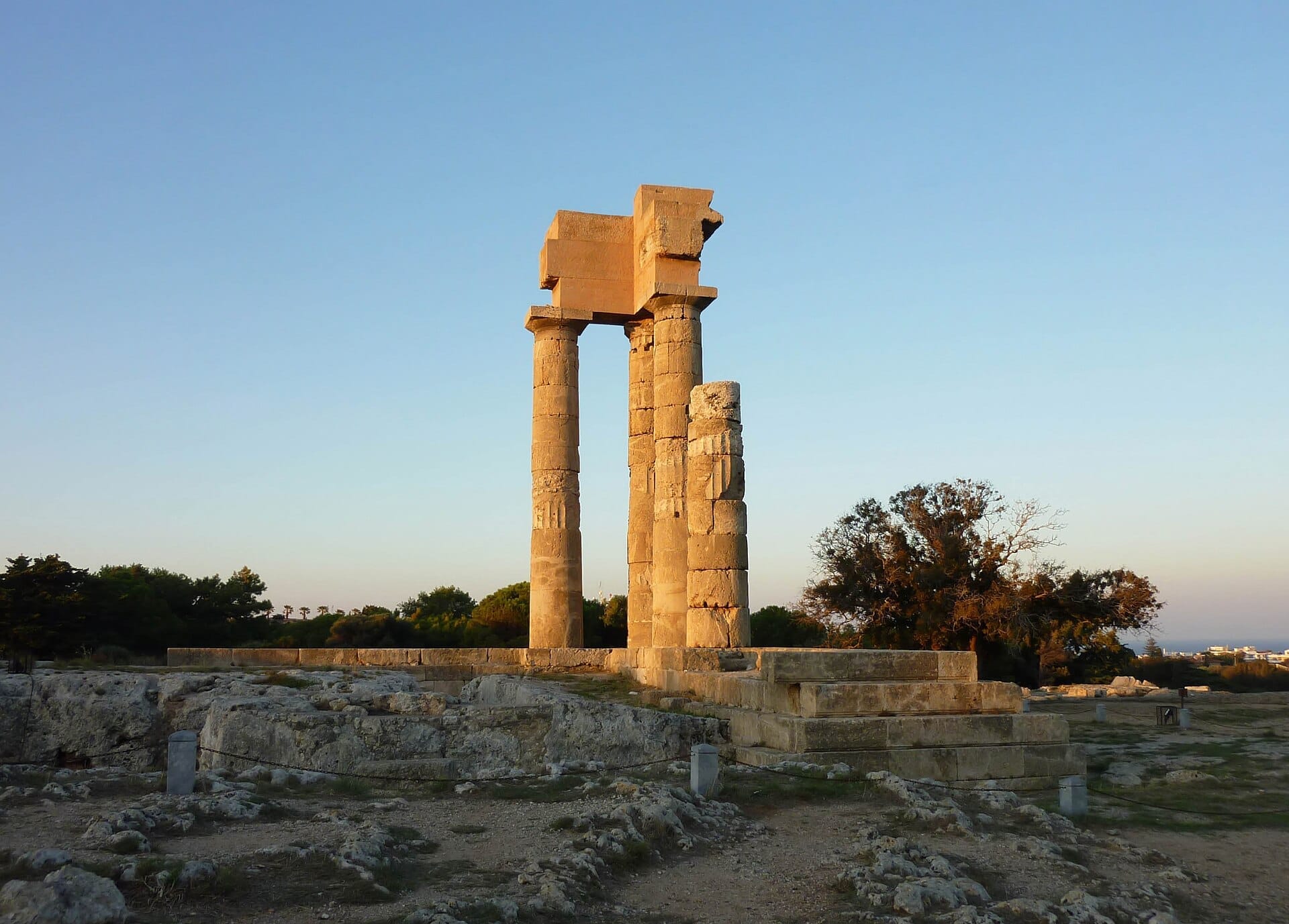
The Temple of Apollo, formally known as the Pythian Temple of Apollo (Ναός Απόλλωνος), stands on the northern terrace of the Acropolis of Rhodes on Monte Smith hill, roughly 1.5 kilometres west of Rhodes Town's historic core. What survives today is fragmentary but striking: a cluster of re-erected column drums and architectural blocks arranged on a rectangular stone platform, rising from a terrace of pale limestone. It is not a complete colonnade, and it was never meant to look finished in the modern reconstruction sense. What you see is honest archaeology, not theatrical restoration.
The temple dates to the Hellenistic period, generally placed in the 3rd to 2nd century BC, when the city of Rhodes was one of the most powerful trading centres in the eastern Mediterranean. It was built in the Doric order, a style associated with civic gravitas, and dedicated to Apollo Pythios, the oracular aspect of Apollo associated with Delphi. That dedication underscores how seriously the Rhodians took their cultural alignment with mainland Greek tradition, even as they operated firmly within their own cosmopolitan orbit.
ℹ️ Good to know
The Temple of Apollo is part of the wider Acropolis of Rhodes archaeological site, which also includes a restored ancient stadium, a small theatre (odeon), and gymnasium foundations. Budget extra time if you plan to explore the full hill.
History: Excavation, War, and Careful Reconstruction
The temple's modern story begins in the early 20th century. Italian archaeologists, working under the Italian occupation of the Dodecanese, excavated the Monte Smith hill site between 1912 and 1945. The Italians had a particular interest in projecting imperial legitimacy through classical archaeology, and Monte Smith became one of their major projects. Much of what is visible today, including the cleared terraces and the repositioning of architectural fragments, reflects decisions made during that period.
The site suffered damage during World War II and the upheaval of the mid-20th century. A significant restoration effort followed in 1996, when Greek archaeological authorities re-erected several column drums using the anastylosis method — reassembling original stone elements in their presumed original positions, rather than introducing new materials. The result is architecturally honest: you can see exactly which stones are ancient and where they belong, without a glossy recreation obscuring the gaps.
For the broader story of how ancient Rhodes functioned as a city-state, the history of Rhodes guide offers useful background, though it focuses on the medieval period. The pre-medieval layers of the island run much deeper.
Tickets & tours
Hand-picked options from our booking partner. Prices are indicative; availability and final rates are confirmed when you complete your booking.
Sunset catamaran cruise with dinner in Rhodes
From 70 €Instant confirmationFree cancellation3-Hour All Inclusive Sun and Sea Swimming Cruise in Rhodes
From 55 €Instant confirmationFree cancellationRhodes Sunset Cruise with Greek BBQ and Unlimited Drinks
From 65 €Instant confirmationFree cancellationPalace of the Grand Master Ticket and Audio Tour by App
From 30 €Instant confirmation
The Experience at Different Times of Day
Early morning is the most rewarding time to visit the Temple of Apollo. By 7am, the hill is almost entirely quiet. The air carries a faint scent of wild thyme and dry grass, the light is low and golden, and the column drums cast long shadows across the stone terrace. Without tour groups or ambient noise from the town below, the scale of the ancient platform becomes genuinely legible in a way it cannot when the site is crowded.
By mid-morning, particularly between May and September, walkers and joggers begin to use the hill's paths, and occasional tour groups arrive from the cruise ships docking at Rhodes port. The site itself remains calm compared to the Old Town, but the sense of solitude disappears. Midday heat in summer is significant at this exposed, treeless hilltop — temperatures on the limestone terrace regularly exceed 35°C between noon and 3pm. Without shade, it becomes uncomfortable quickly.
Late afternoon and sunset bring a different quality entirely. The western orientation of Monte Smith means the temple catches the last light directly. The pale Doric stone shifts from white to amber to a deep ochre as the sun drops toward the Aegean horizon. The view from the terrace at this hour, looking west across the water toward Turkey's faint coastline, is one of the better free panoramas on the island. Bring water, wear sunscreen, and arrive at least 45 minutes before sunset to settle in.
💡 Local tip
Sunrise visits are genuinely exceptional here. The site has no gate and no closing time, so early arrivals are completely feasible. Pair a sunrise walk with a coffee at one of the cafés near the base of the hill afterward.
Navigating the Site: A Practical Walkthrough
The Acropolis of Rhodes is accessed via several paths that wind up from the residential streets on the western edge of Rhodes Town. The most direct approach from the Old Town follows Diagoridon Street and then climbs through a quiet neighbourhood of apartment buildings and small gardens. The walk takes 15 to 20 minutes at a moderate pace, with the last section involving a steady uphill gradient on a dirt and stone path. There are no ticket booths, no turnstiles, and no staff checking entry.
The Temple of Apollo terrace sits on the northern part of the hilltop plateau. From the main access path, you'll typically pass the reconstructed ancient stadium first — a long, narrow track with partially restored seating — before reaching the temple above. The stadium alone is worth pausing at: it is one of the few ancient Greek athletic venues in the Aegean where you can stand on the original track surface.
The full archaeological zone on Monte Smith is sometimes referred to simply as the Acropolis of Rhodes, and the temple is its most visually prominent feature. Allow at least 45 minutes if you plan to walk the whole site, including the stadium and the remnants of the odeon on the southern slope.
Footwear matters here. The terrain is uneven, with loose stones, exposed rock, and low scrub underfoot. Sandals are workable in dry conditions but closed shoes give you more confidence on the steeper paths. The site is not wheelchair accessible — the slope and rocky ground make that effectively impossible. Visitors with limited mobility will find the lower paths around the stadium base manageable, but the temple terrace itself requires navigating steps and rough stone.
Photography Notes
The Temple of Apollo photographs best in early morning or the hour before sunset, when directional light gives the column drums depth and texture. At midday, the overhead sun flattens the stone surface and makes the ruins look bleached rather than dramatic. If you're building a wider photographic itinerary of Rhodes, the Rhodes photography guide covers timing and locations across the island in detail.
For the western sea view, a standard wide-angle composition works well from the temple terrace edge. The column fragments themselves photograph cleanly against the sky with a slightly low camera position. There are no ropes or barriers around the reconstructed columns, which allows close framing, but treat the stones with care — they are original ancient material.
Honesty About Expectations
The Temple of Apollo is not a visually complete monument. If you arrive expecting something like the Parthenon in Athens or even the well-preserved temple rows at Agrigento in Sicily, you will find it modest by comparison. Only a handful of columns have been re-erected, and much of the platform consists of bare foundation stones. The value here is more atmospheric and contextual than spectacular: you are standing on the sacred high point of one of antiquity's wealthiest cities, looking at genuine Hellenistic stonework in situ.
Visitors who want a more complete ancient experience on the island should also consider making the trip to the Acropolis of Lindos, where a significantly larger Doric temple complex survives atop a dramatic coastal promontory. That site charges admission and requires considerably more physical effort, but the architectural remains are more extensive.
Travellers who are primarily interested in shopping, beaches, or nightlife are unlikely to find Monte Smith compelling. The hill offers history, views, and quiet — and that is its entire offer. There is no café, no museum building, no gift shop, and no interpretive signage of any depth at the temple itself. Come prepared with your own background knowledge, or read up beforehand.
Getting There and Practical Logistics
From the Rhodes Old Town, the walk to Monte Smith takes approximately 15 to 20 minutes on foot heading west. Taxis from the Old Town or Rhodes New Town are inexpensive for this short distance. Seasonal local bus services cover the Monte Smith area, but schedules change year to year — check current routes locally. Renting a car or scooter is unnecessary for this single destination, though both options are widely available in Rhodes Town if you're combining the visit with a broader day around the island.
There is no admission fee and no booking required. The site has no official closing time and is accessible during daylight hours without restriction. Bring your own water — there are no facilities on the hill. The nearest services are in the residential streets at the base of Monte Smith.
⚠️ What to skip
In summer, do not attempt the midday visit without water and sun protection. The hilltop is completely exposed, stone surfaces radiate heat, and there is no shade at the temple terrace. Heat exhaustion is a real risk between 11am and 4pm in July and August.
Insider Tips
- Visit at sunrise or in the last hour of daylight. The site is open at both times and the light on the Doric columns at those hours is genuinely worth the early start or the timing effort.
- Combine the temple with the ancient stadium immediately below it — the stadium track is walkable and rarely crowded, and gives the hilltop visit more structure than the temple alone.
- Bring a printed or downloaded article about Hellenistic Rhodes before you go. There is almost no interpretive signage at the site, so background knowledge makes an enormous difference to how much you get out of it.
- The western terrace of the hilltop offers one of the cleaner sunset views over the Aegean in Rhodes Town, without the crowds that gather at Mandraki Harbour. It is not widely promoted as a sunset spot, which keeps it relatively uncrowded.
- Wear closed shoes, particularly if you plan to walk any of the rougher paths around the stadium and odeon. The main terrace is manageable in sandals, but the surrounding site has loose rock and uneven ground.
Who Is Temple of Apollo For?
- History and archaeology enthusiasts who appreciate ruins in their unrestored, honest state
- Photographers looking for golden-hour compositions away from the crowds
- Early risers who want a quiet walk with views before the Old Town fills up
- Walkers combining Monte Smith with a broader morning exploration of Rhodes Town
- Travellers who want to see ancient Rhodes beyond the medieval walls of the Old Town
Nearby Attractions
Other things to see while in Rhodes New Town:
- Acropolis of Rhodes
Perched on Monte Smith hill 3 km southwest of the city center, the Acropolis of Rhodes is an open-air archaeological site dating to the 5th century BC. It holds the partially reconstructed Temple of Apollo, a 210-meter Hellenistic stadium, an odeon, and broad views over the Aegean. Entry is free, crowds are light, and the site rewards visitors with a genuinely atmospheric sense of ancient Rhodes that the medieval Old Town cannot offer.
- Ancient Stadium of Rhodes
The Ancient Stadium of Rhodes sits on Monte Smith Hill, part of the larger Acropolis of Rhodes complex. Dating to the 3rd century BC, this restored Hellenistic track once hosted the Haleion Games in honor of Helios. Entry is free, the views are exceptional, and the site is far less crowded than the medieval attractions in the city below.
- Colossus of Rhodes (Historical Site)
One of the Seven Wonders of the Ancient World, the Colossus of Rhodes was a 33-metre bronze statue of the sun god Helios, built to celebrate a famous military victory. No physical trace survives today, but understanding its story transforms how you see the harbour, the city, and Rhodes itself.
- Elli Beach
Elli Beach stretches 400 metres along the northern tip of Rhodes Town, sitting between Mandraki Harbour and the Rhodes Aquarium. With free entry, water sports, beach bars, and clear Aegean water, it serves as the island's urban beach hub. It is not a desert island escape, but for convenience and character, few beaches in the city come close.