The Colossus of Rhodes: History, Location & What to See Today
One of the Seven Wonders of the Ancient World, the Colossus of Rhodes was a 33-metre bronze statue that stood near Mandraki Harbour around 280 BCE. Nothing physical survives, but the story, the site, and the surrounding attractions make this one of Rhodes' most fascinating stops. Here is everything you need to know.
Plan and book this trip
Tools from our partner Travelpayouts help you compare flights and hotels. If you book through them, we may earn a commission at no extra cost to you.
Flights
Hotels map
TL;DR
- The Colossus of Rhodes was a 33-metre bronze statue of Helios, built around 292–280 BCE and destroyed by an earthquake circa 226 BCE.
- No physical remains exist. The site is generally identified with Mandraki Harbour, marked today by two bronze deer statues on stone columns.
- Visiting is free. Combine it with the nearby Mandraki Harbour and Fort of St. Nicholas for a rich half-day.
- Ignore the popular image of the statue straddling the harbour entrance. That image is a medieval myth with no basis in ancient sources.
- For deeper context, pair this visit with the Archaeological Museum of Rhodes and a walk along the Street of the Knights.
What Was the Colossus of Rhodes?
The Colossus of Rhodes was a colossal bronze statue of Helios, the sun god patron of the island, erected to celebrate a significant military victory. Around 305 BCE, the Macedonian general Demetrius I Poliorcetes laid siege to Rhodes with a massive fleet and an army numbering in the tens of thousands. The Rhodians held out for over a year, and when Demetrius finally withdrew, he left behind much of his siege equipment. The Rhodians sold it, and used the proceeds to fund the statue as a monument to their survival.
Construction was entrusted to Chares of Lindos, a sculptor from the island's eastern coastal town, and took approximately twelve years. The statue stood roughly 32 metres tall, around 108 feet, on a white marble pedestal estimated at 15 metres. That made the total structure comparable in height to the Statue of Liberty from base to torch. It was completed around 280 BCE and was recognised almost immediately as one of the Seven Wonders of the Ancient World.
ℹ️ Good to know
The Colossus stood for only about 54 years before a major earthquake struck Rhodes circa 226 BCE, toppling the statue at its weakest point: the knees. Ancient sources record that it fell in sections across the land, remaining in ruins for nearly nine centuries before Arab forces sold the bronze as scrap around 653–654 CE. By one account, it took 900 camels to carry the metal away.
Debunking the Myths: What the Ancient Sources Actually Say
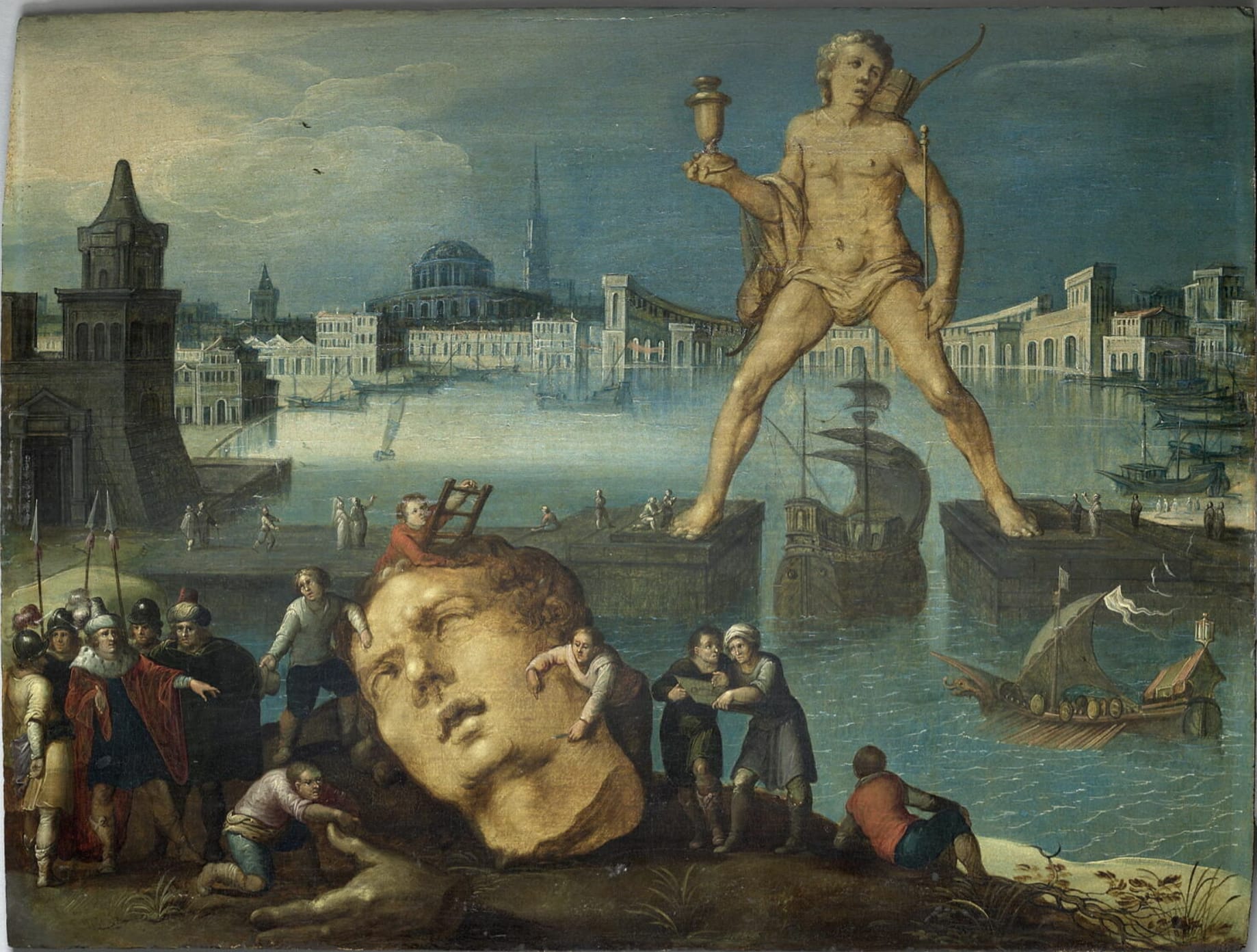
The most persistent image of the Colossus shows it straddling the entrance to Mandraki Harbour, with ships sailing between its legs. This image, endlessly reproduced on postcards and tourist merchandise, is a complete fiction invented in the medieval period. Ancient writers make no mention of the statue spanning the harbour, and structural engineers have long noted that a bronze figure of that scale could not have been built in a straddling position with the technology available at the time. The harbour entrance is also roughly 400 metres wide, far beyond any plausible span.
The exact location is genuinely debated among scholars. The harbour-side position, somewhere on or near the eastern mole at Mandraki, remains the most widely accepted theory and is the one commemorated today. A minority of researchers have proposed the Acropolis of Rhodes as an alternative, which would have given the statue greater visibility across the island. Neither position can be confirmed because the original ruins were sold for scrap, leaving no archaeological trace to analyse.
- Myth: It straddled the harbour entrance False. No ancient source supports this. It was a medieval embellishment that stuck.
- Myth: It was built in 305 BCE False. Construction began around 292 BCE, after the siege equipment was sold, and was completed circa 280 BCE.
- Myth: Its exact location is known Debated. Mandraki Harbour is the most credible candidate, but the Acropolis of Rhodes has also been proposed.
- Myth: Remains can still be seen False. Not a single fragment of the original statue survives above ground.
Where to Go: The Site Today
The modern landmark that marks the Colossus site is Mandraki Harbour, the northernmost of Rhodes' three main harbours. At the harbour mouth, two tall stone columns support bronze deer statues, a doe and a stag, representing Elafos and Elafina, the heraldic symbols of Rhodes. These columns are generally cited as marking the approximate position where the Colossus once stood, though this is tradition rather than confirmed archaeology. The atmosphere here is genuinely evocative: you are looking out at the same stretch of water the ancient statue once overlooked.
A short walk along the eastern mole brings you to the Fort of St. Nicholas, a 15th-century Hospitaller fortification that occupies the tip of the breakwater. Some researchers place the original Colossus pedestal in roughly this area, making the fort itself a layered piece of history. The lighthouse at the fort's tip is still operational. Entry to the harbour area and the mole is free and accessible year-round.
💡 Local tip
Visit Mandraki Harbour in the early morning (before 9am in summer) to avoid cruise ship crowds and the worst of the heat. The light on the water is also significantly better for photography at that hour, with the deer columns catching the low sun.
From Mandraki, the rest of the northern Rhodes Old Town is within easy walking distance. The Palace of the Grand Master is roughly 10 minutes on foot, and the Archaeological Museum of Rhodes holds genuine ancient Rhodian artefacts including sculptures that give a sense of the scale and craft of the period. Neither substitutes for seeing the Colossus itself, but both add meaningful depth to the visit.
Planning Your Visit: Practical Information
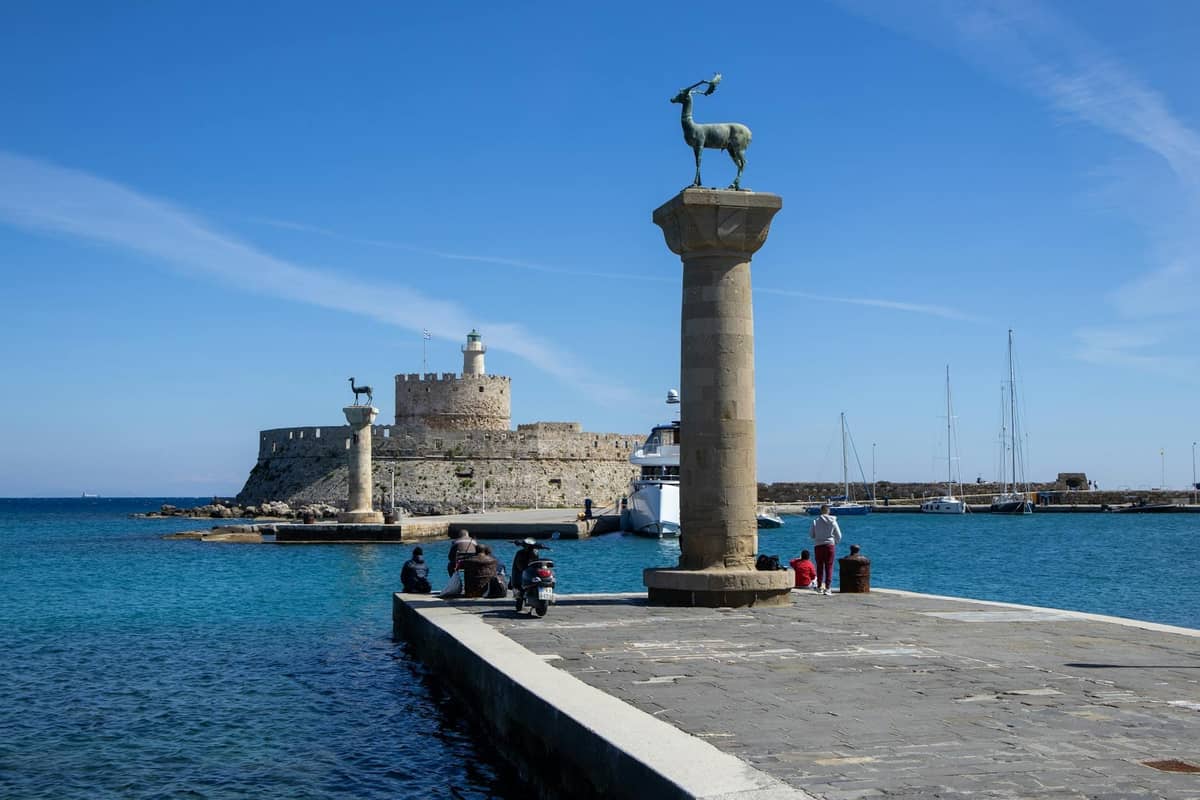
Mandraki Harbour is free to visit at any hour, 365 days a year. There is no ticket, no gate, and no organised tour required specifically for the Colossus site. What you are visiting is, in practical terms, a working harbour with a historical marker, not a managed archaeological site. That distinction matters: manage your expectations accordingly. The payoff is the historical weight of the place and its genuine beauty as a harbour, not any physical monument to inspect.
- Getting there: Mandraki Harbour is at the northern tip of Rhodes city, a 5-10 minute walk from the Old Town's northern gates. Taxis from the airport cost around €25-30 (20 minutes). City buses stop nearby.
- Cost: Free. No admission charge for the harbour or the mole walkway.
- Time needed: 20-30 minutes for the harbour itself. Allow 2-3 hours if combining with the nearby Old Town and fort.
- Best season: April to June and September to October offer comfortable temperatures (18-26°C) and manageable crowds.
- Peak season warning: July and August bring cruise ship arrivals that can make the harbour area uncomfortably crowded between 10am and 5pm.
- Photography: The deer columns at the harbour mouth are the standard shot. A telephoto lens helps isolate the statues against the water.
The Broader Historical Context: Rhodes in the Ancient World
Understanding why the Rhodians built a 33-metre statue requires knowing how important Rhodes was in the ancient Mediterranean. By the late 4th century BCE, the island had developed into one of the most prosperous trading cities in the eastern Mediterranean, with a powerful navy and a sophisticated legal code that later influenced Roman maritime law. The city of Rhodes itself was founded in 408 BCE through the synoikism (merger) of three older cities: Lindos, Ialyssos, and Kameiros.
The siege by Demetrius was not just a military event; it was an attempt by one of Alexander the Great's successors to pull Rhodes into his sphere of influence. The Rhodians' refusal to abandon their neutrality and their successful resistance made them famous across the Greek world. The Colossus was built as much for geopolitical prestige as for religious devotion. Helios was the island's patron deity, and a colossal image of him at the harbour entrance sent a clear message to every ship arriving in port. For more on the forces that shaped the island, the Knights of Rhodes history guide covers the medieval layer that followed.
✨ Pro tip
If you want to see ancient Rhodian sculpture up close, the Archaeological Museum of Rhodes in the Old Town has a strong collection including the Aphrodite of Rhodes, a 1st-century BCE marble figure. It gives you a concrete sense of the artistic tradition from which the Colossus emerged, even if no fragments of the statue itself survive.
What Else to See Near Mandraki Harbour
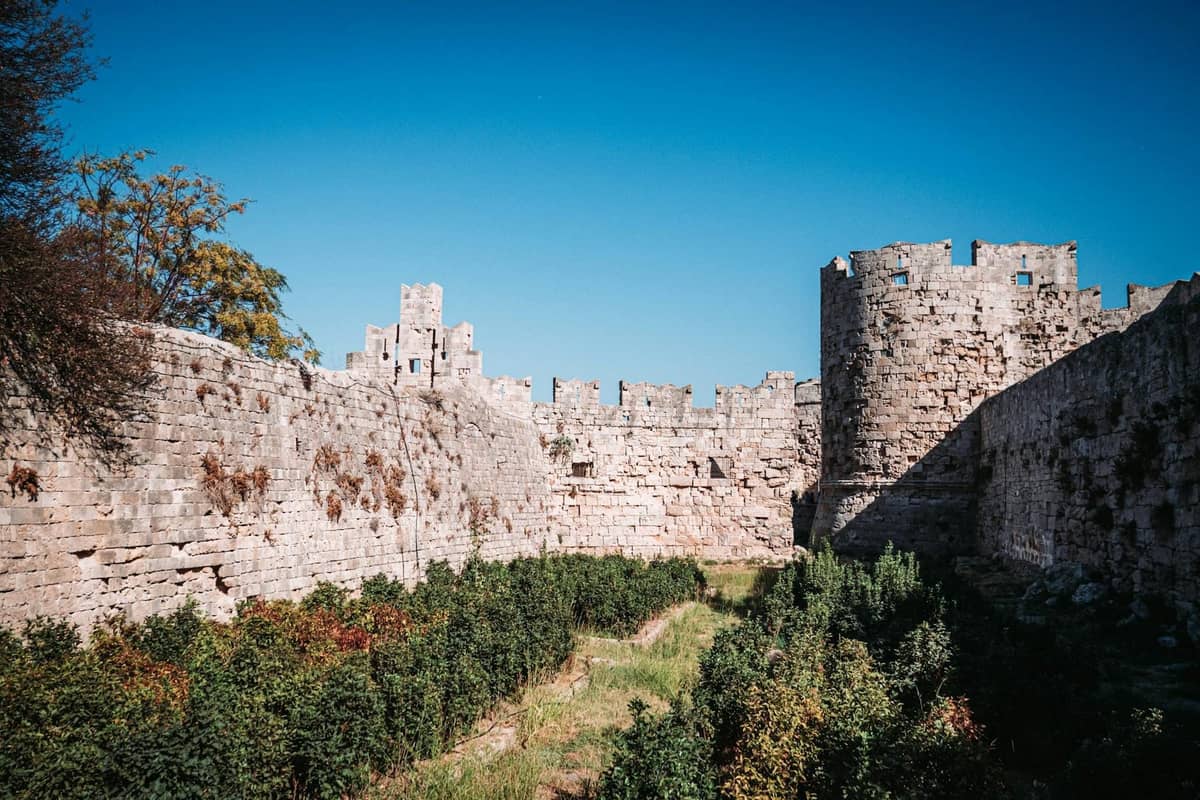
The area around Mandraki is one of the most historically layered parts of Rhodes. The Mosque of Murad Reis and its atmospheric cemetery sit just north of the harbour, a reminder of the Ottoman centuries that followed the Knights. The Colossus of Rhodes site at the harbour mouth connects naturally to a walk along the northern seafront past the Elli Beach into the New Town, where the Italian-era architecture from the early 20th century gives the streets an unexpectedly grand, slightly faded elegance.
For those spending more than a day in Rhodes city, the Rhodes Old Town walking tour covers the medieval circuit comprehensively, while the 3-day Rhodes itinerary helps structure a visit that includes both the city and the wider island.
FAQ
Can you actually see the Colossus of Rhodes?
No physical remains of the Colossus exist. The original statue was destroyed by an earthquake around 226 BCE, and the fallen bronze was sold as scrap in the 7th century CE. What you can visit is Mandraki Harbour, where two modern bronze deer statues on stone columns mark the approximate historical location.
Where exactly did the Colossus of Rhodes stand?
The most widely accepted theory places it at or near the entrance to Mandraki Harbour in Rhodes city. Some scholars have proposed the Acropolis of Rhodes as an alternative site. The exact location cannot be confirmed archaeologically because no remains survived the statue's destruction and subsequent removal.
Did the Colossus of Rhodes really straddle the harbour?
No. This is a medieval myth with no basis in ancient sources. Structural analysis also makes it implausible: the harbour entrance is far too wide, and the casting and support technology of the 3rd century BCE could not have achieved a straddling position at that scale.
How tall was the Colossus of Rhodes?
Ancient sources describe it as approximately 70 cubits tall, which translates to roughly 32 metres (105 feet). It stood on a marble pedestal estimated at around 15 metres, making the total structure roughly 48 metres from ground to crown.
Is there an entrance fee to visit the Colossus site?
No. Mandraki Harbour and the mole where the deer statues stand are freely accessible at all hours, year-round. If you plan to visit nearby paid attractions such as the Palace of the Grand Master or the Old Town walls, budget around €10-15 per person for those separately.