Mosque of Murad Reis: Rhodes' Forgotten Ottoman Cemetery
The Mosque of Murad Reis is one of the most atmospheric and historically layered sites in Rhodes New Town. Free to visit, largely overlooked by tour groups, and home to over 200 graves spread beneath mature trees, it rewards travelers who slow down long enough to actually look.
Quick Facts
- Location
- Near Mandraki Harbour, Medieval Old Town
- Getting There
- 10-minute walk from Mandraki Harbour; 15 minutes on foot from the Medieval Old Town gates
- Time Needed
- 30–45 minutes
- Cost
- Free (mausoleum and cemetery); mosque interior closed for restoration
- Best for
- History lovers, architecture enthusiasts, quiet reflection away from crowds
What Is the Mosque of Murad Reis?
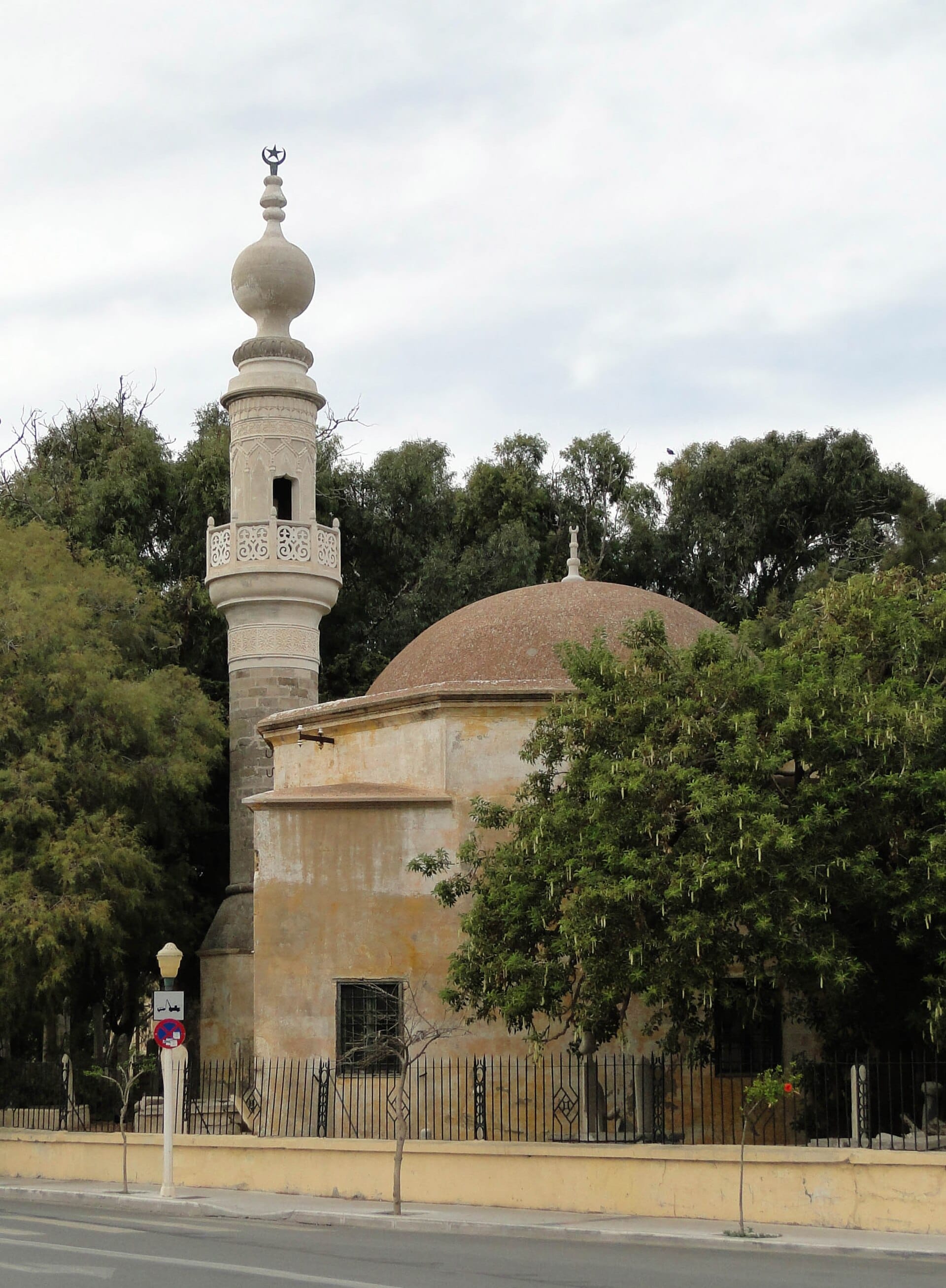
The Mosque of Murad Reis is an Ottoman-era religious and funerary complex located within Rhodes' Medieval Old Town, within easy walking distance of Mandraki Harbour. It consists of the mosque building itself (currently closed for restoration), a circular domed mausoleum known as a türbe, and one of the most significant Ottoman cemeteries on Greek soil, containing over 200 graves spread across a shaded courtyard garden.
The complex takes its name from Murat Reis the Elder, an important admiral of the Ottoman Navy who died around the time of the 1522 siege of Rhodes. His türbe, a round mausoleum with a conical roof, stands at the heart of the complex and remains accessible to visitors. The site also contains eight separate mausoleums, a stone fountain, and the remnants of lodgings that once served pilgrims and travelers between roughly 1700 and 1925.
ℹ️ Good to know
The mosque building has been closed to the public since 2000 and is undergoing a long-term restoration process. The cemetery grounds and türbe remain open and free to visit. Check locally for any updates on reopening.
History: From Byzantine Ground to Ottoman Legacy
The site has religious significance that predates the Ottoman conquest of Rhodes in 1522. The ground on which the complex now stands was originally associated with a Byzantine church dedicated to St. Anthony. After the Knights of St. John surrendered Rhodes to Suleiman the Magnificent, the Ottomans transformed much of the island's religious landscape, and this site became a mosque and burial ground serving the new ruling class.
The complex grew substantially over the following centuries, accumulating graves of Ottoman administrators, merchants, and religious figures. The variety of tombstone styles across the cemetery reflects shifts in Ottoman funerary art across several hundred years: tall, slender turbaned stelae from earlier periods sit alongside later, more rounded forms. Eight individual mausoleums punctuate the grounds, each marking a figure of particular importance.
The Italians added a facade featuring a bulbous-topped minaret replacing the original. This architectural layer is characteristic of Italian interventions across Rhodes during the interwar period, visible also at sites like the Governor's Palace nearby. The resulting building blends Ottoman Baroque elements with Egyptian Revival and Italian neoclassical details, making it a genuinely unusual structure by any standard.
Tickets & tours
Hand-picked options from our booking partner. Prices are indicative; availability and final rates are confirmed when you complete your booking.
Sunset catamaran cruise with dinner in Rhodes
From 70 €Instant confirmationFree cancellation3-Hour All Inclusive Sun and Sea Swimming Cruise in Rhodes
From 55 €Instant confirmationFree cancellationRhodes Sunset Cruise with Greek BBQ and Unlimited Drinks
From 65 €Instant confirmationFree cancellationPalace of the Grand Master Ticket and Audio Tour by App
From 30 €Instant confirmation
What You See When You Visit
You enter the complex through a gate off the main road near Kountourioti Square. The transition is immediate: the traffic noise drops behind you and you step into a quiet, tree-shaded enclosure where the ground is uneven underfoot from the accumulated gravestones and raised tomb platforms. In summer, the shade from the mature trees makes this one of the more comfortable spots in the area during midday heat.
The türbe of Murat Reis occupies a central position in the complex. It is a small, round structure topped with a low dome, built in stone with carved decorative details. The proportions are modest by the standards of imperial Ottoman architecture, but the craftsmanship is precise and the setting, surrounded by graves and greenery, gives it genuine gravity. Visitors can look through the entrance, though the interior is not fully open.
The tombstones themselves are the main visual draw for anyone interested in Islamic funerary art. The carved inscriptions are in Ottoman Turkish using Arabic script. The shapes and proportions of the turbaned headstones vary noticeably across different sections of the cemetery, a reliable signal of how much time has passed between burials. Some stones lean at angles from centuries of ground movement; others have been reset upright. The overall effect is melancholy in the best sense: a place that has been allowed to age with dignity.
💡 Local tip
Visit in the morning, ideally before 10am. The cemetery is generally quiet at that hour, the light filters through the trees at a low angle, and the carved stonework photographs far better than in the flat midday glare.
The Complex in Context: Rhodes New Town
The Mosque of Murad Reis is within the Medieval City of Rhodes that was developed primarily during Italian rule in the early twentieth century. This neighborhood has a different architectural character from the cobblestone lanes of the UNESCO-listed Old Town, and its Ottoman monuments tend to get far less visitor attention as a result. If you approach from Mandraki Harbour, the mosque's white-and-ochre facade becomes visible through the trees at the edge of the square.
This part of town also brings you close to other understated sites. The Fort of St. Nicholas is a short walk along the harbour promenade, and the Rhodes Aquarium sits at the northern tip of the peninsula. For travelers who want to understand the full arc of Rhodes' history, spending a morning moving between the Medieval walls, the Mandraki waterfront, and this cemetery gives a more honest picture of the island's layered past than any single site alone.
Practical Notes for Your Visit
Entry to the cemetery and mausoleum is free. The mosque building itself is closed and has been for some years due to an active restoration project, so do not plan your visit around going inside the mosque. Signage on-site is limited, so a little background reading beforehand makes the visit considerably more rewarding.
The ground throughout the cemetery is uneven. Visitors with mobility limitations should be aware that navigating around the tombstones and raised platforms may be difficult, particularly toward the older sections where the ground is most irregular. There are no dedicated accessibility provisions that can be confirmed at present.
Dress modestly as a matter of respect: covered shoulders and avoiding shorts is appropriate at a functioning religious and funerary site. The complex is generally peaceful and respectful behavior is expected. Photography of the tombstones and architecture is widely practiced and not restricted.
⚠️ What to skip
The site is not staffed or ticketed, so there is no formal opening and closing time visible. Visit during daylight hours. The restoration of the mosque is ongoing with no confirmed reopening date as of the most recent reports.
Is It Worth Your Time?
The Mosque of Murad Reis is not a spectacle. There are no audioguides, no gift shops, no queues. What it offers is a rare opportunity to stand in a space that most visitors to Rhodes walk past entirely: a 500-year-old burial ground in the middle of a modern town that has somehow retained its atmosphere. For travelers with a genuine interest in Ottoman history or Islamic architecture in the Aegean, this is one of the more compelling free stops in Rhodes. You can read more about the Ottoman and Crusader history that shaped this island in our Knights of Rhodes history guide.
If you are primarily here for beaches and pool bars, this one is easy to skip. The attraction requires patience and some historical curiosity to fully appreciate. Families with young children may find the cemetery setting less engaging unless the children have an interest in history or photography.
For those planning a broader exploration of Rhodes, the site fits naturally into a Rhodes Old Town walking tour extended into the New Town area. Allow roughly 30 to 45 minutes to walk the grounds, examine the türbe, and photograph the stonework without rushing.
Insider Tips
- The carved headstones vary significantly across the cemetery: look for the tall, turbaned Ottoman stelae in the older sections near the mausoleum, which are more ornate than the plainer stones added in the eighteenth and nineteenth centuries.
- The mosque building's minaret, is easiest to appreciate from the far edge of Kountourioti Square across the road. From up close, the proportions are harder to read.
- If you visit in late afternoon rather than midday, the light through the trees is considerably warmer and the temperature drops enough to make lingering comfortable even in July and August.
- There is no formal guide service on-site. If you want context, spend 15 minutes reading about Ottoman Rhodes before you arrive. The difference in what you notice is substantial.
- The complex is one of the quietest spots in this part of Rhodes New Town. If you are traveling between sites and need a few minutes of genuine quiet, this courtyard delivers it reliably.
Who Is Mosque of Murad Reis For?
- Travelers with an interest in Ottoman history and Islamic funerary architecture
- Photographers looking for textured stonework, dappled light, and atmospheric scenes outside the main tourist circuits
- History-focused visitors who want to understand Rhodes beyond the Crusader narrative
- Solo travelers or couples who appreciate unhurried, contemplative stops
- Anyone combining a morning walk along Mandraki Harbour with a cultural detour
Nearby Attractions
Other things to see while in Rhodes New Town:
- Acropolis of Rhodes
Perched on Monte Smith hill 3 km southwest of the city center, the Acropolis of Rhodes is an open-air archaeological site dating to the 5th century BC. It holds the partially reconstructed Temple of Apollo, a 210-meter Hellenistic stadium, an odeon, and broad views over the Aegean. Entry is free, crowds are light, and the site rewards visitors with a genuinely atmospheric sense of ancient Rhodes that the medieval Old Town cannot offer.
- Ancient Stadium of Rhodes
The Ancient Stadium of Rhodes sits on Monte Smith Hill, part of the larger Acropolis of Rhodes complex. Dating to the 3rd century BC, this restored Hellenistic track once hosted the Haleion Games in honor of Helios. Entry is free, the views are exceptional, and the site is far less crowded than the medieval attractions in the city below.
- Colossus of Rhodes (Historical Site)
One of the Seven Wonders of the Ancient World, the Colossus of Rhodes was a 33-metre bronze statue of the sun god Helios, built to celebrate a famous military victory. No physical trace survives today, but understanding its story transforms how you see the harbour, the city, and Rhodes itself.
- Elli Beach
Elli Beach stretches 400 metres along the northern tip of Rhodes Town, sitting between Mandraki Harbour and the Rhodes Aquarium. With free entry, water sports, beach bars, and clear Aegean water, it serves as the island's urban beach hub. It is not a desert island escape, but for convenience and character, few beaches in the city come close.