Symi Island: The Day Trip from Rhodes That Earns Its Reputation
Symi is a small, mountainous Dodecanese island 41 km north of Rhodes, famous for its stacked neoclassical mansions, crystalline coves reachable only by boat, and the grand Panormitis Monastery. Most visitors come on a day trip from Rhodes by high-speed ferry, though those who stay overnight find a completely different, quieter island once the day-trippers have gone.
Quick Facts
- Location
- Dodecanese, Greece — 41 km (25 miles) north-northwest of Rhodes, approx. 7 km from the Turkish coast
- Getting There
- Ferry from Rhodes port: approx. 1–1 hr 20 min, tickets roughly €10–20 one way. Day-trip excursion boats also depart from Mandraki Harbour.
- Time Needed
- 4–5 hours for a day trip; 2 days to explore the island properly
- Cost
- Ferry ticket (€10–20); entry to most sites free; Panormitis Monastery: free entry (donations welcome)
- Best for
- Architecture lovers, photographers, beach-hoppers, travellers who want a quieter side of the Dodecanese
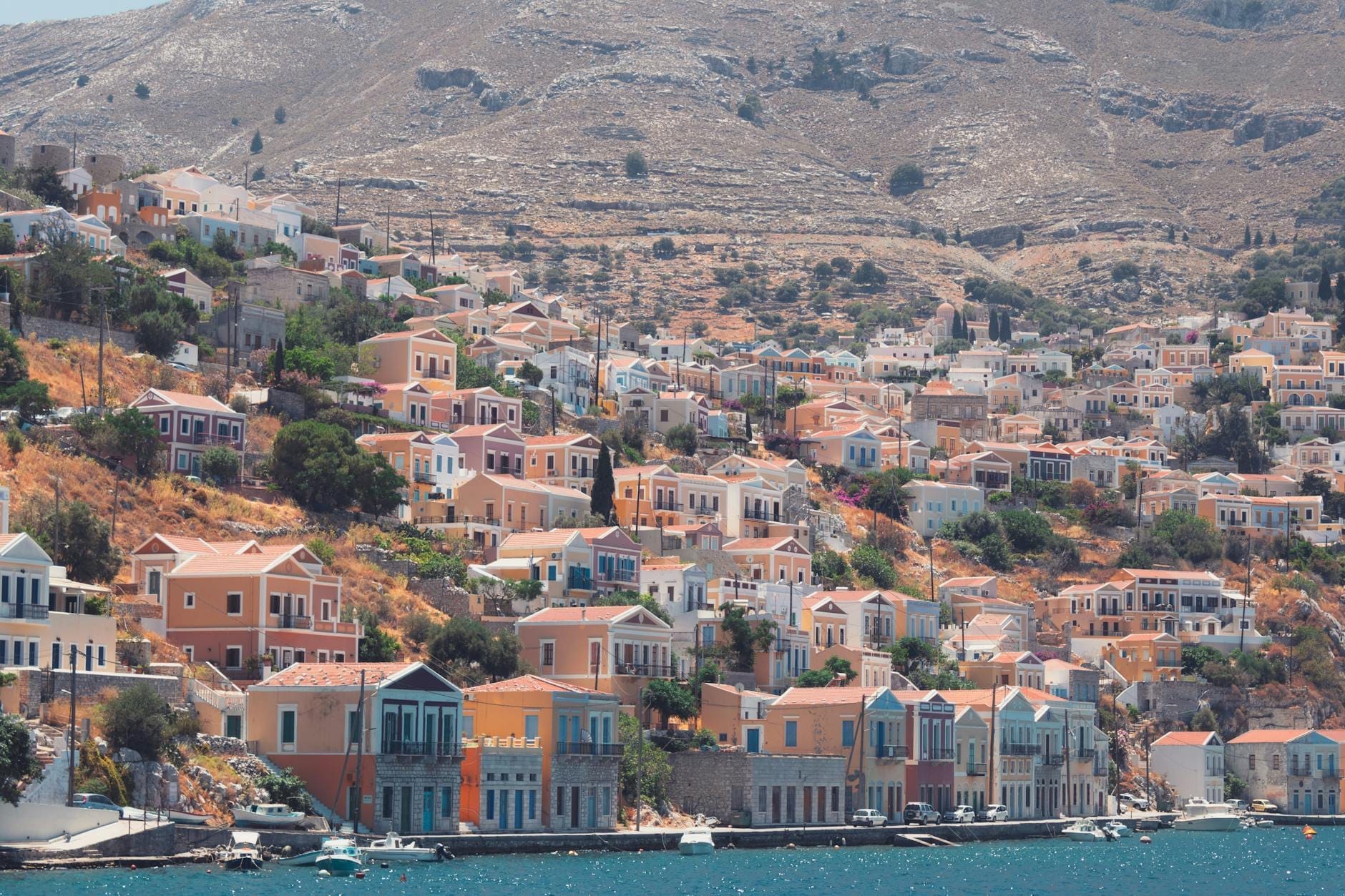
What Symi Island Actually Looks Like
The first sight of Symi harbour stops most first-time visitors mid-sentence. As the ferry rounds the headland and the town comes into view, you see hundreds of ochre, terracotta, and pale-yellow neoclassical mansions stacked in tight vertical rows up a hillside that turns almost cliff-like at the top. It looks painted on. Gialos, the lower harbour district, lines the waterfront with cafes, boat chandlers, and small shops. Above it, reached by the famous Kali Strata staircase of 375 stone steps, sits Horio, the old upper town where many mansions stand empty or half-restored, doors open to the breeze.
The architecture is not Greek island vernacular. Symi's neoclassical building stock dates from the 18th and 19th centuries, when the island prospered through sponge diving and shipbuilding. At its peak, Symi had a larger population than Rhodes and the money to build accordingly. Those mansions were financed by sea trade. When sponge diving collapsed in the early 20th century, the population emigrated and the buildings were simply left. That economic freeze is, paradoxically, why so much survives today.
💡 Local tip
The harbour looks best in morning light. The first excursion boats from Rhodes arrive mid-morning and the waterfront gets crowded quickly. If you take an early ferry, you will have the harbour almost to yourself for the first hour.
Getting to Symi from Rhodes
Regular ferry services connect Rhodes Port with Symi's Gialos harbour. Journey times run approximately 1 hour to 1 hour 20 minutes depending on the vessel, with tickets generally ranging from €10 to €20 one way. Day-trip excursion boats also depart from Mandraki Harbour in Rhodes New Town, often including a stop at Panormitis Monastery en route. These tend to cost more but include a guide.
Departures are seasonal, with the highest frequency running from Easter through to November. Outside that window, connections become sparse and some services stop entirely. If you are planning to visit in shoulder or off-season, confirm schedules directly with ferry operators before making plans around it.
For general transport planning around Rhodes and its day trips, the getting around Rhodes guide covers ferry routes, bus connections, and car hire options in detail.
Tickets & tours
Hand-picked options from our booking partner. Prices are indicative; availability and final rates are confirmed when you complete your booking.
Guided e-bike tour of Symi Island highlights
From 100 €Instant confirmationFree cancellationHigh-speed boat cruise to Symi Island and St George's Bay
From 49 €Instant confirmationFree cancellationSunset catamaran cruise with dinner in Rhodes
From 70 €Instant confirmationFree cancellation3-Hour All Inclusive Sun and Sea Swimming Cruise in Rhodes
From 55 €Instant confirmationFree cancellation
The Harbour, the Stairs, and the Upper Town
Gialos waterfront is compact and walkable in under ten minutes end to end. The quayside has the expected row of tavernas, a small clock tower, and boat captains advertising trips to nearby beaches. In the morning it smells of fresh coffee and diesel from the fishing boats. By noon in July or August, with multiple excursion boats docked, it smells like sunscreen and sounds like six different languages at once.
The Kali Strata staircase begins at the edge of Gialos and rises steeply through a neighbourhood that shifts noticeably once you get above the tourist line. Halfway up, the cafes thin out and the streets go quiet. Up here you pass walled gardens, cats on window sills, and mansions in various states of restoration. Some have been beautifully renovated. Others have trees growing through their roofs. The contrast between the two is itself worth the climb.
Wear proper shoes on the Kali Strata. The steps are uneven stone, many of them worn smooth, and they are genuinely steep in the upper section. In summer heat, climbing them at midday is uncomfortable. Early morning or late afternoon is far more manageable, and the light on the mansions from the west in the late afternoon is the best you will get for photography.
⚠️ What to skip
The Kali Strata is not suitable for those with limited mobility or knee problems. There are 500 steps with no lift alternative between the lower and upper town.
Panormitis Monastery and the South of the Island
Most excursion boats from Rhodes make a stop at the Monastery of Archangel Michael Panormitis before or after the town, depending on the route. The monastery sits at the southern end of Symi in a wide, sheltered bay called Panormitis, and the scale of it is surprising given how remote the location feels. The complex includes a church with an ornate interior, a small museum, and accommodation for pilgrims. Entry is free, though a donation is customary.
St. Michael Panormitis is one of the most venerated saints in the Dodecanese, and the monastery draws Orthodox pilgrims from across Greece and beyond, particularly around the feast of the Archangel in November. If you visit during a religious festival, the atmosphere is completely different from the standard tourist visit, and worth knowing about if you are timing a trip deliberately. Dress modestly: covered shoulders and knees are required, and sarongs or cover-ups are sometimes available at the entrance.
Beaches and Coves: What to Expect
Symi does not have the long sandy beaches that Rhodes or Kos offer. The island is mostly limestone rock dropping sharply into the sea, and most of the swimmable coves are either pebbly or rocky underfoot. What they have instead is water clarity that genuinely deserves the overused word 'turquoise'. In Saint George Bay, reachable only by boat, the water is shallow over white rock and the colour shifts from pale blue at the edges to deep green further out.
Nanou Beach on the west coast is one of the larger beaches, accessible by boat or by a hike of roughly two hours from Horio. It sits at the mouth of a green valley and has a small taverna operating in season. The hike is rewarding but demanding in summer heat. Bring more water than you think you need. Taxi boats from Gialos run to most beaches in season, and this is the practical choice for most day-trippers.
ℹ️ Good to know
Water shoes or sandals with grip are strongly recommended for most of Symi's beaches. The rock entry points can be slippery and sharp.
Symi in Context: History in Brief
Symi has been inhabited since antiquity. Homer's Iliad names it as the domain of King Nireus, who sent ships to the Trojan War. The island was part of the Dorian Hexapolis, a political grouping of six Aegean cities around 480 BC. It passed through the same sequence of rulers as Rhodes: Knights Hospitaller from 1309, Ottoman from 1522, Italian occupation from around World War One, and finally incorporation into Greece in 1947.
That 1947 date is significant for a specific reason. The Symi Agreement (also called the Dodecanese Accord) was signed on the island in 1944, establishing the terms of German surrender in the Dodecanese to Allied forces. A small monument in Gialos marks the location. The broader history of the Knights in the region is covered in the Knights of Rhodes history guide.
The sponge-diving industry that built the town's mansions is less visible today but still referenced in local identity. Symi sponges are sold throughout the waterfront shops, and while most are now imported, a few local divers still work the traditional trade. It is a detail that connects the ornate facades above to the sea below in a way that makes the architecture feel less decorative and more earned.
Practical Walkthrough for a Day Trip
A standard day trip from Rhodes gives you roughly 4 to 5 hours on the island, depending on the operator. That is enough time to walk the harbour, climb the Kali Strata to Horio, have lunch at a waterfront taverna, and take a taxi boat to one nearby cove if you time it well. It is not enough to do all of that at a relaxed pace. Decide before you arrive whether you want to prioritise the town and architecture or the water, and plan accordingly.
Those who stay overnight find a genuinely different island. Once the day-trip boats leave in the afternoon, Gialos returns to something closer to a working harbour town. Restaurants become less hectic, locals reappear on the waterfront, and the mansions of Horio glow in the evening light without crowds. If your itinerary has room, Symi makes a strong candidate for an overnight stop within a broader 7-day Rhodes itinerary.
There are no ATMs reliably available throughout the island. Bring cash for beaches, taxi boats, and smaller tavernas. Card payment is accepted in the larger waterfront restaurants and some shops, but do not rely on it everywhere.
💡 Local tip
Lunch reservations are not usually necessary, but if you are visiting in July or August and want to eat at one of the better-regarded harbour tavernas, arriving before 12:30 or after 14:30 will avoid the main lunchtime rush from excursion boats.
Insider Tips
- The ferry timetable and day-trip boat schedules do not always align. If you want flexibility to stay longer or catch an earlier return, book a scheduled ferry ticket rather than a packaged excursion, which ties you to fixed departure times.
- The side streets behind the main waterfront in Gialos have several small shops selling locally-produced goods, including genuine Symi sponges, honey, and herb liqueurs. The waterfront-facing shops tend to charge more for the same items.
- The cemetery at the top of Horio is rarely visited by tourists and offers one of the best panoramic views of the harbour and surrounding sea. It is a short walk from the main path through the upper town.
- In August, the excursion boats from Rhodes and from cruise ships can bring over a thousand visitors to the island in a single morning. If you are visiting in peak season, an early first ferry gives you the harbour in its calmest state before 10:00.
- The Kali Strata has a parallel road route for vehicles that also connects Gialos to Horio. It is longer but fully paved and manageable for those who cannot handle the stairs.
Who Is Symi Island For?
- Architecture and history enthusiasts who want more than beach time
- Photographers looking for dramatic townscape compositions, particularly in early morning or late afternoon light
- Travellers already on Rhodes who want a genuine change of scene on a single free day
- Those interested in Dodecanese history, including the Knights Hospitaller period and the WWII Dodecanese campaign
- Anyone willing to stay overnight and experience a Greek island town after the day crowds leave
Nearby Attractions
Combine your visit with:
- Asklipio Castle
Built in 1479 by the Knights Hospitaller on the edge of a limestone ridge above a quiet village, the Castle of Asklipio is one of Rhodes's least-visited medieval fortresses. Free to enter, open at all hours, and commanding views across the southern coastline, it rewards travellers willing to venture beyond Lindos.
- Kritinia Castle
Perched on a rocky hilltop 131 metres above the western coastline of Rhodes, Kritinia Castle is a medieval fortress built by the Knights of Saint John in 1472. The ruins are freely accessible, the views stretch across the Aegean toward Turkey, and the surrounding silence makes it one of the island's more atmospheric stops for history-minded travellers.
- Monastery of Fountoukli
The Monastery of Fountoukli, officially known as Agios Nikolaos Fountoukli, is a 14th-century Byzantine church tucked into the forested hills of the island's interior. With original frescoes, a distinctive four-conch architectural plan, and almost no crowds, it rewards travelers willing to venture beyond the coastline.
- Profitis Ilias
At 798 metres, Profitis Ilias is the third-highest peak on Rhodes, draped in dense pine and cypress forest. It offers a striking contrast to the island's coastal attractions: cool shade, Italian-era architecture, quiet hiking trails, and a hilltop chapel with wide views across the Aegean.