Profitis Ilias: Rhodes' Forested Mountain Escape
At 798 metres, Profitis Ilias is the third-highest peak on Rhodes, draped in dense pine and cypress forest. It offers a striking contrast to the island's coastal attractions: cool shade, Italian-era architecture, quiet hiking trails, and a hilltop chapel with wide views across the Aegean.
Quick Facts
- Location
- Central-western Rhodes, near Eleousa and Salakos villages
- Getting There
- Car or taxi recommended; KTEL buses serve Salakos (confirm schedule locally); winding mountain roads require care
- Time Needed
- 2–5 hours depending on hiking vs. driving to summit
- Cost
- Free public access; no admission charge
- Best for
- Hikers, nature lovers, history seekers, those escaping summer heat
What Profitis Ilias Actually Is
Profitis Ilias (Προφήτης Ηλίας, meaning Prophet Elijah) is a 798-metre mountain in the central-western part of Rhodes, roughly southwest of Rhodes Town and inland from the ancient site of Kamiros. It is the third-highest peak on the island, after Attavyros at 1,210 metres. Unlike most of Rhodes, which bakes under a Mediterranean sun from May through September, Profitis Ilias stays noticeably cooler thanks to a thick canopy of Calabrian pine and cypress that covers the upper slopes. On a hot July afternoon in the coastal resorts, the temperature up here can feel 5 to 8 degrees lower.
The mountain is a natural site with free public access, no turnstiles, and no ticket booths. What draws visitors is a combination of things: the landscape itself, a cluster of Italian-period buildings that feel transplanted from the Alps, a small chapel dedicated to the Prophet Elijah, and trails that can be walked without specialised gear. It is not a dramatic alpine summit in the Swiss sense, but it is unlike anything else on Rhodes.
💡 Local tip
The access road from Eleousa village to the summit area is narrow and winding. Drive slowly, watch for walkers on the road, and check your fuel before heading up. There are no petrol stations on the mountain.
The Italian Legacy: Hotels, Villages, and a Rumoured Villa
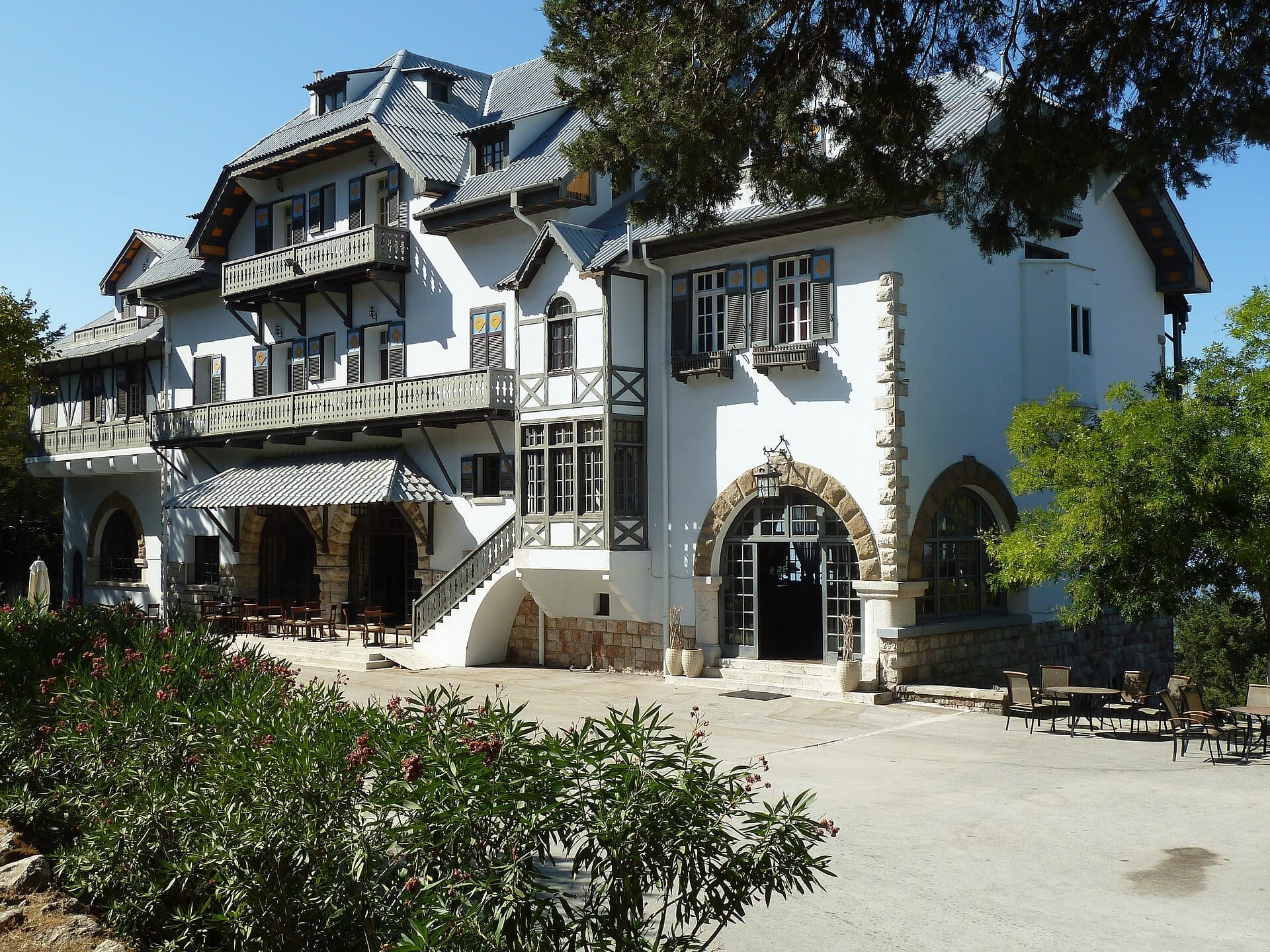
The most visually arresting features of Profitis Ilias are not natural. During the Italian occupation of the Dodecanese (1912 to 1943), the colonial administration developed the island with an ambition that was partly practical and partly theatrical. On the slopes of Profitis Ilias, they constructed two alpine-style hotels: Hotel Elafos (meaning Stag, completed 1929) and Hotel Elaina (Doe, completed 1932). Both buildings are built in a Tyrolean chalet style that sits surreally among Greek pines, with steep rooflines, timber detailing, and stone facades. Elafos, the larger of the two, is the one most visitors see first.
Whether either hotel is open or functional at any given time is not guaranteed. Their status has fluctuated over the decades. Do not arrive expecting a working restaurant or café without verifying locally first. What you will find regardless is the architecture itself, which is worth seeing even from the outside: a quiet reminder that Rhodes spent 30 years under Italian rule before joining Greece in 1947.
The nearby village of Eleousa, at the foot of the mountain, was itself an Italian agricultural settlement. Originally named Campochiaro by the Italians, it was developed as a model farming community and retains a distinctly un-Greek plan, with a central piazza, an arched arcade, and Italian Rationalist civic buildings. It is worth a slow walk through. On the slopes between Eleousa and the summit, local tradition places the ruins of a villa associated with Mussolini, though this cannot be verified with certainty. The ruin, if you find it, is overgrown and unmarked.
Tickets & tours
Hand-picked options from our booking partner. Prices are indicative; availability and final rates are confirmed when you complete your booking.
Sunset catamaran cruise with dinner in Rhodes
From 70 €Instant confirmationFree cancellation3-Hour All Inclusive Sun and Sea Swimming Cruise in Rhodes
From 55 €Instant confirmationFree cancellationRhodes Sunset Cruise with Greek BBQ and Unlimited Drinks
From 65 €Instant confirmationFree cancellationPalace of the Grand Master Ticket and Audio Tour by App
From 30 €Instant confirmation
The Chapel and the Summit Area
At or near the summit stands a small whitewashed chapel dedicated to Profitis Ilias, the Prophet Elijah, after whom the mountain is named. Elijah is associated with high places throughout the Greek Orthodox tradition, and chapels bearing his name sit on peaks across Greece. This one is modest and typically locked except during the feast of the Prophet Elijah in late July, when a small panegyri (local festival) may be held here. The date falls around 20 July, and if you happen to be on Rhodes then, it is worth checking locally whether the celebration is taking place.
The views from the summit area extend west toward the Turkish coast on clear days and south along Rhodes' spine toward Attavyros. The landscape is not an open panoramic platform like the Acropolis of Lindos. Trees partially block sightlines, and the best views come from specific clearings. Early morning, before haze builds, offers the sharpest visibility.
Hiking to the Summit: What the Trail is Actually Like
The most commonly used hiking approach begins from Salakos, a small village on the western slopes. The trail covers roughly 7 kilometres round trip and climbs steadily through pine forest. The path is moderate in difficulty: there are no technical sections, but the gradient is consistent enough to make it a genuine workout in summer heat. Sturdy footwear is sensible. Carry at least 1.5 litres of water per person.
Early morning starts, before 8am, have two advantages: the light is soft and photogenic filtering through the pines, and you will almost certainly have the trail to yourself. By midday in summer, the forest holds warmth and the path becomes less pleasant. October and May are arguably the best months: the air is clear, the forest is quiet, and the trail is dry. In winter, the upper slopes can be cold and occasionally misty.
Profitis Ilias works well as part of a broader inland itinerary. The Valley of the Butterflies is accessible in the same general region, and the ancient site of Kallithea Springs makes for a contrasting coastal stop on the return.
⚠️ What to skip
There is no reliable water source on the mountain. The Elafaki taverna near the lower parking area sometimes operates in summer, but do not count on it being open. Bring everything you need from Salakos or Eleousa.
How the Mountain Changes Through the Day
In the morning, the forest smells strongly of pine resin, which becomes more noticeable in the heat of the day. Birdsong is most active in the first two hours after sunrise. The light at this hour cuts through the trees at low angles, creating long shadows across the path and illuminating the forest floor in a way that rewards photographers. If you are driving up, the road out of Eleousa climbs quickly, and you notice the temperature drop within a few minutes of leaving the village.
By midday the forest is warm and quiet. Most casual visitors have arrived, parked near the hotels, walked a short circuit, and moved on. The summit area is genuinely peaceful from about 2pm to 4pm, when tour groups are typically elsewhere. Late afternoon brings a golden light that works well for photographing the Italian hotels. Sunset from the summit clearings can be striking, but the road back down in the dark requires careful driving.
If you are building a full-day itinerary around the interior of Rhodes, the Seven Springs (Epta Piges) to the northeast is another forested site worth combining with Profitis Ilias. For broader context on planning your time on the island, the 3-day Rhodes itinerary covers how to balance coastal and inland attractions.
Practical Information for Visitors
Profitis Ilias has free public access with no admission charge. There are no official opening hours because it is an open natural site. The access road is paved but narrow; a standard car handles it without difficulty, but larger vehicles should take care on bends. Parking is available near the Elafaki taverna area and near the hotels.
Public transport to the mountain itself is limited. KTEL buses serve Salakos from Rhodes Town, and from Salakos you can walk or arrange a taxi for the final climb. Renting a car gives you the most flexibility and is the practical choice for most visitors. The drive from Rhodes Town takes around 45 minutes under normal conditions.
For those planning a self-drive day around western and central Rhodes, the Rhodes car hire guide covers what to expect from rental costs, road conditions, and local driving norms.
Accessibility for visitors with mobility limitations is restricted. The summit area is reachable by car, but the terrain around the hotels and chapel is uneven, with gravel paths, tree roots, and no formal paving. The hiking trail from Salakos is not suitable for wheelchairs or strollers. Visitors who cannot manage uneven terrain can still drive to the hotel area and appreciate the architecture and forest from the immediate vicinity.
ℹ️ Good to know
Dress in layers if you visit in spring or autumn. The summit area is consistently cooler than the coast, and a light jacket is useful even in June. In winter, temperatures can approach zero at night.
Honest Assessment: Is It Worth the Trip?
Profitis Ilias rewards visitors who approach it on its own terms. It is not a dramatic spectacle. There is no panoramic terrace with a café and a gift shop. The Elafos hotel may or may not be open. The chapel is small. What the mountain offers is texture: a landscape that feels entirely different from the beach resorts, architecture that tells a chapter of Rhodes' history that most tourists overlook, and genuine quiet.
Visitors who come primarily for beaches, nightlife, or ancient history may find it a detour that does not pay off. Those who are curious about the island's Italian period, enjoy forested walks, or simply want an afternoon away from the crowds at Lindos or Faliraki are likely to find it satisfying. It pairs particularly well with the nearby Eleousa village and a swing past the Kamiros archaeological site on the coast below.
For a fuller picture of what Rhodes offers beyond its famous sites, the Rhodes hidden gems guide covers several interior and lesser-visited spots that match the tone of a Profitis Ilias visit.
Insider Tips
- The feast of the Prophet Elijah falls around 20 July. If you are on Rhodes at that time, ask locally whether a panegyri is being held at the summit chapel. These small festivals, with music, food, and candles, are among the most authentic experiences on the island.
- The road from Eleousa to the summit passes through some of the most atmospheric pine forest on Rhodes. Drive slowly and stop at any of the natural pull-offs. The forest floor and filtered light are worth photographing even before you reach the top.
- Eleousa village below the mountain retains its Italian Rationalist architecture almost completely. The central arcade and piazza are rarely visited by tourists and deserve 20 to 30 minutes of exploration before or after the mountain.
- The Elafaki taverna near the lower parking area occasionally operates in summer and is a good spot for a cold drink after a hike, but its hours are irregular. Do not plan your schedule around it.
- For the clearest coastal views, aim for early morning in October or May. Summer heat haze typically reduces long-distance visibility by mid-morning.
Who Is Profitis Ilias For?
- Hikers and walkers looking for a forest trail with cultural context
- History enthusiasts interested in Rhodes' Italian colonial period
- Photographers seeking forested landscapes and atmospheric architecture
- Travellers who want to escape summer coastal heat for a few hours
- Curious visitors who want to see a side of Rhodes most package tourists miss
Nearby Attractions
Combine your visit with:
- Asklipio Castle
Built in 1479 by the Knights Hospitaller on the edge of a limestone ridge above a quiet village, the Castle of Asklipio is one of Rhodes's least-visited medieval fortresses. Free to enter, open at all hours, and commanding views across the southern coastline, it rewards travellers willing to venture beyond Lindos.
- Kritinia Castle
Perched on a rocky hilltop 131 metres above the western coastline of Rhodes, Kritinia Castle is a medieval fortress built by the Knights of Saint John in 1472. The ruins are freely accessible, the views stretch across the Aegean toward Turkey, and the surrounding silence makes it one of the island's more atmospheric stops for history-minded travellers.
- Monastery of Fountoukli
The Monastery of Fountoukli, officially known as Agios Nikolaos Fountoukli, is a 14th-century Byzantine church tucked into the forested hills of the island's interior. With original frescoes, a distinctive four-conch architectural plan, and almost no crowds, it rewards travelers willing to venture beyond the coastline.
- Seven Springs (Epta Piges)
Seven Springs, known in Greek as Epta Piges, is a forested valley 27 km from Rhodes Town where seven natural springs feed a 1930s Italian-built tunnel and artificial lake. It is one of the few inland attractions on Rhodes that genuinely rewards the detour, offering cool shade, running water, and a narrow 186-metre underground passage that most visitors will never forget.