Monastery of Fountoukli: Rhodes' Forgotten Byzantine Treasure
The Monastery of Fountoukli, officially known as Agios Nikolaos Fountoukli, is a 14th-century Byzantine church tucked into the forested hills of the island's interior. With original frescoes, a distinctive four-conch architectural plan, and almost no crowds, it rewards travelers willing to venture beyond the coastline.
Quick Facts
- Location
- 2 km from Eleousa village toward Apollona, central-western interior of Rhodes
- Getting There
- Car only; approx. 25–30 min drive from Rhodes city via Psinthos and Archipoli
- Time Needed
- 30–60 minutes on site; allow extra for the scenic drive
- Cost
- Free entry
- Best for
- Byzantine history, photography, quiet contemplation, off-the-beaten-path travelers
What Is the Monastery of Fountoukli?
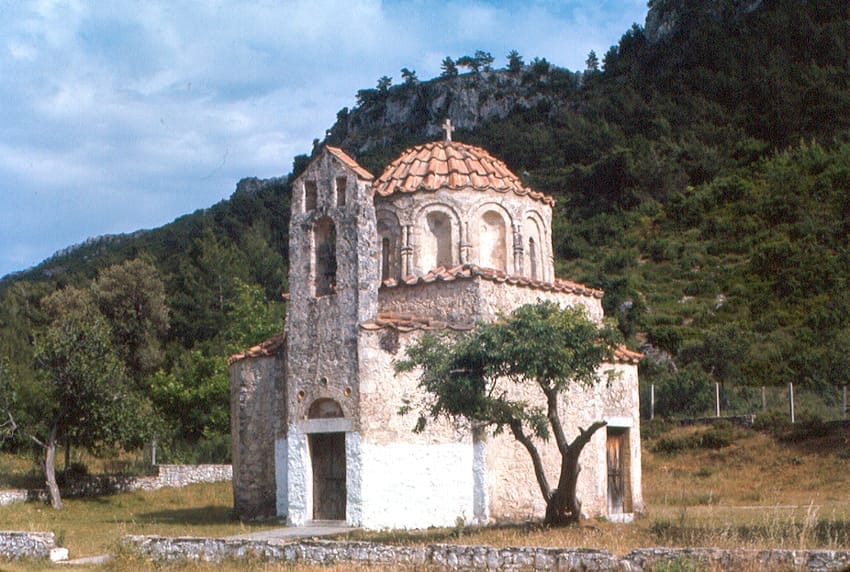
Agios Nikolaos Fountoukli sits in the pine-covered uplands of central Rhodes, about 2 kilometers from the village of Eleousa on the road to Apollona. The name 'Fountoukli' is thought to derive from the Greek word for hazelnut, a reference to the nut-bearing trees that once dominated the surrounding hillside. The church itself is small, almost modest from the outside, but its interior contains some of the most atmospheric Byzantine frescoes remaining on the island.
This is not a functioning monastery in the conventional sense. There are no resident monks, no gift shop, and no guided tours. What you find instead is a centuries-old place of worship that still receives local devotees, sits quietly in a pine-shaded clearing, and asks almost nothing of the visitor except respect and attention.
💡 Local tip
Dress modestly before arriving. Cover shoulders and knees, as this is an active Orthodox site. There are no changing areas or wraps provided on-site.
History and Architecture: A Rare Byzantine Survivor
The church dates to the 14th or 15th century, placing its construction in the late Byzantine period when Rhodes was transitioning toward Hospitaller rule under the Knights of Saint John. Its architectural form is a four-conch plan, meaning the interior is shaped by four semicircular apses radiating from a central core, topped by a dome. This layout, common in Byzantine ecclesiastical design but rare in surviving Aegean examples, gives the interior an unusual sense of spatial balance despite its compact size.
The dome visible today is largely a product of early 20th-century reconstruction carried out under Italian administration, which controlled the Dodecanese from 1912 until World War II. The rebuilt dome lacks the original fresco decoration, a noticeable absence once you understand the layered history of the site. However, the walls and arches of the main body retain significant portions of the original frescoes, which specialists have studied for their iconographic content.
The frescoes include depictions of the church's donors and, strikingly, their deceased children shown in Paradise. These donor portraits and memorial compositions are relatively rare in Byzantine provincial art and give Fountoukli a documentary quality beyond its spiritual function. Travelers interested in this broader period of Rhodes history will find useful context in the Knights of Rhodes history guide, which traces how Byzantine and Crusader influences overlapped on the island.
Tickets & tours
Hand-picked options from our booking partner. Prices are indicative; availability and final rates are confirmed when you complete your booking.
Sunset catamaran cruise with dinner in Rhodes
From 70 €Instant confirmationFree cancellation3-Hour All Inclusive Sun and Sea Swimming Cruise in Rhodes
From 55 €Instant confirmationFree cancellationRhodes Sunset Cruise with Greek BBQ and Unlimited Drinks
From 65 €Instant confirmationFree cancellationPalace of the Grand Master Ticket and Audio Tour by App
From 30 €Instant confirmation
What It Feels Like to Visit
Approach from the east along a narrow asphalt road through dense Rhodian pine forest, and the church appears almost without warning: a low stone structure with a small bell tower, surrounded by a few old cypress trees and a rough stone courtyard. There is often a single wooden bench or a low wall where visitors sit after entering. The air carries the smell of pine resin and, if a recent service has been held, the faint trace of incense.
Step through the low doorway and your eyes adjust slowly. The interior is dim and cool even on the hottest summer afternoons. Candle stands near the entrance hold spent wax. The frescoes cover the curved walls in muted ochres, deep reds, and faded blues, the colors weathered but still readable. Byzantine saints occupy the upper registers; the donor figures appear lower down, painted in a more human, almost vernacular style compared to the formal iconographic representations above them.
Midday visits in July and August are actually reasonable here, unlike the coast, because the elevation and tree cover keep temperatures noticeably lower than sea level. Early morning or late afternoon visits offer better natural light inside the church, as soft light enters through the small windows at a lower angle and illuminates the frescoes more evenly. Avoid visiting during or immediately after heavy rain in the shoulder seasons, when the unpaved parking area and approach paths can become muddy.
Crowds and Atmosphere Through the Day
Fountoukli sees a fraction of the foot traffic that major island attractions receive. On most weekdays, you may have the site entirely to yourself. Weekends bring occasional small groups of Greek visitors, particularly local families and elderly Orthodox devotees who come to light candles. Foreign tourists do visit, but rarely in large numbers; those who make the effort tend to be curious rather than casual.
The feast day of Saint Nicholas falls on December 6th, when the church holds a proper liturgy and attracts a larger local congregation. If you are on Rhodes in early December and interested in Orthodox tradition as it is actually practiced rather than performed for tourists, this is worth timing your visit around.
ℹ️ Good to know
The church is technically open 24 hours, but the interior may be locked outside of active worship periods. The exterior and courtyard are always accessible, and the setting alone justifies the drive.
Getting There and Practical Logistics
There is no public bus service to Fountoukli. A rental car is the only realistic option for most visitors. The drive from Rhodes city takes approximately 25 to 30 minutes via the inland route through Psinthos and Archipoli, passing through agricultural villages and increasingly forested terrain. The roads are narrow in places but generally paved and manageable for standard vehicles.
From the coast, Fountoukli pairs naturally with a visit to Profitis Ilias, the forested mountain summit a few kilometers further west. Combined, the two sites make a half-day inland excursion that contrasts well with the beach-and-history focus of most Rhodes itineraries. The nearby village of Eleousa, built by Italian authorities in the 1930s as an agricultural colony, also makes a brief stop for its distinctive rationalist architecture and central piazza.
Travelers building a wider itinerary can use this area as a midpoint on the way to other interior attractions. The Valley of the Butterflies lies further west and is accessible on the same loop drive, making it possible to visit three distinct inland sites in a single day without backtracking significantly.
💡 Local tip
GPS works reliably in this area, but carry a screenshot of the location in case signal drops on the forest roads. Search for 'Agios Nikolaos Fountoukli' or 'Fountoukli Church Eleousa' in Google Maps for accurate routing.
Photography and What to Bring
The exterior photographs well in the golden hour before sunset, when low light catches the stone facade and the surrounding pines soften in color. For interior photography, a wide-angle lens and patience with low light will serve you better than a flash, which flattens the texture of the frescoes and is inappropriate in an active place of worship. A small portable light source helps when examining fresco details, though ask locally or check notices at the entrance before using one.
If you are building a broader photography itinerary across Rhodes, the Rhodes photography guide covers locations and lighting conditions across the island in more detail.
Bring water. There are no facilities, no cafes, and no shops within easy walking distance. In summer, carry more than you think you need; the drive back to the nearest village takes fifteen minutes at minimum. Comfortable walking shoes are sufficient; the terrain around the church is flat and the surfaces are rough stone rather than uneven hiking trails.
Honest Assessment: Who Will Appreciate This Place
Fountoukli is genuinely rewarding for visitors with an interest in Byzantine art, medieval religious history, or simply quiet places that feel untouched by mass tourism. The frescoes require some prior context to fully appreciate. Without knowing what you are looking at, the interior may seem dark and the paintings faded rather than evocative. This is not an attraction that sells itself immediately or loudly.
Travelers primarily seeking beaches, nightlife, or the well-documented medieval streetscapes of Rhodes Old Town will likely find the detour unjustified unless they have already covered the main sites. For those with three days or fewer on the island, other priorities should probably come first. But for anyone spending a week or more, or for travelers who specifically want to see a different, quieter side of Rhodes, this church delivers something few sites on the island can match: genuine historical atmosphere without a single ticket booth in sight.
For context on how to structure a longer island visit that includes interior sites like this one, the 7-day Rhodes itinerary includes practical suggestions for balancing coast and interior.
Insider Tips
- The interior is sometimes locked outside of worship hours. If you find it closed, the exterior and courtyard are still worth exploring, and a local in Eleousa village may know when the next service is scheduled.
- Combine the visit with Profitis Ilias summit a few kilometers west. The total loop from Rhodes city covers forested highlands that feel completely different from the coastal resort strip.
- Morning light between 8am and 10am enters the small windows at an angle that illuminates the lower frescoes more clearly than midday, when the interior is at its darkest.
- The Italian-era village of Eleousa, just a few kilometers east, is worth a brief stop. Its 1930s rationalist architecture and quiet central square are architecturally distinctive and rarely mentioned in guidebooks.
- December 6th, the feast of Saint Nicholas, is when the church sees its most significant local activity of the year. If you are on Rhodes in early winter, this is a rare opportunity to witness a small Orthodox celebration in an authentic rural setting.
Who Is Monastery of Fountoukli For?
- History and art travelers with an interest in Byzantine frescoes and medieval ecclesiastical architecture
- Photographers seeking interior religious subjects and forested landscape settings
- Visitors on longer stays who have covered the main coastal and urban sites
- Travelers renting a car and exploring the island's interior independently
- Anyone wanting a quiet, crowd-free experience with genuine historical depth
Nearby Attractions
Combine your visit with:
- Asklipio Castle
Built in 1479 by the Knights Hospitaller on the edge of a limestone ridge above a quiet village, the Castle of Asklipio is one of Rhodes's least-visited medieval fortresses. Free to enter, open at all hours, and commanding views across the southern coastline, it rewards travellers willing to venture beyond Lindos.
- Kritinia Castle
Perched on a rocky hilltop 131 metres above the western coastline of Rhodes, Kritinia Castle is a medieval fortress built by the Knights of Saint John in 1472. The ruins are freely accessible, the views stretch across the Aegean toward Turkey, and the surrounding silence makes it one of the island's more atmospheric stops for history-minded travellers.
- Profitis Ilias
At 798 metres, Profitis Ilias is the third-highest peak on Rhodes, draped in dense pine and cypress forest. It offers a striking contrast to the island's coastal attractions: cool shade, Italian-era architecture, quiet hiking trails, and a hilltop chapel with wide views across the Aegean.
- Seven Springs (Epta Piges)
Seven Springs, known in Greek as Epta Piges, is a forested valley 27 km from Rhodes Town where seven natural springs feed a 1930s Italian-built tunnel and artificial lake. It is one of the few inland attractions on Rhodes that genuinely rewards the detour, offering cool shade, running water, and a narrow 186-metre underground passage that most visitors will never forget.