Asklipio Castle: The Forgotten Fortress of Southern Rhodes
Built in 1479 by the Knights Hospitaller on the edge of a limestone ridge above a quiet village, the Castle of Asklipio is one of Rhodes's least-visited medieval fortresses. Free to enter, open at all hours, and commanding views across the southern coastline, it rewards travellers willing to venture beyond Lindos.
Quick Facts
- Location
- Asklipieio village, southern Rhodes, ~25 km southwest of Lindos (64 km from Rhodes city)
- Getting There
- Private car or rental only; park at the main church in the village, then 10-min uphill walk
- Time Needed
- 45–90 minutes at the castle; allow extra time for the village
- Cost
- Free; open access at all times
- Best for
- History enthusiasts, photographers, road-trippers, travellers avoiding crowds
What Is Asklipio Castle?
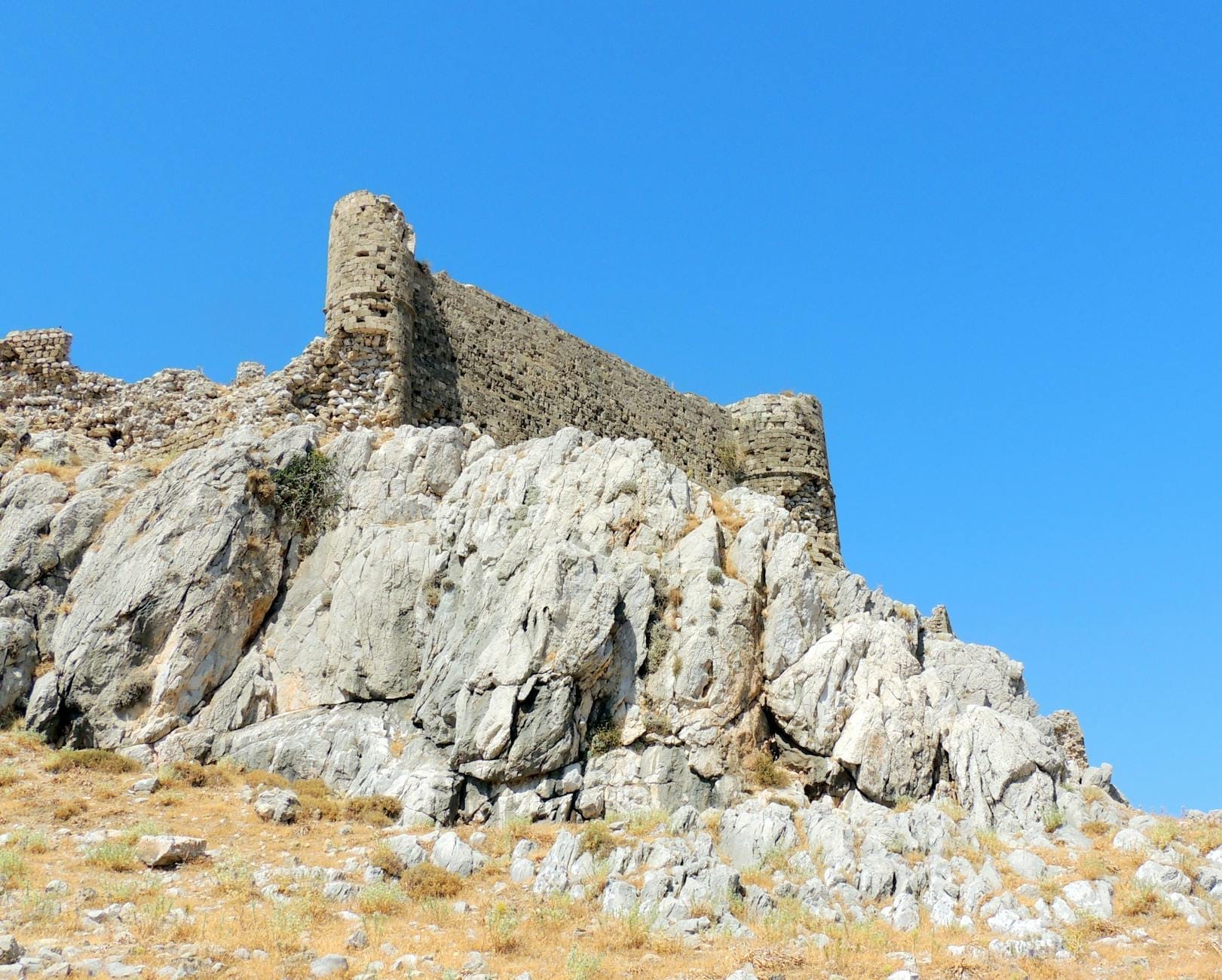
The Castle of Asklipio (Greek: Κάστρο Ασκληπείου) is a 15th-century fortress constructed by the Knights Hospitaller, the military order that controlled Rhodes from 1309 until the Ottoman conquest of 1522. According to historical records, it was built in 1479 under Grand Master Pierre d'Aubusson, likely on a site that had previously served as a Byzantine watchtower or ancient lighthouse position. The castle crowns a steep limestone ridge at roughly 250 metres above sea level, above the small agricultural village of Asklipieio in the island's southern interior.
In architectural terms, this is a compact but serious piece of medieval military engineering. The enceinte follows an irregular plan shaped by the natural rock, with rounded corners, two massive rectangular towers, a narrow southeast gate designed to slow attackers, and vaulted cisterns cut into the lower levels. It is not a grand palace fortress like the Palace of the Grand Master in Rhodes city. It is a garrison fortification, built for function over ceremony, and that austerity is precisely what makes it interesting.
💡 Local tip
Park near the Dormition of the Virgin Church at the base of the village. The path to the castle begins close by and takes around 10 minutes on foot. Wear proper shoes: the limestone underfoot is uneven and can be slippery after rain.
The Walk Up and First Impressions
The approach to the castle sets the tone immediately. Asklipieio village is calm and unhurried in a way that most tourist-facing parts of Rhodes are not. The street leading uphill from the church square is narrow and shaded, bordered by stone walls and occasional fig trees. As the path steepens, the castle walls begin to appear above, pale grey limestone against blue sky, with no gift shops, no ticket booth, and no queue. The only sounds are often insects and wind.
Entering through the narrow southeast gate, the scale of the interior surprises. The courtyard is larger than the exterior silhouette suggests, with two floors of arched stonework still standing in sections and enough structural integrity to explore safely, though caution is genuinely required. The walls are not uniformly preserved: some sections are solid and walkable at lower heights, while others have eroded to rubble. There are no railings, no safety barriers. The site is authentic in the fullest sense of that word.
Tickets & tours
Hand-picked options from our booking partner. Prices are indicative; availability and final rates are confirmed when you complete your booking.
Sunset catamaran cruise with dinner in Rhodes
From 70 €Instant confirmationFree cancellation3-Hour All Inclusive Sun and Sea Swimming Cruise in Rhodes
From 55 €Instant confirmationFree cancellationRhodes Sunset Cruise with Greek BBQ and Unlimited Drinks
From 65 €Instant confirmationFree cancellationPalace of the Grand Master Ticket and Audio Tour by App
From 30 €Instant confirmation
The Views and Why They Matter
The strategic logic of this site becomes clear the moment you look outward. From the upper levels of the castle, the southeastern coastline of Rhodes opens up in a long arc, with the deep blue of the Aegean visible between ridges, and the patchwork of olive groves and dry scrubland stretching toward the shore. On clear days, the silhouette of the Turkish coast is visible to the east. This was not a decorative choice of location: the ridge gave the Hospitallers clear sightlines to monitor coastal approaches and communicate with other garrison points along the southern shore.
For photographers, the light here behaves well in both morning and late afternoon. Morning visits tend to produce warmer light on the western-facing stonework, while the late afternoon casts long shadows that bring out the texture of the medieval masonry. The surrounding landscape, largely free of modern development, means the castle reads cleanly against its setting. For more context on getting the most from Rhodes's photogenic sites, the Rhodes photography guide covers timing and technique across the island's key locations.
Historical Context: The Hospitallers in the South
The Knights Hospitaller, formally the Order of Saint John of Jerusalem, understood Rhodes as a strategic buffer between Christian Europe and the expanding Ottoman Empire. Their fortification programme across the island was methodical: the city of Rhodes received the most elaborate defences, but coastal and inland outposts like Asklipio protected agricultural land and gave early warning of raids. The 1479 construction date placed it in a particularly tense period: the Ottomans had attempted to take Rhodes as recently as 1480, and the Order was investing heavily in its defensive network.
The castle's vaulted cisterns, still visible in the lower levels, underscore how seriously the Knights took the possibility of a prolonged siege. A garrison that could store water and provisions independently was far harder to dislodge. For visitors who want to understand this broader system of fortification, the Knights of Rhodes history guide places Asklipio within the wider context of Hospitaller strategy and architecture across the island.
Whether the site had a Byzantine predecessor has not been definitively established by archaeological excavation, but the ridge's natural defensive advantages and the references to an earlier lighthouse function suggest continuous occupation dating well before the 15th century. The village of Asklipieio itself takes its name from Asklepios, the ancient Greek god of medicine, pointing to even earlier classical-era significance in this landscape.
Visiting Practically: What to Expect On the Ground
Asklipio Castle has no official opening hours and no admission fee. It is, in the simplest terms, a ruin on a hillside that is accessible whenever you arrive. That freedom comes with corresponding responsibility. There are no staff on site, no information panels in English (or any language), and no first aid facilities. The terrain inside the enceinte includes significant height differences, loose stone, and sections where walls have partially collapsed. Children and older visitors need to be closely supervised, and the site is not accessible to anyone with limited mobility.
The best months to visit are May, June, September, and October, when temperatures are manageable for the uphill walk and the light is generally clear. In July and August, the exposed limestone radiates heat, and the midday visit becomes genuinely uncomfortable. Early morning in summer is the obvious solution: arrive before 9am and you will have the site to yourself, in relatively cool air, with excellent photographic light. Winter visits are possible but the path can be slippery after rain, and the surrounding landscape loses some of its colour.
⚠️ What to skip
There are no guardrails, handrails, or safety barriers anywhere in the castle. The upper wall sections, while tempting for views, are genuinely unstable in places. Stay on clearly established paths within the courtyard and do not attempt to scale damaged wall sections.
Getting here requires a car or a rental vehicle. There is no public bus service to Asklipieio village. The drive from Rhodes city takes roughly 50 to 60 minutes via the east coast road through Lindos. From Lindos itself, the village is about 25 kilometres and 30 minutes by road. The route passes through attractive inland terrain and the drive forms a natural part of a southern Rhodes loop.
Pairing Asklipio with the Surrounding Area
Asklipio village has more to offer than just the castle. The Church of the Dormition of the Virgin, located at the base of the hill, is one of the best-preserved Byzantine churches on Rhodes and contains remarkable 17th-century frescoes. It is worth spending 20 to 30 minutes here before or after the castle climb. The village also has a small folklore museum. Combined, the castle, church, and village make for a satisfying half-day excursion. Pair this with a stop at Seven Springs to the north, or continue south toward Prasonisi for a completely different kind of landscape.
For those building an itinerary around southern Rhodes, Asklipio sits naturally alongside Tsambika Monastery and the coastline around Pefkos. The seven-day Rhodes itinerary includes practical routing suggestions for combining the southern interior with coastal stops on both the east and west shores.
Who Should Skip It
Visitors without a car have no realistic way to reach Asklipio. Anyone expecting interpretive panels, restored interiors, or a curated museum experience will be disappointed: this is a raw ruin, and very little of the physical structure has been restored or explained. Travellers with limited time in Rhodes who have not yet seen the Palace of the Grand Master, the Street of the Knights, or Lindos should prioritise those first. Asklipio rewards prior knowledge of medieval military architecture and Hospitaller history; without that context, it can feel like a pile of old stones on a hill.
It is also not the right choice for visitors with mobility limitations, small children who are difficult to supervise on uneven terrain, or anyone who finds exposed heights uncomfortable. None of these are criticisms of the site itself: they are simply honest assessments of what this place is and is not.
Insider Tips
- Arrive before 9am in summer. The limestone traps heat and by midday the interior becomes significantly uncomfortable. Morning light also produces the best conditions for photographing the stonework.
- The Church of the Dormition of the Virgin at the foot of the hill contains elaborate 17th-century frescoes that most visitors rush past on their way to the castle. Allow 20 minutes inside: it is one of the most intact Byzantine interiors on the island.
- Look for the vaulted cisterns in the lower level of the castle interior. They are easy to miss but give the clearest sense of how the garrison was designed to function during a siege.
- The ridge to the north of the castle offers slightly better southward views than the castle itself if you are willing to scramble carefully along the lower lip of the hill on the way back down.
- Combine this with the drive south to Prasonisi, particularly outside peak season when the peninsula is quiet. The contrast between the medieval hilltop site and the windswept cape at the island's tip makes for a genuinely memorable day in southern Rhodes.
Who Is Asklipio Castle For?
- History and archaeology enthusiasts with background knowledge of the Knights Hospitaller
- Photographers looking for medieval architecture without tourist crowds
- Road-trippers building a southern Rhodes loop by car
- Travellers who prefer free, unmediated access to historic sites over guided museum experiences
- Couples or independent travellers who value quiet and isolation over organised attractions
Nearby Attractions
Combine your visit with:
- Kritinia Castle
Perched on a rocky hilltop 131 metres above the western coastline of Rhodes, Kritinia Castle is a medieval fortress built by the Knights of Saint John in 1472. The ruins are freely accessible, the views stretch across the Aegean toward Turkey, and the surrounding silence makes it one of the island's more atmospheric stops for history-minded travellers.
- Monastery of Fountoukli
The Monastery of Fountoukli, officially known as Agios Nikolaos Fountoukli, is a 14th-century Byzantine church tucked into the forested hills of the island's interior. With original frescoes, a distinctive four-conch architectural plan, and almost no crowds, it rewards travelers willing to venture beyond the coastline.
- Profitis Ilias
At 798 metres, Profitis Ilias is the third-highest peak on Rhodes, draped in dense pine and cypress forest. It offers a striking contrast to the island's coastal attractions: cool shade, Italian-era architecture, quiet hiking trails, and a hilltop chapel with wide views across the Aegean.
- Seven Springs (Epta Piges)
Seven Springs, known in Greek as Epta Piges, is a forested valley 27 km from Rhodes Town where seven natural springs feed a 1930s Italian-built tunnel and artificial lake. It is one of the few inland attractions on Rhodes that genuinely rewards the detour, offering cool shade, running water, and a narrow 186-metre underground passage that most visitors will never forget.