Tsambika Monastery: Rhodes' Hilltop Pilgrimage Site
Tsambika Monastery draws visitors from across Rhodes for two very different reasons: its miraculous icon with a centuries-old fertility legend, and the breathtaking panoramic views from the hilltop chapel. Whether you climb all 307 steps or simply visit the lower church, the site carries a weight of devotion that few places on the island can match.
Quick Facts
- Location
- On the EO Rhodes-Lindos road, between Kolymbia and Archangelos, ~25 km south of Rhodes city
- Getting There
- By car or scooter from Rhodes city (~35 min); KTEL buses on the Rhodes-Lindos route stop nearby
- Time Needed
- 1.5–2.5 hours including the hilltop climb; 30–45 minutes for lower monastery only
- Cost
- Free entry; donations welcome at the church
- Best for
- Panoramic views, religious pilgrimage, photography, cultural immersion
What Is Tsambika Monastery, and Why Do People Come Here?
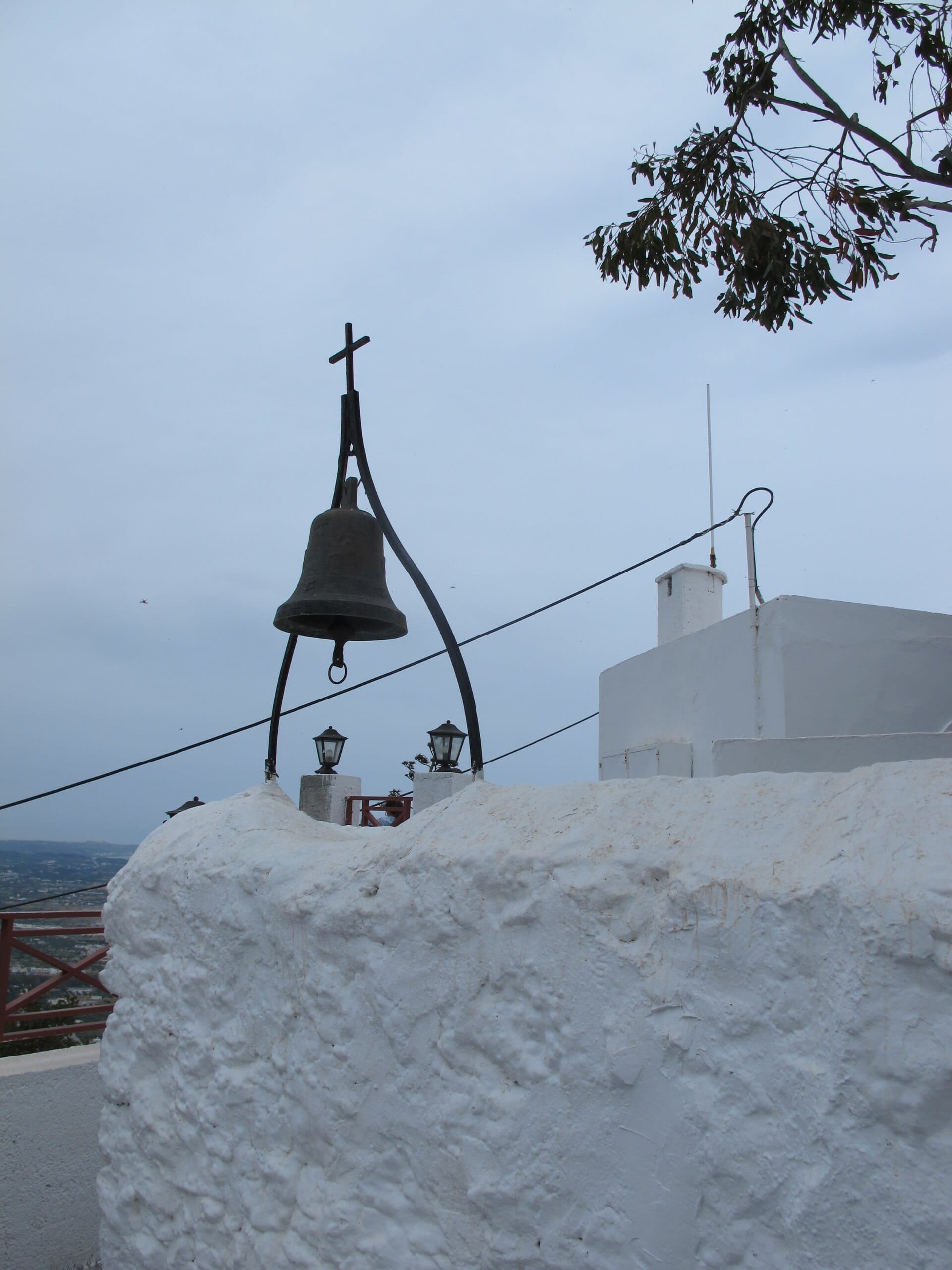
The full official name is Ιερά Μονή Παναγίας Τσαμπίκας (Panagia Tsambika Monastery), and the site actually has two distinct parts that visitors often conflate. Kato Tsambika (Lower Tsambika) is the monastery complex on the main road, a 19th-century walled church that is no longer inhabited by monks but remains open for prayer and reflection. Kyra Tsambika (Upper Tsambika) is the tiny hilltop chapel perched at roughly 300 metres above the coastal plain, reached by a steep concrete access road and then 307 worn stone steps.
Most travellers passing through on the Rhodes-Lindos corridor encounter the lower site first. It is calm, modestly decorated, and easy to visit in modest clothing. The upper chapel is the spiritual heart of the place, housing the celebrated icon of the Panagia Tsambika, and it is here that the site's extraordinary legend plays out each year.
ℹ️ Good to know
Dress code is strictly enforced at both sites. Shoulders and knees must be covered. Scarves and wraps are sometimes available at the entrance, but bringing your own is more reliable, especially in summer when the monastery can be warm and crowded.
The Legend of the Icon and the Fertility Pilgrimage
The icon at the heart of Tsambika Monastery is believed to have originated from the Kykkos Monastery in Cyprus. According to the tradition preserved here, the icon appeared miraculously on the rocky hilltop of Rhodes, and when attempts were made to move it elsewhere, it returned each time to the same spot. A burn mark still visible on the icon is said to date from the moment a shepherd tested its authenticity with fire. The icon has been venerated on this hill ever since.
What gives the monastery its particular reputation across Greece is a well-established fertility tradition. Women who have struggled to conceive make the full barefoot pilgrimage up the 307 stone steps, praying to the Panagia for help. Children born after such prayers are often given the name Tsambikos (for boys) or Tsambika (for girls), a naming custom still practiced today. On the feast day of the Nativity of the Theotokos (September 8), and again on the Third Sunday of Great Lent, the hillside fills with pilgrims, candles, and the smell of incense drifting from the open chapel doors. These dates are among the most attended religious events on Rhodes.
The weight of that tradition is palpable even on ordinary days. You may see candles left in the iron holders outside the chapel, old votive offerings inside, or occasionally a lone woman making the climb in bare feet in July heat. It is a sincere act of faith, and worth keeping in mind if you are visiting primarily for the view: the site is an active place of worship, not a scenic lookout with a church attached. For wider context on the island's religious and historical landscape, the Knights of Rhodes history guide covers how the island's layered past shaped its sacred sites.
Tickets & tours
Hand-picked options from our booking partner. Prices are indicative; availability and final rates are confirmed when you complete your booking.
Sunset catamaran cruise with dinner in Rhodes
From 70 €Instant confirmationFree cancellation3-Hour All Inclusive Sun and Sea Swimming Cruise in Rhodes
From 55 €Instant confirmationFree cancellationRhodes Sunset Cruise with Greek BBQ and Unlimited Drinks
From 65 €Instant confirmationFree cancellationPalace of the Grand Master Ticket and Audio Tour by App
From 30 €Instant confirmation
The Climb: What the 307 Steps Actually Feel Like
The ascent to the upper chapel begins after a steep drive up a concrete road to a small car park and a rudimentary café. From there, the steps begin in earnest: uneven, occasionally crumbling, cut into the natural rock in places, and completely exposed to the sun for most of the route. In July and August, this climb in the midday heat is genuinely demanding. The stone under your feet radiates warmth from above 10 a.m., and there is no shade for the first two-thirds of the ascent.
Start early (before 9 a.m. if possible) or wait until late afternoon when the sun has dropped behind the summit. Wear proper footwear with grip. The steps are not steep enough to require hiking poles, but sandals with no ankle support become treacherous on the descent, particularly if the stone is damp from overnight moisture. Allow 20-30 minutes for the climb at a steady pace, more if you stop for photographs.
⚠️ What to skip
The upper chapel is not wheelchair accessible and is challenging for anyone with limited mobility or knee problems. The lower monastery is fully accessible and still worth visiting on its own for the icon, church architecture, and courtyard.
The reward at the top is real. The chapel itself is tiny, no larger than a small living room, packed with hanging lamps, votive offerings, and the scent of beeswax candles. If the doors are open, step inside quietly. On clear days the view from the summit takes in the full arc of Tsambika Beach directly below, the coastline stretching north toward Kolymbia, the flat agricultural plain inland, and on exceptionally clear days the outlines of distant islands to the northeast.
The Lower Monastery: Often Overlooked, Worth Your Time
The Kato Tsambika complex on the main road is the older structure in terms of its current form, built in the 19th century, and retains the proportions and whitewashed simplicity of a traditional Orthodox monastic church. The main church holds religious art including icons and carved iconostasis elements. The monastery is no longer home to a resident monastic community, but it functions as a parish church and is kept in careful order.
Visiting between 8 a.m. and 8 p.m. (daily, per current information; verify locally during off-season as hours can change), you will generally find the church open and quiet. Early mornings have a particular stillness: the light falls through the narrow windows in angled shafts, and the air carries the faint smell of old incense and melted wax that clings to Orthodox churches everywhere. It is a grounding contrast to the effort of the hilltop climb.
If you are combining this visit with the beach directly below, Tsambika Beach is one of the finest stretches of sand on the island: a long crescent of golden sand with unusually clear water. Many visitors do the monastery climb in the morning cool, then descend to the beach for the afternoon, which is an entirely sensible use of the location.
Getting There and Practical Logistics
Tsambika Monastery sits on the main EO Rhodes-Lindos road, approximately 26 kilometres south of Rhodes city, just past Tsambika Beach and roughly 1 kilometre before Archangelos village. By car or scooter from Rhodes city, the drive takes around 35 minutes along a well-maintained main road. The lower monastery has a small roadside pull-in; the upper chapel access road branches off and climbs steeply to a car park near the steps.
KTEL buses on the Rhodes-Lindos route pass along this road and can drop you near the lower monastery, though you should confirm the nearest stop with the driver. Renting a car or scooter gives you far more flexibility, especially if you plan to combine the monastery with nearby sites. The Rhodes car hire guide covers the main options and what to watch for with local rental companies.
For those building a longer itinerary through the island's middle and southern sections, Tsambika pairs naturally with Seven Springs (about 10 km north) and the Acropolis of Lindos (about 15 km south), making for a full-day loop with genuine variety. The 3-day Rhodes itinerary maps out exactly this kind of route.
Photography, Crowds, and Honest Expectations
The summit of Tsambika is one of the more photographed viewpoints on Rhodes, and for good reason. The vertical drop from the chapel to the beach creates a dramatic composition that is difficult to replicate elsewhere on the island. Golden hour before sunset, when the beach sand turns amber and the sea deepens to indigo, is the optimum time for photography, though the chapel may be closing as light fades. Early morning offers softer light and far fewer people, which matters both for photography and for experiencing the place on its own terms.
In peak summer (July-August), the steps can be crowded by mid-morning, with tour groups from the coastal resorts making the climb in waves. The chapel becomes genuinely cramped with ten or more people inside simultaneously. This is not a place to rush in high season. Either arrive first thing or accept that you will be sharing the experience.
💡 Local tip
The lower monastery courtyard offers a quiet spot to sit and rest that most visitors walk past without stopping. The shade in the courtyard is particularly welcome in summer, and the carved wooden doors of the church repay close attention if ecclesiastical architecture interests you.
Who might not enjoy Tsambika: travellers with mobility limitations will find the upper chapel inaccessible and potentially frustrating if that was their primary goal. Those sensitive to religious settings who expect a purely scenic lookout may find the active devotional atmosphere not quite what they anticipated. And anyone visiting on September 8 without planning for it will encounter a full pilgrimage crowd that transforms the site entirely; it is extraordinary to witness, but logistically demanding.
Cultural Context: Fitting Tsambika Into Rhodes
Tsambika Monastery belongs to a pattern of hilltop chapels and monastery sites scattered across Rhodes that speak to the island's deep continuity of Orthodox Christian practice, even through centuries of Ottoman and Italian administration. Understanding that continuity adds real depth to a visit. The island's religious history sits alongside its medieval fortifications and ancient ruins in ways that the Rhodes medieval Old Town guide explores in detail for the city itself.
The name Tsambika is thought to derive from a word for a burning or glowing light, connected to the legend of the icon's discovery. Whether or not one engages with the religious dimension, the site functions as a kind of record of how communities have oriented themselves around this particular hilltop for centuries: the view it commands over the coast would have made it significant long before any chapel was built.
Insider Tips
- Start the hilltop climb before 8:30 a.m. in summer. By 10 a.m., the stone steps are fully sun-baked and the upper car park fills with tour vehicles. The chapel in early morning light, with no crowds and the sea still a cool grey-blue below, is a genuinely different experience from the midday version.
- The small café near the upper car park sells cold water and Greek coffee. It is not always open in early morning or late afternoon, so carry your own water for the climb: at least half a litre per person in warm weather.
- If you visit on September 8 (feast of the Nativity of the Theotokos), arrive very early or expect a significant crowd. The festival atmosphere is authentic and worth witnessing, but the site is genuinely packed and the steps can feel slow-moving in both directions.
- The lower monastery church is often skipped by visitors who drive straight to the upper access road. It is the more architecturally refined of the two sites and worth 15 minutes even if you are focused on the hilltop views.
- Children are generally fine on the climb if they are comfortable walkers and the heat is not extreme. Keep them to the inside of the steps on the descent, where the drop on the outer edge is unguarded in places.
Who Is Tsambika Monastery For?
- Travellers combining a cultural site with a beach day at Tsambika Beach directly below
- Photography enthusiasts after elevated coastal views with genuine compositional drama
- Visitors interested in active Greek Orthodox pilgrimage traditions rather than museum-piece religion
- Road-trippers heading south toward Lindos who want a stop with more substance than a roadside viewpoint
- Early risers who want a genuine sense of place before the tour groups arrive on the main circuit
Nearby Attractions
Combine your visit with:
- Asklipio Castle
Built in 1479 by the Knights Hospitaller on the edge of a limestone ridge above a quiet village, the Castle of Asklipio is one of Rhodes's least-visited medieval fortresses. Free to enter, open at all hours, and commanding views across the southern coastline, it rewards travellers willing to venture beyond Lindos.
- Kritinia Castle
Perched on a rocky hilltop 131 metres above the western coastline of Rhodes, Kritinia Castle is a medieval fortress built by the Knights of Saint John in 1472. The ruins are freely accessible, the views stretch across the Aegean toward Turkey, and the surrounding silence makes it one of the island's more atmospheric stops for history-minded travellers.
- Monastery of Fountoukli
The Monastery of Fountoukli, officially known as Agios Nikolaos Fountoukli, is a 14th-century Byzantine church tucked into the forested hills of the island's interior. With original frescoes, a distinctive four-conch architectural plan, and almost no crowds, it rewards travelers willing to venture beyond the coastline.
- Profitis Ilias
At 798 metres, Profitis Ilias is the third-highest peak on Rhodes, draped in dense pine and cypress forest. It offers a striking contrast to the island's coastal attractions: cool shade, Italian-era architecture, quiet hiking trails, and a hilltop chapel with wide views across the Aegean.