Kritinia Castle: The Knights' Fortress at the Edge of Western Rhodes
Perched on a rocky hilltop 131 metres above the western coastline of Rhodes, Kritinia Castle is a medieval fortress built by the Knights of Saint John in 1472. The ruins are freely accessible, the views stretch across the Aegean toward Turkey, and the surrounding silence makes it one of the island's more atmospheric stops for history-minded travellers.
Quick Facts
- Location
- West of Kritinia village, western Rhodes, approx. 49 km from Rhodes Town
- Getting There
- Car strongly recommended; KTEL bus to Kritinia village, then uphill walk or short drive on dirt road
- Time Needed
- 1 to 1.5 hours including the approach and views
- Cost
- Free; no entry fee or ticket required
- Best for
- History enthusiasts, photographers, scenic drives, sunset seekers
What Is Kritinia Castle?
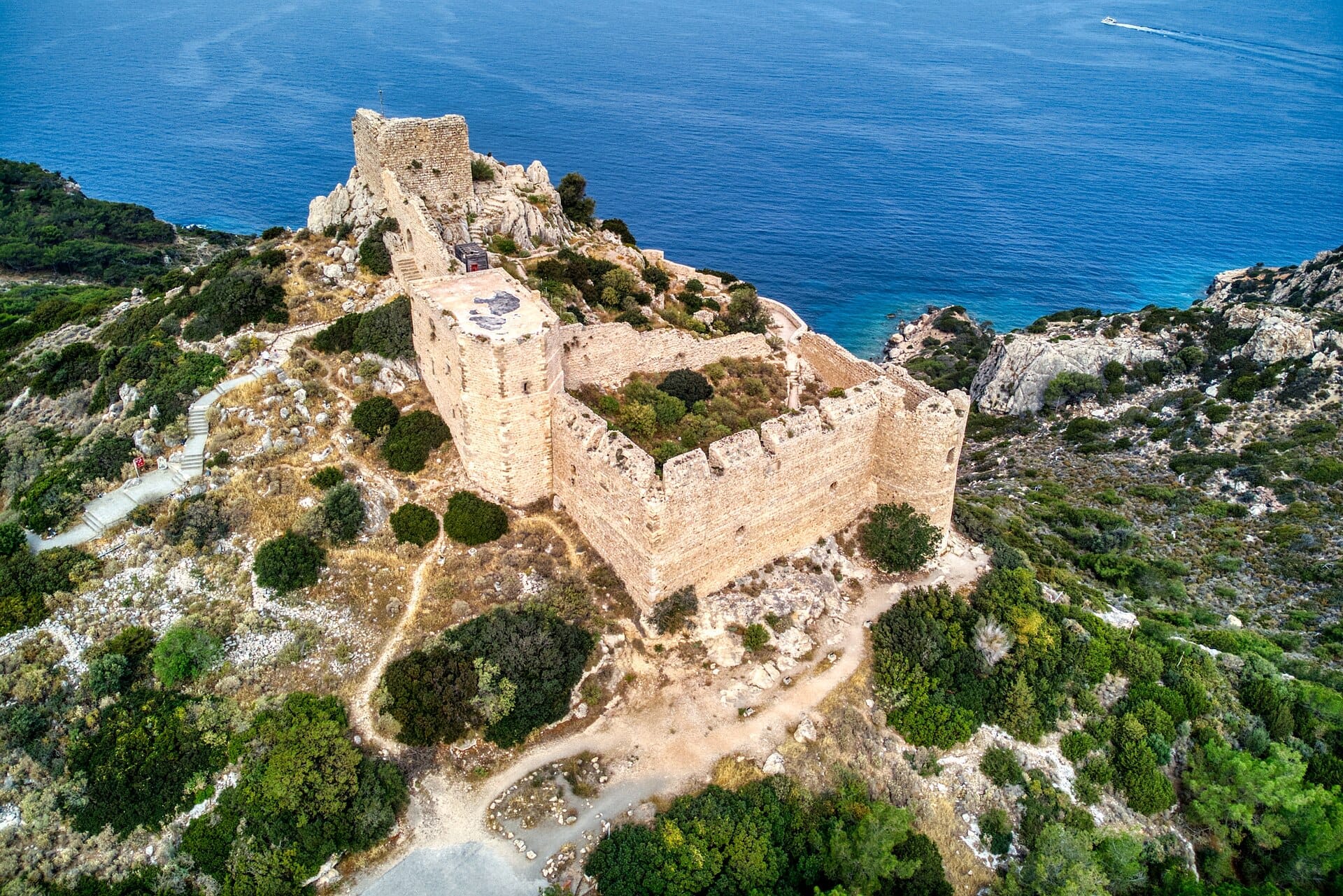
The Castle of Kritinia, known locally as Kastellos, sits on a steep limestone hill on the western coast of Rhodes, overlooking a stretch of Aegean Sea that on clear days reveals the silhouettes of Chalki and Alimia islands. Built in 1472 under the supervision of Giorgio Orsini and commissioned by the Knights of Saint John, the fortress was part of a chain of defensive positions the Knights maintained across the island to repel Ottoman naval raids and pirate incursions. Unlike the grand Palace of the Grand Master in Rhodes Town, Kritinia was never a seat of power. It was a watchtower, a signal post, a place to hold a line.
Today the castle is a ruin, and an honest one at that. Sections of wall have crumbled, the interior spaces are exposed to sky, and the Greek Archaeological Services have carried out reinforcement works to stabilise what remains. What survives is enough to read the structure: towers at the corners, a central courtyard, and the remnants of a small chapel dedicated to Saint John, where fragments of 16th-century wall paintings can still be found if you look carefully at the interior stonework.
ℹ️ Good to know
Kritinia Castle has no staffed entrance, no ticket booth, and no set opening hours. The ruins are freely accessible during daylight hours. Come prepared with water, sun protection, and closed-toe shoes.
The Approach: Getting There Is Part of the Experience
The castle is reached via a narrow dirt road that branches off from the main route near Kritinia village, which itself sits about 49 kilometres southwest of Rhodes Town, roughly a one-hour drive along the west coast road. A rental car is the practical choice for most visitors. The road to the hilltop is passable in a standard car but demands attention, and parking is limited to a small flat area near the base of the final ascent.
Visitors arriving by public transport can take a KTEL bus from Rhodes Town toward the western villages, alighting at Kritinia. From the village, the castle is visible above and reachable on foot, though the path is uneven and exposed. If you are planning a wider loop of the island's west coast, Kritinia sits naturally between the Valley of the Butterflies to the south and the village of Kameiros to the north, both of which reward a stop. For context on planning that kind of day, the day trips from Rhodes guide outlines practical routes.
The final approach on foot from the parking area takes around ten minutes along a rough stone path. The gradient is steady rather than steep, but the surface is loose in places. Sandals are not suitable. In the middle of summer, the hillside offers almost no shade, so the walk feels considerably more demanding between 11am and 4pm than it does in the early morning or late afternoon.
Tickets & tours
Hand-picked options from our booking partner. Prices are indicative; availability and final rates are confirmed when you complete your booking.
Sunset catamaran cruise with dinner in Rhodes
From 70 €Instant confirmationFree cancellation3-Hour All Inclusive Sun and Sea Swimming Cruise in Rhodes
From 55 €Instant confirmationFree cancellationRhodes Sunset Cruise with Greek BBQ and Unlimited Drinks
From 65 €Instant confirmationFree cancellationPalace of the Grand Master Ticket and Audio Tour by App
From 30 €Instant confirmation
Inside the Walls: What You Actually See
Once through the main gate, the interior of the castle opens onto a compact courtyard surrounded by walls of varying height. The eastern tower is the best preserved and rewards a careful look: embedded into the masonry are carved coats of arms belonging to two Grand Masters of the Knights of Saint John, d'Amboise (who held office from 1503 to 1512) and Orsi (who held office 1467 to 1476). These stone heraldic markers were a standard practice across Knights' fortifications in the Dodecanese, a way of asserting ownership and dating construction phases. Their presence here places the castle firmly within the broader building campaign the Order maintained across western Rhodes.
The chapel ruins in the northeastern corner are modest but worth pausing at. The painted plaster that survives on the interior walls is fragmentary, the colours faded to ochre and grey, but it is genuinely medieval work and gives the castle a human scale that purely military architecture rarely offers. There are no interpretive panels or labels inside the castle, which some visitors will find frustrating and others will find refreshing.
The Knights of Saint John left their architectural mark across much of Rhodes, most dramatically in the Street of the Knights and the Palace of the Grand Master in Rhodes Town. Kritinia sits at the quieter, less-visited end of that legacy, and the contrast is striking.
The Views: The Real Reason Most People Come
Whatever the castle's historical significance, most visitors are here for what they can see standing on the walls. The panorama from the upper ramparts covers a wide arc of the western coastline, the agricultural plain below Kritinia village, and the open Aegean stretching toward the smaller Dodecanese islands. On calm, clear days in spring and autumn, the visibility is exceptional. In high summer, haze often softens the horizon, and the midday glare can wash out the colour contrast that makes photographs satisfying.
Late afternoon is the optimum time for photography. From around 4pm onward the light becomes directional and warm, the castle walls take on a deeper tone, and the shadows across the landscape below add texture to otherwise flat terrain. Sunset from the upper walls is genuinely impressive, though arriving with enough time to explore the ruins before the light fades requires planning: the castle is not lit, and picking your way back down the path in low light is not recommended.
💡 Local tip
For the best photography, arrive 90 minutes before sunset. This gives you enough time to explore the interior, then position yourself on the eastern wall for warm directional light across the Aegean.
Historical Context: The Knights and Western Rhodes
The Knights of Saint John controlled Rhodes from 1309 until the Ottoman siege and conquest of 1522. During those two centuries, they transformed the island's defensive architecture systematically, building or reinforcing castles at strategic coastal and hilltop positions across the island. Kritinia was one node in that network. The history of the Knights of Rhodes is a long one, but the short version relevant here is that western Rhodes, facing the open sea lanes between the Aegean and the Eastern Mediterranean, was a priority for surveillance. A signal fire or flag from Kritinia could alert the garrison at Rhodes Town to approaching fleets within minutes.
The choice of location reflects a precise tactical logic: at 110 to 131 metres elevation, the hilltop commands sightlines that no vessel could enter the western approach without being observed. The castle was not designed to repel large land forces; it was a forward observation post with enough fortification to hold a small garrison against a raiding party long enough for help to arrive.
After the Ottoman conquest, the castle gradually fell out of use and into decay. No significant medieval or Ottoman-era development followed, which is partly why the ruins retain the character they do: they represent a single, relatively coherent phase of construction rather than the layered complexity of a site that was repurposed repeatedly.
Practical Details: What to Know Before You Go
There is no entrance fee, no ticket office, and no formal opening and closing time. The castle is an open ruin on public land. In practical terms this means you can arrive at any point during daylight, but be aware that there is no on-site infrastructure: no toilets, no cafe, no shelter, and no staff. Bring water, especially between June and September when the hillside temperature in direct sun can reach uncomfortable levels.
The site is not accessible to visitors with limited mobility. The dirt road, the stone path, and the uneven interior surfaces all require stable footing. The Greek Archaeological Services have carried out stabilisation work on the walls, but the castle remains a genuine ruin rather than a restored monument, and some caution is appropriate when moving through the interior.
⚠️ What to skip
Do not attempt to climb deteriorating wall sections. Reinforcement work has been done but the structure is not fully consolidated. Stay on the established paths within the castle.
If you are driving a rental car around western Rhodes, Kritinia pairs well with a stop at the Valley of the Butterflies, located further south along the same coast road. The two sites together make a half-day circuit from Rhodes Town without significant backtracking. For a broader view of what the island's western interior offers, the Rhodes hidden spots guide includes several lesser-visited sites in this part of the island.
Who Should Skip This
Kritinia Castle is not for everyone. Visitors expecting a polished heritage experience with interpretive signage, accessible paths, and facilities will be disappointed. The ruins are skeletal, the on-site information is non-existent, and the drive is long if you are based in Rhodes Town and managing limited time. If your primary interest is in well-presented medieval architecture with full context, the Palace of the Grand Master and the medieval Old Town of Rhodes offer considerably more structure and depth for the same historical period.
Visitors who dislike exposed hilltop heat, rough terrain, or driving on narrow rural roads should also factor those realities into their decision. This is a rewarding stop, but the reward is proportional to the effort you are willing to put in.
Insider Tips
- The best time to visit is May, June, or September. Summer heat on the exposed hilltop is intense, and the haze reduces the long-distance views that make the site worthwhile.
- Bring more water than you think you need. The nearest shop or cafe is in Kritinia village, and once you start the approach there is no shade or water on the hillside.
- Look closely at the northeastern chapel walls for traces of the medieval fresco work. They are easy to walk past without noticing if you are not specifically looking for them.
- If you are driving a rental car, a standard vehicle handles the dirt access road comfortably in dry conditions. After rain, the surface becomes slippery and a higher-clearance vehicle is preferable.
- The castle is almost entirely unvisited in the morning on weekdays outside of July and August. Arriving early means you will likely have the whole site to yourself, which makes the atmosphere considerably more evocative.
Who Is Kritinia Castle For?
- History enthusiasts interested in Knights of Saint John fortifications beyond the main tourist sites
- Photographers looking for elevated coastal views with medieval foreground interest
- Drivers on a western Rhodes road trip combining multiple stops in a single day
- Travellers who prefer sites that are quiet, unmediated, and free of crowds
- Sunset seekers willing to plan around the light rather than just dropping in
Nearby Attractions
Combine your visit with:
- Asklipio Castle
Built in 1479 by the Knights Hospitaller on the edge of a limestone ridge above a quiet village, the Castle of Asklipio is one of Rhodes's least-visited medieval fortresses. Free to enter, open at all hours, and commanding views across the southern coastline, it rewards travellers willing to venture beyond Lindos.
- Monastery of Fountoukli
The Monastery of Fountoukli, officially known as Agios Nikolaos Fountoukli, is a 14th-century Byzantine church tucked into the forested hills of the island's interior. With original frescoes, a distinctive four-conch architectural plan, and almost no crowds, it rewards travelers willing to venture beyond the coastline.
- Profitis Ilias
At 798 metres, Profitis Ilias is the third-highest peak on Rhodes, draped in dense pine and cypress forest. It offers a striking contrast to the island's coastal attractions: cool shade, Italian-era architecture, quiet hiking trails, and a hilltop chapel with wide views across the Aegean.
- Seven Springs (Epta Piges)
Seven Springs, known in Greek as Epta Piges, is a forested valley 27 km from Rhodes Town where seven natural springs feed a 1930s Italian-built tunnel and artificial lake. It is one of the few inland attractions on Rhodes that genuinely rewards the detour, offering cool shade, running water, and a narrow 186-metre underground passage that most visitors will never forget.