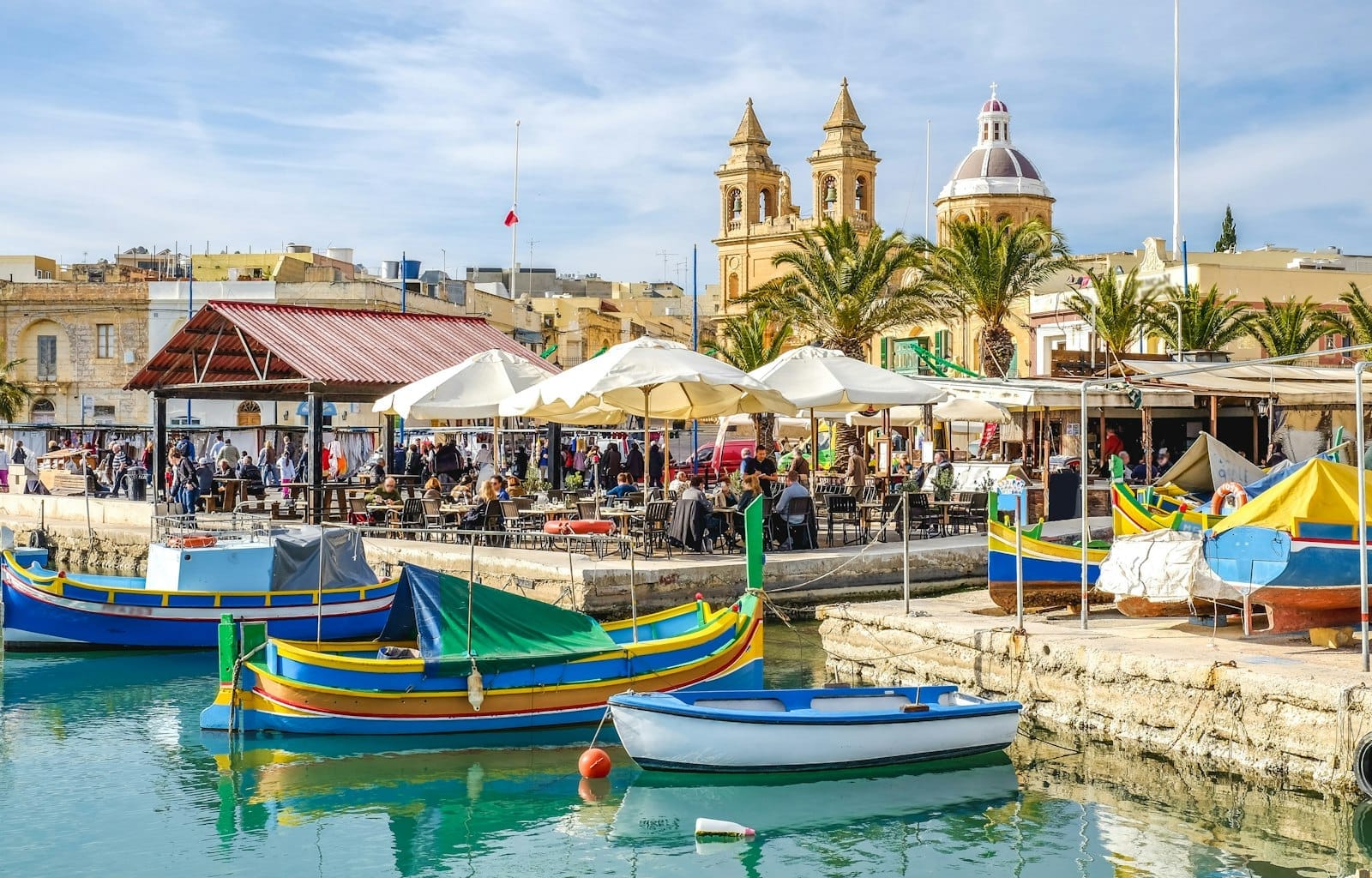
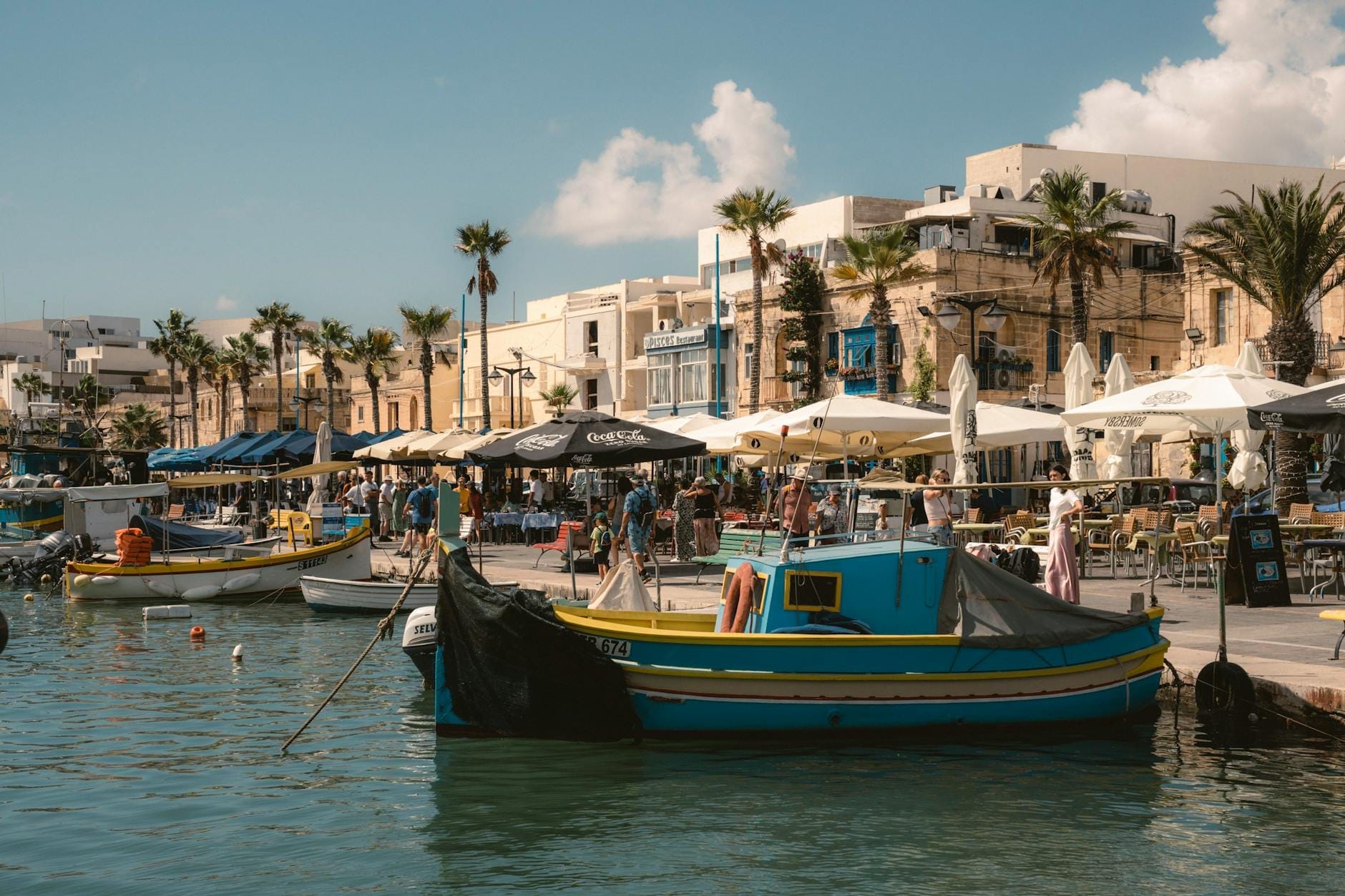
Marsaxlokk is a traditional fishing village on Malta's southeastern coast, best known for its photogenic harbor lined with brightly painted luzzu boats, its weekly Sunday fish market, and some of the freshest seafood restaurants on the island. It offers a genuine slice of Maltese life that most coastal towns have long since traded away.
Marsaxlokk sits on the sheltered southeastern bay of the same name, and it remains the most working, unpolished fishing village left on Malta. The harbor is still active, the boats are still hand-painted in red, yellow, and blue, and the smell of grilled lampuki drifts along the promenade on a Sunday morning in a way that no restaurant menu can replicate.
Orientation
Marsaxlokk sits on the western shore of Marsaxlokk Bay, roughly 14 kilometers southeast of Valletta as the crow flies. The village wraps around a sheltered natural harbor, with the promenade running along the inner curve of the bay from the main market area in the north down toward the fishing quays in the south. The road into the village arrives from the northwest, passing through the outskirts of Zejtun before the bay opens up ahead of you.
The village boundary is compact. The historic core is essentially the promenade, the parish church of Our Lady of Pompei, and the grid of low residential streets immediately behind the waterfront. Walk ten minutes inland and you are already in farmland. Neighboring villages include Birzebbuga to the east along the bay's far shore, Zejtun to the northwest, and Marsascala further up the coast to the north.
One thing the maps don't always make clear: Marsaxlokk Bay is large, and the industrial infrastructure of Malta sits around its eastern and southern shores. The power station, the container freeport, and ship-repair facilities are all on the far side of the water from the village. From the promenade itself, you see mostly open bay and the opposite headland, but on clear days the industrial silhouettes are visible. This doesn't affect the village atmosphere, but it's worth knowing before you expect a completely pristine Mediterranean scene.
Character & Atmosphere
Early on a weekday morning, Marsaxlokk functions exactly as it has for generations. Fishermen work on their luzzus in the harbor, untangling nets or repainting hulls in the bold geometric patterns that identify each boat to its owner. The luzzu is a distinctly Maltese craft, traditionally decorated with the Eye of Osiris on the prow, a symbol believed to watch over sailors at sea. The boats are not decorative props. They go out at night and return before dawn, and if you arrive at the harbor around 6 or 7 in the morning, you can sometimes watch the catch being unloaded directly from boat to truck.
By mid-morning on weekdays, the village is quiet in the way that genuine working places are quiet. A few restaurants are setting out tables along the promenade. Local women walk to the small shops along the back streets. The light on the harbor water is sharp and almost blue-white before noon, making the painted boats look almost theatrically colorful against it. This is the best time to photograph the harbor, before the afternoon haze softens the contrast.
On Sunday, the entire character shifts. The weekly fish market stretches along the full length of the promenade from early morning, and by 9 am the village is packed. Stalls sell fresh fish, seafood, fruit, vegetables, and Maltese food products. Tourists arrive in numbers, the restaurants fill up quickly, and parking becomes genuinely difficult. The market is worth the crowds if you time it right. Arrive before 9 am if you want to buy fish at reasonable prices from locals doing their weekly shopping. After 10 am, the dynamic tilts toward the tourist trade and prices adjust accordingly.
By late afternoon, even on Sundays, the village quiets again. The market vendors pack up by early afternoon. The promenade restaurants keep going through the evening, but Marsaxlokk is not a nightlife destination. After dark, it is calm, almost silent, with the lights of the harbor reflecting off the water and the boats sitting still at their moorings. For travelers who find the noise of Sliema or Paceville exhausting, this is one of the more genuinely restful places to spend an evening in Malta.
💡 Local tip
If the Sunday market is your main reason for visiting, aim to arrive by 8:30 am. The freshest fish sells out early, the light is better for photography, and you will avoid the worst of the midday crowds.
What to See & Do
The harbor promenade is the obvious starting point and, frankly, the heart of the village. Walk its full length, from the market area at the northern end down to the fishing quays at the south, and you get a complete picture of how the village works. The luzzus are moored in clusters, and up close you notice how much variation there is in their decoration and condition: some freshly painted in brilliant primary colors, others weathered and patched. The quayside is not fenced off or prettified. It is a real working space.
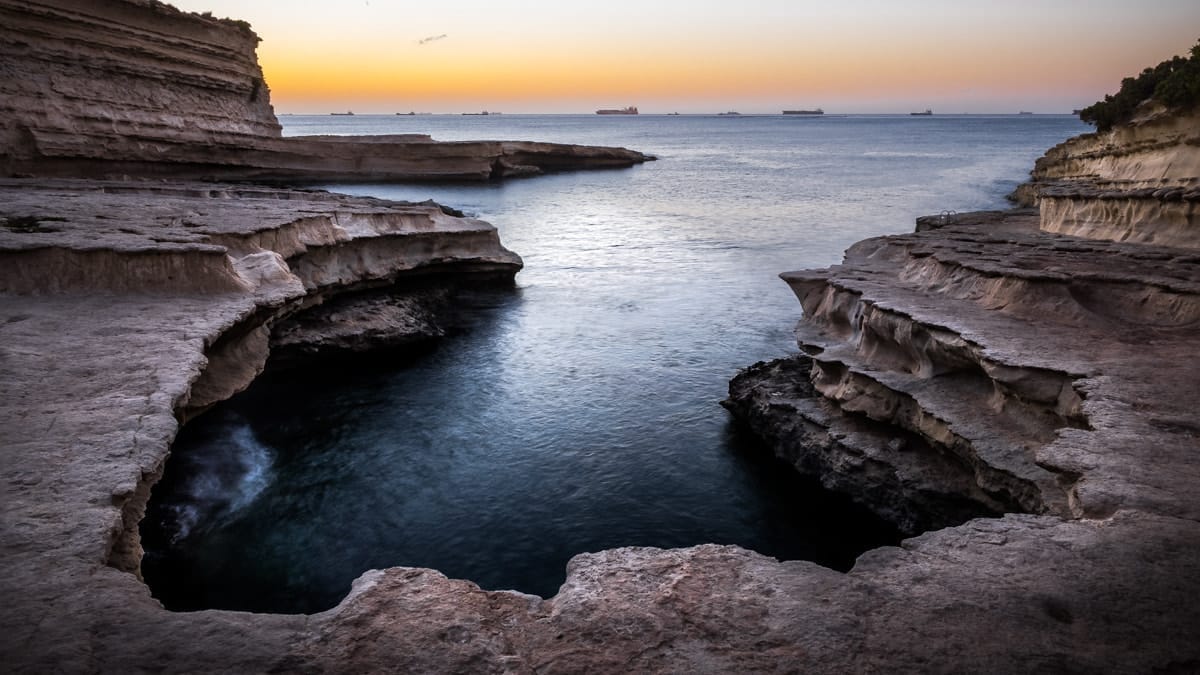
A short drive or a 30-minute walk south of the village along rocky coastal paths brings you to St. Peter's Pool, a natural rock-pool swimming area that is one of the most photogenic spots in southern Malta. There are no sandy beaches here: the swimming is from flat limestone ledges that step down into clear, deep water. It gets busy in summer, particularly on weekends, but during the week it remains relatively uncrowded. Bring shoes with grip for the rocks and something to sit on.
The parish church of Our Lady of Pompei anchors the village square just back from the promenade. It's a 19th-century structure, modest by Maltese standards, but worth looking into for its interior and its role as the social center of a village that still takes its Catholicism seriously. The square in front of it is where local life congregates in the evenings, away from the tourist activity along the waterfront.
The Tas-Silg archaeological site, located on a ridge above the bay to the northwest, contains Punic and Roman temple remains that date back several thousand years. This is one of the lesser-visited ancient sites in Malta, far quieter than the famous temples elsewhere on the island. Access is limited and signage is minimal, so treat it as a bonus if you are driving and curious, rather than a primary attraction.
For context on Malta's extraordinary prehistoric heritage, the Hagar Qim Temples are roughly 20 kilometers west along the southern coast and can be combined with a Marsaxlokk visit into a good half-day itinerary covering the island's southern edge.
ℹ️ Good to know
Fort San Lucjan, on the headland at the bay's entrance, was built in the early 17th century and now houses the University of Malta's marine sciences laboratory. It is not open to the public, but the fort exterior and its headland position are visible from the promenade on the far side of the bay.
Eating & Drinking
Marsaxlokk's reputation for seafood is well earned. The promenade is lined with restaurants that serve fish caught by the same boats you can see in the harbor. The menu staples are lampuki (dolphinfish, highly seasonal in autumn), fresh octopus, sea bream, sea bass, and various preparations of local shellfish. Several restaurants also offer traditional Maltese fish stew, a slow-cooked dish with tomato, capers, and olives that reflects the village's deep connection to the sea.
Prices are noticeably higher than they were a decade ago, partly because of the Sunday tourist trade and partly because fresh seafood has simply become more expensive everywhere. Expect to pay around 20 to 30 euros per person for a proper sit-down seafood meal with wine. Most restaurants have outdoor tables facing the harbor, and on a clear evening with a light breeze, this is about as pleasant as waterfront dining gets in Malta.
For cheaper eating, the Sunday market itself is the better option. Vendors sell pastizzi (flaky pastry filled with ricotta or mushy peas), fresh bread, olives, and various local snacks. There are also stalls selling smoked fish and prepared seafood that you can take away. This kind of casual market eating gives a far more accurate picture of how Maltese people actually engage with food than a sit-down tourist restaurant does.
Look for restaurants displaying the day's catch on ice at the entrance: it usually indicates the fish is genuinely fresh rather than sourced from a wholesaler.
Lampuki season runs roughly from August to November. If you visit in this window, the lampuki pie (a savoury pastry) is worth ordering wherever you see it on the menu.
Several smaller cafes behind the promenade serve coffee and breakfast to locals at prices well below what the waterfront restaurants charge.
Tipping 5-10% is customary in restaurants if service is not already included in the bill.
⚠️ What to skip
On Sunday afternoons, several promenade restaurants start turning away customers by 1 pm because they are full. If you plan to have a proper sit-down meal after the market, either book ahead or arrive to eat before noon.
Getting There & Around
By public bus, routes 81 and 119 connect Marsaxlokk with Valletta's main bus terminus. The journey takes approximately 40 to 50 minutes depending on the route and traffic. Fares are fixed at €2 per single journey as part of the Malta Public Transport network. For a broader overview of getting around the island, the getting around Malta guide covers all the main options.
The CitySightseeing Malta hop-on hop-off South Malta red line also stops at Marsaxlokk as its fourth stop. Departures from the Valletta Waterfront run from around 9:15 am to 4:10 pm, approximately every 30 minutes. This is a more expensive option than the regular bus but convenient if you are combining Marsaxlokk with other southern Malta stops in a single day.
By car, Marsaxlokk is around 25 to 30 minutes from Valletta via the main southern road through Paola and Zejtun. There is a large free parking area on the left side of the bay as you enter the village, and additional street parking along the promenade. On Sunday mornings, both fill up early. If you arrive after 9 am on a Sunday, expect to park on the outskirts of the village and walk in.
Bolt and Uber both operate in Malta. A ride from Valletta to Marsaxlokk typically costs between 10 and 18 euros depending on time of day and demand. This is a reasonable option for a Sunday trip if you don't want to deal with parking, though surge pricing can apply during the market hours.
Within the village itself, everything is walkable. The promenade, the church square, the main restaurants, and the access path toward St. Peter's Pool are all within a 10 to 15 minute walk of the main parking area. The terrain is flat along the waterfront and only slightly uneven on the rocks toward the swimming coves.
Where to Stay
Marsaxlokk is not a hotel district. The village has a small number of guesthouses and self-catering apartments available through short-term rental platforms, mostly in the residential streets just behind the promenade. These suit travelers who specifically want to base themselves somewhere quiet and genuinely local, with the option of buying fresh fish directly from the market or the harbor stalls.
Most visitors to southern Malta base themselves in Valletta, Sliema, or St. Julian's and make day trips to Marsaxlokk. If you want to stay further south on the island, the where to stay in Malta guide provides a full breakdown of which neighborhoods suit different types of travelers. For a quieter, more residential alternative with good transport links, the Three Cities area, just north of Marsaxlokk Bay, offers more accommodation options than Marsaxlokk itself.
If you do stay in the village, the key consideration is Sunday morning. The market and the tourist traffic that arrives with it mean that from around 8 am to 2 pm, the promenade is not a quiet retreat. Accommodation a few streets back from the waterfront is noticeably more peaceful during this window.
History & Context
Marsaxlokk has been significant since antiquity. Its name derives from the Arabic word for the southeastern wind, Xlokk (scirocco), which blows across the bay from the African coast. The bay's sheltered position made it a natural landing point for centuries of invaders and traders. Phoenician and Punic settlements in the area date back to at least the 9th century BC, and the Tas-Silg site above the bay contains layers of occupation from the Bronze Age through the Roman period.
The bay appears repeatedly at critical moments in Maltese history. In 1565, the Ottoman fleet used Marsaxlokk Bay as its initial anchorage during the Great Siege of Malta, the defining event of the Knights of St John's rule over the islands. In 1798, Napoleon's French forces landed here when they seized Malta from the Knights. A good background on the Knights' history is available in the Knights of Malta history guide.
Despite this history of military significance, the modern village settled into its identity as a fishing community, and that identity has proved remarkably durable. The population as of the last census was around 3,500, a small permanent community that has maintained the harbor's function as a working port even as Malta's fishing industry has contracted. The luzzu boats in the harbor are not a heritage display. Many are still in daily use, which makes Marsaxlokk genuinely different from waterfront villages elsewhere in the Mediterranean that have become purely decorative.
The southern coast of Malta, including the cliffs and coastline visible from Marsaxlokk Bay, forms part of a broader itinerary that rewards a full day of exploration. The Marsaxlokk fish market is the obvious anchor, but pairing it with the coastline south toward St. Peter's Pool, or the prehistoric temples inland, creates a more complete picture of this part of the island.
TL;DR
Marsaxlokk is Malta's most authentic active fishing village, with a harbor full of hand-painted luzzu boats and a Sunday market that draws both locals and visitors.
Best visited on a Sunday morning for the fish market, ideally arriving before 9 am for the freshest catch and most reasonable prices.
The seafood restaurants along the promenade are good but have become noticeably more tourist-oriented and expensive; the market stalls offer better value for casual eating.
Not a base for most travelers: limited accommodation, no nightlife, and no major transport hub. It works best as a half-day or full-day trip from Valletta or Sliema.
St. Peter's Pool, a natural rock-pool swimming area 30 minutes south on foot, is worth combining with a market visit for a full day in the southeast.
Malta's megalithic temples are among the oldest free-standing stone structures on Earth, predating Stonehenge by over a thousand years. This guide covers every major site, practical logistics, seasonal advice, and the archaeological context that makes these temples worth the trip.
Malta's coastline is far more varied than the island's small size suggests. From the turquoise waters of Comino's Blue Lagoon to Gozo's red-sand Ramla Bay and Malta's dramatic rocky inlets, this guide covers every type of beach the archipelago has to offer — with candid notes on crowds, access, and the best times to go.
Malta is a year-round destination, but the timing of your trip changes everything. This guide breaks down every season honestly — weather, crowds, prices, and what's actually open — so you can choose the right month for your priorities.
For a country this small, Malta packs a remarkable density of dramatic scenery. These are the viewpoints that earn the detour, from clifftop sunsets and fortress panoramas to harbor vistas and Gozitan sea inlets.
Malta is small enough to explore fully in a week, but the islands around it reward dedicated day trips. From the prehistoric temples of Gozo to the sea caves of the Blue Grotto and the medieval streets of Mdina, these are the best excursions to take from Malta's main island.
Malta packs an extraordinary amount of history, scenery, and culture into a tiny island, and much of it costs nothing. From UNESCO-listed prehistoric temples to cliff-top walks, baroque city streets, and crystal-clear swimming coves, this guide covers the best free experiences across Malta, Gozo, and Comino.
Malta is small — just 316 sq km — but navigating it efficiently takes some planning. This guide covers every transport option available, from the Tallinja bus network to Gozo ferries, ride-hailing apps, and car rental, with straightforward takes on what works and what doesn't.
Gozo is smaller, quieter, and slower-paced than Malta — and that is exactly the point. This guide covers the ferry, the best things to do, where to focus your time, and why two days here beats a rushed day trip.
Malta rewards curious travelers who look beyond the postcard highlights. From sheltered limestone inlets and rock-cut swimming holes to ancient temples and baroque palaces lost in the countryside, these are the places where the real Malta reveals itself.
Malta packs prehistoric temples, Baroque cityscapes, clear-water diving, and surprisingly good food into just 316 square kilometres. But summer crowds, rocky beaches, and rising prices give some travellers pause. Here is a clear-eyed breakdown of what you get and what to watch out for.
The Knights of Malta left an indelible mark on this archipelago across more than two centuries of rule. This guide traces their history through the fortresses, cathedrals, and palaces they built, with practical advice on visiting each key site today.
Three days is enough to cover Malta's greatest hits if you plan smartly. This itinerary takes you through UNESCO-listed Valletta, the ancient Silent City of Mdina, the prehistoric temples of the south coast, and the rural island of Gozo, with practical advice on timing, transport, and what to skip.
Malta is best understood from the water. Whether you want to drift through sea caves glowing electric blue, anchor above the clearest lagoon in the Mediterranean, or cruise past 700 years of Grand Harbour fortifications, these are the boat trips worth planning your days around.
Malta is one of the Mediterranean's top diving destinations, with crystal-clear water, dramatic underwater topography, and wrecks accessible to every skill level. This guide covers the best dive sites on Malta and Gozo, what to expect at each depth, seasonal conditions, and everything you need to plan a successful dive trip.
Malta makes a compelling case as a romantic destination despite its size. Medieval walled cities, cliff-top sunsets, private boat trips to turquoise lagoons, and candlelit wine bars in a Baroque capital — this guide covers the best romantic experiences in Malta for couples, with clear advice on what's worth booking and what to skip.
Seven days is enough time to experience Malta's greatest hits without burning out. This day-by-day itinerary covers the UNESCO capital of Valletta, the island of Gozo, the Blue Lagoon at Comino, medieval Mdina, and the fishing villages of the south coast, with practical advice on what to skip and how to get around without a car.
Malta's nightlife ranges from the dense club strip of Paceville to the refined jazz bars of Valletta's Strait Street. This guide breaks down where to go by neighbourhood, what to expect at each type of venue, and how to avoid the most common tourist mistakes.
Malta surprises most travelers: it is an EU country with a UNESCO capital, 7,000 years of history, and genuinely affordable daily costs if you know where to look. This guide breaks down realistic daily budgets, free and cheap attractions, transport costs, food prices, and the seasonal timing that makes the biggest difference.
Malta consistently ranks among the world's top 10 countries for personal safety, but that doesn't mean risks don't exist. This guide covers crime statistics, common scams, road dangers, beach hazards, and neighborhood-by-neighborhood safety so you can visit with confidence.
The Malta to Sicily ferry is one of the most rewarding short trips in the Mediterranean. This guide covers the Virtu Ferries catamaran route, ticket prices, seasonal schedules, what to do in Pozzallo and beyond, and everything you need to plan a seamless day trip from Malta.
Malta is a surprisingly strong family destination for its size. English is widely spoken, the country is genuinely safe, distances are short, and the mix of beaches, history, and interactive attractions keeps children of all ages engaged. This guide covers the best kid-friendly spots, seasonal advice, transport logistics, and frank assessments of what works and what doesn't.
Malta packs an extraordinary range of experiences into just 316 square kilometres. This guide covers the best things to do across the archipelago, from Valletta's Baroque cathedrals and prehistoric temples to sea caves, clifftop walks, and the famous Blue Lagoon, with practical advice on what's worth your time and what to skip.
Valletta packs more history per square metre than almost any capital in Europe. This guide covers the top things to do in Valletta, from its world-class Baroque cathedral and a 500-year-old star fort to harbour boat tours and the best spots for Maltese coffee. Practical, opinionated, and built for real trips.
Maltese food is one of the Mediterranean's most underrated culinary traditions. This guide covers the essential dishes, the best street food, seasonal specialities, and practical advice on where to eat well without overpaying.
Choosing where to stay in Malta shapes your entire trip. This guide breaks down the best neighborhoods, from the historic capital Valletta to the beach towns of the north, with honest advice on what each area actually delivers.