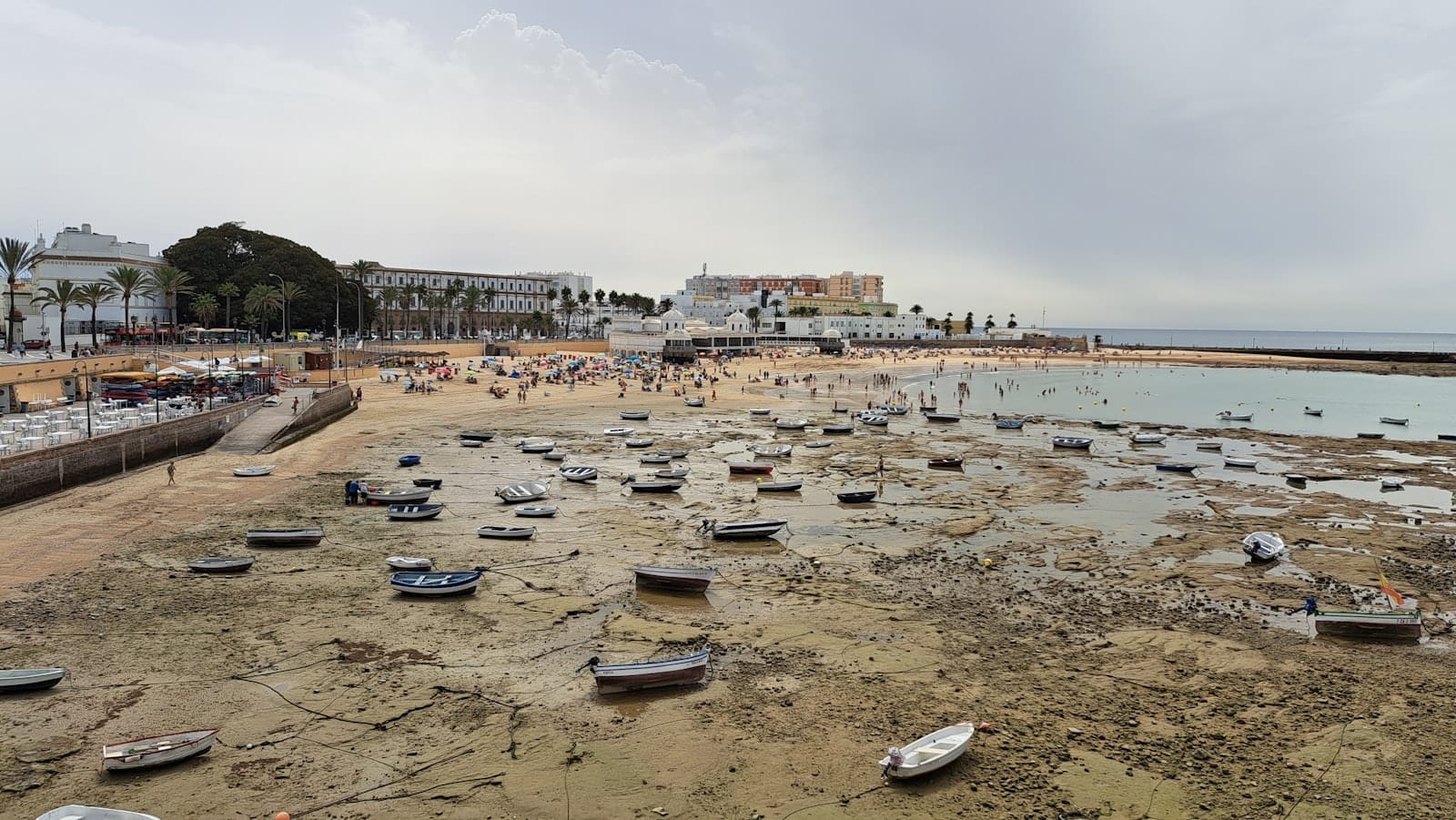
Barrio de La Viña sits at the north-western tip of Cádiz's historic center, pressed between the Atlantic Ocean and the old city walls. It is the neighborhood most closely tied to Cádiz's working-class identity, its fishing heritage, and the fierce local pride that fuels the city's famous Carnival. Narrow streets lined with modest whitewashed houses open suddenly onto the crescent beach of La Caleta, framed by two coastal fortresses.
La Viña is the barrio where Cádiz is most itself: a compact, salt-aired neighborhood of fishing-family traditions, seafood bars packed with locals, and the creative energy that makes the city's Carnival unlike anything else in Spain. The Atlantic is never more than a few minutes' walk in any direction.
Orientation: Where La Viña Sits in Cádiz
Cádiz occupies a narrow peninsula that juts into the Atlantic, and La Viña claims the north-western corner of the historic center. It is the last neighborhood before the sea on two sides: the Atlantic wraps around its western and southern edges, meeting the shore at Playa de La Caleta. On its inland flanks, Calle de la Rosa and Calle Sagasta mark the rough boundary between La Viña and the neighboring barrios of El Balón and San Juan.
Getting your bearings here is straightforward once you accept that almost every street in the old city is narrow and the grid is imperfect. The main internal artery is Calle Virgen de la Palma, which runs westward from the Baroque facade of the Iglesia de la Palma down toward the beach. Everything else in La Viña radiates out from this axis in a dense tangle of callejones and small plazas.
La Viña borders the broader historic center of Cádiz, which means you are a 15-minute walk from the Cathedral, the central market, and the main civic squares. The neighborhood is entirely within the old walled city, so arriving by bus or on foot from the newer parts of Cádiz means passing through the Puertas de Tierra gateway before weaving through the casco antiguo to reach La Viña's particular corner of it.
Character and Atmosphere: What La Viña Actually Feels Like
In the morning, La Viña smells of salt water and frying fish. The bars around Plaza del Tío de la Tiza open early and fill with locals taking coffee at the counter before work. Retired men play cards in doorways. Cats pick their way along iron balcony rails above narrow streets where the buildings are close enough to block the morning sun until nearly midday. It is a genuinely residential neighborhood, and the rhythms of daily life are visible in a way that feels increasingly rare in Spanish cities where tourism has displaced locals.
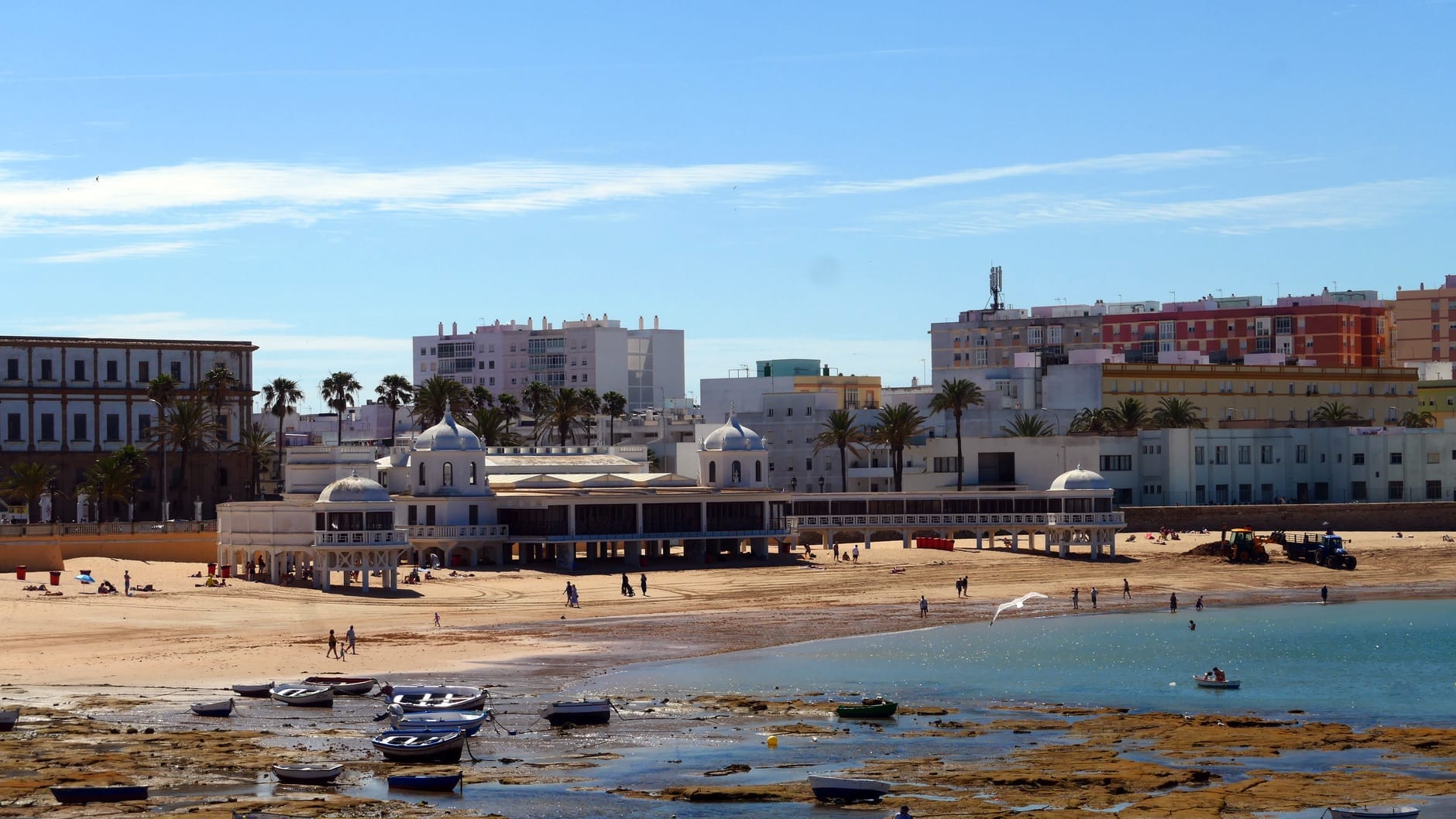
By afternoon, the light changes completely. The western orientation of La Caleta means that the beach and the coastal promenade catch the full Atlantic sun from midday onward, and the streets nearest the shore warm up in a way that drives people onto bar terraces. The area around the Balneario de La Palma, the ornate historic bathing pavilion that sits at the center of the beach, becomes a gathering point. Swimmers come and go. Families set up on the sand.
After dark, La Viña becomes one of the liveliest parts of the old city. The seafood bars and freidurías around Calle Virgen de la Palma and the surrounding streets do serious business from around 9pm. Weekend nights bring a younger crowd from across Cádiz, and the noise levels around the plaza can be significant. This is not a neighborhood for travelers who want quiet evenings: the streets are active until well past midnight on Fridays and Saturdays, and during Carnival the entire barrio operates around the clock for days.
ℹ️ Good to know
La Viña is historically a fishing and working-class neighborhood. Its bars and restaurants cater primarily to locals, which keeps quality high and prices reasonable by Spanish coastal standards. You will not find many concessions to tourist tastes here.
The character of La Viña is inseparable from Carnival. The neighborhood is considered the spiritual home of Cádiz's Carnival, one of the most distinctive festivals in Spain, known for its satirical chirigotas (singing groups) and elaborate street performances. The small Plaza del Tío de la Tiza, named after the 19th-century carnival figure Antonio Rodríguez, serves as a kind of symbolic center for this identity. Even outside February, references to Carnival are everywhere: in bar decorations, in the faces painted on walls, in the conversations of older residents.
What to See and Do in La Viña
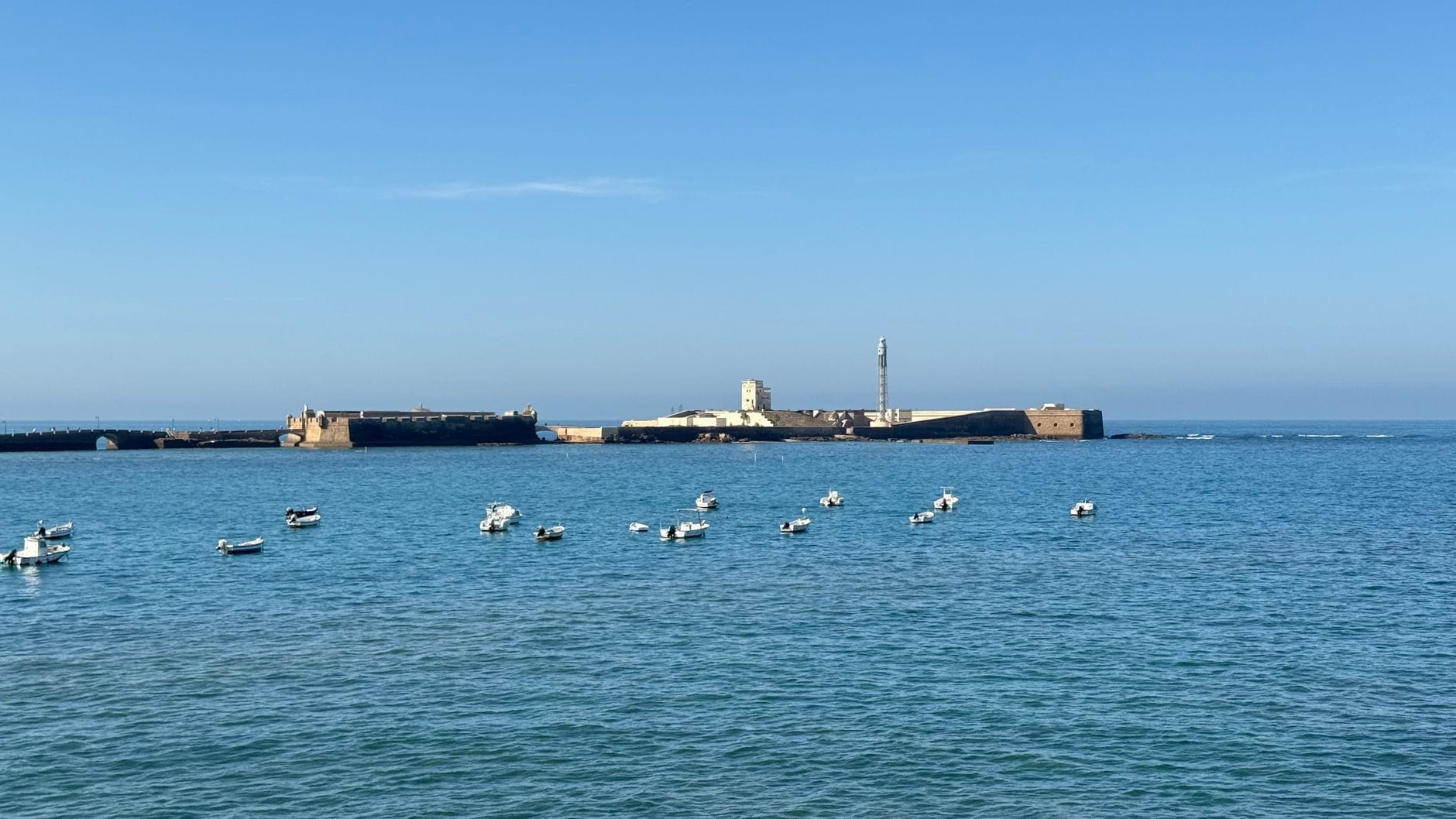
The undisputed focal point is Playa de La Caleta, the only beach within the historic center of Cádiz. It is a crescent of sand sheltered between two fortresses, facing west toward the open Atlantic. The beach is not large, and in summer it fills up quickly, but its setting is exceptional: to the north stands the Castillo de Santa Catalina, to the south the Castillo de San Sebastián connected to the mainland by a long stone causeway. Watching the sun descend into the Atlantic from this beach is one of those experiences that explains why people return to Cádiz repeatedly.
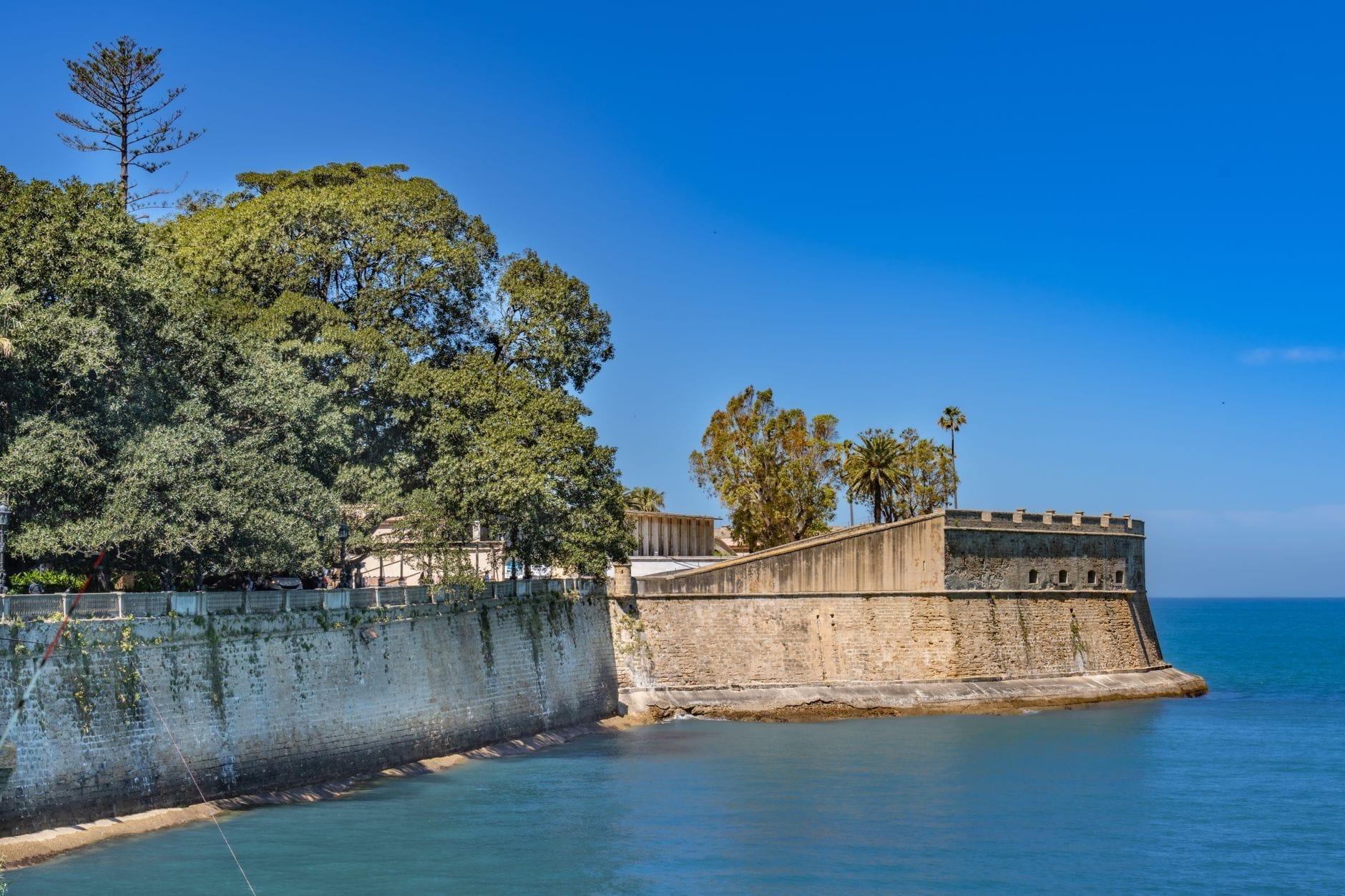
Both fortresses are worth exploring. The Castillo de Santa Catalina on the northern side of La Caleta is a star-shaped fort dating from the early 17th century that now hosts temporary art exhibitions and is free to enter. The Castillo de San Sebastián sits on a rocky islet to the south, reached via the long pedestrian causeway that is a destination in itself for an evening walk.
On the beach itself, the Balneario de La Palma y del Real is a historic seaside bathing pavilion that has stood here since the 19th century. Its ornate iron-and-glass architecture looks improbable against the beach backdrop, but it has been a fixture of Cádiz's coastal identity for generations. The Campo del Sur promenade runs along the southern edge of the old city and connects La Viña's coastline to the Cathedral quarter, making for one of the better seafront walks in the city.
Playa de La Caleta: the historic center's only beach, framed by two fortresses
Castillo de Santa Catalina: free-entry early-17th-century star-shaped fortress with regular exhibitions
Castillo de San Sebastián: islet fortress reached by a dramatic stone causeway
Balneario de La Palma: 19th-century seafront bathing pavilion
Plaza del Tío de la Tiza: the small neighborhood square that anchors La Viña's carnival identity
Iglesia de la Palma: Baroque parish church, completed in 1768, at the top of Calle Virgen de la Palma
Coastal bastions: Baluarte de los Mártires and Baluarte de Capuchinos, for views along the Atlantic wall
💡 Local tip
Walk the full length of Calle Virgen de la Palma from the Iglesia de la Palma to the beach, then turn left and follow the coastal path to the Castillo de San Sebastián causeway. This 30-minute loop takes in the neighborhood's main street, its beach, and both fortresses without doubling back.
Eating and Drinking: Seafood, Sherry, and Freidurías
La Viña has one of the highest concentrations of seafood bars and freidurías (fried fish shops) in all of Cádiz, which is saying something in a city that takes fried fish more seriously than almost anywhere in Andalusia. The streets around Calle Virgen de la Palma and Plaza del Tío de la Tiza are where you find the kind of places that have been feeding fishermen and their families for decades: counters loaded with fresh pescaíto frito, paper cones of chipirones (small squid), grilled urta (a local bream), and platters of tortillitas de camarones (shrimp fritters).
Prices in La Viña are generally lower than in the more tourist-facing streets near the Cathedral or the central market squares. A full lunch with a glass of fino sherry from the Jerez region typically costs less than 15 euros per person at the bar. Sherry is the right drink here: La Viña's food culture is rooted in the combination of cold, dry fino or manzanilla with fresh Atlantic seafood, and the local bars stock it properly.
The food scene is not particularly diverse. This is not a neighborhood for international cuisine or modern gastronomy. What it does exceptionally well is Andalusian seafood cooked simply and served quickly. If you want a sit-down meal at a proper restaurant, the streets just inside the boundary toward the city center offer more options. But for eating at the counter with a paper napkin and a view of a busy kitchen, La Viña is hard to beat anywhere in Cádiz.
💡 Local tip
Look for the freidurías that sell fish by weight to take away in paper cones. This is how many locals eat lunch on the beach in summer and it costs a fraction of restaurant prices. Ask for a mixed selection (variado) if you are unsure what to order.
Getting There and Around
Cádiz has no metro system. The city's main public transport within the historic center is the urban bus network, with routes running along Calle Sagasta and the streets bordering La Viña's inland edge. For most visitors, however, the neighborhood is reached entirely on foot from elsewhere in the old city. From the main train station at Plaza de Sevilla, the walk through the casco antiguo to La Viña takes around 20 to 25 minutes at a relaxed pace.
Within La Viña itself, everything is walkable. The neighborhood is compact: from Calle de la Rosa at the inland boundary to the beach at La Caleta is no more than a 10-minute walk. The streets are pedestrian-only in most sections, and cars are rare. Bicycles are occasionally used in the wider historic center but are impractical in the narrowest lanes of La Viña.
From the central sights of Cádiz, the most natural walking route into La Viña is westward from the Cathedral quarter, along the Campo del Sur coastal road. Alternatively, arriving from the Mercado Central de Abastos area, you can follow Calle San Francisco west, which transitions into the streets of La Viña within about 10 minutes. The neighborhood connects naturally to the rest of the old city without any physical barriers.
Where to Stay in La Viña
La Viña has a modest but growing number of small hotels, hostals, and holiday apartments, mainly on and around Calle Virgen de la Palma and the streets closest to the beach. For travelers who want to be within walking distance of La Caleta and embedded in a genuinely local neighborhood, staying in La Viña makes strong practical sense. For a broader overview of accommodation options across the historic center, the where to stay in Cádiz guide covers the full range of options.
The main trade-off is noise. Accommodations on or near the central plaza and Calle Virgen de la Palma will be loud on weekend nights and extremely loud during Carnival. If you are a light sleeper visiting outside carnival season, request a room on an interior courtyard rather than a street-facing room. Buildings further from the plaza toward the Castillo de Santa Catalina end of the neighborhood are significantly quieter.
La Viña suits independent travelers, couples, and anyone with an interest in local culture who does not need the convenience of being in the main tourist hub near the Cathedral. Families with young children should weigh up the late-night noise before committing to this specific neighborhood, though the beach proximity makes it attractive in summer.
⚠️ What to skip
During Cádiz's Carnival, typically in February, La Viña becomes the epicenter of the city's celebrations. Noise levels are extreme around the clock for several days, and accommodation books up months in advance. Plan accordingly if your visit coincides with Carnival dates.
La Viña and the Wider City: Connections Worth Making
La Viña is best understood as one piece of the old city rather than a standalone destination. Its neighbor to the east, Barrio El Pópulo, is one of the oldest quarters in Cádiz and offers a different kind of historical depth, with medieval arches and a Roman theatre. The two neighborhoods together represent the southern and western extremes of the historic center, and spending a full day moving between them is one of the better ways to understand the city's layers.
If you are building an itinerary, La Viña pairs well with a morning at the Mercado Central de Abastos followed by an afternoon on La Caleta beach and an evening working through the neighborhood's bar circuit. The Cádiz old town walking tour covers the wider historic center and will naturally bring you through La Viña's coastal edges. For anyone interested in what the Carnival actually involves before they arrive, the Cádiz Carnival guide is essential reading.
TL;DR
La Viña is the most authentically local neighborhood in Cádiz's historic center: a fishing-heritage barrio that has retained its working-class character despite growing visitor interest.
The beach at La Caleta, flanked by two 17th-century fortresses, is the neighborhood's defining physical feature and one of the finest urban beach settings in Andalusia.
The food and bar scene centers on Calle Virgen de la Palma and Plaza del Tío de la Tiza: simple, excellent seafood at counter bars with fino sherry, at prices lower than the Cathedral quarter.
Noise is a genuine consideration: weekend evenings are lively and Carnival in February is all-consuming. Light sleepers and families with young children should choose accommodation carefully.
Best suited to: independent travelers who want proximity to the beach, immersion in local bar culture, and a base that feels like real Cádiz rather than a tourist corridor.
Two days is exactly the right amount of time to experience Cádiz's ancient streets, golden beaches, and seafront fortresses. This itinerary organises the city's best sights into a logical, walkable weekend, from the cathedral and Roman theatre on Day 1 to La Caleta and the coastal walk on Day 2.
Cádiz enjoys one of Spain's most agreeable climates, with over 3,000 sunshine hours a year and Atlantic breezes that soften summer heat. But the best time to visit Cádiz depends entirely on what you're after: quiet sightseeing, beach days, Carnival madness, or winter-sun escape. This guide breaks it all down by season, event, and activity type.
Cádiz sits on a narrow peninsula almost entirely surrounded by the Atlantic, giving it one of the most varied coastlines in southern Spain. This guide covers the best beaches in Cádiz city and across the Costa de la Luz province, with honest assessments of crowd levels, water conditions, access logistics, and what each beach is actually good for.
Cádiz Carnival is the biggest event in the city's calendar and the most important mainland carnival in Spain. This guide covers dates, the COAC competition, pre-carnival food events, costume culture, booking logistics, and what to expect on the ground in February.
Cádiz is one of flamenco's true birthplaces, not a footnote to Seville or Granada. This guide covers the best tablaos, local peñas, seasonal festivals, honest price breakdowns, and practical booking advice for seeing genuine flamenco in Cádiz, Spain.
Cádiz, Spain has one of the most distinctive food cultures on the Iberian Peninsula. This guide covers the essential dishes to try, where to eat them, how much to pay, and when to go for the freshest seasonal ingredients straight from the Atlantic.
Cádiz carries more than three millennia of history within a compact peninsula on Spain's Atlantic coast. This guide traces the city's Phoenician roots, Roman grandeur, Age of Exploration wealth, and constitutional legacy — and tells you exactly where to see each layer of that history in person.
July and August bring relentless sun, warm Atlantic waters, and peak crowds to Cádiz, Spain. This guide breaks down the climate realities, the best beaches, how to handle the heat, and whether summer is actually the right time for your trip.
Jerez de la Frontera sits just 22 km from Cádiz by rail, making it one of the most rewarding day trips in Andalusia. This guide covers every transport option, the best things to do once you arrive, and honest advice on making the most of your time in Spain's sherry capital.
Cádiz Old Town packs Roman ruins, baroque cathedrals, medieval quarters, seafront promenades, and one of Andalusia's best markets into a peninsula you can cross on foot in under 20 minutes. This self-guided walking tour maps the essential route, tells you what each stop is actually worth, and gives you the practical details to do it without a guide.
Cádiz sits on a narrow Atlantic peninsula, which means extraordinary views are never far away. This guide covers the city's finest viewpoints, from paid rooftop towers to free coastal walks where the ocean frames everything.
Cádiz is one of Andalusia's most compelling coastal cities, packed with Atlantic beaches, Roman ruins, and a genuinely walkable old town. But is it right for your trip? Here's an honest, detailed look at what the city delivers and where it falls short.
Cádiz is one of Andalusia's most rewarding cities, and most of its best experiences are packed into a compact, walkable old town on a narrow Atlantic peninsula. This guide covers the top sights, beaches, food markets, and cultural stops — with honest advice on what's worth your time and what to skip.
Choosing where to stay in Cádiz Spain shapes your entire trip. This guide breaks down the city's main accommodation zones, names specific hotels with honest price context, and tells you exactly when to book and what to avoid.