Mercado Central de Abastos: Cádiz's 1838 Market
Inaugurated in 1838 on the site of a demolished convent, the Mercado Central de Abastos is often described as one of Spain's oldest covered markets. Set inside a neoclassical Doric portico in the heart of the old town, it serves both as a working daily market and a gastro venue that stays open late on weekends.
Quick Facts
- Location
- Plaza de la Libertad, S/N, 11005 Cádiz
- Getting There
- Bus lines 1, 2, 7 stop nearby; 5-min walk from Cádiz Cathedral or Plaza de San Juan de Dios; 15-min walk from Cádiz train station
- Time Needed
- 30–60 min for the market; longer if you stay for tapas at the Rincón Gastronómico
- Cost
- Free entry. Purchases at stalls and the gastro bar are extra.
- Best for
- Foodies, early-morning visitors, architecture lovers, and anyone wanting an authentic local routine
- Official website
- mercadocentralcadiz.com
What the Mercado Central de Abastos Actually Is
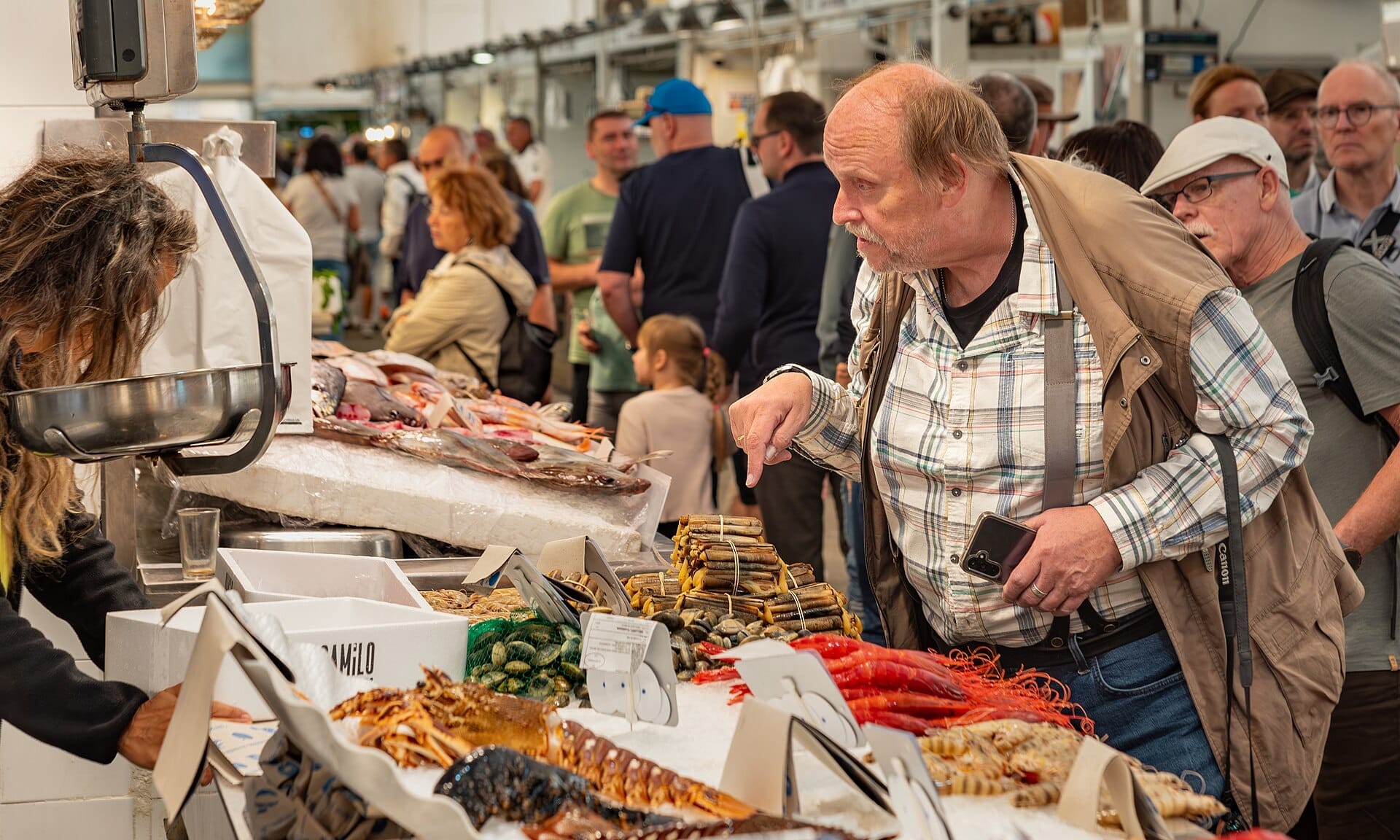
The Mercado Central de Abastos de Cádiz is not a tourist market. No stalls sell ceramic plates or embroidered tablecloths. What you find instead are Cádiz residents doing their weekly shop: elderly couples appraising whole fish, restaurant buyers arriving early for the best catch, and vendors who have worked the same counter for decades. That distinction matters when you are deciding whether to visit. If you want craft goods or souvenirs, look elsewhere. If you want to understand what this city eats and how it shops, this is your place.
The market sits in Plaza de la Libertad, a few minutes' walk from the cathedral and from Plaza de San Juan de Dios. Its neoclassical building, designed by Cádiz architect Torcuato Benjumeda and inaugurated in 1838, is built around a central open courtyard enclosed by a Doric portico. The building underwent a three-year renovation and reopened in October 2009, which explains why the structure looks well-maintained despite its age.
ℹ️ Good to know
The market was built on the former site of the Convento de los Descalzos (Discalced convent), making the current Plaza de la Libertad a layered piece of the city's history long before the first stall opened.
The Architecture: A Doric Portico in the Middle of the Old Town
Torcuato Benjumeda was one of the most prolific architects working in Cádiz in the late 18th and early 19th centuries, responsible for several of the city's neoclassical landmarks. His market design uses a quadrilateral plan with a continuous Doric colonnade framing the courtyard on all four sides. The columns are plain-shafted with simple capitals, which keeps the visual effect restrained and proportional rather than monumental. The overall impression from the outside is of a very large, dignified civic building that does not announce itself with flourishes.
Light enters the central courtyard from above, and during morning hours the sun cuts across the stone floor at a low angle that makes even the fish counters look photogenic. If architectural photography is part of your plan, arrive between 9:00 and 10:30, when the light is good and the stalls are fully stocked. By midday the light flattens and the vendors are beginning to pack down.
For more context on Cádiz's neoclassical architectural heritage, the Catedral de Cádiz and the Ayuntamiento de Cádiz are within easy walking distance and together form one of the best neoclassical city ensembles in southern Spain.
Tickets & tours
Hand-picked options from our booking partner. Prices are indicative; availability and final rates are confirmed when you complete your booking.
Historical Roman Cadiz guided walking tour
From 22 €Instant confirmationFree cancellationDay trip to Tarifa, Vejer, and the Bolonia beach from the Cadiz Bay
From 59 €Instant confirmationFree cancellationWinery tour with tasting of three wines in Sanlucar
From 18 €Instant confirmationFree cancellationWinery tour and wine tasting in Chiclana de la Frontera in Cadiz
From 25 €Instant confirmationFree cancellation
Morning at the Market: What You See, Smell, and Hear
Arrive before 10:00 and the market is operating at full pressure. The fish section is the sensory center of gravity: cold salt water from ice trays pools on the tiled floor, vendors call out prices, and the smell is clean and sharp rather than unpleasant, a sign of genuinely fresh stock. Cádiz's proximity to the Atlantic and the Strait of Gibraltar means the seafood selection is exceptional. You will see whole dorada (gilt-head bream), lenguado (sole), cuttlefish, clams, razor clams, prawns of several sizes, and on good days, atún de almadraba, the bluefin tuna caught using the ancient almadraba trap system in the waters off the Costa de la Luz.
The meat section is calmer and less aromatic. Jamón ibérico hangs from hooks, whole chickens sit in rows, and cuts of pork are displayed with a specificity that assumes the buyer knows exactly what they want. The fruit and vegetable stalls cluster toward the outer edges, piled with tomatoes, peppers, artichokes, and citrus, all in season and locally sourced.
By 13:00 the pace has slowed noticeably. Vendors begin wrapping unsold stock. The floor gets mopped. If you arrive after 14:00 you may find several stalls already closed, which makes the visit feel incomplete. The market closes at 15:30 Monday through Friday and at 16:00 on Saturday in winter.
💡 Local tip
Arrive between 9:30 and 11:00 for the fullest stalls, the best light in the courtyard, and the most activity. Avoid arriving after 13:30 if you want to see the market at its peak.
The Rincón Gastronómico: When the Market Turns Into a Bar
One of the less obvious features of the Mercado Central is the Rincón Gastronómico, a gastromarket area inside the building that operates on a different schedule from the main stalls. In the mornings it runs alongside the regular market, Tuesday through Friday from 09:00 to 15:30 and Saturday until 16:00. But on Tuesday through Thursday evenings it reopens from 18:00 to 23:00, on Friday it stays open until midnight, and on Saturday it runs from 19:00 to midnight.
This is a genuinely useful detail for travelers. It means you can return to the market at night and eat at counters surrounded by the same architecture that houses the morning fish trade. The atmosphere after dark is completely different: lower light levels, a younger crowd, cold Cruzcampo or local manzanilla being poured, and small plates of the same produce you saw raw in the morning. It is not the most polished dining experience in the city, but it has an authenticity that purpose-built tapas bars cannot replicate.
If you are planning a full evening in the old town, the market's gastro area pairs well with a walk through Barrio La Viña, Cádiz's most atmospheric neighborhood for late-night eating and local life.
Practical Walkthrough: Getting In and Moving Around
Entry is free. The market occupies a full city block around Plaza de la Libertad. There are multiple entry points from the surrounding streets, and the layout is open enough that orientation is not difficult. The stalls are not labeled in English, but the produce is self-evident and most vendors are accustomed to visitors pointing and asking questions in broken Spanish.
Accessibility: the municipal tourism authority lists "acceso adaptado" (step-free access) for Plaza de la Libertad, which means wheelchair users and those with pushchairs should be able to enter without difficulty. The interior floor is mostly flat tiled stone, though it can be slippery when wet from ice and cleaning.
City bus lines 1, 2, and 7 stop near the market. From Cádiz train station the walk takes around 15 minutes through the old town streets, which is a pleasant enough introduction to the neighborhood.
⚠️ What to skip
The market is open on Sundays for limited hours. Some sources list limited Sunday openings for food and tapas in certain seasons, but hours are inconsistent. Verify on the official website before planning a Sunday visit.
Who Should Skip This and Who Should Not
Visitors with very limited time who are prioritizing Cádiz's historic monuments may find 30 minutes in a food market hard to justify. The Mercado Central does not contain exhibits, guided tours, or any formal tourist infrastructure. If your itinerary is already tight with cathedral visits, tower climbs, and beach time, it is reasonable to walk past and save the time.
That said, for anyone interested in food culture, daily routines, or simply seeing a piece of working civic life that has existed in this form since 1838, the market is one of the most honest places in the city. It also makes sense as a starting point for a morning walk through the old town before the heat builds. You can buy fruit, cured meats, or a wedge of local cheese and carry it to one of the nearby plazas.
For context on how the market fits into a broader tour of the historic center, the Cádiz old town walking tour covers the surrounding streets, plazas, and landmarks that connect naturally to a visit here.
Seasonal Considerations
The market operates year-round but on different winter and summer schedules set by the Ayuntamiento (city council). During the summer months the lunch break culture of Cádiz shifts later, and the market may feel more animated in the 10:00 to 13:00 window than at the opening hour. In winter the mornings are cooler and the market can feel even more local, with fewer visitors and more genuine household shopping activity.
If you are visiting during Carnival, one of Cádiz's defining events, the market and surrounding streets take on a different energy entirely. The Cádiz Carnival guide explains how the city transforms in February and how to plan around it.
The best general window for visiting is April through June or September through October, when temperatures are moderate (roughly 19 to 26°C), the city is not at peak summer capacity, and the market reflects a normal rhythm of local life rather than a heat-reduced summer pace.
Insider Tips
- If you want to buy atún de almadraba (almadraba bluefin tuna), ask the fish vendors directly what is in season. The almadraba season typically runs from April to June, and fresh cuts sold at the market bear no resemblance in quality to what you will find in supermarkets elsewhere.
- The Rincón Gastronómico on a Friday or Saturday night offers a distinctive setting inside the 19th-century market building, which is unlike anything else in the city.
- Bring a small bag or a shopping net if you plan to buy produce. The stalls sell to locals who come prepared, and the plastic bag situation is minimal.
- The best vantage point for photographing the full interior is from the far end of the courtyard looking back toward the main entrance, around 10:00 when natural light hits the colonnade directly.
- If you are self-catering or staying in an apartment, the market is often the best place for fresh fish and vegetables. The quality difference is also considerable.
Who Is Mercado Central de Abastos For?
- Food-focused travelers who want to understand what Cádiz actually eats
- Architecture enthusiasts interested in neoclassical civic buildings
- Early risers looking for a structured start to a morning walk through the old town
- Self-catering visitors who want the best fresh produce and seafood in the city
- Travelers returning in the evening for the Rincón Gastronómico's late-night tapas session
Nearby Attractions
Other things to see while in Centro Histórico (Old Town):
- Alameda Apodaca
Alameda Apodaca is a protected Romantic-era promenade running along the northern sea wall of Cádiz's old town. Free, open at all hours, and overlooking the Bay of Cádiz, it offers one of the most atmospheric walks in the city — with very little effort required.
- Antiguo Hospital de Mujeres
Founded in 1677 and rebuilt in grand 18th-century baroque style, the Antiguo Hospital de Mujeres is one of Cádiz's most architecturally significant buildings. Today it is managed as a visitable monument linked to the Diocese of Cádiz y Ceuta, opening its twin patios and chapel to visitors for a modest entry fee, offering a rare glimpse into the city's golden-age ambitions.
- Ayuntamiento de Cádiz (City Hall)
The Ayuntamiento de Cádiz stands as one of the most photographed facades in Andalusia's oldest provincial capital. Begun in 1799 and shaped by two distinct architectural phases, it anchors the central plaza of Cádiz's historic core and speaks directly to the city's 19th-century ambitions. This guide covers what to see, when to go, and how the building fits into a walk through the old town.
- Calle Ancha
Calle Ancha cuts through the historic center of Cádiz as its widest and most storied street. Free to walk at any hour, it offers a concentrated dose of Baroque architecture, political history, and the kind of unhurried street life that defines this Atlantic city.