Ayuntamiento de Cádiz: The City Hall That Defines Plaza de San Juan de Dios
The Ayuntamiento de Cádiz stands as one of the most photographed facades in Andalusia's oldest provincial capital. Begun in 1799 and shaped by two distinct architectural phases, it anchors the central plaza of Cádiz's historic core and speaks directly to the city's 19th-century ambitions. This guide covers what to see, when to go, and how the building fits into a walk through the old town.
Quick Facts
- Location
- Plaza de San Juan de Dios s/n, 11005 Cádiz (Centro Histórico)
- Getting There
- Walkable from anywhere in the old town; city buses serve stops around Plaza de San Juan de Dios
- Time Needed
- 20–40 minutes to admire the exterior and explore the plaza; longer if a guided visit is available
- Cost
- Free to view the exterior; guided interior visits may be available — confirm with the Ayuntamiento directly
- Best for
- Architecture enthusiasts, history walkers, photographers, and anyone building a walking tour of the historic center
- Official website
- http://cadiz.es
What You're Looking At: A Building With Two Faces
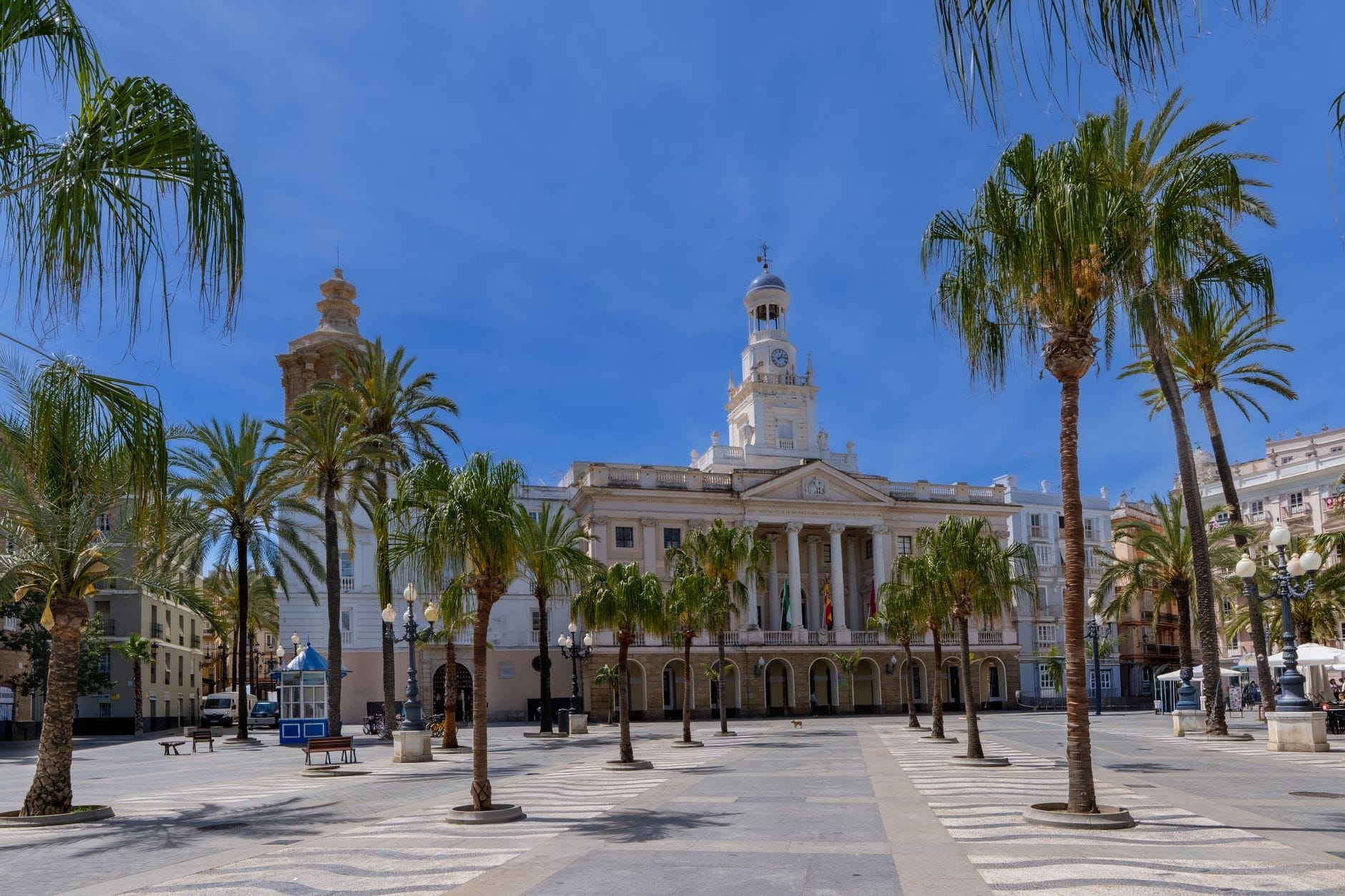
The Ayuntamiento de Cádiz occupies the northern edge of Plaza de San Juan de Dios, and the first thing most visitors notice is the sheer composure of its facade. Unlike the exuberant Baroque excess found elsewhere in Andalusia, this building is restrained, almost stern, its pale stone columns and horizontal lines giving it the bearing of a civic institution that knows its own importance. That restraint is intentional and historically specific.
Construction began in 1799, replacing earlier council houses that had stood on the same site since at least the 16th century. The neoclassical facade was designed by architects Pedro Ángel Albisu and Torcuato Benjumeda, two figures closely associated with the rational, Enlightenment-influenced aesthetic that briefly flourished in late-18th-century Spain before Napoleon's invasion upended everything. Benjumeda in particular left a strong mark on Cádiz's architectural character, and the City Hall is one of his most visible legacies.
The building was not completed in one go. A second major phase, carried out around 1865 by Manuel García del Álamo, introduced eclectic 19th‑century interiors with Neo‑Arab influences that contrast sharply with the neoclassical exterior. The result is a building with two distinct personalities: a cool, geometric public face and a warmer, more ornate interior that reflects the tastes of mid-19th-century Spain. Whether you get to see the interior depends on whether visits are running during your stay — check current visiting arrangements with the Ayuntamiento, as access is subject to municipal scheduling rather than fixed daily tourist opening hours.
💡 Local tip
Interior access is not guaranteed for casual visitors. If seeing the historic rooms matters to you, contact the Ayuntamiento de Cádiz before your visit to ask about visit or guided tour availability. The official contact channels are listed on cadiz.es and institucional.cadiz.es.
The Square It Anchors: Plaza de San Juan de Dios
The Ayuntamiento does not exist in isolation — it defines one side of Plaza de San Juan de Dios, arguably the most functional central square in Cádiz's old town. This is not a decorative plaza designed for photographs. It is a working square: locals cut through it on their way to the port, tourists sit at the cafe tables lining its perimeter, and city buses terminate nearby. It has the unselfconscious energy of a place that serves a practical purpose.
The square opens toward the waterfront on one side, which means that on clear mornings the light comes in from the east, falling directly on the City Hall facade. This is the best light of the day for photography: sharp, warm, and low enough to pick out the detail in the columns and cornices. By midday the facade falls into flat, shadowless glare, and by late afternoon it sits in shade. If the building matters to you as a subject, morning is the window.
The square also functions as a social barometer for the city. On weekday mornings it fills with people running errands at the surrounding offices and the nearby covered market. On weekend evenings it quietens down. During Cádiz Carnival, one of the most important cultural events in Spain, the streets around the plaza pulse with costumed groups, and the City Hall itself becomes a backdrop to the celebrations.
Tickets & tours
Hand-picked options from our booking partner. Prices are indicative; availability and final rates are confirmed when you complete your booking.
Historical Roman Cadiz guided walking tour
From 22 €Instant confirmationFree cancellationDay trip to Tarifa, Vejer, and the Bolonia beach from the Cadiz Bay
From 59 €Instant confirmationFree cancellationWinery tour and wine tasting in Chiclana de la Frontera in Cadiz
From 25 €Instant confirmationFree cancellationGuided tour of medieval Cadiz landmarks and history
From 30 €Instant confirmationFree cancellation
Architectural Detail Worth Slowing Down For
Most visitors walk past the Ayuntamiento de Cádiz at speed, which is a missed opportunity. The neoclassical facade rewards close attention. The ground floor arcade, open to pedestrians, supports two upper stories articulated by pilasters and topped by a balustrade. The central section is slightly projected and more formally composed than the wings, drawing the eye toward the main entrance without resorting to theatrical gesture. It is an exercise in proportion rather than drama.
Look at the stone itself. Much of historic Cádiz is built from ostionera, a local shell-limestone quarried from the seabed. It is soft enough to work with relative ease, which is why the city's builders could achieve fine detail even in an era before power tools. Over centuries, this stone develops a warm, slightly pitted surface texture that photographs poorly but reads beautifully in person, especially in the slanted light of early morning or late afternoon.
For broader context on the city's architectural legacy, the Cathedral of Cádiz — visible just minutes away on foot — was also substantially shaped by Benjumeda and represents a longer, more complicated architectural story spanning nearly 150 years of construction. Seeing both on the same walk gives a clearer sense of how this small city developed a coherent neoclassical identity in the late 18th and early 19th centuries.
Historical Weight: What This Building Has Witnessed
Cádiz was one of the most significant ports in the Spanish Atlantic world for several centuries, and the Ayuntamiento reflects that civic ambition. Construction began in 1799, at a moment when the city's merchant class was wealthy enough to invest in major public buildings. Within a decade, the Napoleonic Wars had transformed the political landscape entirely. Cádiz famously became the refuge of the Spanish Cortes during the French occupation, and it was here, in 1812, that Spain's first liberal constitution was drafted and promulgated.
The City Hall was still under construction during those events, but it represents the same civic spirit that produced the Constitution of 1812 — a belief that Cádiz deserved buildings and institutions equal to its political and commercial standing. That history is woven into the broader history of Cádiz and gives even a brief stop at the Ayuntamiento more depth than the building's exterior alone might suggest.
The Isabelline interiors added in 1865 reflect a later and very different moment: Spain under Isabel II, before the political turbulence of the late 19th century took hold. The decorative vocabulary of that period favored ornament, gilding, and historical references, which is why the interior reportedly contrasts so strikingly with the sober exterior. This dual nature makes the building an unusually compact illustration of two of Spain's most important 19th-century architectural moods.
How It Fits Into a Walking Route
The Ayuntamiento de Cádiz sits at the natural start or end point of a walk through the historic center. If you arrive by ferry from El Puerto de Santa María or from the main bus terminus, Plaza de San Juan de Dios is among the first things you encounter. From here, the old town walking tour unfolds logically westward through the narrow lanes toward the Cathedral, the market, and eventually the Atlantic-facing promenade.
A short walk south from the square leads to the El Pópulo quarter, one of the oldest parts of the city and home to the Roman theatre ruins and medieval arches. North and west from the plaza, the old town opens up into the web of narrow streets that contains most of Cádiz's compact but dense collection of churches, squares, and historic buildings.
One practical note: the streets immediately around Plaza de San Juan de Dios can be noisy and trafficked compared to the quieter lanes further into the old town. If you are sensitive to vehicle noise, spend your time at the Ayuntamiento efficiently and then move into the pedestrian zones to the west, where the character of the city changes noticeably.
ℹ️ Good to know
Plaza de San Juan de Dios has cafe tables with direct views of the City Hall facade, making it a reasonable spot to stop for coffee before or after the morning walk through the old town. Prices at plaza-facing cafes tend to be slightly higher than at bars in the surrounding streets.
Who This Attraction Suits and Who Might Move On Quickly
The Ayuntamiento de Cádiz is not an attraction with a defined visitor experience. There is no queue, no audio guide, no gift shop. It is a working government building whose exterior can be appreciated in ten minutes and whose interior requires specific arrangements. For travelers who want structured, ticket-based experiences, it functions better as a backdrop on a walking route than as a destination in its own right.
Architecture enthusiasts, urban historians, and anyone interested in the relationship between civic design and political history will find it genuinely rewarding. Families with young children will likely linger only for photographs. Those traveling primarily for beaches or nightlife may not find it worth a detour, though it sits naturally on the path to almost everything else in the historic center of Cádiz.
Weather affects the experience in a straightforward way. The plaza is fully exposed, with limited shade. In summer, which in Cádiz means genuine heat even if the Atlantic breeze moderates it compared to inland Andalusia, the midday sun makes extended stops in the square uncomfortable. The best time to visit Cádiz for comfortable sightseeing of outdoor architecture is April through June or September through October, when temperatures are more moderate.
Insider Tips
- Come on a weekday morning before 9:30am if you want the plaza largely to yourself and the east-facing facade in the best natural light. By 10am the commuter traffic picks up and the square fills quickly.
- The arcade at ground level is publicly accessible and gives you a sheltered vantage point to study the upper facade detail and the cornices from directly below — a perspective most visitors miss entirely.
- If you want to see the Isabelline interiors, do not simply turn up and expect entry. Contact the Ayuntamiento via institucional.cadiz.es in advance. Guided visits are not consistently available and require planning.
- The statue in Plaza de San Juan de Dios is of Segismundo Moret, a liberal politician from Cádiz — it is a small but worthwhile detail that adds context to the square as a whole.
- During Cádiz Carnival (typically February), the City Hall facade becomes one of the most photographed backdrops in the city as costumed groups perform in the square. If your visit coincides, plan for crowds but expect an atmosphere that is genuinely unlike anything else in Spain.
Who Is Ayuntamiento de Cádiz (City Hall) For?
- Architecture and design travelers interested in neoclassical and Isabelline styles
- History-focused visitors tracing the constitutional and Atlantic history of Cádiz
- Photographers looking for a landmark facade in controlled morning light
- Walkers building a route through the historic center who want context for the city's civic identity
- Carnival visitors for whom the plaza serves as a key gathering and performance space
Nearby Attractions
Other things to see while in Centro Histórico (Old Town):
- Alameda Apodaca
Alameda Apodaca is a protected Romantic-era promenade running along the northern sea wall of Cádiz's old town. Free, open at all hours, and overlooking the Bay of Cádiz, it offers one of the most atmospheric walks in the city — with very little effort required.
- Antiguo Hospital de Mujeres
Founded in 1677 and rebuilt in grand 18th-century baroque style, the Antiguo Hospital de Mujeres is one of Cádiz's most architecturally significant buildings. Today it is managed as a visitable monument linked to the Diocese of Cádiz y Ceuta, opening its twin patios and chapel to visitors for a modest entry fee, offering a rare glimpse into the city's golden-age ambitions.
- Calle Ancha
Calle Ancha cuts through the historic center of Cádiz as its widest and most storied street. Free to walk at any hour, it offers a concentrated dose of Baroque architecture, political history, and the kind of unhurried street life that defines this Atlantic city.
- Campo del Sur
Campo del Sur is the sweeping coastal avenue that traces the southern edge of Cádiz's historic peninsula, stretching roughly 1.5 km along the Atlantic. Free, open at all hours, and framed by the city's cathedral dome on one end and ancient sea walls on the other, it is one of the most rewarding walks in the old town.