Alameda Apodaca: Cádiz's Seafront Promenade Above the Bay
Alameda Apodaca is a protected Romantic-era promenade running along the northern sea wall of Cádiz's old town. Free, open at all hours, and overlooking the Bay of Cádiz, it offers one of the most atmospheric walks in the city — with very little effort required.
Quick Facts
- Location
- Northern seafront, Casco Antiguo, Cádiz 11003
- Getting There
- Walkable from the historic centre; local buses serve nearby central streets
- Time Needed
- 30–60 minutes for a full walk; longer if you linger at viewpoints
- Cost
- Free — open public space, no ticket required
- Best for
- Evening walks, Atlantic views, heritage architecture, photography
- Official website
- en.andalucia.org/listing/alameda-apodaca/15723101
What Is Alameda Apodaca?
Alameda Apodaca is a landscaped seafront promenade that runs along the northern sea wall of Cádiz's historic centre, stretching between the Baluarte de la Candelaria to the west and the Plaza de Argüelles and Baluarte de San Carlos to the east. The walk is part of Cádiz's protected heritage landscape, reflecting the city's Romantic-era garden tradition — not just a pleasant path by the sea, but a protected cultural landscape.
The promenade's eastern section took on the name Alameda de Apodaca in the 19th century, honouring Admiral Juan José Ruiz de Apodaca y Eliza, a Cádiz-linked figure associated with the city's maritime history. The western section carries the name Marqués de Comillas, after Claudio López Bru, the 2nd Marquis of Comillas. Together with the adjacent Alameda Clara Campoamor and Hermanas Carvia Bernal strips, these gardens form a continuous Romantic-style coastal walk that most visitors experience as a single, seamless route.
ℹ️ Good to know
The Alameda Apodaca is a public open space with no gates or ticketed entry. It is freely accessible as an outdoor promenade.
The Walk: What You Actually See
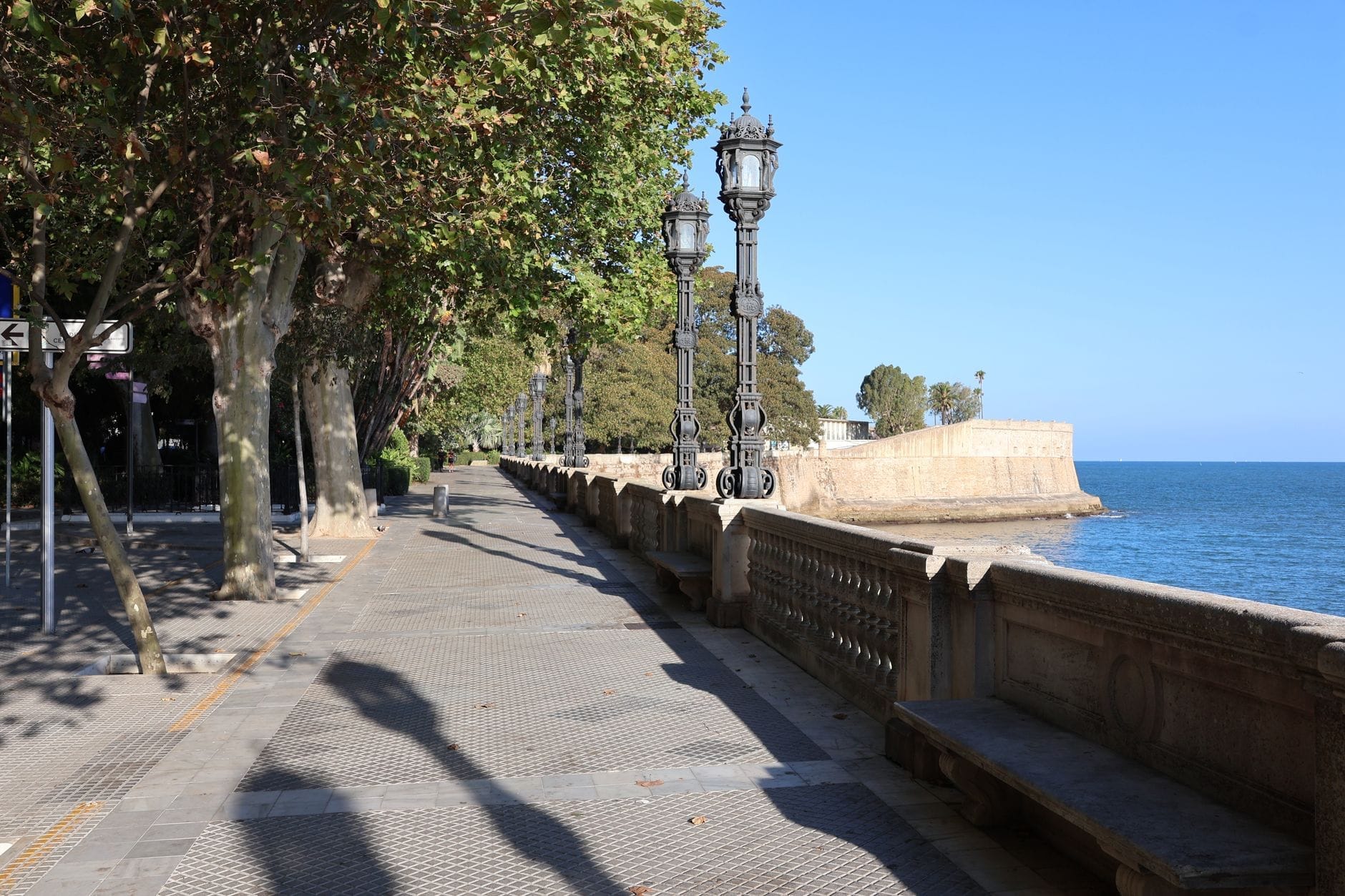
The promenade is defined physically by a broad stone balustrade that separates the garden avenue from a sheer drop to the sea. On one side, ornamental lampposts, pergolas, benches, and clipped hedges line the path. On the other, the Bay of Cádiz opens wide, and on clear days the whitewashed buildings of El Puerto de Santa María are visible across the water. The bay changes colour dramatically across the day: a flat silver in morning light, a deep blue-green at midday, and something close to copper in the late afternoon.
The path surface is cobblestone throughout. It is wide enough that walkers, joggers, and people pausing to look at the sea coexist without congestion except during peak evening hours in summer. The benches along the balustrade face outward toward the bay, which is exactly where you want to be facing. The pergola sections provide shade on hot days, making midday walks more manageable than they would be on an exposed seafront elsewhere in the city.
At the western end, the Baluarte de la Candelaria anchors the promenade with solid 18th-century military architecture. To the east, the route connects naturally into the broader sea-wall walk that links toward Campo del Sur and eventually to the Catedral de Cádiz. Treating the Alameda Apodaca as a standalone destination is valid, but most visitors fold it into a longer northern-then-eastern coastal circuit.
Tickets & tours
Hand-picked options from our booking partner. Prices are indicative; availability and final rates are confirmed when you complete your booking.
Historical Roman Cadiz guided walking tour
From 22 €Instant confirmationFree cancellationDay trip to Tarifa, Vejer, and the Bolonia beach from the Cadiz Bay
From 59 €Instant confirmationFree cancellationWinery tour with tasting of three wines in Sanlucar
From 18 €Instant confirmationFree cancellationWinery tour and wine tasting in Chiclana de la Frontera in Cadiz
From 25 €Instant confirmationFree cancellation
When to Visit and How the Atmosphere Changes
Early mornings are the quietest time on the Alameda. By around 8am, a handful of local residents are out walking dogs or jogging, and the light on the bay has a clean, uncluttered quality. The air carries a slight salt smell, stronger closer to the balustrade, and there is little ambient noise beyond the sea. If you want to photograph the promenade without people in frame, this is your window.
Late afternoons and evenings shift the register completely. From around 6pm onward, particularly in spring and summer, the promenade fills with a cross-section of local life: families with young children, older residents settled on benches, couples walking slowly, and tourists stopping to photograph the horizon. It becomes genuinely social in a way that is more interesting to observe than to be photographed in. The evening light on the bay is the main attraction at this hour — warm tones on the water and rooftops, even though this north-facing promenade does not offer a classic sunset view.
Cádiz's Atlantic climate means the northern seafront can be windier than other parts of the old town, especially in autumn and winter. The balustrade provides minimal wind protection. If you are visiting between November and February, bring a layer regardless of the daytime temperature. For broader seasonal planning, the best time to visit Cádiz guide covers seasonal trade-offs across the city in more detail.
💡 Local tip
The promenade faces almost due north across the Bay of Cádiz. This means it does not offer a classic western sunset view. For sunset photography, the western end near Baluarte de la Candelaria is better angled, or consider combining your visit with a walk to Playa de la Caleta.
Historical and Cultural Context
Romantic-era promenades were a specific urban form in 19th-century Spain, built during a period when coastal and city elites wanted designed outdoor spaces for supervised social mixing. The Alameda Apodaca fits squarely into this tradition. Its formal elements — the stone railings, ornamental fountains, lamp standards, and geometric plantings — reflect the Romantic landscaping style fashionable across southern Spain from the 1840s onward. The naming of the promenade in 1856 after Admiral Apodaca was itself a civic gesture, typical of the period, connecting the space to a prominent figure associated with Cádiz's commercial importance.
Cádiz in the 19th century was a significant Atlantic trading port, and the promenades along its northern sea wall would have been used by merchant families and naval officers as much as by ordinary residents. That layered social history is not immediately obvious when you walk the promenade today, but it gives the space a weight that purely decorative public gardens lack. The formal heritage designation ensures the structure and planting character are maintained close to their historic condition.
For a deeper understanding of Cádiz's historical development and what shaped the architecture of its old town, the Cádiz history guide provides useful context before or after your visit to the Alameda.
Practical Walkthrough: How to Do This Right
The Alameda Apodaca is easy to reach on foot from much of the historic centre. From the central market area or the cathedral district, a short walk north brings you to the sea wall. There are no particular transport stops directly adjacent, but the surrounding streets are well-served by Cádiz's local bus network and are walkable from most accommodation in the old town.
Wear comfortable shoes. The cobblestone surface is not rough, but it is uneven in places, and the full promenade circuit from one end to the other is longer than it appears from the midpoint. There are no official statements confirming full wheelchair accessibility on this surface; if mobility is a concern, the smoother sections toward the eastern end are generally better maintained than the western stretches near the Baluarte de la Candelaria.
A natural itinerary pairs the Alameda with the nearby city walls of Cádiz and a stop at the Torre Tavira for elevated views over the old town. The full northern and eastern coastal circuit, including the Alameda, Campo del Sur, and the cathedral waterfront, takes around two to three hours at a relaxed pace.
⚠️ What to skip
The cobblestone surface can become slippery when wet. After rain, especially in winter months, take care near the balustrade edge. There are no barriers beyond the stone railing.
Honest Assessment: What This Place Is and Is Not
The Alameda Apodaca is a good walk. It is not a destination attraction in the way that the Cádiz cathedral or Torre Tavira are. Visitors who come expecting a formal botanical garden, a dramatic viewpoint, or a significant museum experience will find it understated. The value is in the combination of the sea views, the quality of the historic fabric, the shade of the pergolas, and the ease of integration into a longer walk around the old town.
If you are planning a full day in the historic centre, the Alameda sits naturally alongside other walks in the Cádiz historic centre. It requires no planning, no ticket, and can be enjoyed in under an hour at a relaxed pace. For visitors with very limited time who need to prioritise, the Cádiz old town walking tour shows how the Alameda fits into a structured half-day circuit.
Travellers who dislike uneven surfaces, exposed windy conditions, or spaces without structured programming may find the Alameda less engaging than other parts of the city. It rewards slowness and observational walking rather than activity-focused touring.
Insider Tips
- The benches on the sea-facing side of the balustrade fill up quickly on warm evenings. If you want a seat with an unobstructed bay view, arrive before 7pm in summer.
- The western end near Baluarte de la Candelaria offers the widest field of view across the bay and toward El Puerto de Santa María. Walk to this end before doubling back rather than turning around at the midpoint.
- Morning light hits the bay from the east, making the water brightest and most photogenic in the hour after sunrise. Evening light produces warmer tones but the sun sets behind the old town, not over the water from this vantage point.
- The pergola sections provide genuine shade in summer. If you are visiting during the hotter months, the middle section of the promenade under the pergolas is significantly cooler than the open ends.
- The promenade connects seamlessly to Campo del Sur on its eastern end. Rather than retracing your steps, walk the full circuit west to east along the Alameda, then continue east along the southern sea wall back toward the centre for a natural loop.
Who Is Alameda Apodaca For?
- Slow walkers and those who want a low-effort way to see the Bay of Cádiz
- Photographers looking for long coastal compositions and Romantic-era architectural detail
- Travellers building a full northern and eastern sea-wall circuit of the old town
- Evening strollers wanting a social, local atmosphere without bars or restaurants
- History-minded visitors interested in 19th-century urban design and Andalusian heritage
Nearby Attractions
Other things to see while in Centro Histórico (Old Town):
- Antiguo Hospital de Mujeres
Founded in 1677 and rebuilt in grand 18th-century baroque style, the Antiguo Hospital de Mujeres is one of Cádiz's most architecturally significant buildings. Today it is managed as a visitable monument linked to the Diocese of Cádiz y Ceuta, opening its twin patios and chapel to visitors for a modest entry fee, offering a rare glimpse into the city's golden-age ambitions.
- Ayuntamiento de Cádiz (City Hall)
The Ayuntamiento de Cádiz stands as one of the most photographed facades in Andalusia's oldest provincial capital. Begun in 1799 and shaped by two distinct architectural phases, it anchors the central plaza of Cádiz's historic core and speaks directly to the city's 19th-century ambitions. This guide covers what to see, when to go, and how the building fits into a walk through the old town.
- Calle Ancha
Calle Ancha cuts through the historic center of Cádiz as its widest and most storied street. Free to walk at any hour, it offers a concentrated dose of Baroque architecture, political history, and the kind of unhurried street life that defines this Atlantic city.
- Campo del Sur
Campo del Sur is the sweeping coastal avenue that traces the southern edge of Cádiz's historic peninsula, stretching roughly 1.5 km along the Atlantic. Free, open at all hours, and framed by the city's cathedral dome on one end and ancient sea walls on the other, it is one of the most rewarding walks in the old town.