Antiguo Hospital de Mujeres: Cádiz's Forgotten Baroque Jewel
Founded in 1677 and rebuilt in grand 18th-century baroque style, the Antiguo Hospital de Mujeres is one of Cádiz's most architecturally significant buildings. Today it is managed as a visitable monument linked to the Diocese of Cádiz y Ceuta, opening its twin patios and chapel to visitors for a modest entry fee, offering a rare glimpse into the city's golden-age ambitions.
Quick Facts
- Location
- Calle Hospital de Mujeres, 26, Centro Histórico, Cádiz
- Getting There
- Walkable from Cádiz train and bus station through the old town; city buses serve nearby streets in the casco histórico
- Time Needed
- 45–75 minutes
- Cost
- General admission 5 € including audio guide; reduced and free categories available (verify locally before visiting, as pricing may change)
- Best for
- Baroque architecture, Spanish Golden Age art, off-the-tourist-trail history
What the Antiguo Hospital de Mujeres Actually Is
The Antiguo Hospital de Mujeres, formally known as the Hospital de Nuestra Señora del Carmen, is an 18th-century baroque complex on Calle Hospital de Mujeres in the heart of Cádiz's historic center. It was built between 1736 and 1749 under the direction of architect Pedro Luis Gutiérrez de San Martín, known locally as Maestro Afanador, with sculptural ornamentation by the celebrated Cayetano de Acosta. The inauguration took place on 16 October 1749.
Most visitors come for the El Greco painting housed in the chapel: a large canvas of Saint Francis of Assisi in Ecstasy, widely considered one of the finest works by the Cretan-born master held in Andalusia. But even visitors unmoved by old masters will find the building itself a compelling stop. The facade, the twin interior patios, and the monumental imperial staircase are textbook examples of Andalusian baroque at its most confident.
The institution was founded much earlier, in 1677, by Madre Antonia de la Cruz, initially at a different location near the corner of present-day Calles Columela and Feduchi, in a building that disappeared around 1936. The current building was constructed to replace that earlier, more modest facility as Cádiz's wealth from Atlantic trade grew through the early 18th century. The hospital served female patients until the mid‑20th century, when it closed for economic reasons. It is now managed as a visitable BIC monument linked to the Diocese of Cádiz y Ceuta. It was declared a Bien de Interés Cultural with the category of Monument by Decree 308/2003 of 28 October 2003.
ℹ️ Good to know
Hours and prices are published by Cadiz Sacra: visits are generally Monday to Friday from 10:30 to 16:00 (festivos cerrado; last entry 30 minutes before closing), with a general entry fee of 5 € including audio guide and defined reduced/free categories. Check directly with Cadiz Sacra or a local tourism office for any recent changes before making this your primary stop for the day.
The Architecture: What to Look For
Start at the street facade. The portal is an extravagant composition of carved stone: sinuous columns, carved shell motifs, religious statuary, and a dynamic interplay of concave and convex surfaces that is characteristic of Spanish baroque, particularly the Churrigueresque tendency. Cayetano de Acosta, who also worked on the Hospital de los Venerables in Seville, brought a sculptural intensity to the stonework that rewards close inspection. Stand back on the narrow street to take in the full composition; the facade fills almost the entire width, and the scale becomes clear only from a slight distance.
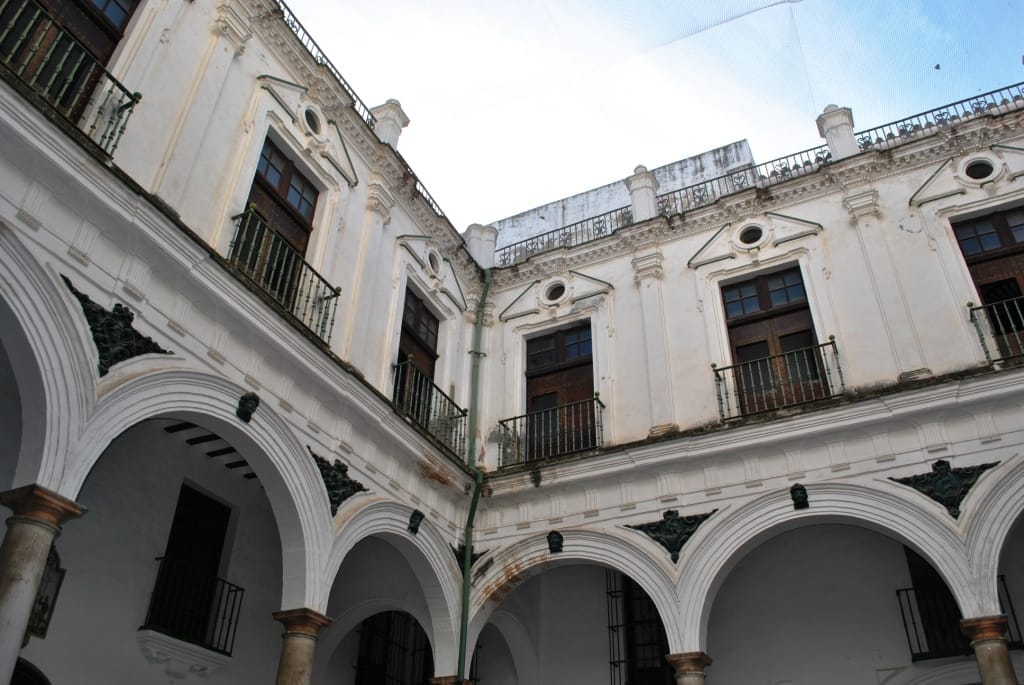
Step through the entrance and the spatial logic of the building opens up immediately. The plan is organized around two linked patios: a formal outer courtyard framed by two-story arcades, and a second inner patio that feels quieter and more domestic. The arcades are carried on stone columns with carved capitals, and the proportions have the kind of rational order that contrasts pleasingly with the exuberance of the exterior.
Between the two patios rises the monumental staircase. It follows what architects call an imperial plan: a single central flight that splits at the first landing into two symmetrical arms ascending in opposite directions. The visual effect is theatrical. Light falls from above, the stone balustrades cast clean shadows, and the whole composition reads as a statement of institutional ambition. This staircase alone justifies the entry fee for anyone interested in 18th-century Spanish architecture.
💡 Local tip
Photography tip: the monumental staircase photographs best in the morning, when natural light enters from above. Use the full height of the space rather than shooting from the base only. The stone color is warm and responds well to the diffuse light of an overcast day.
Tickets & tours
Hand-picked options from our booking partner. Prices are indicative; availability and final rates are confirmed when you complete your booking.
Historical Roman Cadiz guided walking tour
From 22 €Instant confirmationFree cancellationDay trip to Tarifa, Vejer, and the Bolonia beach from the Cadiz Bay
From 59 €Instant confirmationFree cancellationWinery tour with tasting of three wines in Sanlucar
From 18 €Instant confirmationFree cancellationWinery tour and wine tasting in Chiclana de la Frontera in Cadiz
From 25 €Instant confirmationFree cancellation
The El Greco: One Painting Worth Pausing Over
The chapel houses a large canvas attributed to El Greco depicting Saint Francis of Assisi in Ecstasy. El Greco, born Doménikos Theotokópoulos in Crete around 1541, worked in Toledo from the 1570s until his death in 1614 and produced numerous versions of this subject. The composition in Cádiz shows the saint with arms raised, face upturned, bathed in a cold, otherworldly light against a dark ground. The elongated figure and luminous handling of drapery are unmistakably his.
The painting is displayed in the chapel, which is a serene space after the grandeur of the patios and staircase. Spend time with it. El Greco's work does not reward a quick glance; the tonal shifts in the drapery and the quality of the saint's expression are most visible from a moderate distance, roughly four to five meters, where the individual brushstrokes resolve into a coherent whole.
If the El Greco is your primary reason for visiting Cádiz's art, note that the Museo de Cádiz holds a substantial collection of Zurbarán paintings alongside other significant works from the region, making for a logical pairing on the same day.
How the Experience Changes Through the Day
The interior patios are at their best in the morning, roughly between 9 and 11 am, when low-angle sunlight enters the arcades at a raking angle and the stone glows with a honey color. At this time the building is usually quiet, the audio guide is easier to follow without competing noise, and the chapel feels genuinely contemplative.
By midday the light flattens and the temperature inside the stone corridors can feel warm in summer. Cádiz's summers are hot and dry, and the building, for all its mass, does not feel notably cool at peak daytime heat. If you are visiting between June and September, morning entry is more comfortable. Spring visits between April and June are generally the most pleasant, with moderate temperatures and longer opening windows.
The surrounding streets of the Centro Histórico are relatively quiet in the morning compared to the afternoon, which makes the walk to the hospital less crowded and easier to navigate. The building is near the parish church of San Lorenzo, so if you are following the Iglesia de Santa Cruz or planning a broader heritage loop, the hospital fits naturally into a morning circuit of Cádiz's ecclesiastical baroque.
Honest Assessment: Is It Worth Your Time?
For travelers with a specific interest in baroque architecture or Spanish Golden Age painting, yes, without hesitation. The building is extraordinary by any measure, and it receives far fewer visitors than the cathedral or the Torre Tavira, which means you can move through the patios and chapel at your own pace without crowds.
For travelers on a tight schedule who are not especially drawn to religious art or architectural history, the time investment is harder to justify. The visit runs about 45 to 75 minutes including the audio guide, and the experience is essentially interior: patios, staircase, chapel, and a few auxiliary rooms. There are no panoramic views, no food or drink on site, and the interpretive content is limited to what the audio guide provides.
If you are deciding between this and the Catedral de Cádiz for a single architectural stop, the cathedral offers more variety and includes the rooftop terrace with views over the city. The hospital is the better choice if intimacy and architectural depth matter more to you than breadth.
⚠️ What to skip
Because the building is administered through the Cádiz Sacra program in coordination with the Diocese of Cádiz y Ceuta rather than a standalone municipal museum, opening hours can be subject to change for religious or institutional events. Closures can occur without wide advance notice online. Always verify before visiting.
Getting There and Practical Notes
The Antiguo Hospital de Mujeres is located at Calle Hospital de Mujeres, 26, within walking distance of most points in the compact historic center. From the main train and bus station at the edge of the old town, the walk takes roughly 10 to 15 minutes on foot through the narrow streets of the casco histórico. City buses connect the station area to various points in the center, though given the pedestrian-friendly scale of the old town, most visitors arrive on foot.
There is no dedicated parking adjacent to the building. Visitors arriving by car should park in one of the public car parks on the perimeter of the old town and walk in. The streets immediately around the hospital are narrow and largely residential.
Accessibility is limited by the building's 18th-century structure. The monumental staircase, multiple floor levels, and absence of documented step-free routes mean that visitors with significant mobility limitations may not be able to access all areas. Confirm accessibility details directly with the venue before visiting.
- Wear comfortable shoes with grip: the stone floors are smooth and can be slippery
- Dress modestly as this is an active diocesan building with religious functions
- Bring a small amount of cash in case card payment is not accepted at the entry
- The audio guide is generally included in the entry fee and adds meaningful context; use it
Insider Tips
- Visit on a weekday morning to have the patios almost entirely to yourself. Weekend afternoons attract more visitors, and the intimate scale of the courtyards feels crowded with even a dozen people.
- The facade on Calle Hospital de Mujeres is best photographed in late afternoon when the western light falls directly on the carved stonework. For the interior, morning is better. Plan accordingly if photography matters to you.
- The audio guide covers the El Greco painting in detail and is worth following slowly in the chapel rather than skimming. Several attribution and dating debates around the canvas are explained in a way that is accessible without prior art history knowledge.
- Pair this visit with the nearby Oratorio de San Felipe Neri a few streets away. Both are 18th-century religious buildings with strong historical associations to Cádiz's golden age, and together they take a full, satisfying morning.
- Because the building functions as an active institutional headquarters, there are occasionally staff moving through the corridors. This is not intrusive, but it means the experience is less museum-like and more like being a respectful guest in a working building.
Who Is Antiguo Hospital de Mujeres For?
- Travelers with an interest in Spanish baroque architecture who want depth over spectacle
- Art history enthusiasts seeking El Greco works outside major museum circuits
- Visitors who prefer quiet, uncrowded cultural stops over high-footfall attractions
- Anyone doing a focused heritage walk through Cádiz's 18th-century ecclesiastical buildings
- Photographers looking for dramatic interior light, carved stone detail, and architectural geometry
Nearby Attractions
Other things to see while in Centro Histórico (Old Town):
- Alameda Apodaca
Alameda Apodaca is a protected Romantic-era promenade running along the northern sea wall of Cádiz's old town. Free, open at all hours, and overlooking the Bay of Cádiz, it offers one of the most atmospheric walks in the city — with very little effort required.
- Ayuntamiento de Cádiz (City Hall)
The Ayuntamiento de Cádiz stands as one of the most photographed facades in Andalusia's oldest provincial capital. Begun in 1799 and shaped by two distinct architectural phases, it anchors the central plaza of Cádiz's historic core and speaks directly to the city's 19th-century ambitions. This guide covers what to see, when to go, and how the building fits into a walk through the old town.
- Calle Ancha
Calle Ancha cuts through the historic center of Cádiz as its widest and most storied street. Free to walk at any hour, it offers a concentrated dose of Baroque architecture, political history, and the kind of unhurried street life that defines this Atlantic city.
- Campo del Sur
Campo del Sur is the sweeping coastal avenue that traces the southern edge of Cádiz's historic peninsula, stretching roughly 1.5 km along the Atlantic. Free, open at all hours, and framed by the city's cathedral dome on one end and ancient sea walls on the other, it is one of the most rewarding walks in the old town.