Calle Ancha: Cádiz's Grand Promenade Since the 18th Century
Calle Ancha cuts through the historic center of Cádiz as its widest and most storied street. Free to walk at any hour, it offers a concentrated dose of Baroque architecture, political history, and the kind of unhurried street life that defines this Atlantic city.
Quick Facts
- Location
- Historic center (Centro Histórico), Cádiz, Andalusia, Spain
- Getting There
- Walk from Cádiz train/bus station into the old town; Calle Ancha is a few minutes on foot from Plaza de San Juan de Dios
- Time Needed
- 20–45 minutes to stroll the street; longer if you explore the surrounding area
- Cost
- Free – it is a public street open at all hours
- Best for
- Architecture lovers, history enthusiasts, and anyone wanting to understand Cádiz's urban identity
What Is Calle Ancha?
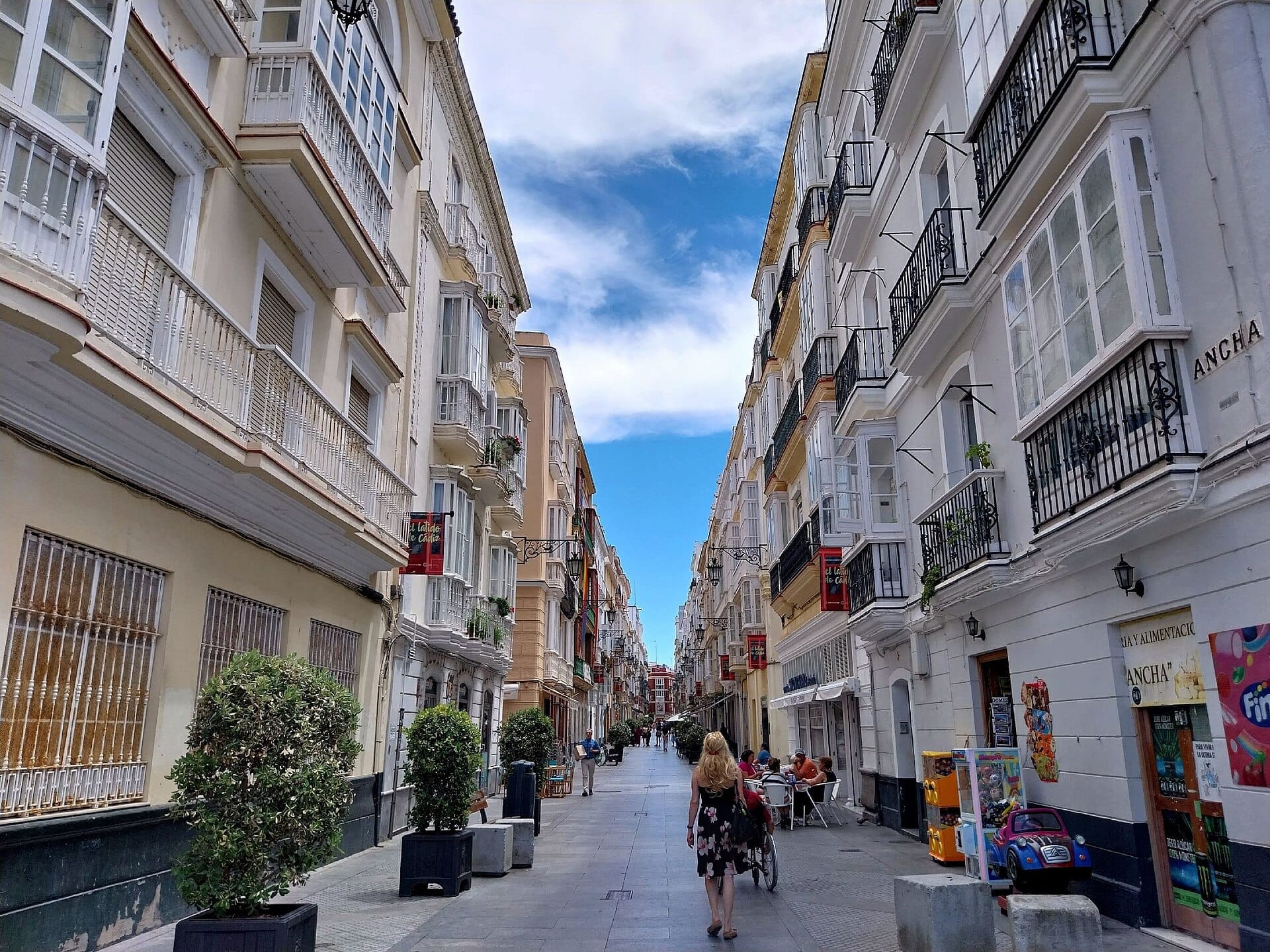
Calle Ancha — literally 'Wide Street' — has been the principal artery of Cádiz's historic center since the 18th century. In a city famous for its narrow, labyrinthine lanes, the name is no exaggeration: the street is noticeably broader than its neighbors, which is exactly why it became the social and commercial spine of the old town. Walking it today, you get a sense of how deliberately it was designed to impress, to allow carriages to pass, crowds to gather, and important business to be conducted in plain view.
The street belongs to the Centro Histórico, the compact old city that occupies the narrow peninsula jutting into the Atlantic. Unlike the cramped medieval quarters such as El Pópulo, Calle Ancha was shaped during Cádiz's commercial golden age, when the city controlled trade with the Americas and had the wealth to build on a grander scale.
💡 Local tip
Practical note: Calle Ancha is a public street with no entrance fee and no opening hours. You can walk it at any time of day or night, though morning and early evening offer the best light and the most interesting street activity.
The Architecture: What You're Actually Looking At
The buildings lining Calle Ancha are predominantly 18th-century in character, reflecting the period when Cádiz was one of the wealthiest trading cities in Europe. Look up as you walk: the facades feature wrought-iron balconies, stone window surrounds, and the distinctive gaditano towers — some visible from the street level — that merchant families built to watch incoming ships from the Atlantic.
The street's proportions allow you to step back far enough to actually appreciate the full height of the buildings, something impossible in the narrower lanes nearby. The lower floors have largely been converted to retail and cafes, but the upper stories retain their original residential and commercial character. The contrast between the ground-floor activity and the quiet, formal upper facades tells the story of how the street has evolved across three centuries.
If you want to understand the architectural language of the old town more deeply, Calle Ancha works well as a starting point before visiting the Torre Tavira, the tallest of the old merchant watchtowers, which is just a short walk away and offers rooftop views across the historic center.
Tickets & tours
Hand-picked options from our booking partner. Prices are indicative; availability and final rates are confirmed when you complete your booking.
Historical Roman Cadiz guided walking tour
From 22 €Instant confirmationFree cancellationDay trip to Tarifa, Vejer, and the Bolonia beach from the Cadiz Bay
From 59 €Instant confirmationFree cancellationWinery tour with tasting of three wines in Sanlucar
From 18 €Instant confirmationFree cancellationWinery tour and wine tasting in Chiclana de la Frontera in Cadiz
From 25 €Instant confirmationFree cancellation
The 1812 Connection: History You Can Feel Underfoot
The most significant historical episode associated with Calle Ancha dates to the period around 1812, when Cádiz was one of the few Spanish cities not under Napoleonic occupation. The Cortes de Cádiz, the parliament that drafted Spain's first liberal constitution, met in the city during this period, and Calle Ancha was part of the political and social fabric of that remarkable moment. The street functioned as a gathering place where sessions and debate spilled out of formal venues into the public realm.
The novelist Benito Pérez Galdós, one of the great chroniclers of 19th-century Spanish life, referenced this period and this street in his writing, giving Calle Ancha a place in Spanish literary as well as political history. For anyone interested in the constitutional history of the Iberian Peninsula, walking this street is a way of connecting to an episode that had consequences far beyond Cádiz.
To put this political context in fuller perspective, the Oratorio de San Felipe Neri — where the 1812 Constitution was actually debated and signed — is one of the most important stops on any historically focused walk through the old town, and it sits within easy reach of Calle Ancha.
How the Street Changes Through the Day
Early mornings on Calle Ancha are quiet enough to appreciate the architecture without distraction. The light is soft and low, catching the stone detailing on the upper facades, and you will hear the city waking up rather than see it fully awake: a bar pulling up its metal shutter, someone walking a dog, the distant sound of delivery trucks on the outer streets.
By mid-morning the street fills with a mix of locals going about daily business and visitors on walking tours. This is when the cafes are busiest, and it is easy to find a seat outside with a coffee and simply watch. The character is distinctly local rather than tourist-focused: Cádiz residents use Calle Ancha as a practical thoroughfare as much as a leisure space, which gives it a different energy to a purely touristic zone.
Late afternoon and early evening bring the paseo, the traditional Spanish ritual of walking for its own sake. This is when Calle Ancha is at its most socially alive: families, older residents, and groups of friends move at the relaxed pace the street seems to invite. The low Atlantic sun catches the stone facades in warm tones around golden hour, making this also the best time for photography.
ℹ️ Good to know
During Cádiz Carnival, Calle Ancha becomes one of the primary routes for groups and processions. If you are visiting in February, expect the street to be significantly more crowded and festive than at any other time of year.
How to Walk It: A Practical Route
Calle Ancha is short enough to cover in a single pass but rewarding when taken slowly. A sensible approach is to use it as a connecting thread between other sights rather than treating it as a standalone destination. Starting from Plaza de San Juan de Dios near the waterfront, it is a short walk through the old town to reach the street, and from there you are well placed to reach several of the city's most significant monuments.
The Catedral de Cádiz and its surrounding plaza are accessible within a few minutes on foot. In the other direction, the street connects logically toward the Plaza de España and the older commercial heart of the city. Calle Ancha works particularly well as part of a Cádiz old town walking tour that takes in the full range of the historic center.
The surface underfoot is even urban paving, and the wide carriageway makes it one of the more comfortable streets in the old town for anyone with limited mobility, though official accessibility assessments are not documented in available sources. The lack of significant elevation change makes it an easy walk at any pace.
Honest Assessment: What This Street Is and Is Not
Calle Ancha is not a spectacle. It will not appear on a list of Europe's most dramatic streets or earn its own photograph on a travel poster. What it offers is something more understated: a chance to understand how a historic city was structured, to move through space that has been continuously occupied and used for over three centuries, and to see the everyday life of Cádiz playing out against a genuinely historic backdrop.
Visitors expecting a polished, sanitized heritage experience may find it ordinary. The shops are a mix of everyday local retail and the kind of small businesses that serve residents rather than tourists. There are no grand museums on the street itself, no single famous building demanding your attention. The value is in the cumulative effect of walking it, not in any single moment.
Travelers who want concentrated sightseeing will find more to engage with at the Museo de Cádiz or the cathedral, but those who enjoy reading a city through its streets rather than its highlights will find Calle Ancha genuinely satisfying.
Insider Tips
- Walk the street twice: once in the morning for the architecture and once in the late afternoon for the social atmosphere. They feel like two different places at different hours.
- The side streets immediately off Calle Ancha reward exploration. Some of the narrower lanes running perpendicular give a sharp contrast in scale that underlines just how unusual the street's width was for its era.
- If you are interested in the 1812 constitutional period, read a short account of the Cortes de Cádiz before visiting. The street means more when you know what was happening here politically, even if nothing physically marks that history today.
- For the best facade photography, position yourself in the late afternoon when the sun comes from the west and rakes across the stone detailing. Morning light works too, but the late afternoon gives warmer tones.
- The cafes on and immediately around Calle Ancha tend to be more locally oriented in price and menu than those closer to the main tourist squares. A coffee here costs what a coffee costs for residents, not the tourist premium.
Who Is Calle Ancha For?
- Architecture enthusiasts interested in 18th-century Spanish urban design
- History travelers following the trail of the 1812 Constitution and the Cortes de Cádiz
- Slow travelers who prefer absorbing a city's rhythm over ticking off sights
- Photographers looking for classic Andalusian street scenes without heavy tourist crowds
- First-time visitors to Cádiz who want a clear geographic and visual anchor in the old town
Nearby Attractions
Other things to see while in Centro Histórico (Old Town):
- Alameda Apodaca
Alameda Apodaca is a protected Romantic-era promenade running along the northern sea wall of Cádiz's old town. Free, open at all hours, and overlooking the Bay of Cádiz, it offers one of the most atmospheric walks in the city — with very little effort required.
- Antiguo Hospital de Mujeres
Founded in 1677 and rebuilt in grand 18th-century baroque style, the Antiguo Hospital de Mujeres is one of Cádiz's most architecturally significant buildings. Today it is managed as a visitable monument linked to the Diocese of Cádiz y Ceuta, opening its twin patios and chapel to visitors for a modest entry fee, offering a rare glimpse into the city's golden-age ambitions.
- Ayuntamiento de Cádiz (City Hall)
The Ayuntamiento de Cádiz stands as one of the most photographed facades in Andalusia's oldest provincial capital. Begun in 1799 and shaped by two distinct architectural phases, it anchors the central plaza of Cádiz's historic core and speaks directly to the city's 19th-century ambitions. This guide covers what to see, when to go, and how the building fits into a walk through the old town.
- Campo del Sur
Campo del Sur is the sweeping coastal avenue that traces the southern edge of Cádiz's historic peninsula, stretching roughly 1.5 km along the Atlantic. Free, open at all hours, and framed by the city's cathedral dome on one end and ancient sea walls on the other, it is one of the most rewarding walks in the old town.