Oratorio de San Felipe Neri: Where Spain's Constitution Was Born
Built starting in 1688 and inaugurated in 1719, the Oratorio de San Felipe Neri is the Baroque church in Cádiz's historic centre where the landmark Spanish Constitution of 1812 was proclaimed. Its elliptical floor plan, layered marble altars, and profound political history make it one of the most significant stops in the entire old town.
Quick Facts
- Location
- Plaza de San Felipe Neri, Cádiz
- Getting There
- Walk 10 min from Cádiz Cathedral; local buses serve the historic centre
- Time Needed
- 45–75 minutes
- Cost
- General €5 | Seniors 65+ / Youth under 25 / Disability under 60% €4 | Groups 15+ €3 | Children under 12 free
- Best for
- History enthusiasts, architecture lovers, travellers tracing Spain's constitutional story
- Official website
- www.obispadocadizyceuta.es/oratorio-san-felipe-neri
Why This Church Matters
Most churches in Cádiz receive passing admiration. The Oratorio de San Felipe Neri demands a longer stop. On 19 March 1812, Spanish liberal deputies assembled here, in what was then the only free Spanish city not occupied by Napoleon's forces, and promulgated the Constitution of 1812, one of the first modern constitutions of the Spanish-speaking world. The locals called it La Pepa, after Saint Joseph's feast day on which it was signed. That document abolished feudalism, declared national sovereignty, and influenced constitutional drafts from Latin America to Portugal.
The building had already stood for almost a century by that point, completed in 1719 to designs by Blas Díaz for the Filipenses, the religious congregation founded by Saint Philip Neri. Its elliptical floor plan, rare in Andalusian Baroque, gave the interior a natural amphitheatre shape that made it logistically suitable for parliamentary debate. History and architecture converged here in an unusually literal way.
ℹ️ Good to know
The church was declared a Bien de Interés Cultural (Property of Cultural Interest) as early as 1907, making it one of Spain's earliest formally protected monuments.
The Architecture: Baroque With a Geometric Twist
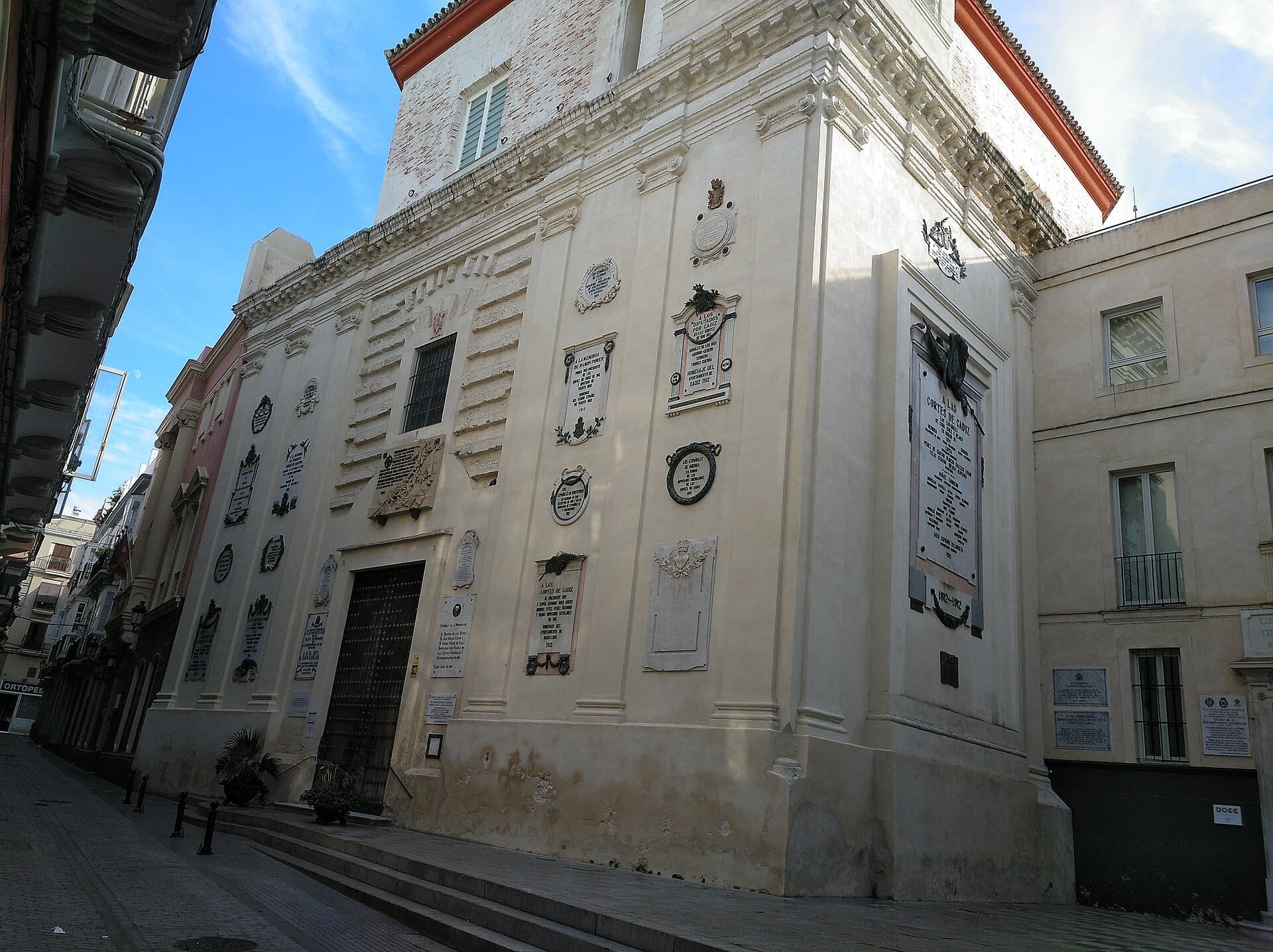
From the exterior, the Oratorio de San Felipe Neri presents a modest limestone facade, weathered to a pale cream by Cádiz's salt air. The proportions are dignified but not showy. What happens once you step through the entrance, however, is something you don't anticipate from the street: the interior opens into a full ellipse, with two tiers of semicircular balconies rising around the nave. Light enters from above through a central cupola, falling in diffuse columns that shift noticeably over the course of the morning.
The elliptical plan, constructed between 1688 and 1719, is the building's defining architectural statement. Rather than drawing the eye forward toward a distant altar in the conventional longitudinal nave format, this design pulls the gaze upward and outward. The gallery balconies, supported by slender columns with gilded capitals, wrap the space like the tiers of an opera house. It feels intimate despite its height.
Seven chapels radiate from the ellipse, each containing altarpieces of varying quality and period. The finest is the main altar, which holds a celebrated Immaculate Conception painted by Bartolomé Esteban Murillo, completed in 1680. The painting was among Murillo's last major works; he died in Seville a couple of years later. Standing close, you can see the loose, luminous brushwork Murillo deployed in his late period, quite different from the tighter finish of his early career.
Tickets & tours
Hand-picked options from our booking partner. Prices are indicative; availability and final rates are confirmed when you complete your booking.
Historical Roman Cadiz guided walking tour
From 22 €Instant confirmationFree cancellationDay trip to Tarifa, Vejer, and the Bolonia beach from the Cadiz Bay
From 59 €Instant confirmationFree cancellationWinery tour with tasting of three wines in Sanlucar
From 18 €Instant confirmationFree cancellationWinery tour and wine tasting in Chiclana de la Frontera in Cadiz
From 25 €Instant confirmationFree cancellation
What a Visit Actually Feels Like
Arrive at opening time on a weekday morning (10:30) and you will often have the interior largely to yourself for the first twenty minutes. The silence is particular: the thick walls muffle street noise almost completely, and the acoustic quality of the ellipse is noticeably live, so footsteps and whispers carry in ways that feel slightly theatrical. In the cooler months the air inside is noticeably cold and faintly damp, as with most old stone churches, so a layer is worth packing even in spring.
Midday brings tour groups, especially on weekends. If you are visiting as part of a broader exploration of the historic centre, slotting this in before 12:00 or after 15:00 on weekdays gives you more space to circulate freely and to stand in front of the Murillo without a crowd. The afternoon light through the cupola is warmer and more photogenic than the flat midday illumination.
💡 Local tip
A free entry window exists Monday through Thursday from 09:30 to 10:30 under the BIC (Bien de Interés Cultural) scheme. Access must be requested in advance through cadizsacra.es. If you plan ahead, this saves the regular ticket cost for each paying visitor.
Photography is possible without flash inside; the two-tier balcony provides an excellent elevated angle on the altar and nave if you can access it during your visit. Tripods are generally not permitted in working churches, so hand-held or monopod shots work best in the lower light of the upper gallery.
The 1812 Constitution: Context for the Visit
To understand why this building carries such weight in Spanish collective memory, a little context helps. By 1810, Napoleon's armies had occupied most of mainland Spain. Cádiz, protected by its peninsular position and the British Royal Navy, became the seat of the Spanish resistance government. Deputies from Spain and its overseas colonies gathered here to draft a document that would define the nation after liberation. The Cortes of Cádiz, as the assembly was known, sat in the Oratorio de San Felipe Neri for its historic session on 19 March 1812. For a deeper look at how that history shapes the city today, the Cádiz history guide covers the full arc from Phoenician foundations to the contemporary city.
Inside the church, a commemorative plaque marks the spot where the deputies deliberated. The elliptical balconies, which in 1812 held observers and journalists as well as deputies, still carry that spatial logic clearly. Standing in the nave and looking up at those curved galleries, it is not difficult to picture the hall packed with argument.
The bicentennial in 2012 brought significant restoration work to the building, and the interior is in notably good condition compared to some of Cádiz's other historic churches. The restoration cleaned decades of candle smoke from the upper vaulting, and the painted sections of the cupola now read clearly.
Practical Information for Your Visit
The Oratorio de San Felipe Neri sits on Plaza de San Felipe Neri in the historic centre, roughly a ten-minute walk from Cádiz Cathedral and a similar distance from the Torre Tàvira. The street grid in this part of the old town is compact and slightly irregular, so a map app is useful for the last two blocks.
- Opening hours (Sept–June): Mon–Fri 10:30–16:00 (last entry 15:30), Saturday 10:00–14:00 (last entry 13:30), Sunday: Mass only 12:00–13:00
- Opening hours (July–August): Mon–Fri 10:30–16:00, Saturday 10:30–14:00, Sunday: Mass only
- Closed on public holidays
- General admission: €5 | Seniors 65+, youth under 25, disability under 60%: €4 | Groups of 15+: €3 | Children under 12 and visitors with disability over 60%: free
- Free BIC entry: Mon–Thu 09:30–10:30, must be requested in advance via cadizsacra.es
- Contact: +34 662 64 22 33 | oratoriosanfelipeneri@obispadocadizyceuta.es
Accessibility: TripAdvisor listings indicate adapted access from Calle de Santa Inés. Visitors with specific mobility requirements are advised to confirm arrangements directly with the oratory by phone or email before arrival, as detailed information on internal adaptations is not published officially.
⚠️ What to skip
The oratory is a working church. Sunday visits are limited to the 12:00–13:00 Mass. If your only free day is Sunday, plan accordingly and be respectful of the liturgical context.
Combining the Visit with the Surrounding Historic Centre
The Oratorio de San Felipe Neri sits within easy walking distance of several of Cádiz's most rewarding historic-centre sites. The Cádiz Cathedral is about ten minutes on foot and makes a natural pairing given the architectural contrast: the Cathedral's facade and dome in stone versus the Oratorio's intimate interior geometry. The Torre Tàvira, Cádiz's highest watchtower and home to a notable camera obscura, is also within ten minutes' walk and offers a completely different kind of experience.
For those following a structured route through the old town, the Cádiz old town walking tour passes through this neighbourhood and can be used to sequence the Oratorio alongside the Museo de Cádiz and the Plaza de San Juan de Dios. Most visitors find that two focused hours in this part of the centre, combining two or three of these sites, is more rewarding than rushing through all of them.
If you are hungry after the visit, the streets immediately west of the plaza have a reasonable mix of cafés and tapas bars. The neighbourhood is quieter than the area around the Cathedral and tends to attract more local than tourist foot traffic, which usually reflects in the prices.
Insider Tips
- Use the free BIC entry window (Mon–Thu 09:30–10:30) if you can book through cadizsacra.es in advance. It requires a small administrative step but saves the full ticket cost for each person in your group.
- Stand in the centre of the nave and look directly upward at the cupola. The geometry of the ellipse is most readable from this point, and the light in mid-morning creates a clear separation between the painted vaulting and the stone structure.
- The Murillo Immaculate Conception on the main altar is often overlooked by visitors focused on the constitutional history. Get close: the painting's condition is remarkable for a work completed in 1680, and the brushwork in the drapery repays attention.
- If you visit on a weekday morning, ask at the entrance whether access to the upper gallery balconies is available. When open, they provide the best overview of the elliptical plan and a strong photographic angle on the nave below.
- The plaza outside the church is quiet and has benches. It is a good place to read the context before entering rather than after, so the architectural and historical details resonate while you are inside.
Who Is Oratorio de San Felipe Neri For?
- History travellers with an interest in Spanish constitutional and political history
- Architecture enthusiasts studying Baroque design and unusual floor plans
- Art historians or visitors specifically seeking Murillo's late-period work
- Travellers doing a deep dive into Cádiz's historic centre over at least two days
- Those who prefer smaller, less crowded sites over major tourist landmarks
Nearby Attractions
Other things to see while in Centro Histórico (Old Town):
- Alameda Apodaca
Alameda Apodaca is a protected Romantic-era promenade running along the northern sea wall of Cádiz's old town. Free, open at all hours, and overlooking the Bay of Cádiz, it offers one of the most atmospheric walks in the city — with very little effort required.
- Antiguo Hospital de Mujeres
Founded in 1677 and rebuilt in grand 18th-century baroque style, the Antiguo Hospital de Mujeres is one of Cádiz's most architecturally significant buildings. Today it is managed as a visitable monument linked to the Diocese of Cádiz y Ceuta, opening its twin patios and chapel to visitors for a modest entry fee, offering a rare glimpse into the city's golden-age ambitions.
- Ayuntamiento de Cádiz (City Hall)
The Ayuntamiento de Cádiz stands as one of the most photographed facades in Andalusia's oldest provincial capital. Begun in 1799 and shaped by two distinct architectural phases, it anchors the central plaza of Cádiz's historic core and speaks directly to the city's 19th-century ambitions. This guide covers what to see, when to go, and how the building fits into a walk through the old town.
- Calle Ancha
Calle Ancha cuts through the historic center of Cádiz as its widest and most storied street. Free to walk at any hour, it offers a concentrated dose of Baroque architecture, political history, and the kind of unhurried street life that defines this Atlantic city.