Catedral de Cádiz: The Cathedral That Took 116 Years to Build
The Cathedral of Cádiz, officially the Santa y Apostólica Iglesia Catedral de Cádiz y Ceuta, is the architectural centerpiece of the old city. Construction began in 1722 and finished in 1838, leaving behind a building that blends Baroque interiors with a Neoclassical facade and one of the most recognizable golden domes in Spain. The clock tower offers the best rooftop panorama in the historic center.
Quick Facts
- Location
- Plaza de la Catedral, 11005 Cádiz (Centro Histórico)
- Getting There
- Walkable from Cádiz train station and port; city buses serve Plaza de la Catedral
- Time Needed
- 1.5 to 2.5 hours (cathedral + tower + museum)
- Cost
- General 8–15 € depending on ticket type; reduced rates available for seniors and students; under 12 free
- Best for
- Architecture enthusiasts, history lovers, panoramic views of the bay
- Official website
- catedraldecadiz.com
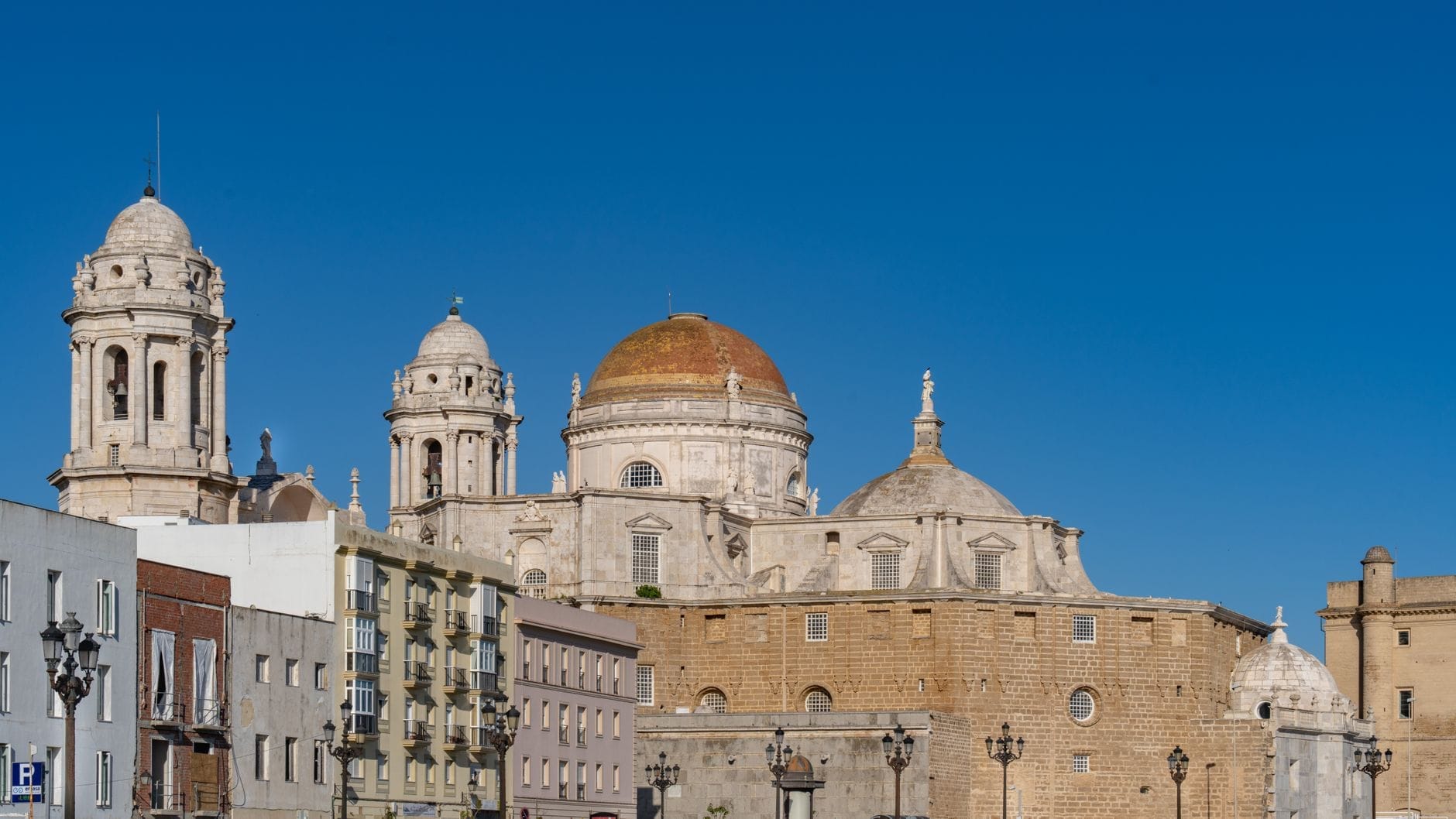
What You're Looking At and Why It Matters
The Catedral de Cádiz stands at the southeastern edge of the old city, where the streets of the historic center open unexpectedly onto a wide plaza and the Atlantic glitters beyond. The building's most striking feature from the outside is its main dome, covered in glazed yellow tiles that glow amber in morning light and almost white at midday. It is one of the most identifiable silhouettes on the entire Andalusian coastline, visible from the sea long before you dock.
The cathedral's official name is the Santa y Apostólica Iglesia Catedral de Cádiz y Ceuta, historically known as the Catedral de Santa Cruz sobre las Aguas, also known informally as the Catedral Nueva (New Cathedral) to distinguish it from the older Iglesia de Santa Cruz that preceded it on the same site. That nickname has stuck for nearly three centuries, which tells you something about how long residents had to wait for it to be finished.
The building sits in the Centro Histórico, and the plaza in front of it functions as one of the main social anchors of the old town. In the mornings, it is relatively quiet. By early afternoon, groups gather on the steps, and by late afternoon the plaza fills with a mix of residents cutting through and visitors who have just finished the interior tour and are blinking in the sunlight trying to figure out what they just saw.
A Building 116 Years in the Making
Construction of the current cathedral began in 1722, designed by the architect Vicente Acero. It was formally consecrated on 28 November 1838, after more than a century of interrupted work. That long timeline is reflected in the architecture itself: the plan and much of the interior follow a Baroque conception, while the facade, towers, upper interior, and domes shifted toward Neoclassical forms as tastes and architects changed over the decades. The result is not a confused building but a layered one, where you can read the history of Spanish architectural fashion across a single structure.
Part of the reason construction dragged on was financial. Cádiz in the 18th century was one of the wealthiest cities in Spain, holding a monopoly on trade with the Americas. That wealth funded the ambition. But wars, economic shifts, and political upheaval repeatedly interrupted the building campaign. By the time it was finished, the commercial golden age that had made it possible was already over. The cathedral is partly a monument to that prosperity and partly a record of its slow decline.
ℹ️ Good to know
The cathedral is also the burial place of the composer Manuel de Falla, one of Spain's most celebrated 20th-century musicians, whose family roots were in Cádiz. His tomb is in the crypt, accessible on the standard tour.
Tickets & tours
Hand-picked options from our booking partner. Prices are indicative; availability and final rates are confirmed when you complete your booking.
Historical Roman Cadiz guided walking tour
From 22 €Instant confirmationFree cancellationDay trip to Tarifa, Vejer, and the Bolonia beach from the Cadiz Bay
From 59 €Instant confirmationFree cancellationWinery tour and wine tasting in Chiclana de la Frontera in Cadiz
From 25 €Instant confirmationFree cancellationGuided tour of medieval Cadiz landmarks and history
From 30 €Instant confirmationFree cancellation
Inside the Cathedral: What to Expect
Entering through the main facade on Plaza de la Catedral, the scale of the interior is immediately apparent. The nave is broad and tall, with barrel vaults and a crossing dome that draws the eye upward. The quality of light inside varies significantly by time of day: morning visits benefit from softer, more diffuse illumination, while afternoon visits bring stronger contrasts through the high windows. The stone is a pale limestone that reads as almost white under good light and grey on overcast days.
The choir stalls are worth slowing down for. They are elaborately carved and occupy the center of the nave in the Spanish tradition, creating a kind of box within the larger space. The cathedral's treasury, housed in the Casa de la Contaduría (the museum section), contains goldsmith work, liturgical textiles, and processional pieces that reflect the wealth that once flowed through this port city. The Casa de la Contaduría has its own hours, which are shorter than the cathedral’s and may vary seasonally; check current times before visiting.
For visitors who are not particularly drawn to religious art or baroque interiors, the cathedral interior alone may feel like more than enough after 30 to 40 minutes. The real draw for many people is the tower.
⚠️ What to skip
The Clock Tower climb involves a significant number of stairs and uneven surfaces. It is not suitable for visitors with mobility limitations. If this applies to you, the cathedral floor and museum offer plenty to see without the ascent.
The Clock Tower: Best Viewpoint in the Old City
The Torre de Poniente, the western tower open to visitors and commonly called the Clock Tower, rises to approximately 55 meters. The climb is not technically difficult but it is sustained, with narrow stairwells and sections where you step over worn stone. Arriving at the top, the view is one of the most complete in the city: the entire historic center spreads out below, with the Atlantic on three sides and the bay curving toward the mainland on the fourth.
From this height you can trace the layout of the old town clearly, picking out the other rooftop towers that dot the historic district. Cádiz once had dozens of these watchtowers, built by merchant families to spot their ships returning from the Americas. The Torre Tavira is the tallest surviving example and is visible from the cathedral tower. Together, they give you a sense of how densely the old city was watched over during its commercial peak.
Tower hours may differ slightly from the main cathedral and can vary by season and special events; consult the current schedule when planning your visit. On clear days, the late afternoon light is ideal for photography, but expect more company at that hour. If you want the tower mostly to yourself, aim for a weekday morning around opening time.
💡 Local tip
For sunset photography, the cathedral dome is better photographed from street level at Plaza de la Catedral or from the Campo del Sur promenade. From the tower itself, you are looking outward rather than at the dome, so bring a wide-angle lens or phone if you want sweeping bay shots.
Practical Visiting Information
The cathedral is generally open daily with extended hours, though opening and closing times vary by season; check current schedules before visiting. General admission is usually between 8 and 15 euros depending on whether you include the tower, crypt, and museum. Reduced tickets are available for seniors, students, and people with disabilities, and children under 12 enter free with a paying adult. Visitors with a recognized disability of 60 percent or above currently benefit from free admission under Cádiz Sacra’s policy.
The cathedral is located at Plaza de la Catedral in the old city. From the Cádiz train station, it is a manageable walk of around 15 to 20 minutes through the historic streets. City buses also serve the area. There is no dedicated parking inside the old city, so if you arrive by car, expect to park outside the historic walls and walk in. Hours may shift on religious feast days and during special services; checking the official site before visiting is advisable, especially during Semana Santa and Corpus Christi.
The Plaza de la Catedral itself is a logical starting point for a longer walk through the old town. From here you can move easily toward the Plaza de San Juan de Dios to the north, or follow the sea wall south along the Campo del Sur for a coastal view of the cathedral's exterior. The combination of these routes makes for a complete half-day circuit of the southern old town.
When to Go and What Affects the Experience
The cathedral receives substantial visitor numbers from late spring through early autumn. July and August are the peak months, when the plaza can feel crowded by mid-morning and the tower queue lengthens noticeably. The best visiting windows for quieter conditions are April to early June and September to October, when temperatures in Cádiz typically sit between 19 and 26 degrees Celsius and the Atlantic breeze keeps things comfortable. Winter visits are perfectly viable: the cathedral interior is cool and calm, crowds are minimal, and the low winter light gives the stone a particularly warm quality.
If you are planning around Cádiz's famous Carnival in February, note that the area around the cathedral becomes one of the focal points of celebration. The building itself remains open for religious functions, but the surrounding plaza is overtaken by processions and performances. For more on timing your visit to the city, the best time to visit Cádiz guide covers seasonal conditions in detail.
Rain affects the tower experience more than the interior visit. The stairwells are covered, but the top platform is open, and wind off the Atlantic can be sharp even in mild weather. A light layer is worth carrying regardless of season.
Who This Attraction Is and Is Not For
The Catedral de Cádiz earns its admission for visitors who enjoy architectural history, want a reliable high viewpoint, or are tracing the cultural and economic story of the city. Paired with a visit to the Museo de Cádiz and a walk through the Barrio El Pópulo, it forms the backbone of a serious day in the historic center.
Travelers who are generally unmoved by church architecture and have no particular interest in the colonial-era history of the city may find the ticket price hard to justify, especially when the exterior view from the plaza and the Campo del Sur costs nothing. The golden dome is genuinely spectacular from the outside, and if a budget or time is tight, spending 20 minutes in the plaza and then moving on is a reasonable choice. There is no shame in skipping the interior if it is not your kind of thing.
Families with young children should note that the interior demands quiet and the tower climb requires sure footing. Children under 12 enter free, which helps with the cost, but restlessness inside the cathedral is more conspicuous here than in many other Spanish churches due to the acoustics and the scale of the space.
Insider Tips
- The best exterior photographs of the golden dome are taken from the Campo del Sur promenade, roughly 150 meters southeast of the building, where you get the full facade and dome together with the sea in the background. Early morning gives the cleanest light and fewest people on the promenade.
- Sunday opening for tourists does not begin until 13:30, which catches many visitors off guard. If you arrive on a Sunday morning and find the doors closed to tourists, the cathedral may be in the middle of Mass. Plan accordingly and use the morning to explore the plaza and surrounding streets.
- The audioguide available at the entrance adds meaningful context to the treasury and the choir stalls, both of which can feel opaque without background. It can be added on to most ticket types.
- If you are visiting in summer and want to avoid the tower queue, aim for opening time on a weekday. The queue is longest in the hour before closing, when people rush to fit in the climb before the day ends.
- Manuel de Falla's tomb in the crypt is included in the general admission. It is low-key and easy to walk past without realizing what it is. Ask at the entrance or follow the floor markers to find it.
Who Is Catedral de Cádiz For?
- Architecture enthusiasts interested in the shift from Baroque to Neoclassical across a single building
- History-focused travelers tracing Cádiz's 18th-century trade monopoly with the Americas
- Visitors seeking the best 360-degree panorama of the old city and bay without a long hike
- Travelers on a deeper exploration of Andalusian sacred art and goldsmith heritage
- Anyone using the cathedral plaza as the anchor for a full walking day through the historic center
Nearby Attractions
Other things to see while in Centro Histórico (Old Town):
- Alameda Apodaca
Alameda Apodaca is a protected Romantic-era promenade running along the northern sea wall of Cádiz's old town. Free, open at all hours, and overlooking the Bay of Cádiz, it offers one of the most atmospheric walks in the city — with very little effort required.
- Antiguo Hospital de Mujeres
Founded in 1677 and rebuilt in grand 18th-century baroque style, the Antiguo Hospital de Mujeres is one of Cádiz's most architecturally significant buildings. Today it is managed as a visitable monument linked to the Diocese of Cádiz y Ceuta, opening its twin patios and chapel to visitors for a modest entry fee, offering a rare glimpse into the city's golden-age ambitions.
- Ayuntamiento de Cádiz (City Hall)
The Ayuntamiento de Cádiz stands as one of the most photographed facades in Andalusia's oldest provincial capital. Begun in 1799 and shaped by two distinct architectural phases, it anchors the central plaza of Cádiz's historic core and speaks directly to the city's 19th-century ambitions. This guide covers what to see, when to go, and how the building fits into a walk through the old town.
- Calle Ancha
Calle Ancha cuts through the historic center of Cádiz as its widest and most storied street. Free to walk at any hour, it offers a concentrated dose of Baroque architecture, political history, and the kind of unhurried street life that defines this Atlantic city.