Museo de Cádiz: The City's History and Art Under One Roof
The Museo de Cádiz brings together archaeology, fine arts, and ethnography in a neoclassical building on Plaza de Mina. From ancient Phoenician sarcophagi to a remarkable collection of Zurbarán canvases, this is the most complete single introduction to Cádiz's long history. Entry is free for EU citizens, with a small fee for non-EU visitors.
Quick Facts
- Location
- Plaza de Mina s/n, 11004 Cádiz (Centro Histórico)
- Getting There
- A 10–15 min walk from most old town hotels; local city buses serve Plaza de Mina and surrounding streets
- Time Needed
- 1.5 to 2.5 hours for a thorough visit
- Cost
- Free for EU citizens; €1.50 for non-EU visitors (verify current price at the museum or official website).
- Best for
- History lovers, art enthusiasts, anyone seeking shelter from summer heat or wet winter days
- Official website
- www.museosdeandalucia.es/web/museodecadiz
What the Museo de Cádiz Actually Is
The Museo de Cádiz is Andalusia's provincial museum for the city of Cádiz, combining archaeology, fine arts, and ethnography in a single neoclassical building on the leafy Plaza de Mina. In practice, most visitors split their time between the ground-floor archaeological galleries, which trace Cádiz from Phoenician settlement through Roman occupation, and the upper-floor fine arts collection, anchored by an extraordinary group of paintings by Francisco de Zurbarán.
For anyone trying to understand how Cádiz became one of the most historically layered cities on the Iberian Peninsula, this museum is the clearest starting point. The city's old town already contains Roman theatre ruins, medieval arches, and Baroque churches within a short walk of each other, but the museum gives you the interpretive framework to make sense of all of it.
If you are building an itinerary, the museum pairs naturally with a morning at the Teatro Romano de Cádiz and an afternoon walk through the historic centre. Together, they make a coherent full-day immersion in the city's past without feeling rushed.
💡 Local tip
EU citizens enter free. Non-EU visitors pay a small fee — the exact amount can change, so check the official website or confirm at the door before your visit. The museum is closed on Mondays (except some holiday eves), on 1 and 6 January, 1 May, and 24, 25, and 31 December.
The Building and Its History
The museum occupies a neoclassical building on Plaza de Mina that forms part of the former San Francisco convent complex, whose land was made available after the Mendizábal disentailment of the 1830s dissolved many monastic properties across Spain. Paintings confiscated from Cádiz's convents were deposited with the local Academy of Fine Arts, forming the nucleus of what would become the Museo Provincial de Bellas Artes.
In 1970, by Decree 3345/1970, the provincial fine arts and archaeological museums were merged into the single institution known today as the Museo de Cádiz. That merger was more than administrative tidying: it created one of the few regional museums in Spain where you can move from a Phoenician anthropoid sarcophagus to a 17th-century oil painting without leaving the building.
The building itself is worth a moment's attention. The facade on Plaza de Mina is restrained and symmetrical in the way neoclassical civic architecture tends to be, but the interior has a calm, high-ceilinged quality that suits the collections well. Natural light comes through tall windows, especially in the upper-floor painting galleries, which can look quite different depending on the time of day you visit.
Tickets & tours
Hand-picked options from our booking partner. Prices are indicative; availability and final rates are confirmed when you complete your booking.
Historical Roman Cadiz guided walking tour
From 22 €Instant confirmationFree cancellationDay trip to Tarifa, Vejer, and the Bolonia beach from the Cadiz Bay
From 59 €Instant confirmationFree cancellationWinery tour and wine tasting in Chiclana de la Frontera in Cadiz
From 25 €Instant confirmationFree cancellationGuided tour of medieval Cadiz landmarks and history
From 30 €Instant confirmationFree cancellation
The Archaeology Floor: Phoenicians, Greeks, and Romans
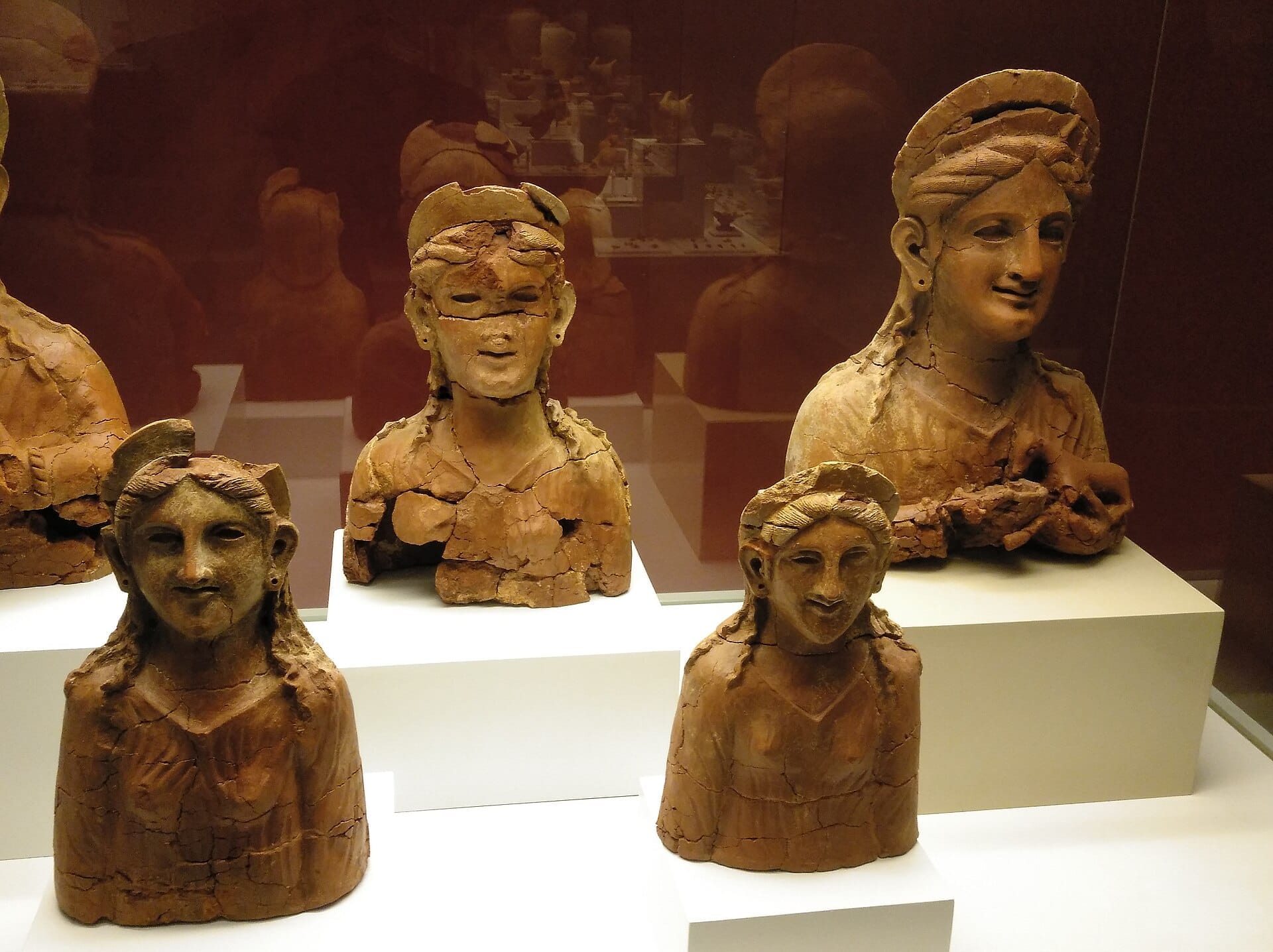
The ground-floor archaeology galleries are organized roughly chronologically, beginning with prehistoric material and moving through the Phoenician, Punic, Greek, and Roman periods that shaped early Cádiz. The objects on display here are not merely decorative: they document a city that served as one of the ancient Mediterranean's westernmost trading hubs, positioned at the edge of the known world and connecting Atlantic trade routes with those of the inland Iberian peninsula.
The star objects are the two Phoenician anthropoid sarcophagi, male and female, carved from marble in the 5th century BCE. They are among the finest examples of this type of funerary sculpture found anywhere in the western Mediterranean. The male sarcophagus in particular tends to stop people mid-stride: the facial expression is individualized in a way that feels almost portraiture-like rather than symbolic. These were not mass-produced burial containers but objects of status and craft. Standing in front of them, you get a direct physical connection to the Phoenician population that founded this city more than two and a half millennia ago.
Beyond the sarcophagi, look for the Roman funerary material and the collection of ancient glass, amphorae, and small bronzes recovered from the sea floor and local excavations. The labeling is primarily in Spanish, so if your Spanish is limited, spend a few minutes on the official website or download a translation app before you arrive.
ℹ️ Good to know
The archaeology galleries are on the ground floor and tend to be cooler and quieter than the fine arts rooms above. On summer afternoons, when the streets outside are at their hottest, the lower floor is a genuinely pleasant place to linger.
The Fine Arts Collection: Zurbarán and Beyond
The upper floors hold the fine arts collection, and the centerpiece is a group of 18 canvases by Francisco de Zurbarán, the 17th-century Spanish Baroque painter whose severe, almost sculptural treatment of religious figures made him one of the defining voices of the Counter-Reformation in Spanish art. These paintings were originally commissioned for the Charterhouse of Jerez de la Frontera and are displayed together in a dedicated gallery that gives them the space their scale demands.
Zurbarán's work rewards slow looking. The figures are painted with an almost obsessive attention to the texture of cloth, the fall of light on white habits, and the psychological weight of devotional expression. Compared with the more theatrically dramatic work of his contemporaries, his canvases have a stillness that can feel almost modern. The Cádiz collection is one of the most significant concentrations of his work in Spain, and it is not as crowded as comparable rooms in Madrid or Seville.
The broader painting collection extends to other Spanish and Flemish works, and there is a smaller ethnographic section documenting local crafts, popular traditions, and the social life of Cádiz across different centuries. For a deeper cultural context around the traditions represented here, the Cádiz history guide provides useful background on how the city's maritime wealth shaped its artistic and cultural output.
When to Visit and What to Expect at Different Hours
The museum’s hours vary seasonally. In winter, it is open from Tuesday to Saturday from 10:00 to 20:30, and on Sundays and public holidays from 10:00 to 17:00, while in summer (June to September) it opens from Tuesday to Saturday from 09:00 to 15:00 and on Sundays and public holidays from 10:00 to 17:00; it is closed on Mondays. The extended weekday hours are genuinely useful: arriving in the first hour after opening means you will likely have several galleries to yourself, particularly on weekdays outside of Spanish school holiday periods. In summer (June–September) that window is 09:00–10:00; in winter it is 10:00–11:00. The archaeological floor is especially quiet in the first hour after opening.
Midday is the most crowded window, roughly 11:30 to 13:30, when tour groups and independent visitors overlap. If you arrive then, start on the upper floor with the Zurbarán gallery, where the natural light through the windows is at its best in the morning, and work downward. By late afternoon, around 16:00 onwards, the crowds thin again and the pace becomes more contemplative.
In summer, the museum is one of the most effective ways to structure a midday pause. Temperatures outside in July and August regularly exceed 30°C, and the building's thick neoclassical walls and air-conditioned interiors make it a practical refuge, not just a cultural one. In winter, with opening hours running into the early evening from Tuesday to Saturday, you can visit on a wet January afternoon and spend two hours without feeling rushed.
⚠️ What to skip
The museum is closed on several fixed dates: 1 and 6 January, 1 May, and 24, 25, and 31 December. If you are visiting around a Spanish bank holiday, check the official Junta de Andalucía website to confirm that day's schedule before making the trip.
Getting There and Practical Logistics
Plaza de Mina is in the heart of the old town, and the museum is walkable from virtually every point in the historic centre. From the cathedral, it is roughly a 10-minute walk northwest through the narrow streets. From the main gateway at Puertas de Tierra, allow 15 to 20 minutes on foot. Local city buses serve stops around Plaza de Mina and the surrounding streets, though given the compact scale of the old town, most visitors arrive on foot.
Plaza de Mina itself is a pleasant square with benches and mature trees, and it functions as a natural meeting point in the centro histórico. After your visit, the square sits between several worthwhile attractions: the Oratorio de la Santa Cueva is a few minutes' walk away, and the Torre Tavira is within easy reach for a view over the city's rooftops.
Photography inside the museum follows standard European museum practice: personal, non-flash photography is generally permitted in the permanent galleries, but check at the entrance desk as policies can vary by temporary exhibition. There are no bag lockers mentioned in publicly available information, so travel light or check at the front desk on arrival. The museum has a small shop near the entrance worth a look for art history publications related to the collection.
Visitors with specific mobility needs should contact the museum directly before their visit. The building is a 19th-century structure across multiple floors, and while modern museum services have been installed, detailed English-language information about step-free access and adapted facilities is not comprehensively documented in public sources.
Is the Museo de Cádiz Worth Your Time?
For a certain kind of traveler, this museum is one of the strongest arguments for spending more than a day in Cádiz. The Phoenician sarcophagi alone are extraordinary objects that you will not find in the mainstream European museum circuit, and the Zurbarán collection is genuinely significant by any measure of Spanish Baroque art. The combination of both, housed in a building with a coherent history and a comfortable pace, makes for a visit that feels proportionate and satisfying rather than exhausting.
That said, travelers on a very tight schedule who are primarily interested in beaches, seafood, and street-level atmosphere may find that an hour in the museum feels like an obligation rather than a pleasure. If that describes you, consider a shorter visit focused only on the archaeology floor and the Zurbarán room, which together take about 45 minutes. For a broader picture of how to use your time in the city, the things to do in Cádiz guide and the old town walking tour can help you sequence the museum alongside other stops.
The museum does not have a café on-site based on currently available information, so plan your coffee break for one of the bars immediately around Plaza de Mina, which have outdoor seating and are open through the morning and afternoon.
Insider Tips
- The Phoenician male sarcophagus is the single most remarkable object in the museum, but it is easy to walk past quickly. Spend at least five minutes with it: the facial detailing and the story of its discovery in a Cádiz burial site in 1887 make it worth a slow look.
- EU citizens enter free as a general policy for state museums in Andalusia, but bring ID. Non-EU visitors currently pay €1.50, though amounts can change, so check the current fee directly with the museum.
- The upper-floor Zurbarán gallery receives strong natural light in the morning, which is the best time to see the texture and tonal range of the canvases. Afternoon light can be more diffuse and less flattering to the paintings.
- Weekday mornings shortly after opening are the quietest window. In summer (June–September) the museum opens at 09:00; in winter it opens at 10:00. Arriving in the first hour means the archaeology floor will likely be almost empty.
- The square outside, Plaza de Mina, hosts a small Sunday market at certain times of year. If your visit falls on a Sunday morning, combine the museum's early hours with a look at what is being sold in the square before the 15:00 closing time catches you.
Who Is Museo de Cádiz For?
- History and archaeology enthusiasts who want grounded, object-based evidence of Cádiz's ancient Phoenician and Roman past
- Art travelers with a specific interest in Spanish Baroque painting and the work of Francisco de Zurbarán
- Visitors spending two or more days in Cádiz who want interpretive context before exploring the old town's streets and ruins
- Families with older children or teenagers looking for a structured, air-conditioned activity during summer heat
- Travelers visiting on a wet or overcast day who need a full-morning indoor option in the historic centre
Nearby Attractions
Other things to see while in Centro Histórico (Old Town):
- Alameda Apodaca
Alameda Apodaca is a protected Romantic-era promenade running along the northern sea wall of Cádiz's old town. Free, open at all hours, and overlooking the Bay of Cádiz, it offers one of the most atmospheric walks in the city — with very little effort required.
- Antiguo Hospital de Mujeres
Founded in 1677 and rebuilt in grand 18th-century baroque style, the Antiguo Hospital de Mujeres is one of Cádiz's most architecturally significant buildings. Today it is managed as a visitable monument linked to the Diocese of Cádiz y Ceuta, opening its twin patios and chapel to visitors for a modest entry fee, offering a rare glimpse into the city's golden-age ambitions.
- Ayuntamiento de Cádiz (City Hall)
The Ayuntamiento de Cádiz stands as one of the most photographed facades in Andalusia's oldest provincial capital. Begun in 1799 and shaped by two distinct architectural phases, it anchors the central plaza of Cádiz's historic core and speaks directly to the city's 19th-century ambitions. This guide covers what to see, when to go, and how the building fits into a walk through the old town.
- Calle Ancha
Calle Ancha cuts through the historic center of Cádiz as its widest and most storied street. Free to walk at any hour, it offers a concentrated dose of Baroque architecture, political history, and the kind of unhurried street life that defines this Atlantic city.