Oratorio de la Santa Cueva: Goya, Baroque Architecture, and a Hidden Underground Chapel
The Oratorio de la Santa Cueva is one of the most architecturally and artistically distinctive religious sites in Cádiz. Built around 1781, it contains two stacked chapels, each with a completely different character, and three original round canvases by Francisco de Goya in the upper chapel. Small in scale but dense in quality, it rewards close attention.
Quick Facts
- Location
- Calle Rosario 10, Historic Center, Cádiz
- Getting There
- Walkable from most central landmarks; EMT Cádiz buses serve the historic center
- Time Needed
- 45–75 minutes
- Cost
- General 5 €; Groups (15+) 3 €; Free Mon–Thu 09:30–10:30 with prior reservation
- Best for
- Art lovers, Baroque architecture, history enthusiasts, quiet contemplation
What Is the Oratorio de la Santa Cueva?
The Oratorio de la Santa Cueva is a late 18th-century religious complex tucked beside the Parroquia del Rosario on Calle Rosario, in the heart of Cádiz's historic center. Its ornate Baroque stone facade on Calle Rosario is easy to walk past without noticing — the entrance is modest compared with the cathedral — but inside lies one of the most architecturally layered religious interiors in Andalusia.
The oratory was conceived for the Congregación del Retiro Espiritual, a devotional congregation established in Cádiz around 1730. Construction of the current building began around 1781 under José Sáenz de Santa María, the Marquis of Valde-Íñigo. It was declared a Bien de Interés Cultural, Spain's highest heritage protection category, in 1982. That status is earned: this is a building with few equals in the city for sheer artistic concentration.
ℹ️ Good to know
Opening hours: Monday to Friday 10:30–16:00 (last entry 15:30); Saturday 10:00–14:00. Closed to tourist visits on Sundays except for a Latin Mass 12:00–13:00. Free entry Monday to Thursday 09:30–10:30 with prior reservation through cadizsacra.es.
Two Chapels, Two Entirely Different Worlds
The defining feature of the Oratorio de la Santa Cueva is its structure: two superimposed chapels, stacked vertically, each dedicated to a different theme and each with its own architectural personality. Most visitors are surprised to discover that they are essentially visiting two distinct spaces within one modest building.
The lower chapel, dedicated to the Passion of Christ, is the one that gives the oratory its name. It is underground, low-ceilinged, and deliberately austere. The stone surfaces absorb light rather than reflect it, and the atmosphere is close to that of a catacomb. A sculptural representation of the Last Supper is displayed here, and the overall effect is solemn and contemplative. Even visitors with no religious interest tend to respond to the weight of the space.
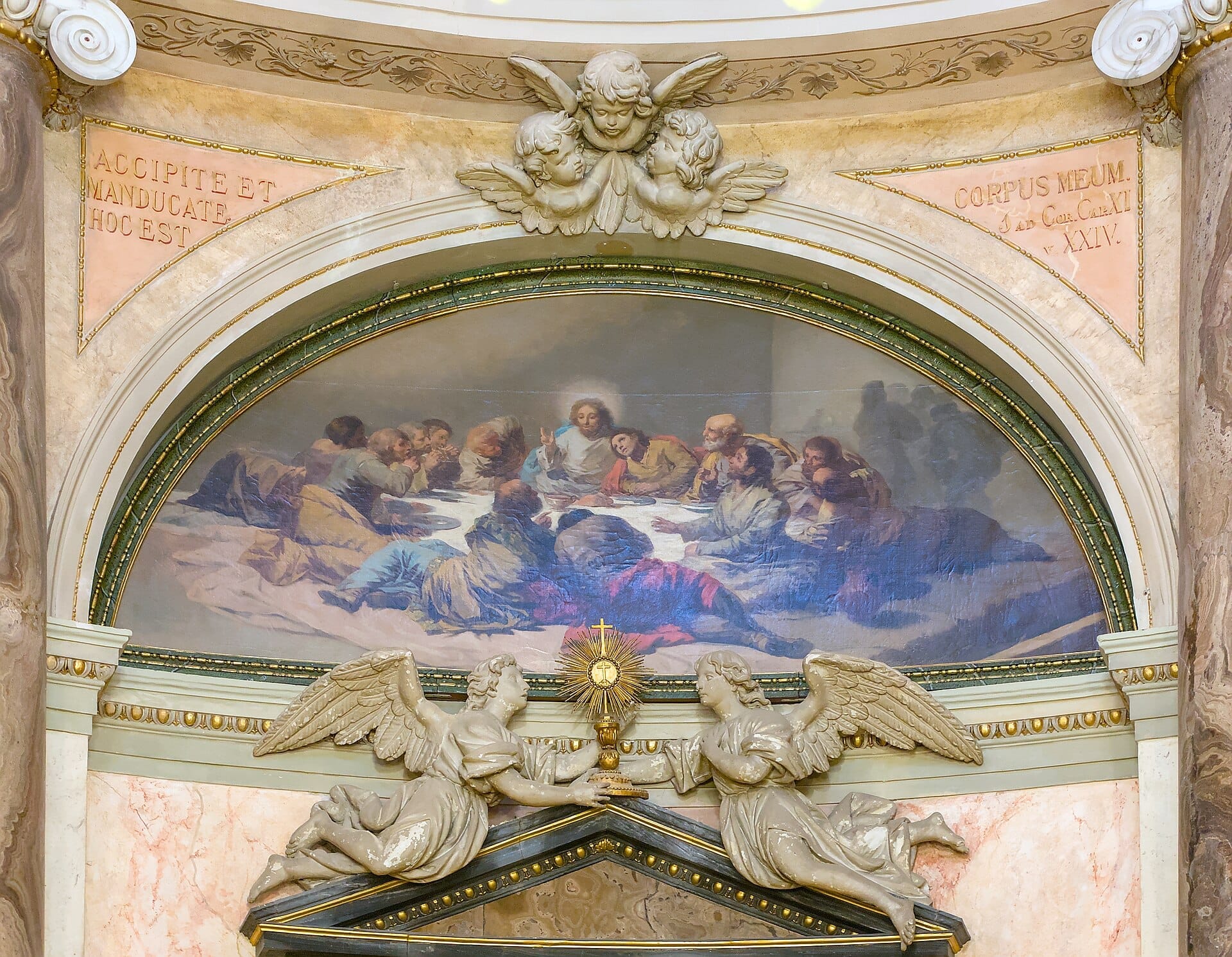
Climbing the stairs to the upper chapel is a genuinely jarring transition. The upper chapel is dedicated to the Blessed Sacrament and is everything the lower level is not: oval in plan, flooded with light from a central dome, finished in white and gold, and decorated with neoclassical detailing. The shift from cave-like compression to airy elliptical space is one of the more effective architectural contrasts you will find anywhere in Cádiz.
⚠️ What to skip
Access between the two chapels requires stairs. There is no confirmed step-free route between levels. Visitors with reduced mobility should contact the site in advance to discuss options.
Tickets & tours
Hand-picked options from our booking partner. Prices are indicative; availability and final rates are confirmed when you complete your booking.
Historical Roman Cadiz guided walking tour
From 22 €Instant confirmationFree cancellationDay trip to Tarifa, Vejer, and the Bolonia beach from the Cadiz Bay
From 59 €Instant confirmationFree cancellationWinery tour with tasting of three wines in Sanlucar
From 18 €Instant confirmationFree cancellationWinery tour and wine tasting in Chiclana de la Frontera in Cadiz
From 25 €Instant confirmationFree cancellation
The Goya Paintings: Why They Matter
The upper chapel contains three round canvases by Francisco de Goya, painted around 1796. These are not minor works. Goya was at the height of his powers during this period, and the commission for the Oratorio de la Santa Cueva came shortly before he began the Caprichos. The three paintings depict scenes from the Gospels: The Miracle of the Loaves and Fishes, The Wedding at Cana, and The Parable of the Rich Man and Poor Lazarus.
What makes them unusual in the context of Spanish religious art is their humanity. The figures are not idealized. The poor are visibly poor. The crowds pressing toward Jesus in The Miracle of the Loaves and Fishes look fatigued and real. The compositions are loose by the standards of academic religious painting, which is precisely what makes them compelling. Goya was already pulling away from formal conventions, and you can see it here.
The round format of the canvases, called tondos, was specified by the architectural design of the upper chapel and fits the wall niches precisely. Standing in the oval room, looking up at them in their curved frames, gives a sense of how deliberately integrated the artwork and the architecture were meant to be. This is not a building where paintings were added later. The paintings were part of the original vision.
If Goya is a significant reason for your visit to Cádiz, note that the Museo de Cádiz also holds important works by Zurbarán and is worth visiting on the same day.
What a Visit Actually Feels Like
The oratory is small. The entire visit, if you take your time with the Goya paintings and read the interpretive panels in the lower chapel, runs between 45 and 75 minutes. Groups move through in waves, and because the spaces are compact, the atmosphere can shift quickly from hushed and private to noticeably crowded.
Morning visits on weekdays are the quietest. Arriving just after opening at 10:30 on a Tuesday or Wednesday typically means having the lower chapel almost to yourself. The light in the upper chapel is at its best mid-morning when the dome is lit from above rather than in the flat light of early afternoon. Photography without flash is generally tolerated, and the curved walls and central dome of the upper chapel create interesting compositional opportunities.
The interpretive materials inside are mostly in Spanish. Some panels have English translations, but do not rely on it. Downloading or printing background information before you visit will significantly improve what you take away from the lower chapel in particular, where the symbolism of the sculptures rewards some context.
💡 Local tip
If you want free entry, reserve the 09:30–10:30 slot (Monday to Thursday) through cadizsacra.es. You will arrive before the main crowds and see the spaces at their most peaceful.
Location and Getting There
Calle Rosario 10 is in the historic center of Cádiz, roughly equidistant from several of the city's major landmarks. The oratory is attached to the Parroquia del Rosario, which is the most useful visual landmark if you are navigating on foot. The streets in this part of the old town are narrow and the signage is modest, so having a map open is worthwhile for the last 200 meters.
The oratory is a short walk from the Catedral de Cádiz and the Torre Tavira, making it easy to combine all three in a single morning loop through the historic center.
For a broader orientation to what the historic center contains, the Cádiz old town walking tour covers the key sights in a logical sequence and places the oratory in context.
Is It Worth Your Time? Honest Assessment
The Oratorio de la Santa Cueva is not a site that works for every kind of traveler. If your primary interest is Cádiz's beaches, seafood, or outdoor atmosphere, this is easy to skip without regret. The building is indoors, the visit is contemplative, and the content is dense with religious and art-historical references that require engagement to appreciate.
For visitors with an interest in Spanish painting, Baroque and neoclassical architecture, or 18th-century religious culture, it is one of the better stops in the city. The Goya paintings alone are worth the entry fee for anyone who takes art seriously. The architectural contrast between the two chapels is genuinely unusual, and the building has been well maintained.
It also fits naturally alongside a visit to the Oratorio de San Felipe Neri, another architecturally significant oratory in the historic center with its own political and historical weight. Visiting both in the same day gives a strong sense of the density of 18th-century civic and religious life in Cádiz.
If you are still building your overall itinerary, the guide to things to do in Cádiz will help you prioritize based on your interests and the time you have available.
Insider Tips
- Reserve the free morning slot (09:30–10:30, Monday to Thursday) through cadizsacra.es rather than paying at the door. You get the same access, earlier, with fewer people.
- The lower chapel is noticeably cooler than street level, which is welcome in summer but can feel cold in winter. A light layer is useful year-round.
- Stand in the center of the upper chapel and look directly up at the dome before examining the Goya canvases. The spatial logic of the oval room makes more sense once you have that reference point.
- The Parroquia del Rosario next door is usually open and free to enter. It gives useful architectural context for understanding the period when the oratory was built.
- Saturday mornings (10:00–14:00) attract a different crowd than weekdays, often including local families. Weekday mornings remain the quietest option for extended contemplation of the paintings.
Who Is Oratorio de la Santa Cueva For?
- Art enthusiasts with an interest in Goya and late 18th-century Spanish painting
- Architecture travelers drawn to Baroque and neoclassical interiors
- History-focused visitors exploring Cádiz's religious and civic heritage
- Travelers looking for a quiet, uncrowded cultural stop in the middle of a busy sightseeing day
- Anyone combining a focused morning loop of the historic center's major indoor monuments
Nearby Attractions
Other things to see while in Centro Histórico (Old Town):
- Alameda Apodaca
Alameda Apodaca is a protected Romantic-era promenade running along the northern sea wall of Cádiz's old town. Free, open at all hours, and overlooking the Bay of Cádiz, it offers one of the most atmospheric walks in the city — with very little effort required.
- Antiguo Hospital de Mujeres
Founded in 1677 and rebuilt in grand 18th-century baroque style, the Antiguo Hospital de Mujeres is one of Cádiz's most architecturally significant buildings. Today it is managed as a visitable monument linked to the Diocese of Cádiz y Ceuta, opening its twin patios and chapel to visitors for a modest entry fee, offering a rare glimpse into the city's golden-age ambitions.
- Ayuntamiento de Cádiz (City Hall)
The Ayuntamiento de Cádiz stands as one of the most photographed facades in Andalusia's oldest provincial capital. Begun in 1799 and shaped by two distinct architectural phases, it anchors the central plaza of Cádiz's historic core and speaks directly to the city's 19th-century ambitions. This guide covers what to see, when to go, and how the building fits into a walk through the old town.
- Calle Ancha
Calle Ancha cuts through the historic center of Cádiz as its widest and most storied street. Free to walk at any hour, it offers a concentrated dose of Baroque architecture, political history, and the kind of unhurried street life that defines this Atlantic city.