Puertas de Tierra: Cádiz's Ancient Gateway Between Two Worlds
Puertas de Tierra is the monumental 18th-century stone gateway that marks the land entrance to Cádiz's historic peninsula. Free to enter, it rewards visitors with a rooftop walkway, architectural detail, and a clear sense of how the old city was once sealed from the outside world.
Quick Facts
- Location
- Plaza de la Constitución, s/n, Cádiz (border of Centro Histórico and modern Cádiz)
- Getting There
- On foot from the old town or by bus to Plaza de la Constitución; the gate is unmissable at the entrance to the peninsula
- Time Needed
- 30–50 minutes for the gateway, turret, and upper walkway
- Cost
- Free (Entrada libre)
- Best for
- History enthusiasts, photographers, architecture lovers, and anyone walking between the new and old city
- Official website
- turismo.cadiz.es/es/rutas-y-visitas-en-cadiz/puerta-de-tierra
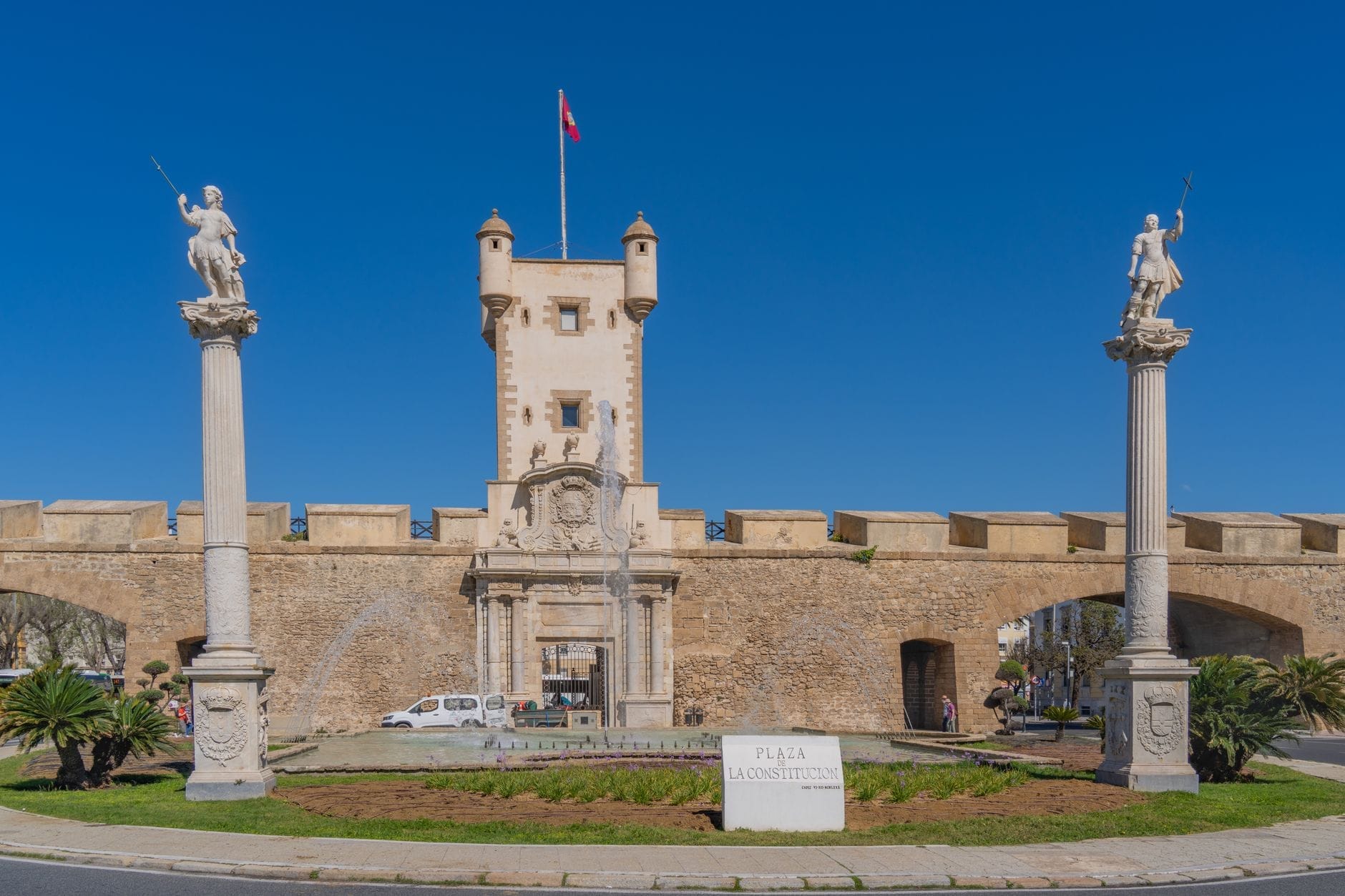
What Is Puertas de Tierra?
Puertas de Tierra, which translates roughly as 'Gates of Land', is the grand defensive gateway that once served as the only land entrance into Cádiz's old city. Standing at the neck of the narrow peninsula where the historic centre meets the more modern residential and commercial districts, it is one of Andalusia's best-preserved examples of 18th-century military baroque architecture. The structure was designed by architect Torcuato Cayón and completed in the 18th century, and it holds official protected status as a Bien de Interés Cultural.
The name itself speaks to the city's unusual geography. Because Cádiz sits almost entirely surrounded by the Atlantic on a long, thin spit of land, the only approach by land was through this single controlled point. For centuries, entering or leaving the city meant passing through this gate, and that gave it enormous strategic and symbolic weight. Today the surrounding walls have largely disappeared or been absorbed into the urban fabric, but Puertas de Tierra survives as a solid, stone reminder of a city that once guarded itself carefully against both military and maritime threats.
💡 Local tip
The Torreón and upper walkway are open to visitors on a seasonal schedule. Check hours before visiting: the gate is closed on Mondays, and closing times shift between summer and winter schedules.
The Architecture Up Close
Seen from the modern city side, Puertas de Tierra presents a wide, three-arched facade in pale ochre stone, flanked by two cylindrical turrets that rise above the roofline. The central arch is the largest, originally intended for vehicles and livestock, while the two flanking arches accommodated foot traffic. Stone relief carvings sit above the central vault, though weathering has softened their edges over the centuries. The whole composition has a muscular, horizontal quality, more about controlled force than decorative flourish.
Inside, the vaulted passage itself is worth a pause. The ceiling ribs concentrate and amplify the ambient sound of the street, so the rumble of passing traffic and conversation takes on a slightly echo-chamber quality. The stone underfoot is worn smooth in the centre where foot and wheel traffic was heaviest, and the walls retain patches of plaster at different depths, a kind of accidental stratigraphy of the gate's many repair cycles.
The upper walkway and Torreón (turret interior) open up the structure in a way that a ground-level pass-through does not. Once you climb up, the scale of the gate's construction becomes more legible: the depth of the rampart walls, the sight lines across the open ground that once served as a clear field of fire, and the way the old city's roofscape steps away to the west in a dense mosaic of terracotta and white.
Tickets & tours
Hand-picked options from our booking partner. Prices are indicative; availability and final rates are confirmed when you complete your booking.
Historical Roman Cadiz guided walking tour
From 22 €Instant confirmationFree cancellationDay trip to Tarifa, Vejer, and the Bolonia beach from the Cadiz Bay
From 59 €Instant confirmationFree cancellationWinery tour with tasting of three wines in Sanlucar
From 18 €Instant confirmationFree cancellationWinery tour and wine tasting in Chiclana de la Frontera in Cadiz
From 25 €Instant confirmationFree cancellation
How the Experience Changes Through the Day
Early morning is the most textured time to visit. The low Atlantic light catches the pale stone and deepens every shadow in the relief carvings. The road running through the gate carries a steady trickle of commuters on foot and by bike, and there is a real sense of the gateway still functioning as a threshold, not just a monument. The smell of bread from nearby bakeries drifts through the arch from the old city side.
By mid-morning, once the Torreón opens at 11:00, the site takes on more of a visitor atmosphere. Groups gather beneath the arches to photograph the facade, and the upper walkway becomes the best spot in the immediate area for a clear view toward the old town's skyline. On overcast days, the stone reads a cooler grey and the atmosphere is more subdued; in full sun, the gateway almost glows. Midday in summer can be intense: the stone radiates stored heat and there is no shade on the walkway.
⚠️ What to skip
In summer (June–September), the walkway is fully exposed to direct sun. Bring water and visit in the morning or after 17:00 when the site reopens for evening hours.
Late afternoon visits have their own logic. The light shifts to gold by around 18:00 in summer, and the gate is backlit from the west, which makes for dramatic photography from the modern city side. A few locals use the lower passage as a cut-through on their way home, and the gate briefly returns to the rhythm it has had for three centuries: a place of movement and crossing, not just observation.
Historical Context: Why This Gate Mattered
Cádiz's vulnerability as a peninsula city made its single land entrance both a defensive asset and a strategic bottleneck. For most of its history, whoever controlled Puertas de Tierra effectively controlled access to the city. The 18th century saw the gateway rebuilt in its current form as part of broader Bourbon-era improvements to Spain's Atlantic port defenses, driven partly by the enormous wealth flowing through Cádiz as the primary port for trade with Spanish America. The city you see when you walk through the arch and into the historic centre was largely shaped by that commercial golden age, and the gate was its formal entrance.
The reopening of the Torreón and walkway to the public in 2013 marked a shift in how the city treats the monument, moving it from traffic infrastructure to cultural heritage destination. It now fits naturally into any old town walking tour, serving as either a starting point or a bookend depending on which direction you approach the historic quarter.
The gate's status as a Bien de Interés Cultural means it falls under Spain's highest level of heritage protection, restricting alterations and requiring ongoing conservation work. That protection is partly why the stone retains its original texture rather than being smoothed over with modern render, which gives the structure an authenticity that many restored monuments have lost.
Opening Hours and Practical Details
The gateway passage itself is open at all hours as a public thoroughfare. The Torreón and upper walkway follow a seasonal schedule managed by the city tourism authority.
- 5 January – 31 May and 1 October – 22 December: Tuesday to Saturday 11:00–18:00; Sunday 11:00–14:00; Monday closed.
- 1 June – 30 September and 23 December – 4 January: Tuesday to Saturday 11:00–15:00 and 17:00–21:00; Sunday 11:00–14:00; Monday closed.
- Entry to both the gateway passage and the Torreón is free of charge.
The address is Plaza de la Constitución, s/n, Cádiz. There is no dedicated parking at the monument, and the old city beyond the gate is largely pedestrianised. Arriving on foot or by local bus is the straightforward option. The gate is genuinely impossible to miss if you are approaching the historic centre from the east: it sits directly across the road at the point where the peninsula narrows.
ℹ️ Good to know
No detailed mobility-access information for the Torreón interior is published on the official city tourism page. If accessibility is a concern, contact the Ayuntamiento de Cádiz tourism office directly before visiting.
Photography and What to Capture
The facade photograph that appears in nearly every Cádiz guidebook is taken from the modern city side, straight-on to the central arch, in morning light. That shot is easy to replicate and genuinely good, but there are less predictable angles worth pursuing. The view from directly beneath the central vault, looking up at the rib vaulting against the sky, requires a wide lens but produces a compelling geometric image. From the upper walkway, a long shot along the roofline of the old city toward the cathedral towers gives a sense of the peninsula's density.
The gate also works well as a framing device. Shooting the historic centre through the arch, with the arch providing a stone border and the narrow streets converging behind, is a classic compositional move that still works because the proportions are generous. For those combining the gate with broader exploration, Cádiz's best viewpoints include several elevated spots within walking distance where the gate can be seen in its full urban context.
Honest Assessment: Is It Worth Your Time?
Puertas de Tierra is not the kind of attraction you spend an afternoon at. It earns its place on an itinerary as a short, free, and architecturally rewarding stop, particularly if you are already arriving from outside the old city. The upper walkway adds genuine value that the ground-level pass-through does not offer, so if the Torreón is open when you arrive, it is worth the few minutes to go up. If it is closed (Mondays, or outside listed hours), the gate is still compelling as an exterior subject, but there is not much else to do. For a deeper sense of what surrounds it, the El Pópulo quarter just inside the gate is one of Cádiz's oldest neighbourhoods and deserves at least as much of your time.
Travelers who are primarily interested in beaches, food, or modern Cádiz will likely find this a quick glance on the way to something else, and that is a fair use of it. Anyone with an interest in military architecture, Andalusian urban history, or the Bourbon fortification of Spain's Atlantic coast will find it a satisfying stop with more to read in its stonework than the brief visit time suggests.
Insider Tips
- Visit on a Tuesday or Wednesday morning to avoid weekend tour groups who tend to arrive around 11:30 and cluster under the arches for group photos.
- Stand at the midpoint of the central vault and speak at a normal volume: the acoustics create an unexpected resonance that makes the scale of the stonework physically felt rather than just seen.
- The view from the upper walkway is better toward the old city (west) than toward the modern city (east), so orient yourself accordingly when you reach the top.
- If you plan to visit the cathedral and Torre Tavira on the same day, Puertas de Tierra works best as your first stop, anchoring the eastern end of a west-to-northwest walk through the historic centre.
- The gate's exterior is lit at night, and the illuminated facade against the dark sky makes for a strong photograph from the modern city side, but the Torreón is not open for evening access.
Who Is Puertas de Tierra For?
- History and architecture enthusiasts wanting to understand Cádiz's defensive past
- Photographers looking for strong geometric subjects and old-city framing opportunities
- Visitors on a tight budget: the entire experience, including the upper walkway, is free
- Walkers using the gate as the natural starting point for a self-guided old town circuit
- Travelers combining Cádiz with a broader Andalusian heritage itinerary
Nearby Attractions
Other things to see while in Centro Histórico (Old Town):
- Alameda Apodaca
Alameda Apodaca is a protected Romantic-era promenade running along the northern sea wall of Cádiz's old town. Free, open at all hours, and overlooking the Bay of Cádiz, it offers one of the most atmospheric walks in the city — with very little effort required.
- Antiguo Hospital de Mujeres
Founded in 1677 and rebuilt in grand 18th-century baroque style, the Antiguo Hospital de Mujeres is one of Cádiz's most architecturally significant buildings. Today it is managed as a visitable monument linked to the Diocese of Cádiz y Ceuta, opening its twin patios and chapel to visitors for a modest entry fee, offering a rare glimpse into the city's golden-age ambitions.
- Ayuntamiento de Cádiz (City Hall)
The Ayuntamiento de Cádiz stands as one of the most photographed facades in Andalusia's oldest provincial capital. Begun in 1799 and shaped by two distinct architectural phases, it anchors the central plaza of Cádiz's historic core and speaks directly to the city's 19th-century ambitions. This guide covers what to see, when to go, and how the building fits into a walk through the old town.
- Calle Ancha
Calle Ancha cuts through the historic center of Cádiz as its widest and most storied street. Free to walk at any hour, it offers a concentrated dose of Baroque architecture, political history, and the kind of unhurried street life that defines this Atlantic city.