Playa de La Caleta: Cádiz's Iconic Walled-City Beach
Playa de La Caleta is the smallest and most storied beach in Cádiz, tucked between the Castillo de San Sebastián and the Castillo de Santa Catalina inside the historic walled city. Free to access at any hour, it draws locals for an early-morning swim, families by afternoon, and visitors seeking one of Andalusia's most atmospheric Atlantic sunsets.
Quick Facts
- Location
- Playa de La Caleta, 11002 Cádiz — La Viña neighborhood, on the oceanfront at the edge of the historic walled city
- Getting There
- Walkable from Cádiz old town; city buses serve stops throughout the historic center
- Time Needed
- 1–3 hours depending on whether you swim, walk the promenade, or stay for sunset
- Cost
- Free — public beach, open 24/7
- Best for
- Sunset watching, a quick city swim, photography, and understanding Cádiz's ancient harbor history
- Official website
- en.andalucia.org/listing/playa-de-la-caleta/15411101
What Makes La Caleta Different From Every Other Beach in Cádiz
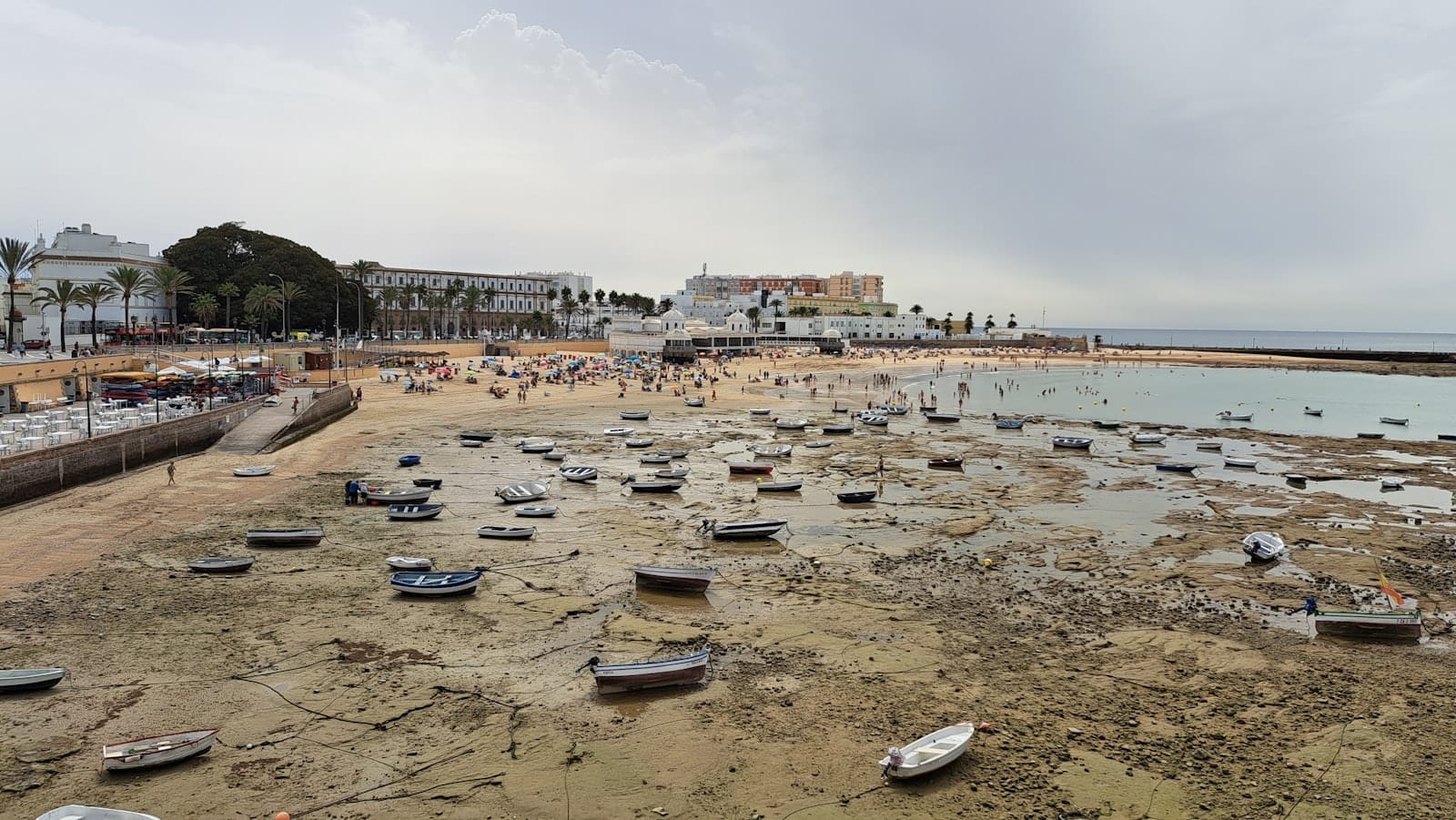
Playa de La Caleta is an anomaly: the only open beach sitting at the edge of Cádiz's walled city, and by some distance the smallest, stretching about 450 metres in length with a maximum width of around 50 metres at low tide. Most city beaches are appendages to urban sprawl. La Caleta is something different — it is framed on both headlands by working historic fortifications, the Castillo de San Sebastián to the west and the Castillo de Santa Catalina to the east, so that wherever you sit on the sand, you are looking at centuries of military architecture.
The beach belongs to the La Viña neighborhood, one of the most authentically gaditano corners of the city. There are no hotel chains pressing up against the promenade here. The buildings behind the seafront are low, ochre-toned residential blocks whose ground floors house the kind of no-frills seafood bars that serve fried fish in paper cones to the same families who have been coming for generations. That texture — local, slightly worn, completely unpolished — is what separates La Caleta from resort beaches further along the coast.
ℹ️ Good to know
Tide awareness matters here: La Caleta's usable beach area shrinks considerably at high tide. Check tide times before you go if you want space to spread a towel. At low tide the beach is generous; at high tide it can reduce to a narrow strip.
Three Thousand Years of History Beneath Your Feet
La Caleta is not merely old in the way that many European landmarks are old. This cove served as the primary natural harbor for Phoenician, Carthaginian, and Roman mariners approaching the settlement that would eventually become Cádiz. Before the city's grand commercial port existed, ships loaded and unloaded cargo here, and the calm, protected arc of the bay made it the logical landfall for anyone crossing from North Africa or the eastern Mediterranean. The sea floor around La Caleta has yielded significant archaeological finds over the decades — anchors, amphorae, and other remnants that confirmed the beach's role as one of the most continuously used anchorages in the ancient western world.
A major beach nourishment project, which added over 41,000 cubic metres of sand sourced from Cortadura beach, is a reminder that La Caleta requires active management to remain a functioning urban beach. The natural harbor geography that made it attractive to ancient sailors — its relative shelter from the prevailing Atlantic swells — also means sediment does not replenish here as readily as on Cádiz's open ocean-facing beaches. For deeper context on the city's ancient timeline, the Museo de Cádiz holds the most important collection of Phoenician and Roman artifacts recovered from these waters.
Tickets & tours
Hand-picked options from our booking partner. Prices are indicative; availability and final rates are confirmed when you complete your booking.
Historical Roman Cadiz guided walking tour
From 22 €Instant confirmationFree cancellationDay trip to Tarifa, Vejer, and the Bolonia beach from the Cadiz Bay
From 59 €Instant confirmationFree cancellationWinery tour with tasting of three wines in Sanlucar
From 18 €Instant confirmationFree cancellationWinery tour and wine tasting in Chiclana de la Frontera in Cadiz
From 25 €Instant confirmationFree cancellation
How the Beach Changes Through the Day
Early mornings at La Caleta belong almost entirely to locals. By seven or eight in the morning on a summer day, you will find gaditanos who have walked down from the old town for a pre-work swim, older residents doing laps in the shallows, and a handful of joggers moving along the promenade above. The light at this hour is flat and silvery over the Atlantic, and the two castles catch a warm glow that intensifies as the sun clears the city roofline. It is the quietest and coolest window for visiting, and the water is noticeably less disturbed.
From late morning through mid-afternoon in summer, the beach fills quickly. Families arrive with umbrellas and coolers, the sand gets crowded in the middle section, and the water — generally calm by Atlantic standards inside the cove — becomes busy with children and teenagers. The smell of sunscreen mixes with the salt air, and the surrounding bars start doing brisk trade in cold drinks and bocadillos. If you are not specifically there to swim and sunbathe with a crowd, this window is the least rewarding.
The late afternoon and sunset window, roughly from 6 p.m. onward, is when La Caleta becomes genuinely extraordinary. As the sun drops toward the horizon over the open Atlantic, both castles are silhouetted against an orange and pink sky. The promenade fills with people who have specifically come to watch, including many who will never touch the water. Photographers set up on the low walls above the beach. The bars put chairs outside. The air cools perceptibly, carrying that particular Atlantic salt smell that seems stronger in the evening. In terms of sheer visual reward for the time invested, there are few sunset spots in Cádiz that compete.
💡 Local tip
For sunset photography, position yourself on the promenade slightly east of center. This gives you the Castillo de San Sebastián's causeway in the foreground with the sun dropping behind it — the composition that appears in almost every striking image of La Caleta.
The Two Castles That Frame the Beach
The Castillo de San Sebastián sits on a small rocky islet at the western tip of La Caleta, connected to the mainland by a narrow causeway that is accessible on foot. The current fortification dates from the 18th century, though there has been a defensive structure on the site for much longer. Walking the causeway is one of the more unusual pedestrian experiences in the city: the Atlantic is immediately on both sides, the water rushes past the rocks below, and you feel entirely removed from the urban environment behind you.
To the east, the Castillo de Santa Catalina is a star-shaped Renaissance fortress built in the early 17th century following the English raid on Cádiz in 1596. Unlike many of Cádiz's fortifications, Santa Catalina is not merely an exterior landmark — it functions today as a cultural venue and is generally open to visitors, making it worth combining with a La Caleta visit.
Practical Walkthrough: Getting There and Making the Most of It
La Caleta is straightforward to reach on foot from anywhere in Cádiz's historic center. From the Cathedral it is a comfortable 10 to 15 minute walk heading west through the old town. The route passes through narrow residential streets before the promenade and sea open up in front of you — the transition is abrupt and satisfying. City buses serve the historic center broadly, and because the old town is compact, cycling and walking are the practical transport options for most visitors.
The boardwalk promenade running above the beach provides level access along the seafront, and is usable for people with mobility limitations. Reaching the sand itself requires descending stairs or ramps from the promenade level. Specific adapted bathing facilities such as amphibious wheelchairs are not confirmed at this location, so visitors with particular accessibility requirements should verify current provision directly with the Cádiz municipal services before visiting.
There is no locker or facility infrastructure on La Caleta comparable to what you find at larger urban beaches. Bring what you need and take it with you. The bars along the promenade and the streets of La Viña directly behind the beach cover most needs: cold drinks, fried fish, ice cream, basic snacks. Parking in the old town is scarce and expensive; arriving by bus or on foot from accommodation in the historic center is consistently easier than arriving by car.
⚠️ What to skip
La Caleta faces the Atlantic directly to the west and southwest. On days with strong westerly winds (the Poniente), waves can build inside the cove and make swimming uncomfortable or inadvisable. The sea conditions here can change faster than they appear from the promenade. If the water looks rough, it probably is.
What the Beach Is Not: Setting Honest Expectations
La Caleta is famous within Cádiz and earns its reputation as a visual and cultural landmark. It is not, however, a beach suited to travelers whose priority is long stretches of fine sand, calm swimming conditions, and beach amenities. For that kind of day, Playa de la Victoria on the Atlantic-facing side of the isthmus is the better choice — wider, longer, better-equipped, and consistently more sheltered.
The city beach setting also means the sand can carry the marks of a well-used urban space, particularly at the height of summer. Crowds from late morning onward can make it feel more like a public square with water than a peaceful coastal retreat. Visitors who arrive expecting the pristine solitude of a remote cove will be disappointed. Those who arrive understanding they are standing on an ancient harbor inside a living city, watching the same sunset that sailors and merchants watched three millennia ago, will find it entirely worthwhile.
La Caleta fits naturally into a broader walk along Cádiz's seafront. The Campo del Sur promenade runs east from the beach toward the Cathedral, offering a continuous coastal walk that takes in the sea walls, the old town skyline, and multiple viewpoints. Combining La Caleta, the Campo del Sur, and a loop back through the La Viña neighborhood makes for one of the most satisfying half-day walks the city offers.
Insider Tips
- Come at low tide if you want the beach for swimming: the usable sand area at least doubles compared to high tide, and the shallow sections are much more accessible for non-strong swimmers.
- The most photogenic angle of the Castillo de San Sebastián causeway is from the eastern end of the promenade, looking west in the last 45 minutes before sunset. Bring a wide-angle lens or use the panoramic mode on your phone.
- The seafood bars in the streets immediately behind the beach, in La Viña, generally offer better value and more authentic food than the terrace places directly facing the promenade. Walk one or two blocks inland to find where locals actually eat.
- Winter visits are often underrated. On a clear January or February day with a westerly breeze and empty sand, La Caleta is atmospheric in a way summer crowds prevent. The light is lower and more directional, which makes both castles look dramatic.
- If you want to walk the Castillo de San Sebastián causeway, check whether the castle itself is accessible on the day you visit — opening schedules can vary. Even if the castle is closed, the causeway walk is open and worth doing for the sea views alone.
Who Is Playa de La Caleta For?
- Sunset seekers wanting one of the Atlantic coast's most dramatically framed evening skies
- History-minded travelers interested in Phoenician and Roman Cádiz and the ancient harbor setting
- Walkers combining a seafront stroll with the Campo del Sur and a loop through the La Viña neighborhood
- Photographers looking for the castle-and-sea compositions that define Cádiz's visual identity
- Visitors wanting a quick, free, centrally located swim break during a day spent exploring the old town
Nearby Attractions
Other things to see while in Barrio de La Viña:
- Balneario de La Palma (La Caleta)
Standing on a rocky pier at the edge of La Caleta beach, the Balneario de Nuestra Señora de la Palma y del Real is one of the most photographed buildings in Cádiz. Originally a thalassotherapy spa opened in 1926, it now houses the Centro de Arqueología Subacuática (Underwater Archaeology Center) of the Instituto Andaluz del Patrimonio Histórico — but its neoclassical silhouette against the Atlantic remains one of the city's defining images.
- Castillo de San Sebastián
Castillo de San Sebastián sits on a small rocky islet at the western tip of La Caleta beach, connected to the city by a long stone causeway. Entry is free, the views stretch across open Atlantic water, and the history behind the walls runs from Venetian sailors to Napoleonic sieges. It's one of Cádiz's most rewarding walks — if you know when to go.
- Castillo de Santa Catalina
Built after a devastating 1596 raid to defend the Atlantic coastline, the Castillo de Santa Catalina stands on a rocky promontory framing La Caleta beach. Entry is free, the sea views are sweeping, and the interior now doubles as a cultural exhibition centre — making it one of the most rewarding stops in the old city.