Castillo de Santa Catalina: Cádiz's Star Fortress on the Sea
Built after a devastating 1596 raid to defend the Atlantic coastline, the Castillo de Santa Catalina stands on a rocky promontory framing La Caleta beach. Entry is free, the sea views are sweeping, and the interior now doubles as a cultural exhibition centre — making it one of the most rewarding stops in the old city.
Quick Facts
- Location
- Calle Antonio Burgos, s/n, La Viña, Cádiz — north tip of Playa de la Caleta
- Getting There
- Walk west from the old town along Campo del Sur and the seafront; local buses serving La Caleta stop a short walk away
- Time Needed
- 45–90 minutes for the castle; combine with La Caleta beach for a half-day
- Cost
- Free entry (except for previously announced paid events, which may close general access)
- Best for
- History, photography, sea views, architecture, free culture
What You're Actually Looking At
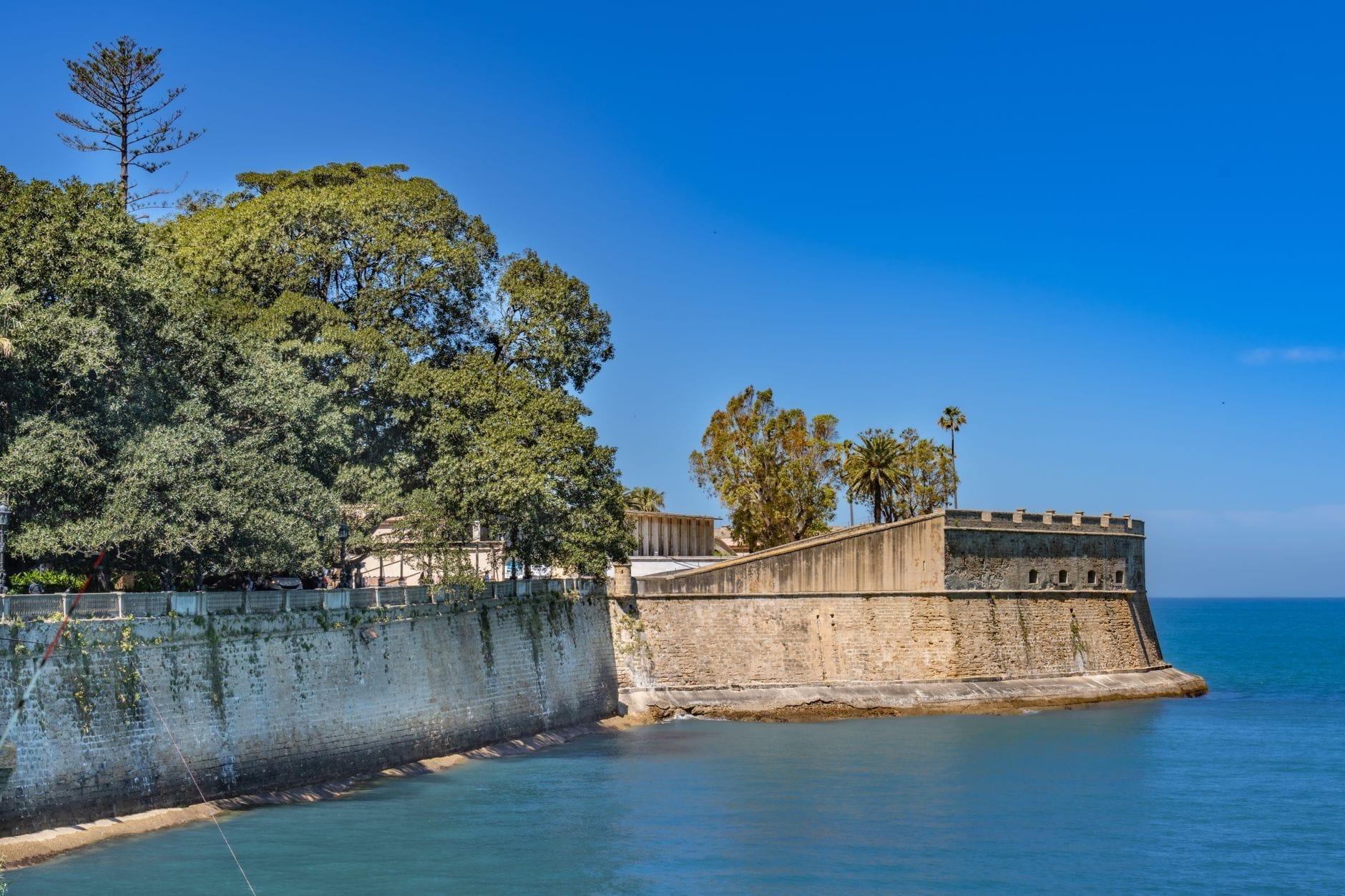
The Castillo de Santa Catalina occupies a low rocky headland on the northern edge of La Caleta beach, flanked by ocean on three sides. From the shore, it reads clearly as a military structure: angular bastions pushing outward in the star-shaped arrangement that defined early modern European fortress design, a dry moat cutting across the land approach, and thick curtain walls that absorb rather than reflect sunlight. What looks austere from the outside opens into something unexpected once you're inside — courtyards, exhibition rooms, and unobstructed Atlantic panoramas that few visitors anticipate.
The castle was declared an Asset of Cultural Interest (Bien de Interés Cultural) in 1985 and is now managed by the Ayuntamiento de Cádiz as a free cultural and exhibition centre. Entry costs nothing on most days, with charges only for previously announced events, which makes it one of the most accessible heritage sites in the city.
ℹ️ Good to know
Opening hours: Monday to Sunday and public holidays 11:00–19:00. Exception: on 3, 10, 17, and 24 July the castle closes at 17:00. The castle may temporarily close for ticketed private or cultural events — check the Ayuntamiento website before visiting.
A Fortress Born from Catastrophe
The origin of the Castillo de Santa Catalina is inseparable from one of the most humiliating episodes in Cádiz's history. In 1596, an Anglo-Dutch fleet commanded by the Earl of Essex and Robert Dudley sailed into the bay, overwhelmed the harbour defences, and sacked the city. The damage was severe enough that King Philip II dispatched military engineer Cristóbal de Rojas to redesign the city's coastal fortifications from scratch.
Construction began in April 1598 and continued through the reign of Philip III, reaching completion in September 1621. The star plan Rojas chose was not decorative — each protruding bastion was calculated to eliminate blind spots and allow defenders to cover the full length of adjacent walls with crossfire. The moat reinforced the land side, since naval attack from the open ocean was the primary threat but opportunistic land assault always had to be planned for.
For much of its operational life the castle functioned exactly as intended: a deterrent. In 1769, under Charles III, its role shifted and it was converted into a military prison. It remained under military authority until 1991, when Spain's Ministry of Defence transferred it to the city. That transition is worth pausing on — the same walls that once held prisoners now hold temporary art exhibitions, and the same bastions that pointed cannons toward the sea now point cameras. You can read about how this coastal edge fits into the broader defensive history of the city in the Murallas de Cádiz guide.
Tickets & tours
Hand-picked options from our booking partner. Prices are indicative; availability and final rates are confirmed when you complete your booking.
Historical Roman Cadiz guided walking tour
From 22 €Instant confirmationFree cancellationDay trip to Tarifa, Vejer, and the Bolonia beach from the Cadiz Bay
From 59 €Instant confirmationFree cancellationWinery tour with tasting of three wines in Sanlucar
From 18 €Instant confirmationFree cancellationWinery tour and wine tasting in Chiclana de la Frontera in Cadiz
From 25 €Instant confirmationFree cancellation
Walking Through the Castle: What to Expect Room by Room
You enter across the moat via a stone bridge — the transition from beach-town noise to the interior quiet happens almost immediately. The walls absorb wind and sound. Inside the main courtyard, the scale is more intimate than the exterior suggests: the buildings lining the inner perimeter are low, whitewashed, and largely unadorned, consistent with military utility rather than aristocratic display.
The exhibition rooms occupy what were originally garrison and storage spaces along the inner walls. The programming rotates, with a leaning toward Andalusian contemporary art, sculpture, and occasional photography shows. Quality varies, as it does at any free municipal gallery, but the setting alone — thick stone walls, high ceilings, natural light filtering through deep window reveals — gives even modest work a solemnity it might not earn elsewhere.
The ramparts are the real draw for most visitors. Walk up to the bastions and you're standing at sea level plus a few metres, with nothing between you and the open Atlantic. On clear days the far side of the Bay of Cádiz is visible. On rougher winter days, spray reaches the walls and the sound of the sea against the stone below is loud enough to stop conversation. Bring a jacket even in summer — the exposed position means wind is a constant.
💡 Local tip
Photography tip: The castle's western bastions face directly into the afternoon sun. If you want clean shots of the fortifications themselves, go in the morning. If you want the ramparts lit warm with the sun behind you and the sea in front, come between 16:00 and 18:00.
How the Experience Changes by Time of Day
Late morning (around 11:00–12:30) is the quietest window. Families with young children have not yet arrived in force, tour groups tend to cluster earlier at the Cathedral, and the light is neutral enough to photograph the stonework without heavy shadow. The air at this hour often carries salt and something faintly mineral from the wet stone of the moat walls.
Midday and early afternoon bring the highest foot traffic, particularly in summer. The courtyard offers some shade but the ramparts are fully exposed and can feel genuinely hot between June and August. Locals know to come at the end of the day, and the late-afternoon crowd shifts accordingly: couples walking the bastions, photographers setting up tripods on the seaward walls, and the occasional visitor who has timed their exit to watch the light turn golden over the water.
The castle sits directly adjacent to Playa de la Caleta, Cádiz's most storied urban beach, and the two work well as a single visit. The beach is at its best early morning or late afternoon; the castle fills the gap in the middle of the day when the sand is too crowded and too bright.
The Neighborhood: La Viña and What Surrounds the Castle
The castle occupies the far western tip of La Viña, a tight-knit working-class neighborhood that Cádiz residents regard as the heartbeat of the city's popular culture. The streets between the castle and the old town centre are lined with frituras (fried fish shops), corner bars, and the kind of narrow lanes where you can hear two separate conversations at once from the same doorway.
La Viña is also the neighborhood most closely identified with the Cádiz Carnival, one of the largest and most distinctive carnivals in Spain. The area's satirical, irreverent character runs deep — it is worth reading the Cádiz Carnival guide if you want to understand why this corner of a small Atlantic city has the cultural weight that it does.
Practically, this means the castle is easy to incorporate into a longer walk without requiring any transit. You can move from the castle along the seafront south toward Campo del Sur, then north into the historic centre, covering a significant portion of the old city on foot. Comfortable shoes and water are the only real requirements.
Accessibility, Logistics, and Honest Limitations
The official tourism listing confirms an adapted entrance at Calle Antonio Burgos. However, the castle is a 17th-century military fortification: sections of the ramparts involve stairs, uneven stone surfaces, and exposed drops with low or no railings. Wheelchair users and visitors with mobility limitations can access the courtyard and ground-floor exhibition rooms via the adapted entrance, but full circuit of the bastions may not be possible. If mobility is a concern, it is worth contacting the Ayuntamiento in advance.
There is no café or ticket office inside the castle. The nearest toilets are outside the walls. The beach promenade just south of the castle has a small cluster of kiosks and bars that work well for a pre or post-visit coffee. If you are visiting in July, note the earlier 17:00 closing on the four Saturdays specified above — arriving at 16:45 thinking you have two hours would be a frustrating mistake.
⚠️ What to skip
The castle occasionally closes entirely for cultural events and private functions. Verify at turismo.cadiz.es before making it the centrepiece of your day.
If you want a compact route that takes in the castle alongside the city's other key landmarks without doubling back, the Cádiz old town walking tour offers a logical sequence that includes La Caleta and the castle as part of a half-day loop.
Insider Tips
- Walk the full perimeter of the outer walls before entering. The moat side and the seaward face give you a clear sense of the star plan that disappears once you're inside the courtyard.
- The castle's seaward bastions offer a direct sightline to Castillo de San Sebastián on the opposite side of La Caleta bay — an unusual chance to see both of Cádiz's coastal fortresses from a single vantage point.
- If the gallery is showing something you're not interested in, don't rush out. The courtyard in the late afternoon, when the light drops below the rampart walls and the temperature cools, is genuinely peaceful in a way that is hard to find in the rest of the old city.
- Check the Ayuntamiento's cultural calendar before visiting. The castle periodically hosts evening concerts and outdoor screenings — these are ticketed but represent a rare chance to be inside the fortress after the standard closing hour.
- Combine the visit with the Mercado Central de Abastos if you are going in the morning — the market closes at lunchtime, while the castle opens at 11:00, so a morning market visit followed by a walk to the castle works well as a half-day itinerary.
Who Is Castillo de Santa Catalina For?
- History and military architecture enthusiasts who want to understand Cádiz's defensive past beyond the Cathedral quarter
- Photographers looking for sea-facing ramparts and strong geometric stonework in Atlantic light
- Travellers on a tight budget who want substantial cultural content without admission fees
- Visitors combining a beach morning at La Caleta with a shaded cultural stop in the early afternoon
- Anyone wanting an uncrowded counterpoint to the busier monuments in the historic centre
Nearby Attractions
Other things to see while in Barrio de La Viña:
- Balneario de La Palma (La Caleta)
Standing on a rocky pier at the edge of La Caleta beach, the Balneario de Nuestra Señora de la Palma y del Real is one of the most photographed buildings in Cádiz. Originally a thalassotherapy spa opened in 1926, it now houses the Centro de Arqueología Subacuática (Underwater Archaeology Center) of the Instituto Andaluz del Patrimonio Histórico — but its neoclassical silhouette against the Atlantic remains one of the city's defining images.
- Castillo de San Sebastián
Castillo de San Sebastián sits on a small rocky islet at the western tip of La Caleta beach, connected to the city by a long stone causeway. Entry is free, the views stretch across open Atlantic water, and the history behind the walls runs from Venetian sailors to Napoleonic sieges. It's one of Cádiz's most rewarding walks — if you know when to go.
- Playa de La Caleta
Playa de La Caleta is the smallest and most storied beach in Cádiz, tucked between the Castillo de San Sebastián and the Castillo de Santa Catalina inside the historic walled city. Free to access at any hour, it draws locals for an early-morning swim, families by afternoon, and visitors seeking one of Andalusia's most atmospheric Atlantic sunsets.