Balneario de La Palma: Cádiz's Beloved Seafront Landmark
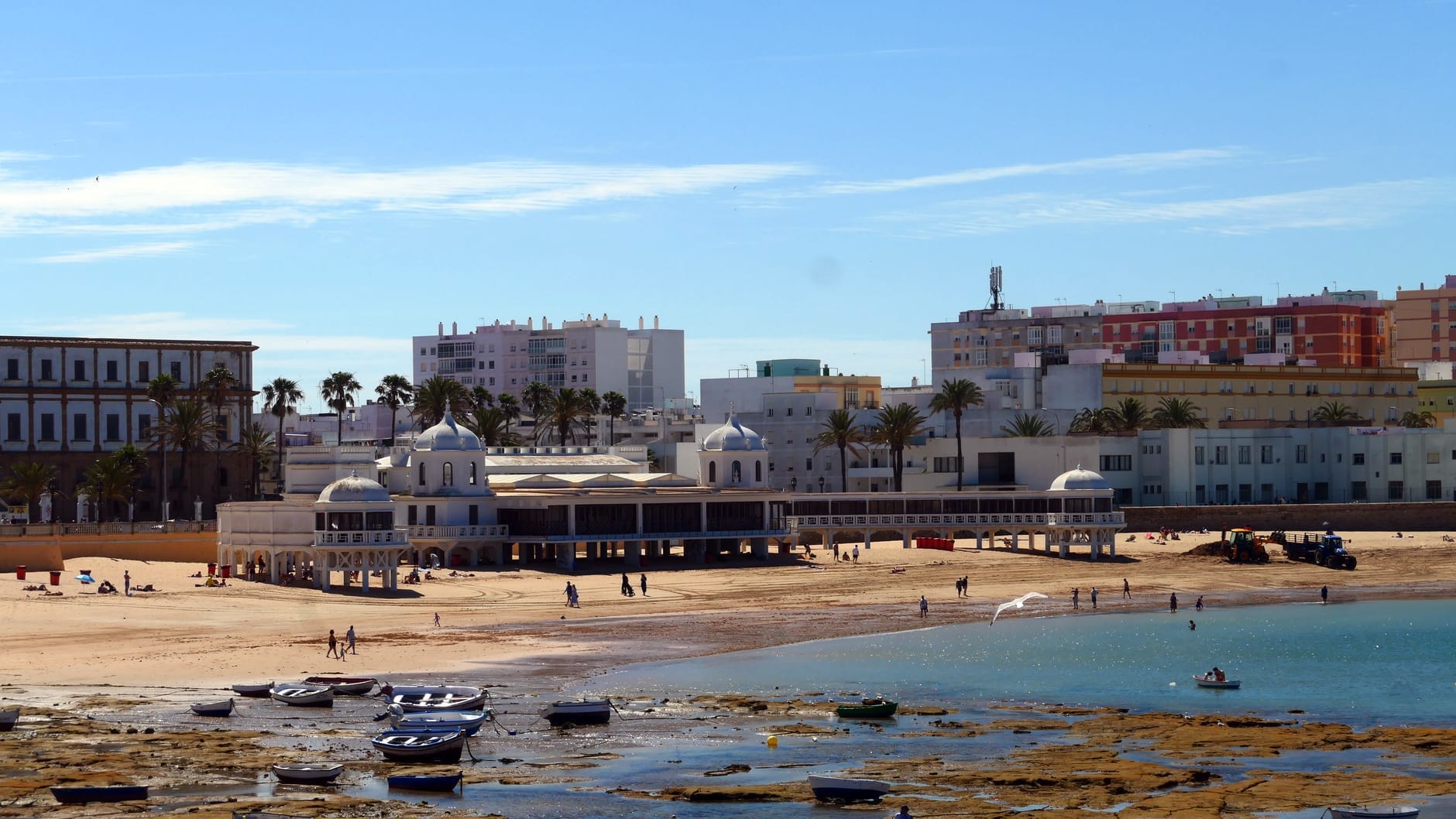
Standing on a rocky pier at the edge of La Caleta beach, the Balneario de Nuestra Señora de la Palma y del Real is one of the most photographed buildings in Cádiz. Originally a thalassotherapy spa opened in 1926, it now houses the Centro de Arqueología Subacuática (Underwater Archaeology Center) of the Instituto Andaluz del Patrimonio Histórico — but its neoclassical silhouette against the Atlantic remains one of the city's defining images.
Quick Facts
- Location
- Avenida Duque de Nájera, 3, 11002 Cádiz — on Playa de La Caleta, Barrio La Viña
- Getting There
- Walkable from the historic center along the seafront promenade; city buses stop near La Caleta beach
- Time Needed
- 15–30 minutes to view exterior and photograph; combine with a longer La Caleta beach visit
- Cost
- Free (exterior only; interior only accessible by prior request, but admission itself is free)
- Best for
- Photography, sunset walks, architecture enthusiasts, and anyone exploring La Caleta
What the Balneario de La Palma Actually Is
First-time visitors sometimes arrive expecting a functioning spa or a museum. It is neither. The Balneario de Nuestra Señora de la Palma y del Real is a neoclassical heritage building that opened in 1926 as a seaside thalassotherapy center — a facility designed to channel La Caleta's seawater into therapeutic baths for paying guests. For decades it was a fashionable retreat on the edge of the Atlantic. Today, the building operates as the headquarters of the Centro de Arqueología Subacuática (Underwater Archaeology Center) of the Instituto Andaluz del Patrimonio Histórico and is listed as a Bien de Interés Cultural, Spain's highest category of heritage protection for immovable property.
The interior is not freely accessible to the general public without a prior appointment or visit request to the administration office. There is no ticketing, no guided tour, and no tourist infrastructure inside the building. What draws people here is entirely on the outside: a beautifully proportioned white structure extending from the shore on a stone pier, surrounded by water on three sides, with two octagonal towers framing its facade. In almost every sunset photograph of Cádiz, the Balneario is in the frame.
ℹ️ Good to know
The interior is not freely open to visitors; access is only possible by prior request or appointment. The experience for casual visitors is purely exterior: the building's architecture, its setting on the water, and the surrounding beach and promenade.
Architecture and Historical Context
The building that stands today replaced earlier wooden bathhouse structures that had occupied the same spot on La Caleta. The 1926 construction introduced a more permanent and architecturally ambitious presence to the beach. The style blends neoclassical formality with regionalist Andalusian influences: white rendered facades, arched windows, and decorative ceramic detailing that connects it visually to the broader tradition of early 20th-century Spanish coastal architecture.
Its position is architecturally deliberate. The building sits on a man-made platform extending into the bay of La Caleta, flanked by the two fortresses that guard the inlet: the Castillo de San Sebastián to the west-southwest and the Castillo de Santa Catalina to the east-northeast. This triangular arrangement — two fortifications and a spa building between them — gives La Caleta a visual coherence that no amount of urban planning could replicate today. The Balneario completes the composition.
Cádiz has no shortage of historically significant buildings, but the Balneario occupies a specific place in the city's collective memory. La Caleta was a working beach long before it became a leisure destination, and the spa's construction in the 1920s represented a deliberate transformation of that identity. To understand the full arc of the city's relationship with its coastline, the history of Cádiz provides essential context — particularly how the city rebuilt its identity around commerce, culture, and coastal life after the economic decline of the 19th century.
Tickets & tours
Hand-picked options from our booking partner. Prices are indicative; availability and final rates are confirmed when you complete your booking.
Historical Roman Cadiz guided walking tour
From 22 €Instant confirmationFree cancellationDay trip to Tarifa, Vejer, and the Bolonia beach from the Cadiz Bay
From 59 €Instant confirmationFree cancellationWinery tour with tasting of three wines in Sanlucar
From 18 €Instant confirmationFree cancellationWinery tour and wine tasting in Chiclana de la Frontera in Cadiz
From 25 €Instant confirmationFree cancellation
La Caleta Beach: The Real Reason to Come
The Balneario sits at the center of La Caleta, a small urban beach that curves between the two castles in a half-moon of fine, pale sand. This beach is not the longest or the most practical in Cádiz — it is only a few hundred meters wide and can fill quickly on summer afternoons. But it has a quality that the longer Atlantic-facing beaches north of the old town cannot replicate: it is sheltered, human-scaled, and entirely surrounded by the city's history.
In the early morning, before 9am, La Caleta is almost private. Local swimmers use the water directly beneath the Balneario's pier; the light hits the building from the east and the stone takes on a warm ochre tone that photographs completely differently from the bleached midday look. By 11am the beach fills steadily, and by early afternoon in summer it is densely packed. If the goal is to see the Balneario in peace, the morning is the only window. For a broader look at how La Caleta compares to Cádiz's other swimming options, the Playa de La Caleta guide covers the beach itself in full detail.
The View from the Promenade
The promenade that runs along the top of the seawall above La Caleta — Paseo Fernando Quiñones — is the best vantage point for seeing the Balneario in its full context. From up here you can see the entire beach laid out below, with the spa building projecting into the bay and both castles anchoring the far ends. This elevated viewpoint is also where you notice the building's unusual isolation: at high tide the pier appears almost to float, surrounded by water, cut off from the land.
Sunset from this promenade is genuinely one of the better photographic moments in the city. The sun drops into the Atlantic directly behind the Castillo de San Sebastián, and the Balneario sits in the foreground silhouetted against the water. It is worth arriving at least 30 minutes before sunset to secure a position on the wall, as this is a well-known spot among both locals and visitors. Cádiz has several strong viewpoints, and the viewpoints guide for Cádiz ranks the best of them with practical directions.
💡 Local tip
For the best sunset photography, position yourself on the seawall promenade above the beach at least 30 minutes before sunset. The low angle of light illuminates the Balneario's white facade and creates reflections in the wet sand at low tide.
The Neighborhood: Barrio La Viña
The Balneario sits at the coastal edge of Barrio La Viña, one of Cádiz's most distinctly local neighborhoods. La Viña is compact, densely residential, and known for two things above all others: the city's Carnival celebrations and its concentration of seafood bars and freidurías (fried fish shops). The streets behind the beach smell of frying pescadito and salt air simultaneously.
Walking from the Balneario back toward the center through La Viña takes no more than 10 minutes on foot, but it passes through a completely different texture of city life than the historic plazas and cathedral district. The bars are narrower, the conversations louder, and the pace less tourist-oriented. La Viña is also the heart of the Cádiz Carnival, one of Spain's most famous winter festivals. If you are planning a trip around that event, the Cádiz Carnival guide explains timing, neighborhoods, and what to expect.
Practical Walkthrough: How to Visit
The Balneario de La Palma is best treated as a stop within a longer walk rather than a standalone destination. The most natural approach is to walk the seafront promenade southwest from the old town, passing the Campo del Sur seawall and dropping down to La Caleta either at the beach access stairs or by continuing along the upper path above the bay. The walk from the cathedral district takes around 15 minutes at a comfortable pace.
If you are arriving by city bus, routes serving the La Caleta area stop close to the beach entrance; verify current routes with the local transport operator as schedules vary. Driving is not recommended in this part of the city — parking near La Caleta is extremely limited in summer and the streets in La Viña are narrow. The old town center has public parking garages, and the walk from there to the Balneario is manageable.
The promenade and beach access are level and wide. The Balneario building itself sits on a pier that extends into the water, and the walkway along its base can be uneven in places. Official sources do not provide specific information on step-free or wheelchair accessibility for the building's immediate pier walkway.
⚠️ What to skip
Do not go out of your way expecting to freely enter the Balneario. It is a working government office (housing the Centro de Arqueología Subacuática), and access for visits requires a prior request or appointment. There is no spa, no cafe, and no public facility routinely open inside the building.
Photography Tips
The Balneario photographs best from three positions: from the beach at low tide when wet sand creates reflections; from the upper promenade for the full landscape context including both castles; and from the causeway leading to the Castillo de San Sebastián, which gives a slightly elevated side view that shows the full length of La Caleta. That last angle is the least well-known and often the most rewarding.
Midday light in summer is harsh and flattens the building's facade detail. Early morning (before 9am) and the hour before sunset are the reliable windows. In winter, the light is more diffuse throughout the day, and La Caleta is dramatically quiet — often just local joggers, a few fishermen on the pier, and the sound of waves against the stone.
Insider Tips
- The side view from the Castillo de San Sebastián causeway — particularly the stretch about halfway along — gives an elevated angle showing the Balneario against the full arc of La Caleta that most visitors never find.
- Low tide changes the beach entirely: the sand extends much further out and wet sand reflections make the Balneario appear to double in height. Check a tide table before planning your visit around photography.
- Winter mornings are underrated here. The beach empties almost completely between October and March, and you can have the entire composition — both castles, the Balneario, open water — to yourself. Weather permitting, this is the most atmospheric version of La Caleta.
- The freidurías on Calle La Palma and the surrounding streets of La Viña, a short walk back from the beach, are among the most local-facing fried fish spots in Cádiz. Pairing a beach walk with lunch here is how residents actually spend time in this part of the city.
- If you plan to photograph the Balneario at sunset, face west from the promenade above the beach — not from the beach itself. The elevation gives a cleaner sightline past the crowds below and frames the building against the open Atlantic horizon.
Who Is Balneario de La Palma (La Caleta) For?
- Architecture and heritage enthusiasts interested in early 20th-century Spanish coastal buildings
- Photographers seeking Cádiz's most iconic exterior compositions, especially at golden hour
- Travelers combining a La Caleta beach visit with an exploration of the La Viña neighborhood
- Anyone walking the full seafront route from the old town toward the western castles
- Visitors who want a quieter, more local-feeling alternative to the central tourist circuit
Nearby Attractions
Other things to see while in Barrio de La Viña:
- Castillo de San Sebastián
Castillo de San Sebastián sits on a small rocky islet at the western tip of La Caleta beach, connected to the city by a long stone causeway. Entry is free, the views stretch across open Atlantic water, and the history behind the walls runs from Venetian sailors to Napoleonic sieges. It's one of Cádiz's most rewarding walks — if you know when to go.
- Castillo de Santa Catalina
Built after a devastating 1596 raid to defend the Atlantic coastline, the Castillo de Santa Catalina stands on a rocky promontory framing La Caleta beach. Entry is free, the sea views are sweeping, and the interior now doubles as a cultural exhibition centre — making it one of the most rewarding stops in the old city.
- Playa de La Caleta
Playa de La Caleta is the smallest and most storied beach in Cádiz, tucked between the Castillo de San Sebastián and the Castillo de Santa Catalina inside the historic walled city. Free to access at any hour, it draws locals for an early-morning swim, families by afternoon, and visitors seeking one of Andalusia's most atmospheric Atlantic sunsets.