Castillo de San Sebastián: Cádiz's Atlantic Fortress at the Edge of the Sea
Castillo de San Sebastián sits on a small rocky islet at the western tip of La Caleta beach, connected to the city by a long stone causeway. Entry is free, the views stretch across open Atlantic water, and the history behind the walls runs from Venetian sailors to Napoleonic sieges. It's one of Cádiz's most rewarding walks — if you know when to go.
Quick Facts
- Location
- Paseo Fernando Quiñones, s/n, Cádiz — islet at the western end of La Caleta beach, Barrio La Viña
- Getting There
- Walk west through Barrio La Viña from the old town; the castle causeway begins at the far end of Playa de la Caleta. No direct bus stop at the islet.
- Time Needed
- 45–90 minutes for the causeway walk and grounds; allow extra time to linger at the lighthouse end
- Cost
- Free entry (€0)
- Best for
- Sunset walks, coastal photography, military history, and escaping the old-town crowds
- Official website
- www.turismo.cadiz.es
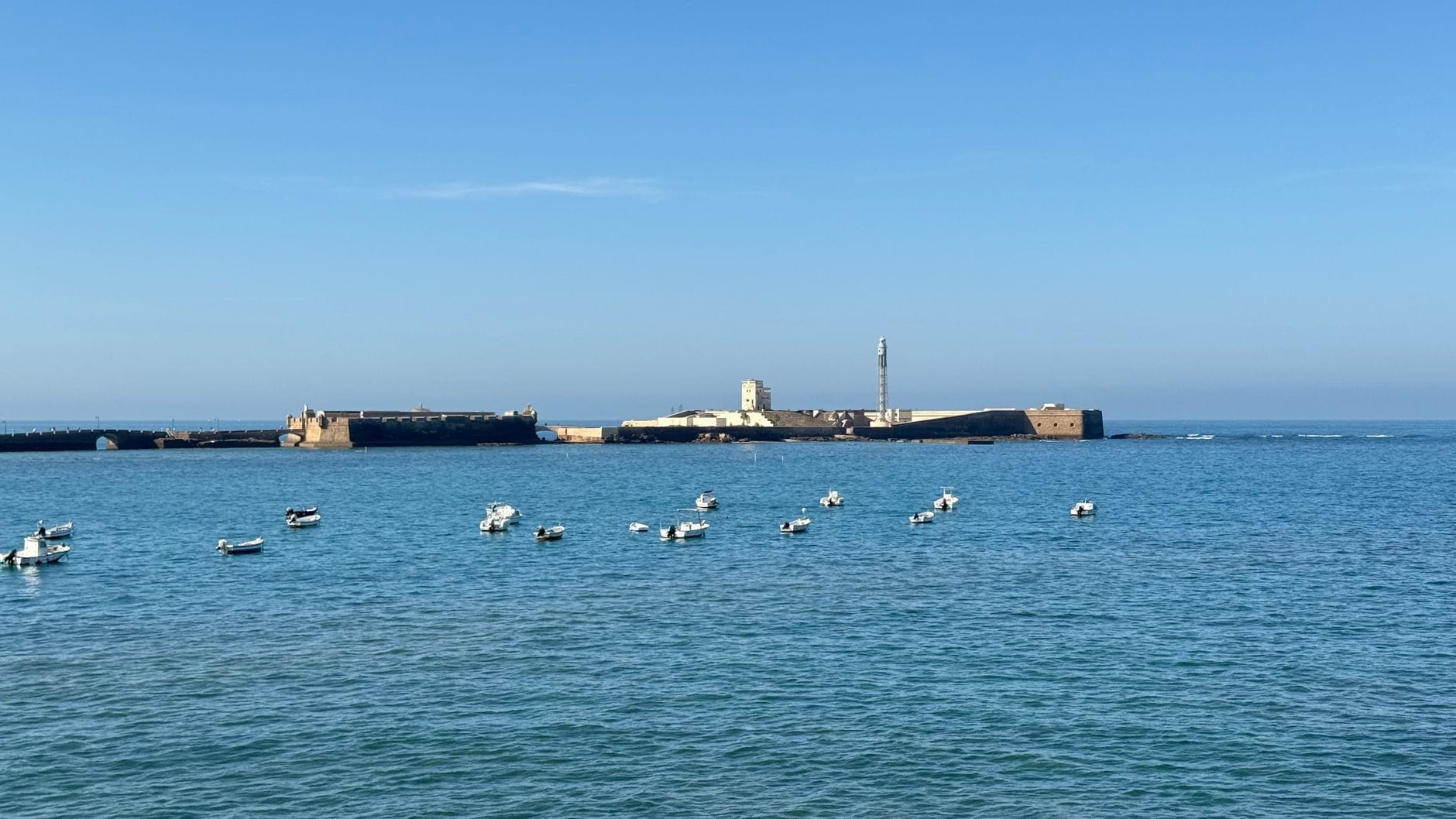
What the Castillo de San Sebastián Actually Is
The Castillo de San Sebastián is a coastal artillery fortress occupying a small islet off the western shoreline of Cádiz, linked to the city by a narrow stone causeway roughly 470 metres long. The walk out is part of the experience: salt spray off the Atlantic, gulls overhead, and the white walls of the old city receding behind you. By the time you reach the castle gate, you are surrounded on three sides by open sea.
Despite its commanding presence in the Cádiz skyline, this is not a conventional museum. There are no permanent exhibition rooms or ticketed interiors in the usual sense; instead, the castle is used for temporary exhibitions and occasional cultural events. What the castle offers is space: fortified walls, a working lighthouse, panoramic water views, and a rare sense of being genuinely at the edge of the city. The site was declared a Bien de Interés Cultural (Asset of Cultural Interest) in 1985, which places it under Spain's highest category of heritage protection.
ℹ️ Good to know
Opening hours run Monday to Sunday, 9:00 to sunset (currently listed as 9:00–21:00 until 30 September). Entry is free. Hours are officially listed as subject to weather changes — on rough Atlantic days, access to the causeway may be restricted. Check conditions before making it the centrepiece of your afternoon.
A Brief History Worth Knowing Before You Go
The site's story begins not with cannons but with a chapel. In 1457, Venetian sailors erected a small chapel on the islet and dedicated it to San Sebastián — hence the name. For nearly 250 years, the rocky outcrop served primarily as a spiritual waypoint for mariners navigating the bay. The military significance came later, when an earlier castle from the early seventeenth century was transformed into the current fortification in 1706, during a period of intense competition for control of southern Spanish ports.
The castle's position made it a key defensive node during the Peninsular War in the early nineteenth century, when Cádiz was one of the few Spanish cities never fully occupied by Napoleonic forces. The city's peninsular geography — narrow land access, sea on nearly every side — turned it into a natural stronghold, and San Sebastián was part of that defensive ring. The lighthouse visible today dates from 1908, replacing an earlier structure, and remains operational.
For deeper context on Cádiz's layered military and colonial history, the Cádiz history guide traces how the city's geography shaped centuries of European power struggles.
Tickets & tours
Hand-picked options from our booking partner. Prices are indicative; availability and final rates are confirmed when you complete your booking.
Historical Roman Cadiz guided walking tour
From 22 €Instant confirmationFree cancellationDay trip to Tarifa, Vejer, and the Bolonia beach from the Cadiz Bay
From 59 €Instant confirmationFree cancellationWinery tour with tasting of three wines in Sanlucar
From 18 €Instant confirmationFree cancellationWinery tour and wine tasting in Chiclana de la Frontera in Cadiz
From 25 €Instant confirmationFree cancellation
The Causeway Walk: What to Expect Step by Step
The approach begins at the southern end of Playa de la Caleta, where the Paseo Fernando Quiñones transitions from beachside promenade to a raised stone walkway pointing out to sea. The causeway is wide enough for pedestrians walking in both directions, and the surface is paved and relatively even. Adapted access is confirmed by official tourism sources — the route is accessible to wheelchair users, though wind and wave spray can make sections uncomfortable during rough weather.
The water on either side changes character depending on the tide and time of day. In the early morning, the bay to the east of the causeway sits calm and pale, while the open Atlantic to the west can already be running a chop. At midday in summer, the glare off the water is intense — sunglasses and sun protection are practical necessities, not optional. Late afternoon softens everything: the light turns amber, the stone walls of the castle glow, and the walk draws a steady stream of locals and visitors alike.
💡 Local tip
Walk out during the last 90 minutes before sunset. The causeway faces west, and the quality of light on the castle walls and over the water is significantly better than at any other time of day. Photographers will want to position themselves on the eastern face of the causeway for the best angle on the lighthouse.
Once past the outer gate, the castle grounds open into a series of low fortified areas with angled walls characteristic of eighteenth-century coastal artillery design. The lighthouse sits at the far end of the islet, its white cylindrical tower visible from most of the peninsula. You cannot enter the lighthouse itself, but the surrounding platform offers the best 360-degree views on the site: the bay of Cádiz to the east, open Atlantic to the south and west, and the pale line of the city's rooftops and cathedral dome to the north.
How the Experience Changes by Time of Day
Early morning visitors, arriving shortly after the 9:00 opening, will usually have the causeway almost entirely to themselves. The bay is quietest at this hour, fishing activity is winding down, and the air carries the sharp smell of salt and seaweed before the day's heat sets in. This is the window for unhurried photography and for appreciating the castle as a piece of military architecture without the distraction of crowds.
Midday in summer brings the sharpest contrast. The causeway offers no shade whatsoever, and the stone and concrete surfaces radiate heat. For visitors sensitive to sun exposure, this is the one period to avoid. The experience is not dangerous, but it is significantly less comfortable, and the flat overhead light does nothing for the castle's visual character.
The late afternoon and pre-sunset period is consistently the most rewarding. Local families, couples, and solo walkers use the causeway as an evening paseo, and there is a relaxed social atmosphere on the walk out and back. The castle itself empties of the day's visitors as sunset approaches, creating a strange quiet inside the walls just as the light reaches its peak quality outside them.
Combining the Castle with La Caleta and the Surrounding Area
The castle sits directly at the western end of Playa de la Caleta, one of Cádiz's most atmospheric beaches. The beach itself is backed by the neighbourhood of Barrio La Viña, a close-knit residential area most famous for its central role in the city's Carnival. The combination of the beach, the castle walk, and a slow return through La Viña's narrow streets makes for one of the more complete afternoon itineraries in Cádiz.
At the eastern end of La Caleta, the Balneario La Palma — a restored nineteenth-century bathing pavilion built on stilts over the water — serves as a visual counterpoint to the castle on the opposite shore. Standing at either end of the beach and looking across at the other is one of those compositions that explains why Cádiz has attracted painters and writers for centuries.
If you want a longer coastal walk, the Campo del Sur promenade connects the La Caleta area to the cathedral quarter and continues around the southern edge of the peninsula. The full walk from the castle back to the Cathedral takes roughly 25–30 minutes at a comfortable pace and passes some of the best open-sea views in the city.
Practical Notes and What to Bring
Footwear matters more here than at most city attractions. The causeway is paved, but the castle grounds include uneven stone surfaces and low steps. Comfortable walking shoes or trainers are appropriate; sandals with no grip can become slippery when sea spray wets the stone near the outer walls.
Wind is a consistent factor at Castillo de San Sebastián regardless of season. Cádiz sits fully exposed to Atlantic weather, and the islet amplifies that exposure. Even on warm days, a light layer is worth carrying. In autumn and winter, the wind off the water can be sharp enough to make the walk genuinely cold.
⚠️ What to skip
Access hours are officially subject to weather changes. During strong Atlantic swells or winter storms, the causeway can be closed without advance notice. If the sea is running rough, check with the tourist office or observe the water conditions from the beach before committing to the walk.
There are no refreshment facilities inside the castle grounds. Water, snacks, and anything else you need should be sorted before leaving the beach promenade. The nearest cafes and bars are back in Barrio La Viña, a short walk from the causeway entrance.
For a broader picture of how the castle fits into a full day in the city, the Cádiz old town walking tour offers a structured route that connects the castle area with the cathedral, the markets, and the historic plazas.
Who This Attraction Suits — and Who It Might Not
The Castillo de San Sebastián rewards visitors who find meaning in the relationship between a place and its landscape. The history is genuinely interesting, but it is experienced through space, light, and position rather than through exhibits or guided tours. Travellers who need an interior to explore, labels to read, or a structured cultural programme may find the visit brief and thin.
Visitors with limited mobility should know that the official listing confirms adapted access to the site. The causeway surface is manageable, though wind and the open exposure may be tiring on difficult days. Those travelling with very young children in pushchairs should be aware that the castle grounds themselves are rougher underfoot than the causeway approach.
In high summer, anyone sensitive to heat or sun should plan either an early morning or late evening visit. The 900-metre round trip on the exposed causeway at 14:00 in July is not a pleasant experience by any measure. The castle is at its best in spring and early autumn, when temperatures sit in the low-to-mid twenties and the light over the water is at its most photogenic.
Insider Tips
- Arrive 90 minutes before sunset on a clear day and walk slowly out to the lighthouse end. The combination of westward light, reflected water, and the city skyline behind you is the single best photographic moment the castle offers.
- The causeway runs parallel to La Caleta beach, and the eastern rail of the walkway looks directly down onto the sand and water below. In summer, the beach scene viewed from the elevated causeway is visually striking — worth stopping to observe even if you have already visited the beach.
- Weekday mornings between 9:00 and 11:00 are the quietest period. Weekend afternoons attract the heaviest local foot traffic, especially in good weather, when the causeway doubles as a popular evening promenade.
- The lighthouse is still operational and managed by the Spanish Port Authority. It cannot be entered by the public, but on clear nights the beam is visible from much of the old town — a useful landmark for orientation if you are exploring after dark.
- Weather forecasts for Cádiz should be checked the evening before your visit. The official hours are listed as conditional on weather, and Atlantic conditions can shift quickly. A forecast showing strong westerly winds above 40 km/h is a signal that the causeway may be closed or unpleasant.
Who Is Castillo de San Sebastián For?
- Photographers looking for golden-hour Atlantic light and wide coastal compositions
- Walkers who want a clear objective at the edge of the sea with easy access from the old town
- History-minded travellers curious about eighteenth-century coastal fortification design
- Couples and families wanting a free, unhurried late-afternoon walk with open-water views
- Anyone looking to combine a beach visit at La Caleta with a short cultural detour
Nearby Attractions
Other things to see while in Barrio de La Viña:
- Balneario de La Palma (La Caleta)
Standing on a rocky pier at the edge of La Caleta beach, the Balneario de Nuestra Señora de la Palma y del Real is one of the most photographed buildings in Cádiz. Originally a thalassotherapy spa opened in 1926, it now houses the Centro de Arqueología Subacuática (Underwater Archaeology Center) of the Instituto Andaluz del Patrimonio Histórico — but its neoclassical silhouette against the Atlantic remains one of the city's defining images.
- Castillo de Santa Catalina
Built after a devastating 1596 raid to defend the Atlantic coastline, the Castillo de Santa Catalina stands on a rocky promontory framing La Caleta beach. Entry is free, the sea views are sweeping, and the interior now doubles as a cultural exhibition centre — making it one of the most rewarding stops in the old city.
- Playa de La Caleta
Playa de La Caleta is the smallest and most storied beach in Cádiz, tucked between the Castillo de San Sebastián and the Castillo de Santa Catalina inside the historic walled city. Free to access at any hour, it draws locals for an early-morning swim, families by afternoon, and visitors seeking one of Andalusia's most atmospheric Atlantic sunsets.