Playa de la Victoria: Cádiz's Best Urban Beach
Playa de la Victoria stretches nearly 3 kilometres along Cádiz's Atlantic coastline, offering wide golden sand, calm family-friendly surf, and a seafront promenade lined with chiringuitos. Free to access and Blue Flag certified, it is the city's most complete beach experience.
Quick Facts
- Location
- Avenida Duque de Nájera, s/n, Cádiz — southwest side of the peninsula, Costa de la Luz
- Getting There
- Urban buses and Cercanías trains connect the beach with the city centre; it is also walkable from the modern Cádiz downtown along the seafront promenade
- Time Needed
- 2–4 hours for a swim and walk; a full day in summer
- Cost
- Free public access. Sun lounger and parasol hire available at extra cost from seasonal vendors
- Best for
- Families, swimmers, evening walkers, and anyone wanting a long stretch of genuine Atlantic beach close to the city
- Official website
- turismo.cadiz.es/es/rutas-y-visitas-en-cadiz/playa-victoria
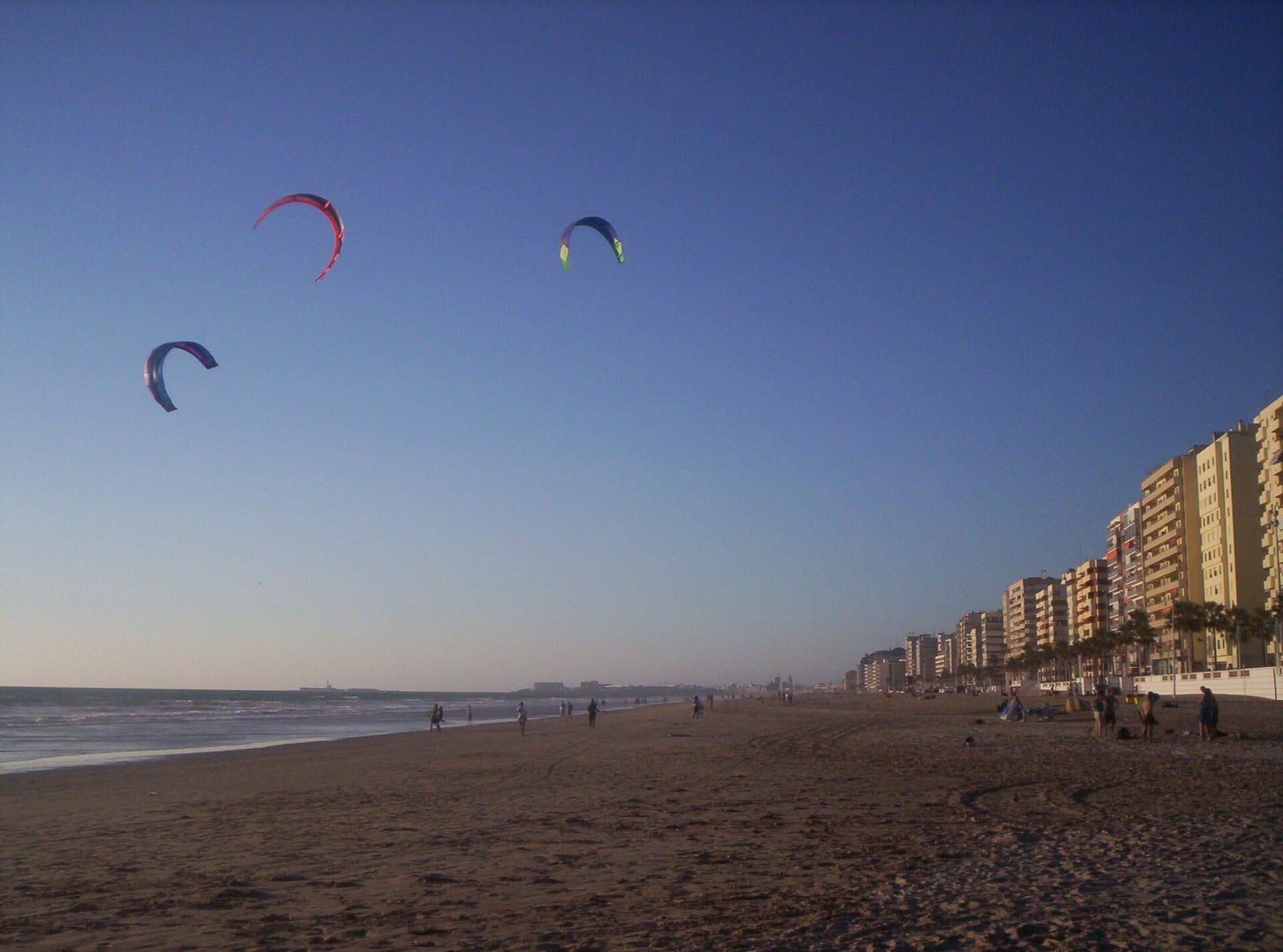
What Playa de la Victoria Actually Is
Playa de la Victoria is Cádiz's main urban beach, and by almost every measure it is the most practical, well-equipped stretch of sand the city has to offer. Running for approximately 2.8 kilometres along the southwestern face of the Cádiz peninsula, it faces the open Atlantic, with the Gulf of Cádiz in front and the rest of the city at its back. The beach sits between the smaller Playa de Santa María del Mar to the north and the historic Cortadura wall to the south.
The sand itself is fine, golden, and siliceous, with a gentle slope of roughly six percent down to the water. At low tide the beach opens to around 185 metres wide, which is unusually generous for a city beach. On a weekday morning in spring you can walk the entire length without weaving through crowds. On a Saturday afternoon in August, the calculation changes entirely.
ℹ️ Good to know
Playa de la Victoria holds Blue Flag certification along with the Q de Calidad Turística award and an ISO 14001 environmental management certification. These distinctions are awarded regularly, so conditions are consistently monitored.
How the Beach Changes Through the Day
Early morning, roughly 7:00 to 9:30, is the most underrated time to visit. The cleaning crews finish their work before sunrise, leaving the sand raked and unmarked. Local runners and dog walkers have the promenade nearly to themselves. The Atlantic light at this hour comes in low and flat, and the water often has a deep steel-blue colour before midday brightens it to turquoise. The air smells of salt and, faintly, of the fryers warming up at the chiringuitos.
From about 10:30 onwards the beach begins to fill. Families with children claim the shallower central section where the slope is most gradual. Teenagers and younger adults tend to drift toward the southern end. By 1:00 in July or August the beach is at full capacity, and finding a clear patch of sand within comfortable distance of a sun umbrella hire point requires patience.
Late afternoon, from around 6:00 to 8:00, brings a second wave of visitors. The worst of the midday heat has passed, the light turns golden, and the promenade fills with people walking, cycling, and sitting at terrace bars. For those who dislike peak-sun swimming, this window offers warm water, softer light, and noticeably fewer towels underfoot.
💡 Local tip
If you visit in July or August, aim for before 10:00 or after 18:00. Midday heat on an exposed Atlantic beach can be intense, and UV levels are consistently high throughout the summer months in Andalusia.
Tickets & tours
Hand-picked options from our booking partner. Prices are indicative; availability and final rates are confirmed when you complete your booking.
Historical Roman Cadiz guided walking tour
From 22 €Instant confirmationFree cancellationDay trip to Tarifa, Vejer, and the Bolonia beach from the Cadiz Bay
From 59 €Instant confirmationFree cancellationWinery tour with tasting of three wines in Sanlucar
From 18 €Instant confirmationFree cancellationWinery tour and wine tasting in Chiclana de la Frontera in Cadiz
From 25 €Instant confirmationFree cancellation
The Promenade and Surroundings
The seafront promenade running alongside Playa de la Victoria is one of the more pleasant urban walking routes in the city. It is wide enough for pedestrians and cyclists to coexist without conflict, and the row of chiringuitos (beach bars and restaurants) provides regular stops for cold drinks, fried fish, and espresso. The quality varies between them, but the competition keeps standards reasonable.
The promenade connects to the broader Paseo Marítimo, which extends the seafront walk further into the city. Walking north from Playa de la Victoria eventually brings you to the narrower, rougher Playa de la Caleta on the Old Town side of the peninsula, though the two beaches are quite different in character. La Caleta is smaller, more photogenic, and packed with historical atmosphere; Victoria is larger, more practical, and better equipped for a full day out.
Behind the beachfront, the Playa Victoria district is the most modern part of Cádiz, built primarily in the second half of the twentieth century. It lacks the architectural drama of the historic centre, but it offers wider streets, easier parking, a more relaxed pace, and a concentration of mid-range hotels and residential buildings. If you are staying in this part of the city, Playa de la Victoria is effectively on your doorstep.
Water Quality, Safety, and Practical Facilities
The beach has open public access at all hours. There are no entry gates and no admission charge. Seasonal lifeguard services operate during the summer months, with flagging systems indicating bathing conditions: green for safe swimming, yellow for caution, and red for no swimming. The Atlantic current along this stretch can strengthen on windy days, so the flag system is worth checking before entering the water with children.
Facilities during the main season typically include shower points, foot-wash stations, public toilets, and sun lounger and parasol hire from private operators along the beach. The beach is listed as accessible for visitors with reduced mobility, with adapted equipment and services documented by Spanish accessible tourism resources.
⚠️ What to skip
On days when the Levante wind blows (a dry easterly that can arrive suddenly in summer), fine sand moves fast across the beach and conditions become unpleasant quickly. If you see a yellowing haze on the horizon or notice sand stinging your ankles at the promenade, it is worth heading to a terrace bar and waiting it out.
When to Visit and Seasonal Differences
The beach is genuinely usable for most of the year, though the experience varies significantly by season. For a fuller picture of how Cádiz behaves across different months, the best time to visit Cádiz guide covers this in detail. In general, the shoulder seasons of April to June and September to October offer the most balanced conditions: warm enough to swim comfortably, fewer crowds than the peak summer weeks, and milder temperatures during the walk back to the city.
July and August are the high-water mark for both heat and visitor numbers. Cádiz draws Spanish domestic tourists heavily in these months, and the beach reflects that. The water is at its warmest, the chiringuitos are at their liveliest, and the evening promenade has a proper summer-town energy. But the beach is also at its most crowded, parking in the district is difficult, and booking accommodation significantly in advance is necessary.
Winter visits are a different proposition. The beach is almost empty from November through February, and the Atlantic shows a rougher, greyer face. Swimming is not practical for most visitors, but the long walk along an empty promenade in mild winter sunshine, followed by coffee and tostadas at a beach bar, has its own particular appeal. A few chiringuitos remain open year-round, though the majority close after October.
Photography and What to Frame
Playa de la Victoria does not have the dramatic backdrop of Playa de la Caleta, which faces the two historic castles. What it does offer is scale and light. The sheer length of the beach, combined with the low horizon of the Atlantic, creates wide-open compositions that reward a standard or slightly telephoto lens. Early morning, shooting south toward the Cortadura end of the beach, the sky frequently shows a gradient of pale orange fading into blue that requires almost no post-processing to look striking.
The promenade itself offers architectural symmetry: a long line of white rental umbrellas in summer, or the empty wooden structures of the chiringuitos in winter, make for strong geometric shots. For people photography, the late afternoon session from around 6:30 onwards is ideal, when the angle of light is flattering and the mix of families, elderly couples, and teenagers reflects the full cross-section of Cádiz daily life.
Who Should Consider Skipping It
Travelers with very limited time in Cádiz and a primary interest in history or architecture will probably find Playa de la Victoria less compelling than the Old Town. If your day is structured around the Catedral de Cádiz, the Roman theatre, or the Torre Tavira, a full beach session is likely to crowd out more irreplaceable experiences.
Visitors who prefer dramatic coastal scenery, clifftop views, or wild unspoiled beaches may find this beach too urban. It is a city beach in the honest sense: well managed, well equipped, backed by a promenade and apartment blocks, and oriented toward practical enjoyment rather than dramatic landscape. If that is not what you are looking for, Cádiz province has other coastline that might suit better.
Insider Tips
- The southern end of the beach, near the Cortadura wall, is noticeably less crowded than the central and northern sections even in high summer. The walk from the main promenade access points takes around fifteen minutes but the reward is room to actually spread out.
- Chiringuito quality improves significantly as you move away from the most prominent promenade locations. The bars that are slightly harder to spot, set back from the main walkway or at the quieter ends of the beach, tend to have better food and more reasonable prices.
- The Blue Flag and quality certifications are renewed annually. The local tourism website (turismo.cadiz.es) posts current-year water quality data during the summer season, which is worth checking if you are visiting with children or have health concerns.
- Urban buses from the city centre connect to the beach in under fifteen minutes. This is almost always faster than trying to drive and park in July or August, when the streets around the promenade slow to a crawl by mid-morning.
- If you are visiting in late February or early March during Carnival season, the beach and promenade take on a completely different character. Groups in costume wander the seafront at all hours. It is one of the more surreal and enjoyable ways to experience Playa de la Victoria outside its beach-season identity.
Who Is Playa de la Victoria For?
- Families with children who need calm, shallow water, solid facilities, and accessible infrastructure
- Swimmers and sunbathers who want a full day on a long, well-maintained Atlantic beach
- Evening walkers and cyclists looking for a flat seafront route with regular stops for food and drink
- Visitors staying in the Playa Victoria district who want beach access without transport
- Travelers in the shoulder seasons of April to June or September to October who want warm water without the August crowds
Nearby Attractions
Other things to see while in Playa de la Victoria & New Town:
- Paseo Marítimo de Cádiz
The Paseo Marítimo de Cádiz is the city's main coastal promenade, running along the Atlantic edge of the peninsula behind Playa de la Victoria. Free, open at all hours, and fully walkable, it offers a genuine slice of gaditano daily life alongside uninterrupted ocean views.