Thirasia is the small volcanic island sitting just across the caldera from Santorini's northwest cliffs, close enough to see from Oia yet worlds apart in atmosphere. With around 300 permanent residents, no major resort development, and a steep hillside village that has barely changed in decades, it offers a genuine contrast to the main island's well-worn tourist circuit.
Thirasia is Santorini's quieter, largely undeveloped neighbor — a crescent of volcanic rock sitting less than two kilometers off the northwest coast, with caldera-rim views to match Oia's but a fraction of the visitors. It is what Santorini looked like before the world arrived.
Orientation
Thirasia covers roughly 9 square kilometers and forms part of the Santorini volcanic archipelago, which also includes Nea Kameni, Palaia Kameni, and the uninhabited Aspronisi. Administratively, it belongs to the municipality of Santorini (Thira). Geologically, it is a remnant of the original island of Strongyli, which was torn apart by the massive volcanic eruption around 1600 BCE that created the caldera the whole region is now built around.
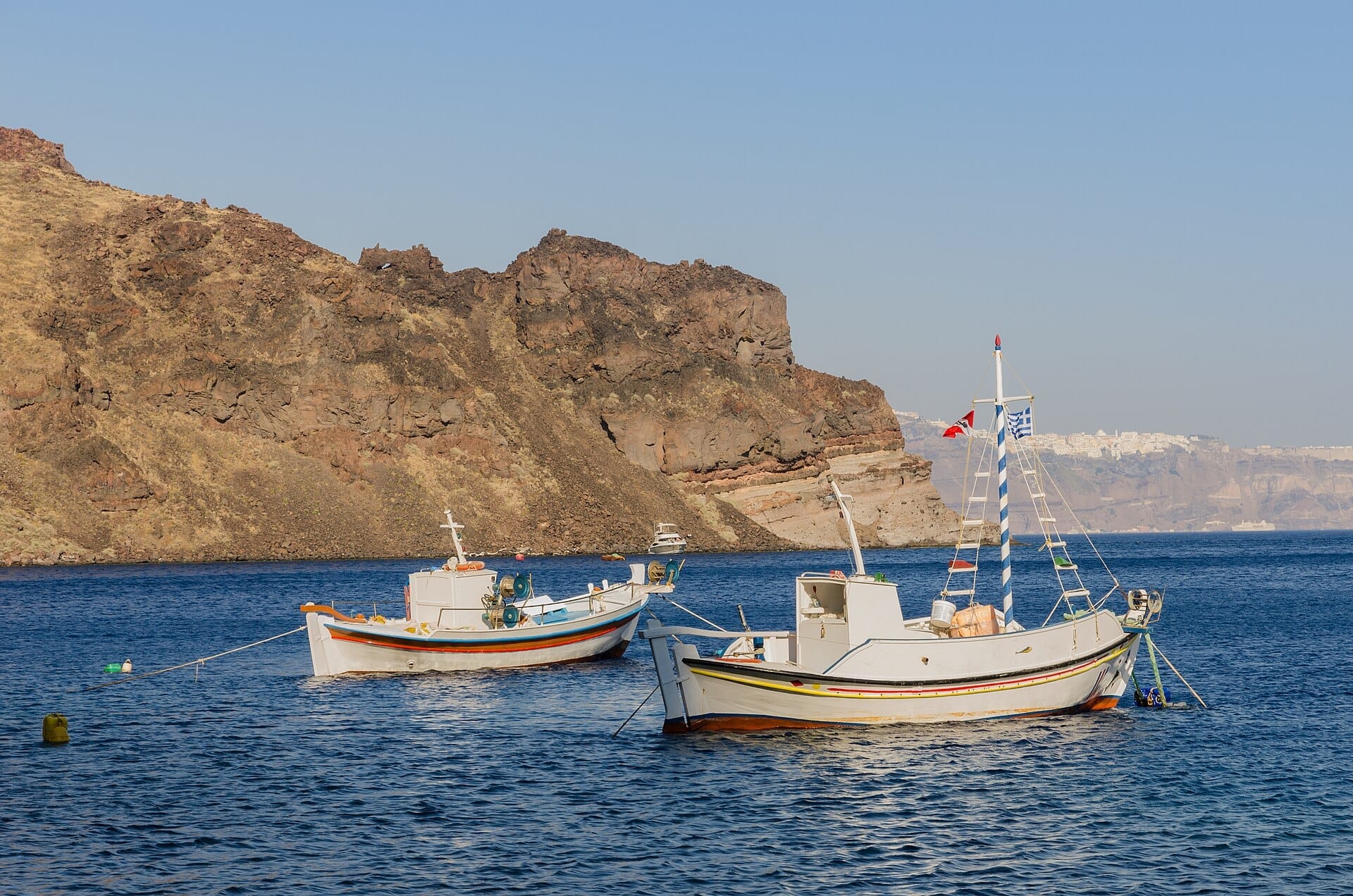
The island sits approximately one nautical mile west of Oia. Its eastern face is the caldera wall: sheer, layered cliffs in the same rust-red and grey volcanic rock you see across the water from Imerovigli or Fira. The western side of the island slopes more gently down toward the open Aegean. The island has two main ports, Riva in the north and Korfos in the east, and five small settlements spread across the interior and caldera rim.
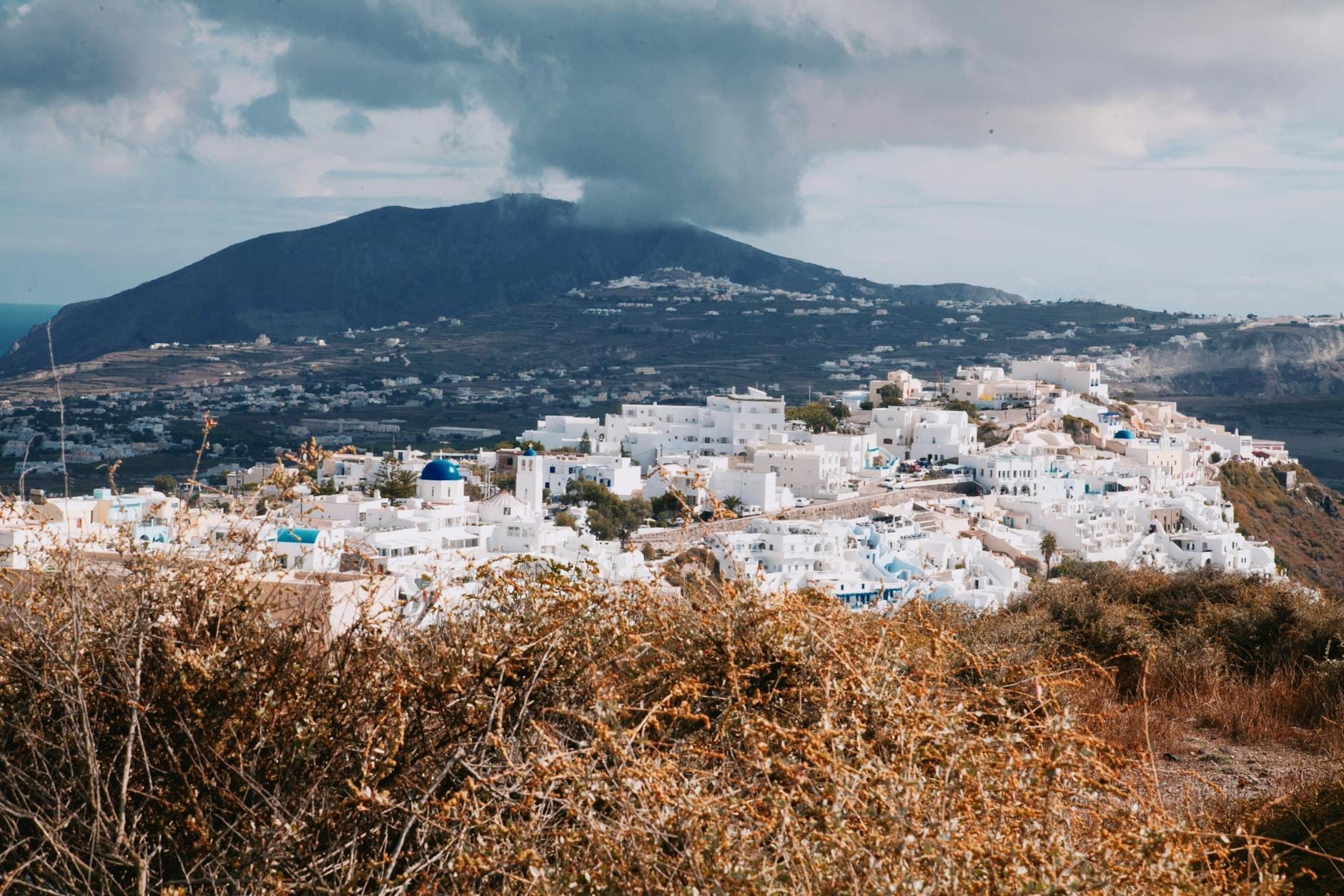
Manolas is the island's capital, perched on the caldera rim opposite Santorini at roughly the same altitude as Oia. Below Manolas, the port of Korfos is where most day visitors arrive. The other villages — Potamos, Agrilia, and the small harbour of Riva — are scattered across the island's interior and northern shoreline, connected by narrow footpaths and a limited road network.
Character & Atmosphere
Step off the boat at Korfos and the first thing you notice is the silence. There are no taxis waiting, no souvenir stalls, no tour guides with flags. The port is a handful of fishing boats, a small quay, and a steep path rising up the cliff face toward Manolas. If you arrive in the morning, the light falls directly on that eastern caldera wall in long, warm angles, and you can see every layer of volcanic deposit in sharp relief.
The climb from Korfos to Manolas takes around 20 to 25 minutes on foot, up a series of stone steps and narrow switchbacks. Donkeys are still used to carry goods between the port and the village, and you may share the path with them. It is steep and exposed in the midday heat, so morning arrivals or early afternoon visits are more comfortable. At the top, Manolas opens up into a whitewashed village of cave houses, small tavernas, and a couple of churches, with unobstructed views across the caldera to Fira and Imerovigli.
By midday in summer, a handful of day-trippers from Santorini pass through, but the village never feels congested. By early afternoon, most have left on the return boat, and Manolas returns to its default state: a few locals sitting outside, cats in the shade, the sound of wind across the caldera rim. There is a real daily rhythm here that has nothing to do with tourism, and that is precisely what makes Thirasia feel different from anything else in the Santorini archipelago.
ℹ️ Good to know
Thirasia has a permanent population of just under 300 people. Most residents speak Greek. While some taverna owners in Manolas speak basic English, communication outside tourist-facing businesses can be limited. Keep this in mind if you need assistance.
The village of Potamos, built around a ravine in the island's interior, has traditional cave houses carved directly into the volcanic rock. Agrilia, described as the oldest settlement on the island, once had active wine canavas — the traditional cave storage cellars used for fermenting and ageing the island's wines. These are largely inactive now but speak to a time when Thirasia was part of a broader Santorini wine-producing culture.
What to See & Do
The village of Manolas is the island's main draw. Walk the main path through the village, past the churches of Agios Konstantinos and Agios Ioannis, and find a spot on the caldera edge where you can look directly across at the cliffs of Santorini. The view is essentially the reverse of what you see from Oia or Fira — and it puts the scale of the caldera into perspective in a way that is harder to appreciate when you're on the main island.
From Manolas, a footpath leads to the Monastery of Koimiseos (the Dormition), set higher on the island with panoramic views across Thirasia and out toward the open Aegean. The path is manageable but requires appropriate footwear and is not suitable in the heat of midday. The monastery itself is a working religious site, so dress modestly and be respectful of visiting times.
The northern port of Riva has a small beach, one of the few easily accessible swimming spots in the Santorini archipelago given how volcanic the coastline generally is. It is calm and rarely visited by anything approaching a crowd. The area around Riva is also the closest point to Ammoudi Bay across the water in Oia.
Walk the caldera rim path in Manolas at sunrise or early morning for the clearest light and fewest visitors
Take the footpath to the Monastery of Koimiseos for the elevated island-wide view
Explore Potamos and its cave houses in the ravine below Manolas
Swim at the small beach near Riva port in the north
Visit Agrilia to see the remnants of the island's traditional wine canava architecture
If you are combining a visit to Thirasia with a broader caldera tour, many sailing operators include it as part of a loop that also takes in Nea Kameni volcano and Palea Kameni hot springs. Check the itinerary carefully — some tours stop at Thirasia for only 30 to 45 minutes, which is enough to see the port but not enough to climb to Manolas.
💡 Local tip
If you want to visit Manolas properly, look for a sailing tour that allocates at least 90 minutes to Thirasia, or take the direct small-boat connection from Ammoudi Bay and go independently. A rushed stop at Korfos port misses most of what makes Thirasia worth the trip.
Eating & Drinking
Manolas has a small number of tavernas and cafes clustered along the main village path, mostly family-run and serving straightforward Greek food: grilled fish, salads, bread, local wine. Prices are generally moderate by Santorini standards, reflecting the fact that the clientele is mostly day visitors rather than high-spend resort tourists. Do not expect a menu in multiple languages or elaborate plating — this is simple, honest Cycladic cooking served with caldera views that cost nothing extra.
The island historically produced wine using the same volcanic-soil viticulture as Santorini, and some local establishments still serve wine made on Thirasia itself, though production is very small. If you are interested in the broader context of Santorini's wine culture, it helps to read up on the tradition before visiting.
Down at Korfos port, there may be a cafe or two open in peak season, but options are limited. Come prepared: bring water, sunscreen, and snacks if you plan to spend more than a couple of hours on the island. For a fuller picture of regional food traditions, the Santorini food guide gives useful context on the Cycladic ingredients and dishes you are likely to encounter.
⚠️ What to skip
Thirasia has very limited infrastructure. There are no ATMs on the island. Bring cash in euros before you arrive. Water from the tap is not recommended for drinking — purchase bottled water before your trip or bring your own.
Getting There & Around
The most direct way to reach Thirasia from Santorini is by small boat from Ammoudi Bay in Oia. The crossing to Riva port takes approximately 10 to 20 minutes. Small local boats and water taxis make this run during the summer season, though schedules vary and should be confirmed locally before you plan your day. A second route connects Korfos port on Thirasia's southeastern side to the main caldera sailing circuit.
Organized sailing and boat tours departing from Athinios Port (Santorini's main ferry port on the west coast) often include Thirasia as one stop on a caldera loop. These tours vary widely in duration and in how long they actually spend at Thirasia, so check the itinerary in advance if Manolas is a priority for you.
Thirasia also sits on a ferry route from mainland Greece. Some passenger ferries on routes from Piraeus and other Cycladic islands call at Riva port, which means the island is theoretically reachable directly from Athens without first transiting through Santorini. This is a slower, less common approach used mainly by Greek travelers visiting the island for longer stays.
On the island itself, there is effectively no usable road connection for visitors between Korfos port and Manolas — access is for all practical purposes on foot or by donkey along the stepped cliff path. Riva port in the north is connected to the interior villages by a road, and vehicles do exist on Thirasia, but they are of little use to day visitors arriving at Korfos. Wear comfortable shoes with grip. The path is wide enough and well-maintained but steep and uneven in places.
For context on how Thirasia fits into the broader Santorini transport picture, the guide to getting around Santorini covers the island's KTEL bus network, taxi options, and ferry connections in more detail.
Where to Stay
Thirasia has very limited accommodation options compared to the main island. A small number of rooms and guesthouses exist in Manolas, typically family-run and basic by international standards. There are no large hotels, no resort pools, and no concierge services. For travelers who want total quiet, a genuine local atmosphere, and the novelty of sleeping on the caldera rim with the traffic of Santorini visible but unreachable across the water, this is exactly the point.
Staying overnight on Thirasia means you will have the village essentially to yourself after the day visitors leave on the afternoon boats. The caldera at dusk and after dark, with Fira and Oia lit across the water, is a remarkable sight from this side. If accommodation options are your priority, though, verify availability well in advance — the island's capacity is extremely limited, and options can be fully booked in peak summer months despite the low overall tourism volume.
Most visitors to Thirasia stay on the main island and make a day trip. For guidance on where to base yourself on Santorini, the Santorini accommodation guide covers the different caldera villages, beach towns, and budget options in detail.
Practical Notes & Honest Drawbacks
Thirasia is not for everyone. There is no beach infrastructure to speak of, no nightlife, no shopping, and limited English spoken outside the few tourist-facing tavernas in Manolas. The path from Korfos to the village is a genuine physical effort in summer heat, and the island has almost no shade on the way up. Visitors with limited mobility should be aware that the stepped path is not accessible for wheelchairs or pushchairs.
The island also has no emergency medical facilities to speak of. In a medical emergency, evacuation to Santorini would be required. The EU emergency number 112 works in Greece, but response times to a remote island will be longer than in any urban setting. This is worth factoring in if you are traveling with young children, elderly companions, or anyone with a significant health condition.
What Thirasia does offer is rare in the Santorini context: a functioning Greek island community that has not reorganized itself around tourism. The caldera views from Manolas are the equal of anything you will see from Imerovigli or Oia, with none of the crowds. For travelers who feel that the main island has become too polished, too performative, or simply too busy, Thirasia is a genuine alternative perspective — literally and figuratively.
If you are building a Santorini itinerary and wondering whether to include Thirasia, the three-day Santorini itinerary can help you work out where a half-day trip fits within the overall schedule. The Santorini sailing and boat tours guide covers the various caldera tours that include a Thirasia stop.
TL;DR
Thirasia is a small volcanic island less than 2km from Oia, with caldera-rim views from its capital Manolas that match anything on the main island — and a fraction of the visitors.
Getting there involves a 20-minute boat crossing from Ammoudi Bay or a caldera sailing tour; the climb from Korfos port to Manolas is steep and takes about 25 minutes on foot.
The island has almost no tourist infrastructure: no ATMs, no large restaurants, limited English, and no practical road connection from the main port to the village for visitors — bring cash, water, and good shoes.
Best suited to travelers who want a quiet half-day away from Santorini's main circuit, and to anyone curious about what the pre-tourism Cycladic island experience feels like.
Overnight stays are possible in a handful of guesthouses in Manolas, but capacity is very limited and must be booked well in advance; most visitors come as a day trip.
Santorini's beaches are unlike anywhere else in Greece. Volcanic geology means most are black or dark-pebbled, with a handful of dramatic color exceptions. This guide covers every beach worth visiting, from the popular to the genuinely quiet.
Santorini rewards visitors differently depending on when they arrive. This guide breaks down every season by weather, crowd levels, prices, and what's actually open so you can pick the timing that matches your priorities.
Santorini rewards visitors who look beyond the caldera rim. This guide covers the best day trips from Santorini, from hiking to Oia and cruising the volcanic islets to hopping across to Folegandros, with full logistics, seasonal notes, and practical booking advice.
Santorini has no metro, no trains, and surprisingly limited taxis. This guide breaks down every transport option on the island — KTEL buses, rentals, taxis, rideshare, and ferries — with real fares, route details, and practical advice on what works best by season.
Santorini polarises travellers. The caldera views are genuinely spectacular, the volcanic landscape is unlike anywhere else in Greece, and the archaeology rivals anything in the Aegean. But the crowds are real, the prices are steep, and the hype can outpace the reality. Here is what you actually need to know before you book.
Santorini's black sand beaches are unlike anything else in the Aegean. Formed by volcanic eruptions and shaped by centuries of erosion, they come with their own rules, quirks, and logistics. This guide covers the main beaches, practical access, seasonal timing, and what first-timers always get wrong.
Santorini is far more than the famous blue domes and caldera selfies. This guide takes you beyond Oia and Fira to the island's medieval villages, wild volcanic beaches, serious wine caves, and ancient ruins that most visitors walk straight past.
Santorini rewards hikers with caldera rim panoramas, ancient ruins, volcanic craters, and medieval villages. This guide covers the island's best trails, from the classic Fira–Oia walk to off-the-beaten-path routes most visitors never find.
Santorini's history stretches back more than 3,600 years, from a sophisticated Bronze Age city buried by volcanic ash to Hellenistic temples, Venetian fortresses, and Byzantine monasteries. This guide covers every significant historical site on the island, with practical advice on when to visit and what to expect.
Santorini's caldera views, volcanic beaches, and world-class sunsets make it one of the most sought-after honeymoon destinations in Europe. This guide breaks down exactly where to stay, what to do, and what to skip so you can plan a trip that lives up to the hype.
September is arguably the smartest month to visit Santorini. The sea is warm, the light is golden, the harvest is underway, and the worst of the summer crowds have thinned. This guide covers everything from weather and pricing to what actually changes as the month progresses.
Three days is enough to cover Santorini's essentials without burning out. This itinerary balances the iconic caldera villages, the volcanic south, ancient ruins, and the island's wine country — with specific timing, realistic costs, and straight talk on where the crowds aren't worth it.
Santorini's luxury scene runs deep, from cliffside suites with direct caldera views in Oia and Imerovigli to upscale beach resorts along the black-sand coast. This guide breaks down where to stay, when to book, what to expect across price tiers, and which high-end experiences are actually worth it.
Santorini has a reputation for luxury prices, and that reputation is partly earned. But with the right timing, accommodation choices, and a few practical strategies, the island is far more accessible than most people expect. This guide breaks down real costs and shows you where to cut spending without sacrificing the experience.
Santorini is one of the world's most photographed destinations, but knowing exactly where to stand, when to arrive, and which lesser-known angles to seek out separates good photos from great ones. This guide covers 23 of the island's best photography locations, from the iconic caldera rim to wild volcanic beaches and medieval hilltop villages.
From semi-private catamaran cruises to full-day private charters, Santorini's boat tour market is crowded and easy to overpay on. This guide breaks down every major format, what each actually includes, real price ranges for 2025-2026, and the questions to ask before you book.
Santorini's sunsets are legendary, but not all viewpoints are equal. This guide covers the best spots across the island, from the famous to the overlooked, with practical advice on when to arrive, how to avoid the worst crowds, and which locations suit different styles of traveler.
Santorini's caldera is one of the most dramatic natural amphitheaters on the planet, and knowing where to stand makes all the difference. This guide covers the island's finest vantage points, from iconic sunset spots to quiet hilltops most visitors never find.
The Santorini caldera holds one of the Mediterranean's most dramatic geological stories. This guide covers the volcano's history, how to visit Nea Kameni and the Palea Kameni hot springs, how to choose a boat tour, and what most visitors get wrong before they arrive.
Two of Greece's most iconic Cycladic islands, but they deliver very different trips. This guide breaks down the real differences between Santorini and Mykonos across beaches, atmosphere, costs, food, and logistics, so you can choose the one that fits your travel style.
Santorini's Mediterranean climate shifts dramatically across the year, from bone-dry summers with 12 hours of daily sunshine to mild, stormy winters. This guide breaks down Santorini weather by month, covering temperatures, rainfall, sea conditions, and crowd patterns so you can choose exactly the right time to visit.
Santorini produces some of Greece's most distinctive wines, shaped by volcanic soils, searing heat, and ancient vines trained in basket shapes against the Aegean wind. This guide covers every wine style, the best wineries to visit, how to book tastings, and what to order with your food.
Santorini is famous for romantic sunsets and honeymoon hotels, but it genuinely works for families too. This guide covers the best beaches for kids, family-friendly activities, where to base yourself, and the practical details that actually matter when you're traveling with children.
Santorini rewards visitors who go beyond the postcard shots. This guide covers the best things to do in Santorini across every interest and budget, from ancient ruins and caldera hikes to sailing tours and wine tasting, with candid assessments of what is actually worth your time.
Santorini's cuisine is shaped by volcanic soil, Bronze Age agriculture, and a seafaring tradition. This guide covers every local dish worth ordering, the ingredients that make them unique, how much to expect to pay, and when to visit for the freshest seasonal produce.
Santorini's accommodation landscape splits cleanly between cliffside caldera villages and laid-back beach towns on the east coast. This guide breaks down every major area by cost, crowd level, and practicality so you can match your base to your actual travel style.