Nea Kameni Volcano: Walking the Caldera Floor in Santorini
Nea Kameni is the youngest volcanic landform in the eastern Mediterranean, rising from the center of Santorini's caldera. Reached only by boat and requiring a steep hike across bare lava fields, it offers a stark, geological contrast to the whitewashed villages on the cliffs above.
Quick Facts
- Location
- Nea Kameni islet, Santorini caldera, Cyclades, Greece
- Getting There
- Boat tour only — departures commonly from Fira Old Port, Athinios Port, or Ammoudi Bay
- Time Needed
- 1.5–2 hours on the island; full boat tour typically 4–6 hours including hot springs stop
- Cost
- €5 park entry fee (cash, paid on landing) plus separate boat tour fare
- Best for
- Geology enthusiasts, hikers, cruise visitors, travelers who want something beyond beach and views
- Official website
- volcano.si.edu/volcano.cfm?vn=212040
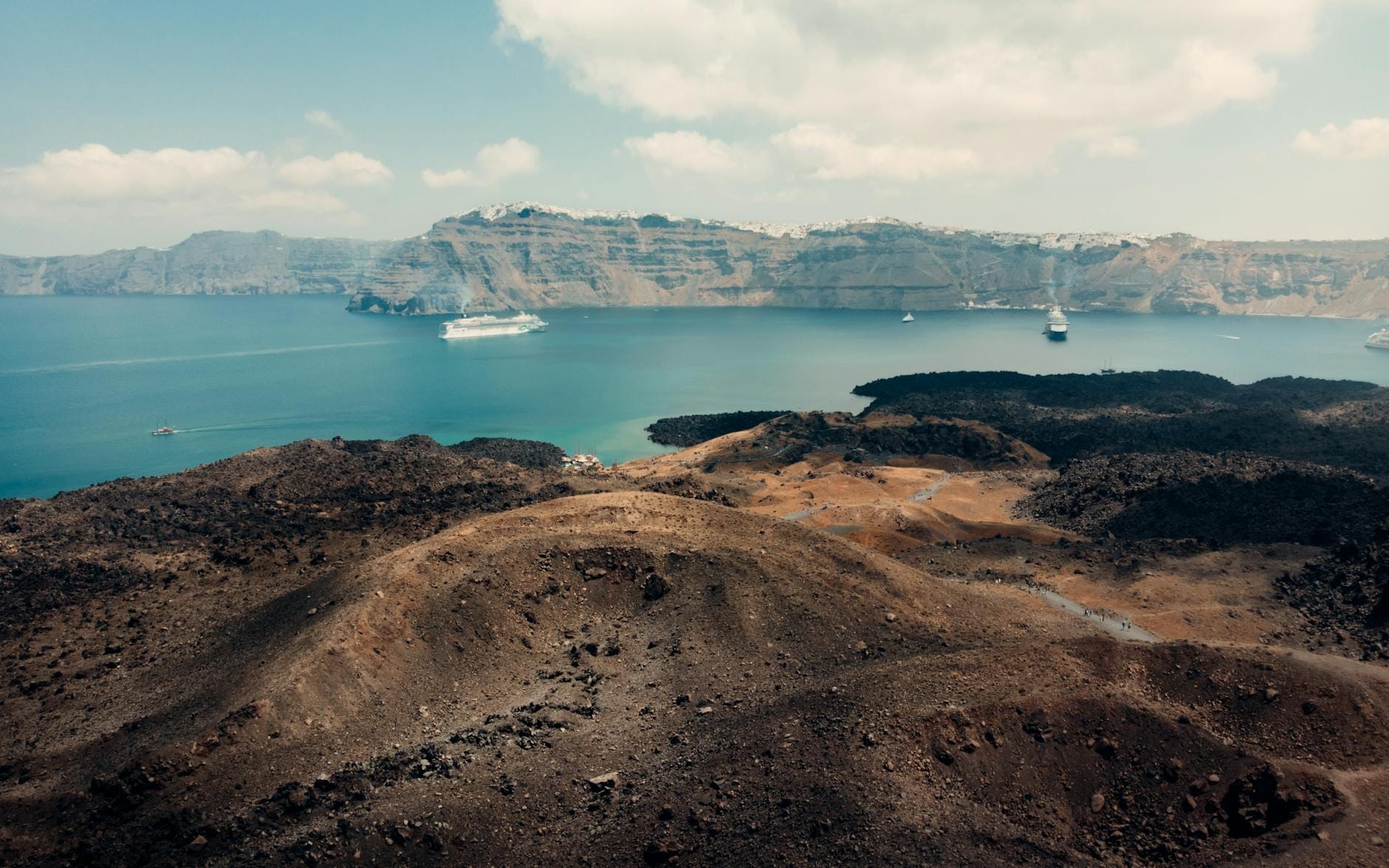
What Nea Kameni Actually Is
Nea Kameni — the name translates roughly as 'New Burnt Island' — is a small volcanic islet sitting in the middle of Santorini's caldera, roughly 1.9 kilometers in diameter. It is the youngest volcanic landform in the eastern Mediterranean, formed primarily through eruptions from the 16th century CE onward, and it remains a protected National Geological Park. The island has no permanent residents, no shops, no shade trees, and no paved paths. What it has is raw, still-warm volcanic rock, sulfurous vents, and an unobstructed view of the caldera walls rising on every side.
The Santorini caldera complex — which includes Thira, Thirassia, Aspronissi, Palea Kameni, and Nea Kameni — formed through a series of massive eruptions over thousands of years. Nea Kameni is the most recently active part of this system. According to the Smithsonian Institution's Global Volcanism Program, the volcano has erupted approximately nine times in the last 1,900 years, with the most recent eruption recorded in 1950. The highest point of the islet reaches around 130 meters above sea level.
ℹ️ Good to know
Nea Kameni is considered an active volcanic system. While there is no current eruption threat that prevents visits, the site is monitored by scientific agencies. Check current advisories before booking during periods of seismic activity.
Getting There: The Boat Is the Only Option
There is no scheduled public ferry route that drops you directly on Nea Kameni as a standalone trip. Access for most visitors is through organized boat tours, which depart mainly from the Old Port of Fira (reached by cable car or mule path from the caldera rim), from Athinios Port on the island's west coast, and less frequently from Ammoudi Bay below Oia. Tour operators run these excursions throughout the main tourist season, typically from spring through late autumn, though exact schedules shift by year and operator.
Most boat tours combine the volcano stop with a visit to Palea Kameni's thermal hot springs, the neighboring islet where you can swim in iron-rich, sulfur-tinged water. Some tours extend further to the island of Thirasia. If you're combining both stops, budget a full half-day minimum. The boat ride from Fira's Old Port to Nea Kameni takes roughly 20 to 30 minutes depending on the vessel.
💡 Local tip
Book your boat tour the day before rather than on the morning of your visit — slots on smaller vessels fill quickly in July and August, and larger group boats can feel crowded on the island trail.
Tickets & tours
Hand-picked options from our booking partner. Prices are indicative; availability and final rates are confirmed when you complete your booking.
Cruise of the volcanic islands around Santorini
From 45 €Instant confirmationFree cancellationVolcanic islands sunset dinner cruise in Santorini
From 85 €Instant confirmationFree cancellationLuxury Sunset Cruise in Santorini
From 120 €Free cancellationGuided e-bike tour in Santorini
From 90 €Instant confirmationFree cancellation
The Hike: Steep, Exposed, Worth the Effort
Once the boat moors and you step ashore, the landscape changes completely. The ground underfoot is black and rust-colored volcanic rock, cracked in places, giving off a faint sulfurous smell that intensifies as you climb toward the crater. The trail to the main crater rim is steep, unpaved, and covered in loose gravel in sections — not technical hiking, but demanding enough that it rules out flip-flops and anyone with significant mobility limitations.
The ascent takes roughly 20 to 30 minutes at a moderate pace. At the top, you stand on the rim of the Georgios crater, the most recently active vent. Yellow sulfur deposits stain the rock around the fumarolic vents, which still release steam and heat. On a still morning, the smell is noticeable but not overwhelming. Touch the ground near the vents and you'll feel warmth through your shoes. The crater itself is not a dramatic open pit — it's more of a depression in the volcanic cone — but the 360-degree view of the caldera, with the white cliffs of Santorini rising 300 meters across the water, is genuinely impressive.
The full circuit of the marked trail, including the crater rim, takes most visitors 45 to 75 minutes depending on pace and photo stops. Tour boats typically allow 60 to 90 minutes on the island before departing.
⚠️ What to skip
There is zero shade on the island. In July and August, midday temperatures on the dark volcanic rock can be significantly hotter than on the mainland. Bring more water than you think you need, wear a hat, and apply sunscreen before leaving the boat.
Time of Day and Seasonal Considerations
Morning departures, typically leaving Fira's Old Port around 9:00 to 10:00 am, give you the best combination of cooler temperatures on the hike and softer light for photography. By early afternoon, the volcanic rock absorbs significant heat and the hike to the crater becomes genuinely uncomfortable in summer. If your tour departs at midday or later, drink extra water and move at a slower pace.
The shoulder months of May, June, and September offer the most comfortable conditions for the hike. The trail is far less crowded than in peak summer, temperatures are manageable, and the caldera views are clear. For broader context on timing your Santorini trip, the best time to visit Santorini guide covers seasonal crowds and weather in more detail.
Tours do not operate in rough sea conditions, which occur occasionally in spring and more frequently from November onward. If you're visiting outside the main season, confirm with operators that excursions are running before making plans around this attraction.
What the Experience Actually Feels Like
Arriving on Nea Kameni feels unlike any other stop in Santorini. The colors shift entirely: no white plaster, no bougainvillea, no terracotta. The island is shades of black, grey, deep red, and ochre. The sound is wind and footsteps on loose rock. Small groups of visitors string out along the trail, the pace instinctively slowing as the incline increases. At the crater, people tend to go quiet for a moment — partly the physical effort, partly the strangeness of standing on something that last erupted within living memory.
Looking back down from the rim, you see the boat moored in the small harbor, the water of the caldera a deep blue-grey, and beyond it the entire arc of Santorini's cliffs. The caldera view from sea level is fundamentally different from the one you get standing on the rim above Fira or Oia — you're inside it rather than looking down into it. For those interested in understanding the full geology of the area, this connects well with a visit to the Museum of Prehistoric Thera in Fira, which provides archaeological and geological context for the volcanic history of the island.
Practical Walkthrough: Fees, Gear, and Logistics
The park entrance fee is €5 per person, paid in cash when you land on the island. Have coins and small notes ready — there are no card payment facilities on Nea Kameni. The boat tour itself is priced separately by the operator, and costs vary depending on whether it's a large group excursion or a smaller private sailing trip. Verify current pricing directly with tour operators before booking, as fares are set independently and change seasonally.
Footwear is the most important practical consideration. Closed-toe shoes with a grip sole are essential — the trail involves uneven volcanic rock and loose gravel in several sections. Sandals and flat canvas shoes are inadequate and make the descent slippery. A small daypack with at least 1.5 liters of water per person, sunscreen, and a hat covers the other essentials. There are no food or drink vendors on the island.
The site is not suitable for visitors with significant mobility issues. The trail is steep, uneven, and has no handrails or paved surfaces. If physical access is a concern, it's worth considering whether the boat ride to the caldera area alone — without the hike — provides enough of the experience. The views of Nea Kameni from the water are striking in their own right, and some tour operators allow passengers to remain on board. For accessible alternatives on the water, Santorini sailing and boat tours outlines the range of caldera tour formats available.
Photography on Nea Kameni
The volcanic landscape photographs well in almost any light, but the high contrast between dark rock and blue caldera water is most striking in morning light before the midday sun flattens the tones. The sulfur-stained rocks near the vents — yellow against black — make for close-up detail shots that look unlike anything else in Santorini. Wide angles from the crater rim showing the full caldera arc are the signature composition. For broader photography planning across the island, the Santorini photography guide covers timing and locations in depth.
Avoid touching the camera to rocky surfaces near fumarole vents — sulfur deposits are corrosive and can damage equipment over time. Keep lenses capped when not shooting in areas of visible steam.
Who Should Consider Skipping This
Nea Kameni is not for everyone, and it's worth being honest about that. If you have limited mobility, a strong sensitivity to heat, or a fear of unstable terrain, the hike will be genuinely unpleasant rather than challenging in a good way. Visitors who prefer manicured experiences — clear paths, facilities, shade — will find the island stark to the point of uncomfortable.
Families with very young children should think carefully about the trail: the loose gravel sections and steep descent require sure footing, and the lack of shade is hard on small kids in summer. The boat ride itself is generally fine for children, and some families choose to do the tour without attempting the full crater hike.
If your priority is Santorini's famous caldera views rather than geological exploration, you may find the time better spent on the rim-top hiking trail or at the caldera viewpoints. The volcano tour is a specific kind of experience, and knowing what you're signing up for makes the difference between finding it fascinating and finding it a hot, dusty letdown.
Insider Tips
- Pay the €5 park fee in cash before leaving the boat — there are no ATMs or card readers on the island, and some operators don't remind you until you're already ashore.
- The first 15 minutes of the trail are the steepest. Set a slow pace from the start rather than pushing hard early and running out of energy before the crater rim.
- Sulfur steam from the fumarole vents is intermittent and depends on wind direction. If you want to photograph the steam actively rising, approach from upwind so the vapor blows toward your lens angle, not into your face.
- Some boat tours schedule the volcano stop after the hot springs swim at Palea Kameni. If you have the option, request or choose a tour that does the volcano first — you'll be cleaner, more comfortable hiking, and less fatigued.
- The caldera view from the crater rim at Nea Kameni looks directly at the cliffs of Fira and Imerovigli from sea level. It's a perspective most visitors to Santorini never get, and it reframes the scale of the caldera in a way no viewpoint from the rim can replicate.
Who Is Nea Kameni Volcano For?
- Geology and volcanology enthusiasts who want to see an active volcanic system up close
- Hikers and active travelers looking for physical engagement beyond beach days
- Cruise passengers with a half-day in port who want a dramatic, compact excursion
- Photographers seeking dramatically different landscapes from the whitewashed village aesthetic
- Travelers on a second or third visit to Santorini who have already covered the standard sights
Nearby Attractions
Combine your visit with:
- Cape Columbo Beach
Cape Columbo Beach sits on Santorini's northeastern tip, backed by 10-metre volcanic ash cliffs and named after the Kolumbo submarine crater offshore. It is unorganized, free, and deliberately hard to reach — which is precisely the point. Bring everything you need and expect a beach that feels nothing like the island's famous caldera-side postcards.
- Emporio Medieval Village
Emporio is Santorini's largest village and home to the Kastelli, a 15th-century fortified settlement widely regarded as the best-preserved medieval castle village on the island. Free to explore and far removed from the caldera crowds, it rewards visitors with labyrinthine alleys, stone watchtowers, and a genuine sense of lived-in history.
- Megalochori Village
Tucked into southwestern Santorini roughly 6–7 km from Fira, Megalochori is one of the island's oldest villages, with roots documented back to the 17th century. Its narrow whitewashed lanes, traditional wine canavas, and Cycladic mansions offer a noticeably different pace from the caldera-rim crowds.
- Palea Kameni Hot Springs
Reachable only by boat, the Palea Kameni Hot Springs sit in a shallow volcanic bay inside Santorini's caldera. Visitors swim from anchored tour boats into warm, sulfur-tinged waters heated by ongoing geothermal activity. It's a genuinely unusual experience, though one that requires realistic expectations.