Megalochori Village: Santorini's Quietest Historic Settlement
Tucked into southwestern Santorini roughly 6–7 km from Fira, Megalochori is one of the island's oldest villages, with roots documented back to the 17th century. Its narrow whitewashed lanes, traditional wine canavas, and Cycladic mansions offer a noticeably different pace from the caldera-rim crowds.
Quick Facts
- Location
- Southwestern Santorini, approx. 6–7 km southwest of Fira
- Getting There
- KTEL bus from Fira central station toward Akrotiri or Vlychada; taxi or rental car also practical
- Time Needed
- 1.5 to 3 hours for walking the village; longer if dining or visiting a winery
- Cost
- Free to enter; costs arise only from restaurants, cafes, or wine venues
- Best for
- Architecture lovers, wine tourism, travelers wanting a quieter Santorini experience
What Megalochori Actually Is
Megalochori Village is a traditional Cycladic settlement on the southwestern side of Santorini, documented as one of the island's oldest communities with origins traced back to the 17th century. Unlike the caldera-rim villages that have been reshaped almost entirely around tourism, Megalochori retains a working residential character. Locals still live here year-round. Cats sleep on doorsteps. Laundry hangs between whitewashed walls. The village square anchors daily life in a way that Oia's main street simply no longer can.
The name translates roughly to 'big village,' which is slightly ironic given how compact and quiet it feels today. Its historical importance came from its role as a wine-producing hub: the large cave-like canavas (underground wine cellars carved into the volcanic rock) that once processed Santorini's grape harvest are still visible throughout the village, several of them converted into restaurants or tasting spaces.
ℹ️ Good to know
Megalochori is a free, open settlement with no entry fees or set hours. Arrive anytime, though early morning and late afternoon offer the most comfortable light and the fewest other visitors.
The Architecture: Mansions, Canavas, and Church Bells
Walking into Megalochori, the first thing that sets it apart from other Santorini villages is the scale of its older buildings. Where much of Fira has been rebuilt or heavily renovated, Megalochori still contains a notable number of traditional captains' mansions and neoclassical houses, their arched doorways and ochre-tinted stonework showing genuine age. Some facades are worn in a way that feels earned rather than theatrical.
The canavas are the most architecturally distinctive element. These semi-subterranean vaulted structures were designed to maintain cool, stable temperatures for wine fermentation and storage, cut directly into the island's soft volcanic pumice. Several still stand in reasonable condition, their thick stone arches giving the lower streets a weight and permanence that contrasts with the typical bright-white plaster finish of Cycladic architecture.
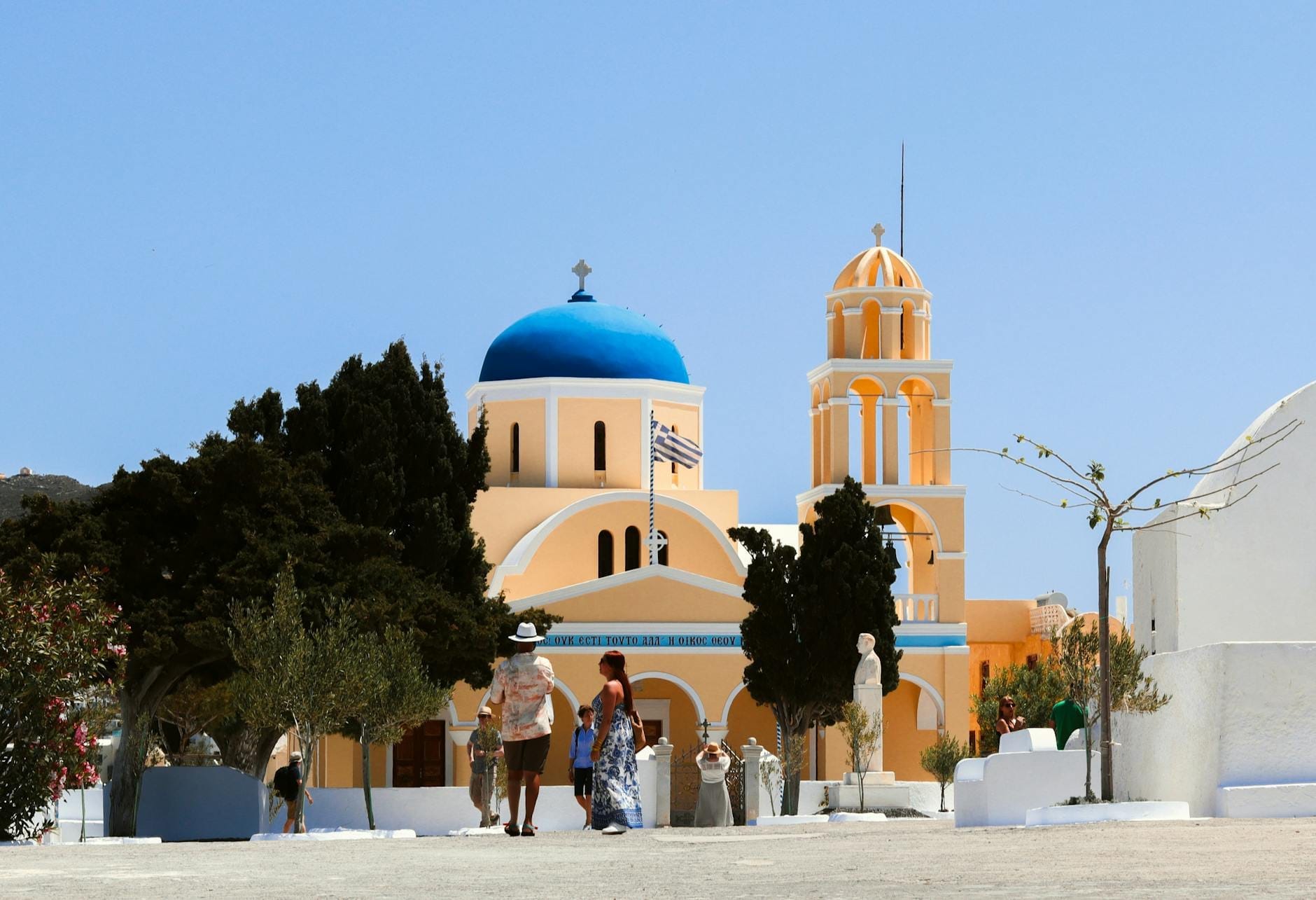
Throughout the village, small Orthodox chapels appear at irregular intervals, their blue domes or simple bell towers marking corners and courtyards. These are not the photogenic postcard structures of Oia's iconic blue-domed churches, but they feel more genuinely integrated into the fabric of daily life. The main village square holds a larger church that becomes the center of local activity on saints' days and Sunday mornings.
Tickets & tours
Hand-picked options from our booking partner. Prices are indicative; availability and final rates are confirmed when you complete your booking.
Luxury Sunset Cruise in Santorini
From 120 €Free cancellationCruise of the volcanic islands around Santorini
From 45 €Instant confirmationFree cancellationGuided e-bike tour in Santorini
From 90 €Instant confirmationFree cancellationSantorini audio guide with TravelMate app
From 5 €Instant confirmation
How the Village Changes Through the Day
In the early morning, before 9am, Megalochori is almost completely still. The light is clean and low, throwing long shadows across the stone-paved lanes. The smell of jasmine and wild herbs is noticeable in the passages between houses, mixed with the faint mineral dryness of volcanic dust. This is the time to photograph the streets without other visitors in frame, and to appreciate the architectural details without distraction.
By mid-morning, a trickle of visitors arrives, mostly travelers who have done their research and are deliberately avoiding the bigger villages. The square comes to life around café opening time. The heat builds through the afternoon in summer, and the stone streets trap warmth noticeably — bring water and avoid the peak sun hours of July and August if you have a choice.
Late afternoon is arguably the best window. The light turns golden across the whitewashed surfaces, the temperature drops slightly, and a few locals reappear in the square. The village is small enough that the whole central area can be explored in a leisurely 90-minute walk, which makes an afternoon visit practical even as part of a longer day in southwestern Santorini.
💡 Local tip
If you are visiting in summer, carry at least 500ml of water. The lanes are narrow, shaded sections are limited, and the nearest convenience options may require backtracking to the square.
Wine Heritage and Where It Fits
Megalochori sits within one of Santorini's most historically significant wine-producing zones. The island's indigenous Assyrtiko grape variety thrives in the volcanic soil of this part of the island, and the village's canavas were once central to the local production process. Santorini's wine culture has been documented for centuries, and for visitors interested in that history, Megalochori provides a ground-level architectural record of how that industry looked and operated. For a broader overview of the island's wine landscape, the Santorini wine guide covers the main estates, varieties, and tasting options across the island.
Several wine venues and restaurants operate out of converted canavas in and near Megalochori, though the specific businesses and their hours change seasonally. The Venetsanos Winery is located nearby in the same southwestern corridor and is one of the more established tasting destinations in this part of the island.
Practical Walkthrough: Navigating the Village
Megalochori does not have a formal walking route or signage system. The village is small enough that getting temporarily lost is part of the experience and carries minimal consequence — most lanes eventually reconnect or bring you back to the central square. The main square is the natural starting point and has a café or two where you can get your bearings.
The streets are paved with irregular stone and are uneven in places. Footwear with grip is worth considering, especially on the steeper connecting passages. Wheeled luggage and strollers will have real difficulty on the more traditional lanes. Visitors with significant mobility limitations will find access to the village core possible in part, but several of the more interesting architectural areas involve steps or steep gradients.
Getting to Megalochori is straightforward. KTEL buses from Fira run along the southwestern route toward Akrotiri and stop at the Megalochori stop on the main road by the village; check current schedules at Fira's central bus station or via the KTEL Santorini website, as timetables vary by season. Taxis from Fira take around 10–15 minutes. If you are renting an ATV or car, parking is available on the village perimeter.
⚠️ What to skip
Megalochori's lanes are residential. Keep noise low, especially in the early morning and late evening. Some passages pass directly alongside private homes.
How It Compares to Other Santorini Villages
Megalochori sits somewhere between the heavily visited caldera villages and the more isolated inland settlements. It offers genuine historic character without the density or commercialization of Fira or Oia, but it also has more visitor infrastructure than, say, a tiny hamlet. For travelers who have already seen the main caldera viewpoints and want something with more architectural texture and fewer tour groups, Megalochori delivers that well. For a broader look at what else southwestern Santorini contains, the Akrotiri Archaeological Site is only a short drive further and makes a natural pairing for a half-day itinerary.
Travelers who prioritize caldera panoramas over village architecture may find Megalochori underwhelming — it does sit near the caldera's western rim, but sweeping caldera views are not its main feature. For those, Imerovigli's caldera viewpoints or the standard Oia vantage points are better choices. Megalochori rewards curiosity and a slower pace rather than a checklist approach.
If you are building a multi-day itinerary that includes this part of the island, the 3-day Santorini itinerary can help you structure how Megalochori fits alongside beaches, archaeological sites, and the caldera villages.
Photography Notes
Megalochori photographs well precisely because it lacks the manicured quality of Santorini's most photographed spots. The worn stone textures, layered building facades, and imperfect symmetry of the lanes give images a quality of age that is harder to find in the more polished caldera villages. Early morning light (within the first hour after sunrise) is ideal for the village's east-facing walls and the square. Afternoon light works better for the narrower lanes, where the low sun reaches between buildings.
For context on timing and light across the island as a whole, the Santorini photography guide provides a useful reference. In Megalochori specifically, the canavas entrances — large arched openings, often darkened inside — offer strong compositional contrast against bright whitewashed exteriors.
Insider Tips
- The village square is quietest on weekday mornings; even in peak July and August, foot traffic is a fraction of what you will find in Fira or Oia at the same hour.
- Look for the older canava doorways on the lower lanes, not just the ones that have been converted into restaurants. The unconverted examples show the raw volcanic-cut construction more clearly.
- If you are driving, park on the main road at the village edge rather than attempting the interior lanes, which were not designed for vehicles.
- Combine Megalochori with a stop at one of the southwestern wineries on the same road — the route between Fira and Akrotiri passes through excellent wine territory, and the distance between stops is short.
- On Sunday mornings, the sound of church bells from the main square carries through the whole village. If you happen to be there, it is worth pausing near the square even if you are not attending a service — the acoustic quality in the enclosed stone streets is notable.
Who Is Megalochori Village For?
- Architecture and history enthusiasts who want to see Santorini's older residential building stock beyond the tourist-facing caldera villages
- Wine travelers looking to understand the physical infrastructure of the island's historic production culture
- Photographers wanting textured, lived-in street scenes rather than polished postcard compositions
- Travelers who have already visited Oia and Fira and want a different register of the island
- Couples or solo visitors who prefer slow, undirected exploration over structured sightseeing
Nearby Attractions
Combine your visit with:
- Cape Columbo Beach
Cape Columbo Beach sits on Santorini's northeastern tip, backed by 10-metre volcanic ash cliffs and named after the Kolumbo submarine crater offshore. It is unorganized, free, and deliberately hard to reach — which is precisely the point. Bring everything you need and expect a beach that feels nothing like the island's famous caldera-side postcards.
- Emporio Medieval Village
Emporio is Santorini's largest village and home to the Kastelli, a 15th-century fortified settlement widely regarded as the best-preserved medieval castle village on the island. Free to explore and far removed from the caldera crowds, it rewards visitors with labyrinthine alleys, stone watchtowers, and a genuine sense of lived-in history.
- Nea Kameni Volcano
Nea Kameni is the youngest volcanic landform in the eastern Mediterranean, rising from the center of Santorini's caldera. Reached only by boat and requiring a steep hike across bare lava fields, it offers a stark, geological contrast to the whitewashed villages on the cliffs above.
- Palea Kameni Hot Springs
Reachable only by boat, the Palea Kameni Hot Springs sit in a shallow volcanic bay inside Santorini's caldera. Visitors swim from anchored tour boats into warm, sulfur-tinged waters heated by ongoing geothermal activity. It's a genuinely unusual experience, though one that requires realistic expectations.