Blue-Domed Churches of Oia: Santorini's Most Iconic View, Explained
The blue-domed churches of Oia are the image most people picture when they think of Santorini. Two small cliff-side churches, Agios Spyridonas and the Anastasi Church, sit on the caldera edge above the Aegean and draw more cameras per square metre than almost anywhere else in Greece. Here is what a visit actually looks like, how to find them, and when the crowds thin enough to make it worthwhile.
Quick Facts
- Location
- Oia village, northwest Santorini — caldera-edge path off the main pedestrian street
- Getting There
- KTEL bus from Fira to Oia, then a short walk from Oia's main square (Panagia Platsani). No metro or rail on Santorini.
- Time Needed
- 20–45 minutes at the viewpoint; allow extra time to find the alley and for crowds at peak hours
- Cost
- Free — the churches are active parish churches with no admission fee
- Best for
- Photography, architecture lovers, sunrise visits, and anyone wanting Santorini's postcard shot in context
What You Are Actually Looking At
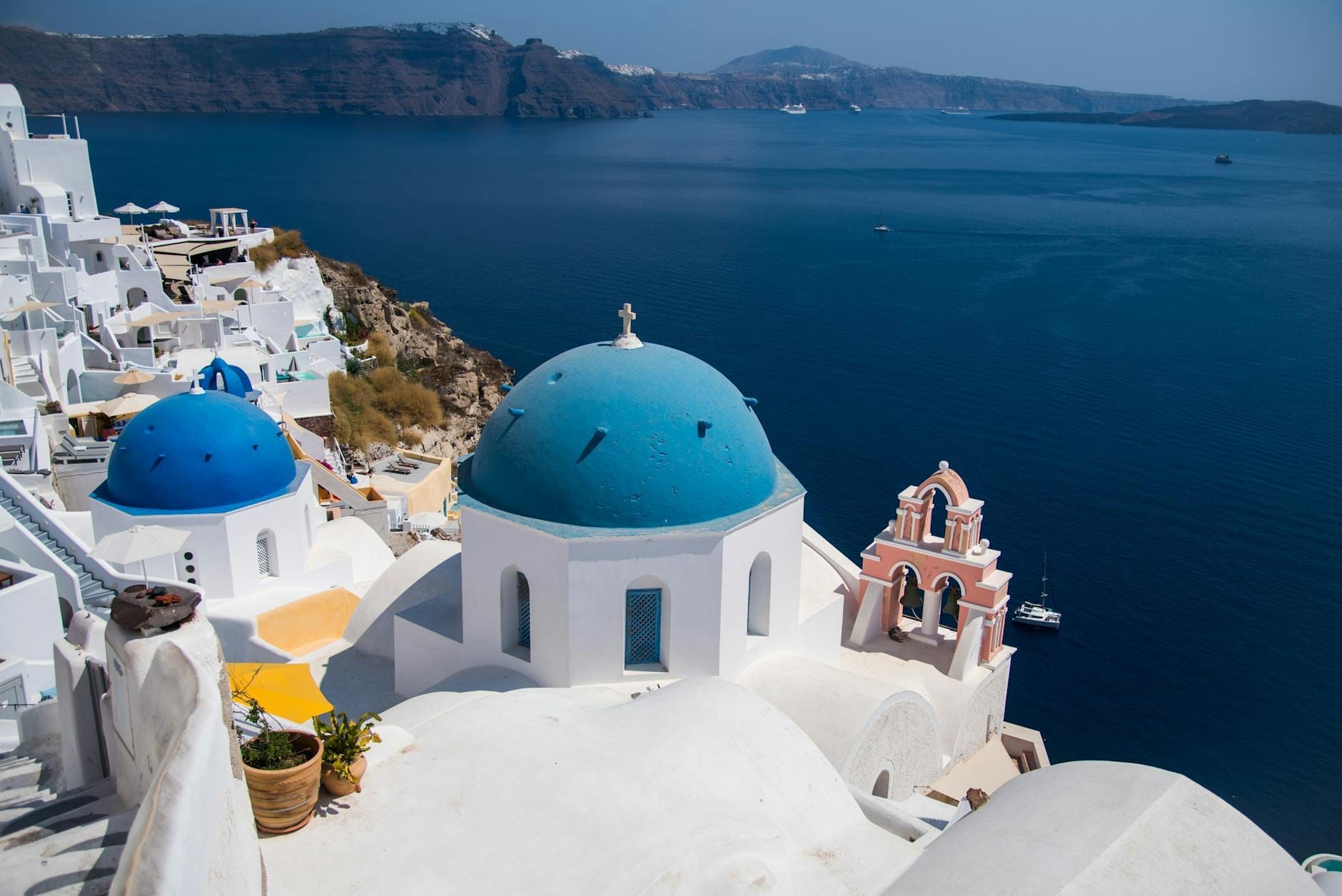
The Blue-Domed Churches of Oia are not a single monument or a paid attraction. They are two small, active Greek Orthodox churches perched on the caldera rim in the village of Oia: Agios Spyridonas (Saint Spyridon) and the Anastasi Church (formally, the Church of the Resurrection of the Lord, or Anastaseos tou Kyriou). The two churches sit close together, their cobalt domes catching the sky above white plaster walls, and the caldera dropping away to volcanic islands below. That specific arrangement — the blue curves against whitewash against deep Aegean blue — is the image that appears on more Santorini postcards, hotel brochures, and travel magazine covers than any other.
The blue-and-white colour scheme is not ancient tradition. It became common across Santorini churches in the second half of the 20th century, chosen to reflect the colours of the Greek flag, and it now defines how much of the world pictures Greece. The domes themselves are modest in scale; up close they feel like working village buildings, not grand religious architecture. The power is entirely in the composition: foreground detail against an extraordinary backdrop.
A third church, Panagia Platsani (also called Panagia Akathistos Hymnos), sits in Oia's main square and serves as the practical navigation point for finding the cliff-side domes. It was originally built inside the old Oia castle but was rebuilt in the centre of the village after the 1956 earthquake severely damaged the area.
How to Find the Viewpoint
Finding the blue domes the first time is not entirely obvious, which is partly why so many visitors end up photographing them from a distance rather than from the classic close-up position. The key is to start at Oia's main square, where Panagia Platsani stands, and then walk along the caldera-side pedestrian path sometimes called Gold Street. Look for the alley near the Minerali jewelry store, turn down it, and follow the narrow lane a short distance toward the cliff edge. The viewpoint opens up almost without warning.
💡 Local tip
Navigation tip: Open a maps app before leaving the main path. The alley is easy to miss among the many similar lanes in Oia. Search for 'Agios Spyridonas Oia' or 'blue domes Oia' and follow the pin rather than relying on signage, which is minimal.
The path involves narrow alleys and uneven steps, consistent with Oia's cliff-side layout throughout. There is no indication from available sources that a step-free or fully accessible route exists to the closest viewpoint. Visitors with mobility considerations should plan for some uneven stone surfaces and tight passages between whitewashed walls.
Tickets & tours
Hand-picked options from our booking partner. Prices are indicative; availability and final rates are confirmed when you complete your booking.
Santorini half-day family tour with wine museum visit
From 200 €Instant confirmationFree cancellationSantorini sunset tour with wine tasting
From 110 €Instant confirmationFree cancellationLuxury Sunset Cruise in Santorini
From 120 €Free cancellationCruise of the volcanic islands around Santorini
From 45 €Instant confirmationFree cancellation
How the Experience Changes by Time of Day
Timing is the single biggest factor in whether a visit here feels worthwhile or frustrating. At midday in peak summer, the narrow alley and the small viewing area in front of the domes can hold dozens of people simultaneously angling for the same shot. The light is also harsh and flat, bleaching out the contrast between the white walls and blue domes that makes the composition so striking.
Early morning, particularly in the hour after sunrise, offers the best combination of soft directional light and thin crowds. The stone paths are cool underfoot, the caldera below is often catching low mist, and the domes take on a warmer tone against the pale morning sky. Most visitors staying in Oia are still asleep or at breakfast. In September and October especially, mornings here can feel almost quiet.
Sunset is the most popular time by far, and the reality is that the viewpoint becomes genuinely congested. People press into the small area, tripods compete for position, and movement becomes slow. The quality of the light is good, the domes glow warm against a darkening sky, and if you are patient and arrive 30 to 40 minutes early to secure a position, the photos can be excellent. But if you arrive expecting a peaceful moment, sunset is not the time to find it. For a calmer version of the evening light without the same pressure,
consider combining the churches with the wider Oia sunset viewpoint experience, which spreads the crowd across a longer section of the caldera rim.
⚠️ What to skip
Crowd warning: In July and August, the blue-domed church viewpoint can reach capacity at sunset, with visitors describing difficulty moving and finding an unobstructed angle. If a clean, uncrowded shot matters to you, sunrise is the only reliable alternative in peak season.
Photography: What Actually Works Here
The classic shot frames both domes together with the caldera and the islands of Palea Kameni or Nea Kameni in the background. A standard wide-angle lens or a phone camera's main lens captures this well from the primary viewpoint. Moving slightly lower on the path, if space allows, changes the foreground-to-sky ratio and can reduce the number of other visitors in frame.
A longer focal length, from a position further back on the main caldera path, compresses the domes against the water and eliminates surrounding structures. This works particularly well in the minutes after sunset when the sky holds colour and the domes are still lit.
For a broader photographic strategy across the island, the Santorini photography guide covers timing, locations, and lens choices in detail.
The Churches as Living Buildings
It is worth remembering that Agios Spyridonas and the Anastasi Church are active parish churches, not heritage monuments maintained for tourism. Visiting during a service, which can happen on Sundays and religious feast days, requires the usual courtesy: quiet behaviour, covered shoulders, and an understanding that worshippers take priority over photographers.
No fixed public visiting hours are published for either cliff-side church, and no admission fee applies. They are generally accessible during daylight hours, but access may be limited during private services or ceremonies. The churches are small inside, with the kind of dim, icon-hung interiors typical of Cycladic Orthodox buildings: brass censers, votive candles, and the faint smell of incense.
Oia itself rewards time spent beyond the church viewpoint. The Oia windmills sit nearby along the caldera rim, and the village's network of pedestrian lanes hides smaller churches, cave-house hotels, and views down toward Ammoudi Bay below the cliff.
Getting to Oia and Around the Village
KTEL buses run between Fira and Oia and are the main affordable public transport option. Schedules and frequency vary by season; check the KTEL Santorini website before travelling rather than assuming a specific timetable. Taxis and pre-booked transfers are also widely used. There is no rail or metro system on Santorini.
Oia is also the end point of the famous caldera-edge walk from Fira, passing through Firostefani and Imerovigli. The Fira to Oia hiking trail takes roughly 2.5 to 3 hours one-way and ends close to the village centre, putting the blue domes within a short walk of the trail's finish. It is a logical way to approach Oia if you want to earn the view.
Driving to Oia and parking in high season is possible but requires patience; the village road narrows sharply and the car park fills early. For most visitors, arriving by bus or taxi and exploring on foot is simpler.
Honest Assessment: Is It Worth the Effort?
The honest answer depends on your expectations. If you arrive at the blue domes at 5pm in August hoping for a serene, photogenic moment, you are likely to find a crowd that makes the experience feel more like a queue than a destination. The viewpoint is small, the churches themselves are not architecturally complex, and the scene is so thoroughly reproduced in photographs that the reality can feel strangely familiar rather than spectacular.
But visited on the right terms, the spot delivers. The combination of the carved dome shapes, the quality of light on white volcanic plaster, and the sheer scale of the caldera behind them is genuinely striking. Early morning in shoulder season, when the alley is empty and the mist is still sitting on the water below, the place earns its reputation. It is not overhyped so much as incorrectly timed by most visitors.
If you want to understand Oia's wider appeal before committing a full day to the village, the Oia neighbourhood guide covers the full range of what the village offers, from restaurants to caldera paths to less-visited corners.
Insider Tips
- Arrive before 8am in peak season. The viewpoint holds almost no one at that hour, the light is soft and angled, and you can take your time with composition rather than negotiating around other visitors.
- The best free alternative position is from the main caldera path above, looking down slightly toward the domes with a longer zoom. This angle compresses the domes against the water and is easier to access without the alley crowd.
- Dress for modest entry. If you want to step inside either church, covered shoulders and knees are expected. The interiors are cool and dark, a welcome contrast to the midday heat outside.
- Combine the visit with Ammoudi Bay below. A steep path from Oia's western edge descends to the small harbour. After early-morning photos at the domes, a late breakfast by the water is a sensible and enjoyable pairing.
- Check the Greek Orthodox calendar before your visit. If a major feast day falls during your trip, the churches may hold services with local participation, which is a completely different and more meaningful experience than a photography stop.
Who Is Blue-Domed Churches of Oia For?
- Photographers who can commit to an early start and want the shot with workable light and minimal crowds
- Architecture and design-focused travellers interested in Cycladic church forms and the evolution of the island's visual identity
- Couples visiting Santorini and wanting the iconic image as part of a broader Oia morning walk
- Repeat visitors to Santorini who skipped this on a previous trip and want to finally see it properly
- Travellers on a short itinerary who can combine the churches with the Fira-to-Oia hike as a single half-day experience
Nearby Attractions
Other things to see while in Oia:
- Ammoudi Bay
Ammoudi Bay is the small volcanic harbor tucked 200-plus steps below Oia's clifftop streets. It offers swimming off jagged lava rocks, a handful of seafood tavernas perched at water level, and caldera boat tours departing from the quay. Access is free, but the steep descent demands good footwear and reasonable fitness.
- Finikia Village
Finikia Village sits less than a kilometre from Oia but feels like a different island entirely. A traditional Cycladic farming settlement with cave houses, arched doorways, and pedestrian lanes too narrow for cars, it offers a genuine contrast to the tourist intensity of its famous neighbour. Entry is free, the pace is slow, and the photography is excellent without the crowds.
- Naval Maritime Museum
Tucked into the pedestrian lanes of Oia, the Naval Maritime Museum occupies a beautifully restored 19th-century captain's mansion and tells the story of Santorini's once-thriving maritime trade. It is a calm, unhurried stop that rewards curious travelers willing to look beyond the caldera views.
- Oia Sunset Viewpoint
Every evening, hundreds of visitors gather at the ruins of Castle Agios Nikolaos on Oia's western edge to watch the sun drop into the Aegean. The spectacle is real and genuinely moving. So is the crowd. Here's what to expect, when to arrive, and whether it's worth the effort.