Panagia Platsani Church: Oia's Domed Heart
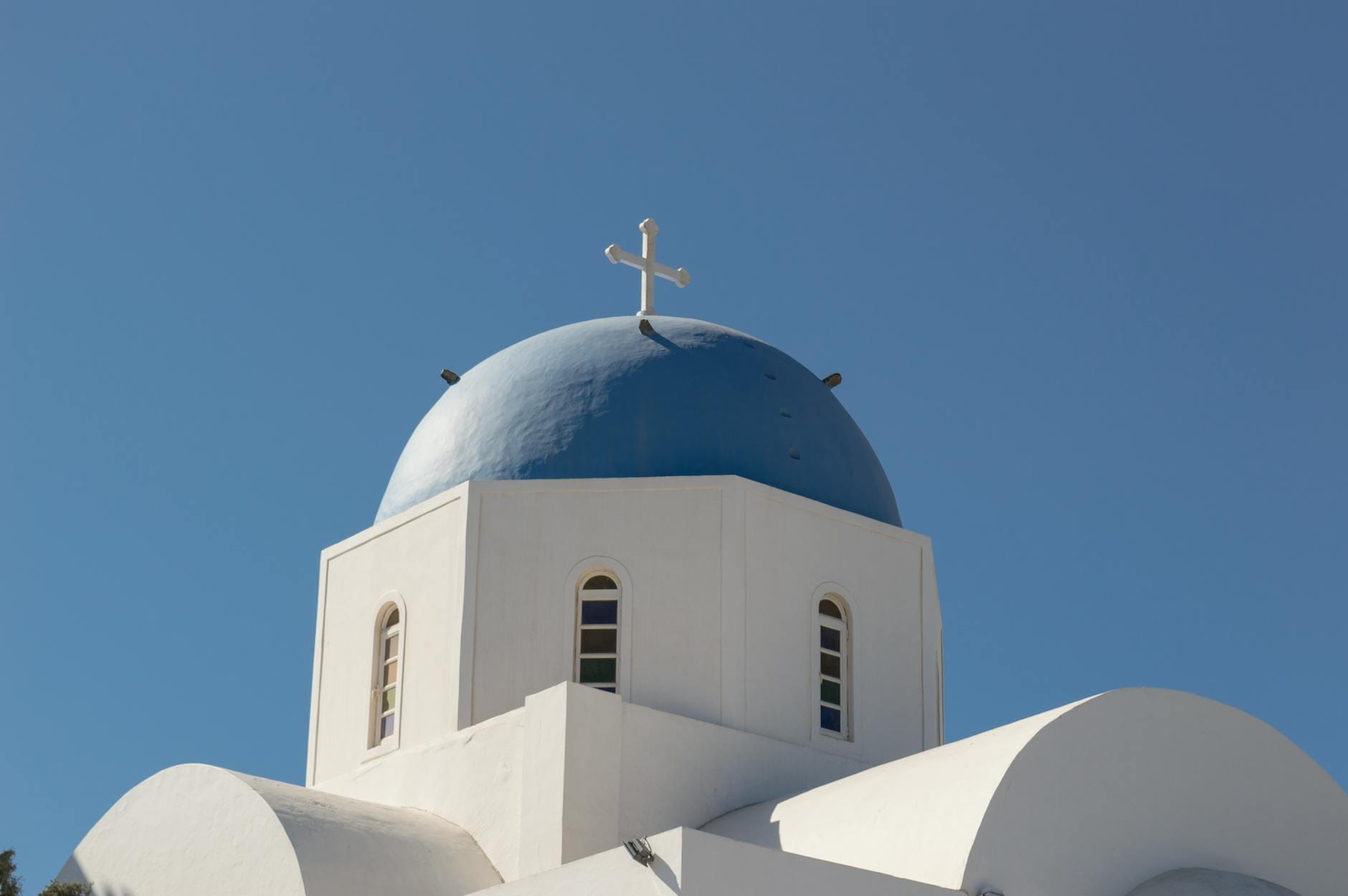
Standing at the center of Oia's main square, Panagia Platsani Church is a Greek Orthodox church rebuilt in 1965 with five domes, a pyramid bell tower, and a name rooted in a legend of an icon found in the sea. Free to enter, architecturally distinctive, and far quieter than the village's sunset viewpoints.
Quick Facts
- Location
- Main square (Platsani), Oia, Santorini, Greece
- Getting There
- KTEL bus or taxi from Fira to Oia; short walk from the Oia bus stop into the central square
- Time Needed
- 15–30 minutes to appreciate the exterior and interior; longer if you arrive during a service
- Cost
- Free admission; no ticket required
- Best for
- Architecture lovers, Orthodox heritage seekers, photographers, and anyone wanting a quiet moment away from the caldera crowds
What Is Panagia Platsani Church?
Panagia Platsani Church (Greek: Παναγία Πλατσανή) is the principal Greek Orthodox church of Oia, positioned at the geographical and social heart of the village on its main open square. While most visitors to Oia have their eyes fixed on the caldera rim or the famous sunset viewpoint, this church stands a short walk from both, its five domes rising quietly above the whitewashed rooflines. It is free to visit and, by the standards of this heavily photographed village, remarkably unhurried.
The church is dedicated to the Standing Hymn to the Mother of God (Akathistos Theotokos), a theological dedication that distinguishes it from the many simpler chapels scattered across Oia. Its official parish falls under the Holy Metropolis of Thera, Amorgos, and Nisoi of the Greek Orthodox Church.
ℹ️ Good to know
Dress code applies: shoulders and knees should be covered before entering. No fixed opening hours are reliably published — the church is generally accessible during daylight hours when no private services are underway, but hours can vary with services and local events. Confirm locally if you plan a specific visit time.
The Legend Behind the Name
The name 'Platsani' is not purely geographical, though the square on which the church stands is sometimes described as a flat, open place. Local tradition holds that the name comes from the sound of waves — 'plats-plats' — striking an icon of the Virgin Mary that was discovered in the sea. The icon was retrieved, the story goes, and a church was built to house it. Whether or not the account is literally true, it has shaped how residents and returning visitors relate to this building. It is a church with a sea story, which feels entirely appropriate for a clifftop island village.
The original church stood inside the medieval Venetian castle that once commanded Oia's northern tip. That structure, along with much of the old village, was destroyed in the catastrophic earthquake of July 1956 — one of the most damaging seismic events in modern Greek history. The current church was rebuilt not on the exposed castle promontory but on the more stable ground of the village square. The present structure was completed in 1965.
Tickets & tours
Hand-picked options from our booking partner. Prices are indicative; availability and final rates are confirmed when you complete your booking.
Luxury Sunset Cruise in Santorini
From 120 €Free cancellationCruise of the volcanic islands around Santorini
From 45 €Instant confirmationFree cancellationGuided e-bike tour in Santorini
From 90 €Instant confirmationFree cancellationSantorini audio guide with TravelMate app
From 5 €Instant confirmation
Architecture: What to Look for Before You Step Inside
The exterior of Panagia Platsani rewards a slow circuit rather than a glance from the path. The building follows a square ground plan topped by five domes, with the largest dome painted in the deep Cycladic blue that has become almost synonymous with Santorini's identity. The four smaller domes flank the central one in a symmetrical arrangement that gives the church a solid, grounded presence — quite different from the single-domed chapels perched on the caldera edge elsewhere in the village.
The bell tower is a study in contrasts: pyramid-shaped rather than arched, and fitted with six bells that are audible throughout the square when rung for services. Above the main entrance, a gilded mosaic catches morning light particularly well. The gold ground of the mosaic picks up warmth from the sun in the first hours after sunrise, when the square itself is nearly empty and the quality of light is at its most painterly.
💡 Local tip
Photography tip: The mosaic above the entrance and the blue central dome read best in soft morning light, before direct sun creates harsh shadows on the white plaster. Come between 8 and 10 a.m. for the cleanest shots with almost no foot traffic in frame.
The Experience: Morning, Midday, and Evening
Oia's crowds follow a predictable rhythm: thin in the morning, steady through midday, and dense in the two hours before sunset when the village fills with visitors making their way toward the castle ruins and the main viewpoint. Panagia Platsani, being set back from the caldera-edge path, sits slightly outside that main flow. In the morning, the square around it functions almost like a local neighborhood — you may hear the bells, smell fresh bread from a nearby bakery, or watch residents crossing to a café. The church itself has the stillness of a place that actually serves a community rather than existing purely for photographs.
By midday, the square sees passing visitors but rarely becomes as congested as the main pedestrian lane or the area around the Oia sunset viewpoint. If you are visiting Oia primarily for the sunset, arriving mid-afternoon gives you time to walk the village, stop at the church, and find a position on the caldera path before the peak crowds arrive.
In the evening, once the sunset crowds have dispersed and the village exhales, the church square becomes one of the quieter spots in Oia. The bells, if rung for an evening service, echo differently at dusk — the sound carries across the flat stone square without competition from foot traffic. This is a detail most visitors miss entirely.
Inside the Church
The interior of Panagia Platsani follows the conventions of a Greek Orthodox nave: an iconostasis separating the nave from the sanctuary, oil lamps hanging from the ceiling, and the smell of incense in the air when services have recently concluded. The acoustics under the central dome are noticeably resonant. Natural light filters through the windows in a way that shifts through the day — the interior is warmest and most atmospheric in the morning.
Visitors should behave as they would in any active place of worship. Photography inside may or may not be permitted depending on whether a service is in progress — if in doubt, ask. The church is not a museum; it is an active parish that conducts regular Orthodox liturgies, and this shapes the atmosphere in a way that purely decorative or ruined churches cannot replicate.
⚠️ What to skip
If a service is underway when you arrive, wait quietly near the entrance or return later. Entering during an active liturgy and moving around to take photographs is not appropriate.
Practical Walkthrough: Getting There and Around
Oia is accessible from Fira by KTEL public bus — the most affordable option — or by taxi, which typically takes around 20–30 minutes depending on traffic. From the Oia bus terminus, the church square is a short walk into the village center. The Fira to Oia hiking trail along the caldera rim also terminates near the northern end of Oia, putting the church within easy walking distance for anyone who has made the full walk.
The church stands on the main square, which is relatively flat compared to much of Oia's stepped terrain. This makes it one of the more accessible points in the village for travelers with limited mobility. However, the surrounding lanes involve uneven cobblestones and occasional steps, and no official information about accessible facilities inside the church has been published. Visitors with specific mobility requirements should verify conditions locally before relying on this.
If you are combining this visit with other Oia landmarks, the Oia windmills are visible from the edge of the square, and the Naval Maritime Museum — which occupies a restored 19th-century mansion nearby — adds cultural depth to any morning spent in the village. For those planning a longer stay in the north of the island, the guide to Santorini's lesser-known spots offers useful context on what lies beyond the main tourist circuit.
Who Should Skip This Attraction
Travelers with no particular interest in religious architecture or Orthodox heritage may find Panagia Platsani underwhelming as a standalone destination. If your visit to Oia is driven entirely by the sunset and caldera views, the church will likely feel like a detour rather than a highlight. It is also not suitable for visitors who are uncomfortable with active religious environments — unlike a converted museum-church, this is a working parish, and that shapes the experience in ways that not everyone will find comfortable.
That said, even travelers primarily interested in scenery tend to pass through the square without realizing it. The church simply adds a layer of meaning to what would otherwise be a transit point. For those who want to understand Oia as a place where people actually live, rather than just as a backdrop for photographs, Panagia Platsani offers one of the clearest windows available. For broader context on what makes this part of the island worth your time, the guide to things to do in Santorini is a useful starting point.
Insider Tips
- Arrive at the square before 9 a.m. on a weekday and you will likely have the church facade almost entirely to yourself. The blue dome against a pale morning sky makes for a very different photograph than the midday version.
- Listen for the bells. The six-bell tower is one of the more sonorous in Oia, and hearing them ring from the square rather than from a distance is worth timing your visit around a scheduled service.
- The gilded mosaic above the entrance is easier to see and photograph from across the square rather than directly in front of the door — step back toward the center of the plaza for a clear, unobstructed view.
- The church name is often misspelled or mispronounced by visitors. 'Platsani' is pronounced roughly as 'PLAH-tsah-nee', which may help if you are asking locals for directions.
- If you are visiting during the Orthodox calendar period of the Akathist Hymn (typically the fifth Friday of Lent), the church holds particular liturgical significance and services may attract a larger local congregation than usual.
Who Is Panagia Platsani Church For?
- Architecture and design enthusiasts interested in Cycladic ecclesiastical building traditions
- Travelers on a photography itinerary who want a quieter alternative to the main viewpoints
- Anyone interested in how a village community maintains everyday life amid heavy tourism
- Honeymoon or couples trips looking for a peaceful morning stop in Oia before the crowds arrive
- Visitors combining a caldera hike with a cultural stop in the village center
Nearby Attractions
Other things to see while in Oia:
- Ammoudi Bay
Ammoudi Bay is the small volcanic harbor tucked 200-plus steps below Oia's clifftop streets. It offers swimming off jagged lava rocks, a handful of seafood tavernas perched at water level, and caldera boat tours departing from the quay. Access is free, but the steep descent demands good footwear and reasonable fitness.
- Blue-Domed Churches of Oia
The blue-domed churches of Oia are the image most people picture when they think of Santorini. Two small cliff-side churches, Agios Spyridonas and the Anastasi Church, sit on the caldera edge above the Aegean and draw more cameras per square metre than almost anywhere else in Greece. Here is what a visit actually looks like, how to find them, and when the crowds thin enough to make it worthwhile.
- Finikia Village
Finikia Village sits less than a kilometre from Oia but feels like a different island entirely. A traditional Cycladic farming settlement with cave houses, arched doorways, and pedestrian lanes too narrow for cars, it offers a genuine contrast to the tourist intensity of its famous neighbour. Entry is free, the pace is slow, and the photography is excellent without the crowds.
- Naval Maritime Museum
Tucked into the pedestrian lanes of Oia, the Naval Maritime Museum occupies a beautifully restored 19th-century captain's mansion and tells the story of Santorini's once-thriving maritime trade. It is a calm, unhurried stop that rewards curious travelers willing to look beyond the caldera views.