Oia Sunset Viewpoint: The Reality Behind the Most Famous Sunset in Greece
Every evening, hundreds of visitors gather at the ruins of Castle Agios Nikolaos on Oia's western edge to watch the sun drop into the Aegean. The spectacle is real and genuinely moving. So is the crowd. Here's what to expect, when to arrive, and whether it's worth the effort.
Quick Facts
- Location
- Castle of Agios Nikolaos, Oia, northern Santorini, Cyclades, Greece
- Getting There
- KTEL bus from Fira to Oia, then about a 10–15 min walk through pedestrian lanes to the castle ruins
- Time Needed
- 1.5–3 hours (arrive early, stay through the afterglow)
- Cost
- Free. No ticket or entry fee required.
- Best for
- Couples, photographers, first-time visitors to Santorini
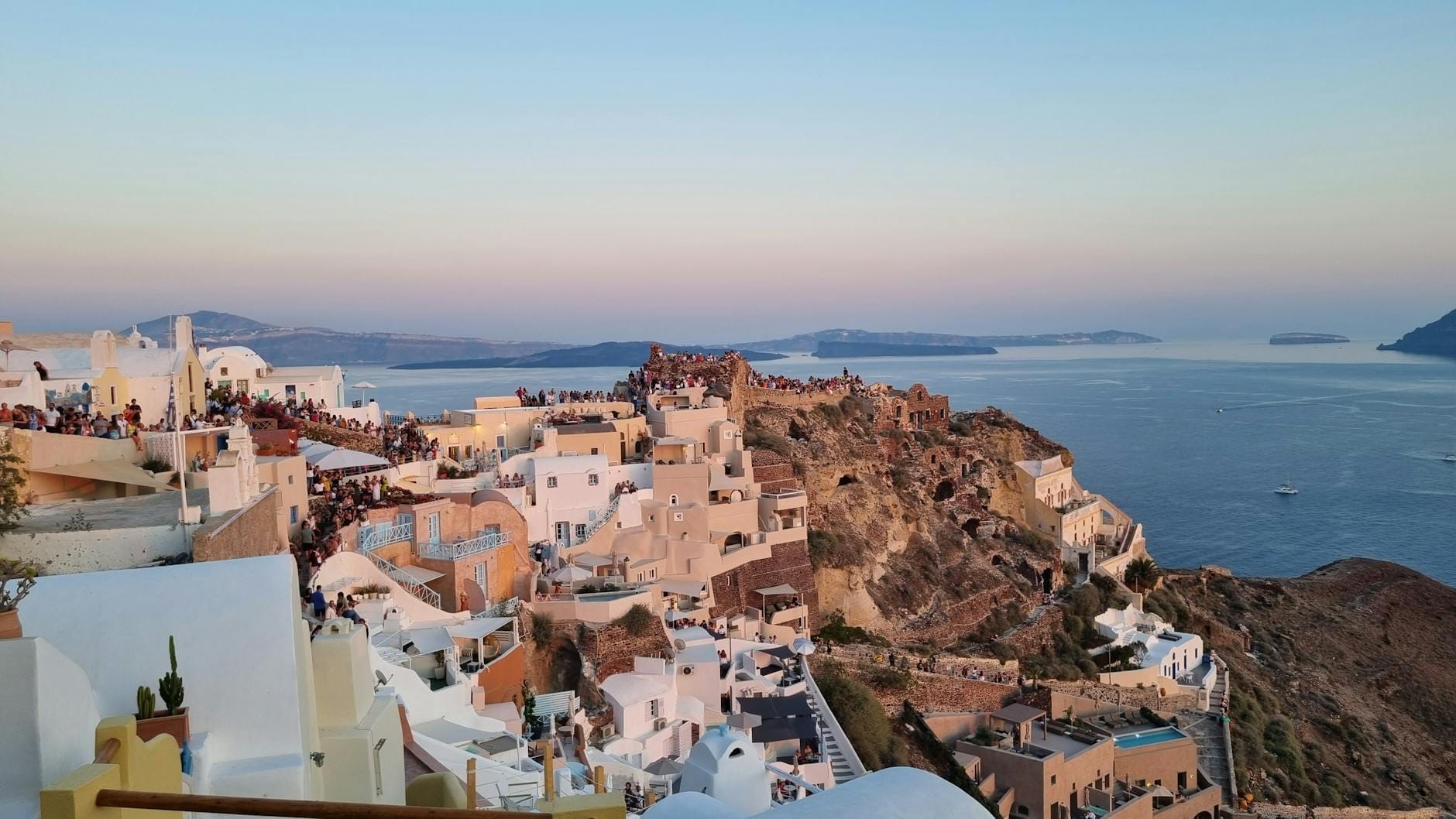
What the Oia Sunset Viewpoint Actually Is
The Oia Sunset Viewpoint is not a formal attraction with a ticket booth or a dedicated platform. It is, at its core, the ruins of the Castle of Agios Nikolaos, a 15th-century Venetian watchtower built on Oia's western cliff to guard against pirates raiding the area. The 1956 earthquake left the castle largely in rubble. What remains is a wide, elevated terrace of broken stone walls and open sky, jutting over the caldera with an unobstructed westward view of the sea, the volcanic islands of Nea Kameni and Palea Kameni, and the horizon where the sun sets.
Because it sits at the far western end of Oia's ridge, the castle position means the sun drops in front of you on clear evenings, framed by nothing but open water and the crumbling silhouette of its own walls. That spatial alignment is exactly why this spot developed its reputation. The view is not incidental. It is architecturally and geographically deliberate, even if the Venetians who built it were watching for ships rather than sunsets.
For a broader understanding of Oia as a place, including its whitewashed lanes, cave houses, and position above the caldera, see the Oia neighborhood guide.
The Crowd: What No One Tells You Up Front
⚠️ What to skip
In peak season (July and August), crowds at the castle viewpoint can reach thousands of people. Arrive at least 90 minutes before sunset to secure a good standing position on the ruins. By 30 minutes before sunset, the prime spots are full.
The Oia sunset experience is widely discussed, and that popularity has real consequences for the experience itself. On summer evenings, the path leading to the castle fills with visitors moving in one direction: west. The ruins become a standing-room terrace of cameras, selfie sticks, and raised phones. The atmosphere is social and festive, occasionally noisy. Applause often breaks out at the moment of sunset, which is either charming or absurd depending on your disposition.
None of this makes the sunset less beautiful. The light is still extraordinary: warm amber and deep orange spreading across the caldera water, the white cube buildings of Oia glowing coral, the volcanic islands darkening to silhouettes. But you will share it with a large number of people, and that is simply part of the experience here. If solitary contemplation is what you want, the castle viewpoint in high summer is not the right choice.
Travelers willing to explore alternatives will find that Santorini's sunset guide covers several less-crowded viewpoints across the island, some of which offer comparable light with far fewer people.
Tickets & tours
Hand-picked options from our booking partner. Prices are indicative; availability and final rates are confirmed when you complete your booking.
Santorini sunset tour with wine tasting
From 110 €Instant confirmationFree cancellationLuxury Sunset Cruise in Santorini
From 120 €Free cancellationSmall-Group Sunset Sailing Cruise with BBQ, Drinks and Hotel Transfers
From 195 €Instant confirmationFree cancellationSemi private sunset cruise in Santorini
From 150 €Instant confirmationFree cancellation
How the Experience Changes Through the Day
Earlier in the day, the castle ruins are largely quiet. The stone paths through Oia carry a steady flow of visitors exploring the village, but the castle itself sees only a fraction of the evening crowd during afternoon hours. The light at midday is harsh and flat for photography, but the caldera view from the ruins is still commanding: the sheer drop of the cliffs, the deep blue of the water, the almost disorienting scale of the flooded volcanic crater stretching out below.
In the two hours before sunset, the atmosphere shifts. Foot traffic on Oia's main pedestrian street increases noticeably. Visitors begin moving toward the western end of the village. By about an hour before sunset, the castle terrace starts to fill. The best unobstructed positions on the higher sections of the ruins go first. Vendors occasionally circulate nearby. The smell of sunscreen and the sounds of multiple languages mix in the evening air.
After the sun drops below the horizon, most visitors leave quickly. If you stay for the 15 to 20 minutes of afterglow, the sky often produces its most saturated colors: deep violet and crimson over the water, the lights of Fira beginning to appear on the caldera rim to the south. This post-sunset window is also when the crowd thins fastest and the atmosphere becomes noticeably calmer.
Getting There: The Walk Through Oia
The KTEL bus from Fira stops in Oia village. From there, the walk to the castle takes roughly 10 to 15 minutes along the main pedestrian lane, which is paved with smooth stone and flanked by whitewashed buildings, church domes, and shops. The lane is generally flat until the final approach to the castle, where the path narrows and involves uneven stone surfaces and some steps.
Visitors with mobility impairments should be aware that the final section involves irregular terrain and can be genuinely difficult. The castle ruins themselves are not formally adapted for accessibility. Some nearby restaurants and hotel terraces in Oia's western end offer caldera and sunset views from seated, level positions, and for anyone who cannot manage stairs and rough ground, these are worth considering as alternatives.
Driving to Oia and parking near the western end of the village is possible but can be unreliable in peak season. The most dependable approach on a busy evening is the bus or a taxi to the village, then on foot through the lanes.
💡 Local tip
Wear closed-toe shoes or sandals with grip. The stone paths through Oia and the castle ruins are polished smooth in places and can be slippery, especially if you are moving quickly in the crowd.
Photography at the Viewpoint
The Oia castle viewpoint is one of the most photographed locations in the Cyclades. The iconic image, white buildings cascading down the cliff with the sun sinking behind the volcano-edged sea, is achievable from here. A wide-angle lens captures the full sweep of the caldera and the village. A telephoto lens isolates the sun touching the horizon with the volcanic islands in the frame. For more structured guidance on capturing Santorini's light, the Santorini photography guide covers equipment, timing, and positioning across multiple spots.
The practical challenge at this viewpoint is not the light but the crowd. Getting a clear shot of the sunset without other visitors in frame requires either arriving extremely early to claim a front position on the ruins, or embracing the crowd as part of the composition, which some photographers do intentionally. Silhouetted figures against the orange sky have their own visual power.
Golden hour in September and October tends to be sharper and more golden-toned than the hazy summer light of July and August. For photography specifically, shoulder season visits produce better color gradations and a smaller crowd to work around.
The Honest Assessment: Is It Worth It?
Yes, with realistic expectations. The Oia sunset from the Castle of Agios Nikolaos is genuinely spectacular when conditions cooperate. A clear evening with low atmospheric haze produces a light show over the caldera that is difficult to overstate. The combination of the Aegean geography, the volcanic islands on the horizon, and the warm stone tones of the village creates an atmosphere that photographs cannot fully convey.
The crowd is real, and it will affect your experience. Visitors expecting quiet contemplation will find the castle terrace in summer more like an outdoor event than a meditative viewpoint. That said, the energy of the crowd, including the collective spontaneous applause at sunset, can itself be memorable.
Travelers who find large tourist gatherings stressful, or who are visiting outside the main summer season and want flexibility, might prefer the viewpoints at Imerovigli or Firostefani, both of which offer caldera views with smaller crowds. First-time visitors to Santorini who have come specifically for the iconic experience, however, will find that the Oia castle sunset earns its reputation.
If you are planning your wider Santorini schedule around the sunset, the 3-day Santorini itinerary incorporates the Oia sunset into a logical sequence that avoids common timing mistakes.
Practical Notes and Seasonal Considerations
The viewpoint is a public open space with no fixed opening hours and no admission fee. There are no toilets at the ruins themselves; use the facilities in Oia's village before heading to the castle. Small shops and cafes along Oia's main lane sell water and snacks. Bring water if you are visiting in summer, as the wait in full sun can be long and dehydrating.
Sunset times shift considerably across the season. In June, the sun sets around 8:20 to 8:45 pm local time. By October, it sets closer to 6:45 to 7:00 pm. Checking the actual sunset time for your travel date is essential for planning your arrival. Arriving 90 minutes before sunset is a reliable buffer during peak season; 60 minutes may be sufficient in the shoulder months of April, May, September, and October.
ℹ️ Good to know
Cloud cover and haze affect the sunset quality significantly. A clear horizon produces vivid color; a high-pressure haze, common in July and August, can wash out the most intense tones. Light cloud on the horizon occasionally enhances the spectacle by catching color after the sun disappears.
For a full picture of seasonal conditions, including which months offer the clearest skies and smallest crowds, the Santorini weather by month guide provides month-by-month breakdowns.
Insider Tips
- The higher sections of the castle ruins fill first. If you arrive early, position yourself on the elevated stone walls rather than the flat terrace below — you will have an unobstructed view over the crowd.
- The 15 minutes after the sun disappears below the horizon often produce the richest sky colors. Most visitors leave immediately after sunset, so staying through the afterglow gives you the view with a fraction of the crowd.
- September and early October combine smaller crowds, cooler temperatures, and crisper golden-hour light than peak summer. If your schedule allows, these months offer a materially better experience at this viewpoint.
- If the castle terrace is overwhelmingly packed on your visit, walk back along Oia's main lane toward Firostefani. The caldera-edge path westward still captures the sunset light and the caldera panorama with far fewer people around you.
- Taxis from Fira to Oia become scarce after sunset as demand spikes. If you are not staying in Oia, arrange your return transport before you arrive or plan to take the KTEL bus back.
Who Is Oia Sunset Viewpoint For?
- First-time visitors to Santorini who want the full iconic experience
- Couples looking for a genuinely atmospheric evening setting
- Photographers targeting the classic Cycladic-sunset image
- Travelers visiting in shoulder season (April-May or September-October) who want a manageable crowd
- Anyone combining the sunset with a walk through Oia's lanes earlier in the day
Nearby Attractions
Other things to see while in Oia:
- Ammoudi Bay
Ammoudi Bay is the small volcanic harbor tucked 200-plus steps below Oia's clifftop streets. It offers swimming off jagged lava rocks, a handful of seafood tavernas perched at water level, and caldera boat tours departing from the quay. Access is free, but the steep descent demands good footwear and reasonable fitness.
- Blue-Domed Churches of Oia
The blue-domed churches of Oia are the image most people picture when they think of Santorini. Two small cliff-side churches, Agios Spyridonas and the Anastasi Church, sit on the caldera edge above the Aegean and draw more cameras per square metre than almost anywhere else in Greece. Here is what a visit actually looks like, how to find them, and when the crowds thin enough to make it worthwhile.
- Finikia Village
Finikia Village sits less than a kilometre from Oia but feels like a different island entirely. A traditional Cycladic farming settlement with cave houses, arched doorways, and pedestrian lanes too narrow for cars, it offers a genuine contrast to the tourist intensity of its famous neighbour. Entry is free, the pace is slow, and the photography is excellent without the crowds.
- Naval Maritime Museum
Tucked into the pedestrian lanes of Oia, the Naval Maritime Museum occupies a beautifully restored 19th-century captain's mansion and tells the story of Santorini's once-thriving maritime trade. It is a calm, unhurried stop that rewards curious travelers willing to look beyond the caldera views.