Fira to Oia Hiking Trail: The Complete Caldera Walk
The Fira–Oia Hiking Trail is Santorini's most rewarding walk: a 10-kilometre path along the caldera rim connecting the island's capital to its most photographed village. Free to walk, open at all hours, and lined with volcanic cliffs, whitewashed chapels, and sweeping Aegean views, it rewards those who go prepared and go early.
Quick Facts
- Location
- Fira to Oia, caldera rim, Santorini
- Getting There
- KTEL bus to Fira or Oia; most hikers take the bus to one end and walk to the other
- Time Needed
- 2.5–5 hours one way (approx. 10 km)
- Cost
- Free — no ticket or entry fee
- Best for
- Scenery, photography, caldera views, active travellers
What the Fira–Oia Trail Actually Is
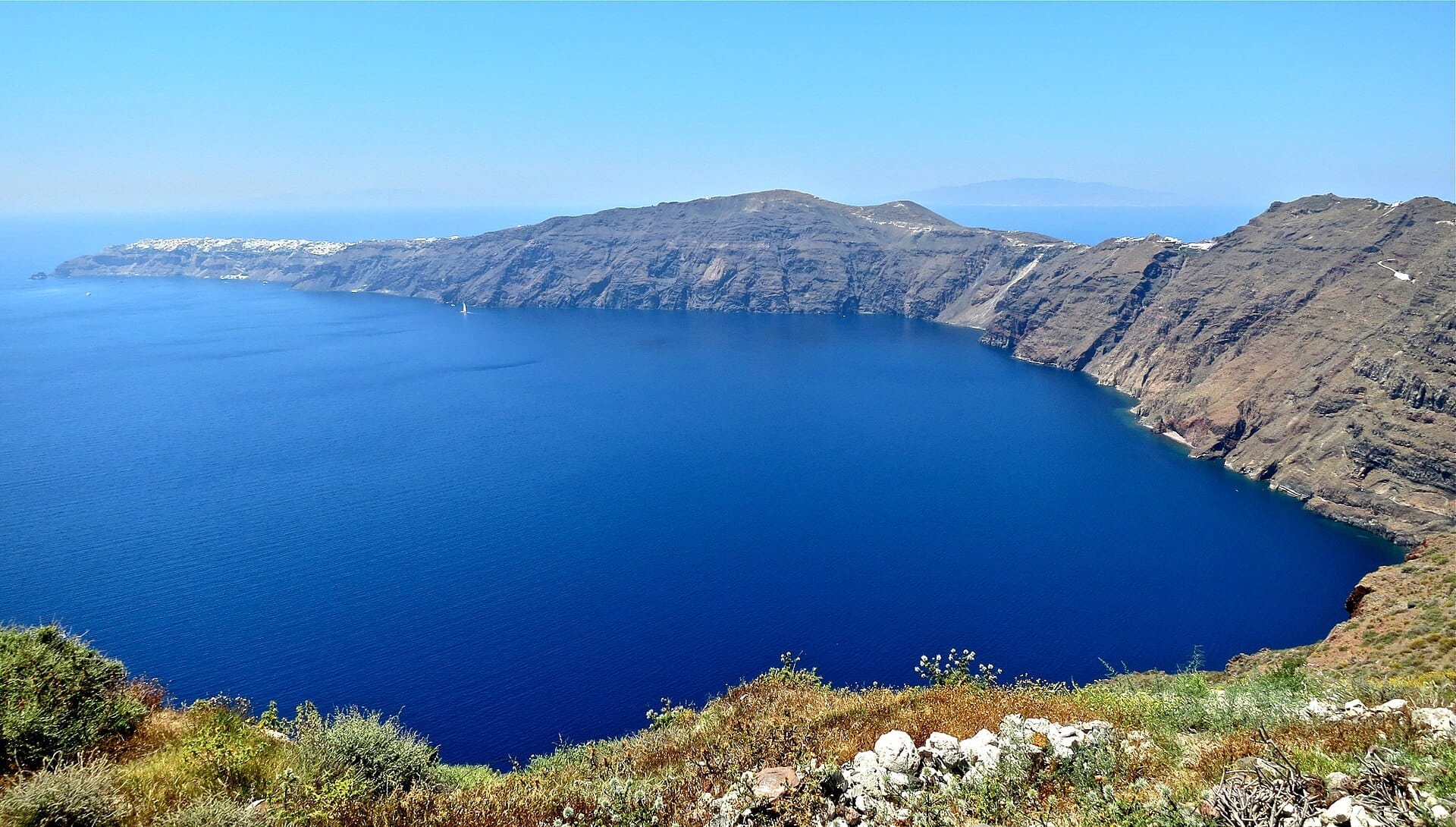
The Fira–Oia Hiking Trail is an informal, unticketed public footpath that traces the western edge of Santorini's volcanic caldera for approximately 10 to 10.5 kilometres. It connects Fira (the island's capital, sitting at roughly 270 metres above sea level) to Oia in the north (at around 130 metres), passing through the cliff-edge villages of Firostefani and Imerovigli, reaching its highest point near Imerovigli at about 350 metres. The trail has no gates, no admission fees, and no formal operating hours. You simply start walking.
It is not a wilderness trail in the mountain-hiking sense. Much of it is paved or cobbled pedestrian path through living villages, with stretches of compacted dirt and rough stone between settlements. What makes it exceptional is the continuous panorama: to your left, the caldera drops hundreds of metres to the sea, with the volcanic islands of Nea Kameni and Palea Kameni sitting in the middle of the water below. To your right, the layered geology of the island's cliffs tells the story of a colossal ancient eruption. The scale only becomes clear when you are actually on the path.
💡 Local tip
Most hikers travel Fira to Oia (south to north), which means the caldera view is on your left and always in front of you as you descend toward Oia. Starting from Fira also means the hardest elevation gain, around Imerovigli, comes early when legs are fresh.
The Route: Section by Section
Fira to Firostefani
The Fira trailhead is near the Orthodox Metropolitan Cathedral and Hotel Atlantis, on the northern edge of Fira town. The path north out of Fira initially feels like an extension of the town itself: narrow lanes, souvenir shops thinning out, and then the first open caldera views as you enter Firostefani. This opening section is relatively flat and takes around 20 to 30 minutes at a comfortable pace. It is the least dramatic stretch of the walk, but it eases you in before the terrain gets more demanding.
Firostefani sits immediately north of Fira on the caldera rim and is easy to pass through without noticing the transition. But this is worth slowing down for: the Three Bells of Fira are visible from here, and the views back south over Fira's dense white architecture against the caldera are among the sharpest on the whole walk.
Firostefani to Imerovigli
The path from Firostefani to Imerovigli is short (15 to 20 minutes) but marks the shift from town walking to something that feels more like genuine hiking. The caldera edge becomes more exposed, the path narrows, and the views open dramatically. Imerovigli sits at the highest point of the caldera villages and the surrounding area feels wider and quieter than Fira.
From Imerovigli, the major detour option is Skaros Rock: a medieval castle promontory that juts out into the caldera. It requires a steep descent and re-ascent on rough steps and adds 40 to 60 minutes to the walk. It is physically demanding but rewards with 270-degree caldera views that are genuinely difficult to match anywhere on the island. See the dedicated entry for Skaros Rock if you are considering this detour.
Imerovigli to Oia
After Imerovigli, the trail leaves the dense village streetscape almost entirely. This central section is the most exposed stretch of the walk: a rough footpath across the volcanic ridge with almost no shade, steep drops to the caldera on one side and open hillside on the other. The surface alternates between worn stone, loose gravel, and compacted earth. This is where you need proper footwear and sufficient water. It is also where the trail feels most rewarding, particularly in early morning light when the caldera glows and the crowds have not yet arrived.
The final approach to Oia descends along the ridge before dropping into the village's eastern edge, near the area around Perivolas. The village reveals itself gradually: first a few buildings, then the unmistakable blue domes and white facades stacked down the cliff. The descent into Oia's lanes is steep and uneven underfoot.
Tickets & tours
Hand-picked options from our booking partner. Prices are indicative; availability and final rates are confirmed when you complete your booking.
Santorini half-day family tour with wine museum visit
From 200 €Instant confirmationFree cancellationSantorini catamaran cruise with pick-up, BBQ and drinks from Fira
From 70 €Instant confirmationFree cancellationWalking Tour of Fira town in Santorini
From 49 €Instant confirmationFree cancellationSantorini sunset tour with wine tasting
From 110 €Instant confirmationFree cancellation
When to Walk: Time of Day and Season
Timing is the single biggest factor in whether this walk is a highlight or an ordeal. In July and August, midday temperatures on Santorini commonly exceed 30°C, and the trail offers very little shade for most of its length. Walking between roughly 11am and 4pm in peak summer is genuinely uncomfortable and carries real heat exhaustion risk for anyone not accustomed to it.
A 6am to 7am start from Fira is the preferred option from late May through September. The air is noticeably cooler, the light is clear and directional (excellent for photography), and you will have the middle section of the trail largely to yourself. Arriving in Oia mid-morning also puts you there before the main cruise-ship crowds descend on the village.
The shoulder months, April through May and September through October, are the most reliably pleasant window for this walk. Temperatures are milder, the sun is lower, and the island is operating but not overwhelmed. For a full picture of how weather affects the Santorini experience across the year, the Santorini weather by month guide is worth consulting before you plan.
⚠️ What to skip
In summer, walking in the middle of the day without adequate water, sun protection, and a hat is a serious risk. The trail between Imerovigli and Oia has almost no shade. Carry at least 1.5 litres of water per person if starting after 8am in warm weather.
What to Wear and Bring
Footwear matters more than most travellers expect. Sections of the trail are uneven cobblestone, loose gravel, and rough steps. Flip-flops or smooth-soled sandals make the rocky stretches between Imerovigli and Oia actively hazardous, particularly on loose stone. Closed-toe shoes with grip — trail runners, light hiking shoes, or sturdy sneakers — are the practical minimum. This is not a trail that punishes under-preparation in terms of distance, but it does in terms of surface conditions.
- Footwear with grip: trail runners or light hiking shoes recommended
- At least 1.5 litres of water per person (more in summer or heat)
- Sunscreen, sunglasses, and a hat — shade on the trail is minimal
- A small snack or energy bar for the exposed middle section
- A charged phone with an offline map (Google Maps or Maps.me work for the route)
- Cash for a coffee or meal at either end
Photography and the View
The Fira–Oia trail delivers one of the most sustained photographic sequences on the island. The caldera view changes constantly as you move north: wide and panoramic from Imerovigli, more intimate and framed by whitewashed buildings through the villages. The Santorini caldera from trail height offers perspectives unavailable from any terrace or viewpoint bar — you see the full arc of the collapsed crater wall stretching north and south simultaneously.
Golden hour (roughly the hour after sunrise) turns the caldera cliffs from grey to amber, and the white buildings catch warm directional light that looks entirely different from the flat midday glare that dominates most tourist photographs of the island. If sunset photography is your goal, Santorini photography guide has detailed notes on positioning and timing across the island's main viewpoints.
The middle section of the trail, between Imerovigli and Oia, is the least photographed and the most geologically striking. The raw volcanic cliff face is visible here without buildings in the way: layers of pumice, lava, and ash compressed over centuries. It is worth pausing here even if you are not carrying a camera.
Getting There, Getting Back, and Logistics
Both Fira and Oia are connected to the rest of Santorini by KTEL public buses. The bus network links Fira with major villages, beaches, and the port and airport routes. Schedules vary by season, so checking the current KTEL timetable before your trip is advisable. Most hikers take the bus to their starting point and either walk the full route or take a bus or taxi back from the other end.
Taxis from Oia back to Fira are available but can be in demand during busy periods, particularly in the late afternoon when many hikers finish. Booking in advance or allowing flexibility in your return timing is sensible in July and August. The drive from Oia to Fira by road takes around 20 to 25 minutes.
The trail is a one-way hike in practice for most visitors, not a loop. Walking the return route the same day is possible for fit hikers, but roughly 21 kilometres with the elevation and exposure involved makes it an ambitious full day. Most people walk one direction and return by bus or taxi.
ℹ️ Good to know
Accessibility note: The Fira–Oia trail is not suitable for wheelchairs or standard pushchairs. The path includes significant sections of uneven stone, steep steps (particularly around the Skaros Rock area), and loose gravel. The village sections in Firostefani and Imerovigli are more accessible but the open trail sections are not.
Who Should Consider Skipping It
This trail is not the right choice for everyone, and it is worth being honest about that. If you are visiting Santorini primarily for relaxed beach time, the walk's 3 to 5 hour commitment (plus return logistics) takes a significant chunk from a short trip. The views from the trail are extraordinary, but many of the caldera panoramas it offers are also accessible from village terraces in Imerovigli and Firostefani without the exertion.
Travellers with significant mobility limitations, knee problems, or a strong aversion to uneven surfaces will find the trail frustrating rather than rewarding. Anyone visiting in peak summer who cannot commit to an early start should also think carefully: walking this route between 10am and 3pm in July is an unpleasant and potentially risky experience. If the goal is caldera scenery without the hike, the Imerovigli caldera viewpoints deliver comparable drama with a fraction of the physical effort.
Insider Tips
- Start from Fira rather than Oia. The elevation profile works in your favour heading north — you climb early through the easier village sections and then descend toward Oia on the more demanding open terrain. It also means arriving in Oia (the more dramatic destination) as a reward at the end.
- The section between Imerovigli and Oia is the quietest and most exposed part of the trail. Even in August, you may find stretches here that feel noticeably quieter than the village sections. This is where the walk earns its reputation — do not rush through it.
- Finish in Oia rather than rushing straight to the sunset viewpoint. After a 3 to 5 hour walk, you will want food and water before navigating Oia's lanes. Build in at least an hour of recovery time before planning any evening activities.
- The cobblestone sections through the villages can be slippery after light rain, which occasionally occurs even in spring. If you are walking in April or early May, check the forecast the night before.
- Use the village cafes in Firostefani or Imerovigli as a natural midpoint break. Prices are noticeably lower than in Fira or Oia, and the caldera views from their terraces are excellent — stopping here also lets you gauge your pace and energy before the more exposed second half of the walk.
Who Is Fira–Oia Hiking Trail For?
- Active travellers who want to earn their caldera views on foot
- Photographers seeking sustained early-morning light along the volcanic rim
- Couples looking for a scenic full-day excursion that combines walking with village exploration
- Travellers visiting in the shoulder season (April–May or September–October) who want the definitive Santorini landscape experience
- Anyone with a flexible schedule who can commit to an early start and a full morning
Nearby Attractions
Other things to see while in Fira:
- Archaeological Museum of Thera
Set in the heart of Fira, the recently renovated Archaeological Museum of Thera brings together centuries of island history under one roof. The star exhibit is the Kore of Thera, a 2.48-metre Archaic statue carved from Naxian marble and hidden from public view for over two decades. For anyone serious about understanding Santorini beyond its postcard image, this is the clearest starting point.
- Fira Town Center
Fira is the administrative and social heart of Santorini, built on the rim of the caldera at roughly 260 meters above the Aegean. Free to enter and walkable from multiple directions, it offers caldera views, museums, restaurants, and a cable car connection to the old port — all within a compact, cliff-top layout that rewards early risers and punishes late arrivals in summer.
- Firostefani
Perched on the caldera rim just north of Fira, Firostefani is a small whitewashed village that blends into Santorini's capital while offering noticeably calmer streets and sweeping volcano views. Its name translates literally as 'Crown of Fira,' and the elevated position earns that title. Entry is free, the caldera path is walkable from Fira in under 15 minutes, and the atmosphere is several degrees quieter than either Fira's main drag or Oia's famous sunset strip.
- Lost Atlantis Experience
The Lost Atlantis Experience in Megalochori is Santorini's only museum dedicated entirely to the Atlantis myth, using 9D simulation, holograms, and digital exhibits to explore the legend's possible link to the island's volcanic past. Opened in 2019 and spread across 700 square metres, it offers a rainy-day alternative and a genuinely different angle on the island's ancient story.