Archaeological Museum of Thera: Santorini's Ancient Story in Stone
Set in the heart of Fira, the recently renovated Archaeological Museum of Thera brings together centuries of island history under one roof. The star exhibit is the Kore of Thera, a 2.48-metre Archaic statue carved from Naxian marble and hidden from public view for over two decades. For anyone serious about understanding Santorini beyond its postcard image, this is the clearest starting point.
Quick Facts
- Location
- Central Fira, near the cable car, Santorini (Thira), Greece
- Getting There
- Short walk from Fira bus station or cable car upper terminal; no metro on Santorini
- Time Needed
- 1 to 1.5 hours for a thorough visit
- Cost
- Check current pricing via the Hellenic Ministry of Culture; comparable state museums charge around €10 in summer, with concessions and free days available
- Best for
- History enthusiasts, archaeology lovers, travelers seeking context beyond the caldera views
- Official website
- www.culture.gov.gr/en/service/SitePages/view.aspx?iID=2695
What the Archaeological Museum of Thera Actually Is
The Archaeological Museum of Thera (Αρχαιολογικό Μουσείο Θήρας) sits in central Fira, a few minutes on foot from the cable car that links the town with the old port below. It is a Greek state museum administered by the Ephorate of Antiquities of the Cyclades under the Hellenic Ministry of Culture and Sports, and it holds the most significant archaeological finds excavated from various sites across Santorini, with the notable exception of the prehistoric Akrotiri material, which is housed separately at the Museum of Prehistoric Thera nearby.
The building itself carries its own quiet significance. Designed by architect Konstantinos Dekavallas following the devastating 1956 earthquake that reshaped much of Fira, it incorporates elements of mid-century modernism including skylights that draw natural light down onto the exhibits and strategic internal sightlines that give the space a considered, unhurried quality. A major renovation, inaugurated by Greece's Minister of Culture Lina Mendoni, has brought the museum up to a standard that matches the importance of its collection.
ℹ️ Good to know
The museum is typically closed on Mondays, in line with Greek state museum policy. Opening hours vary by season, generally running from around 08:30 in the morning with afternoon closing. Confirm exact hours and current ticket prices directly via the Ministry of Culture website before your visit, as schedules are updated seasonally.
The Kore of Thera: The Exhibit That Changes Everything
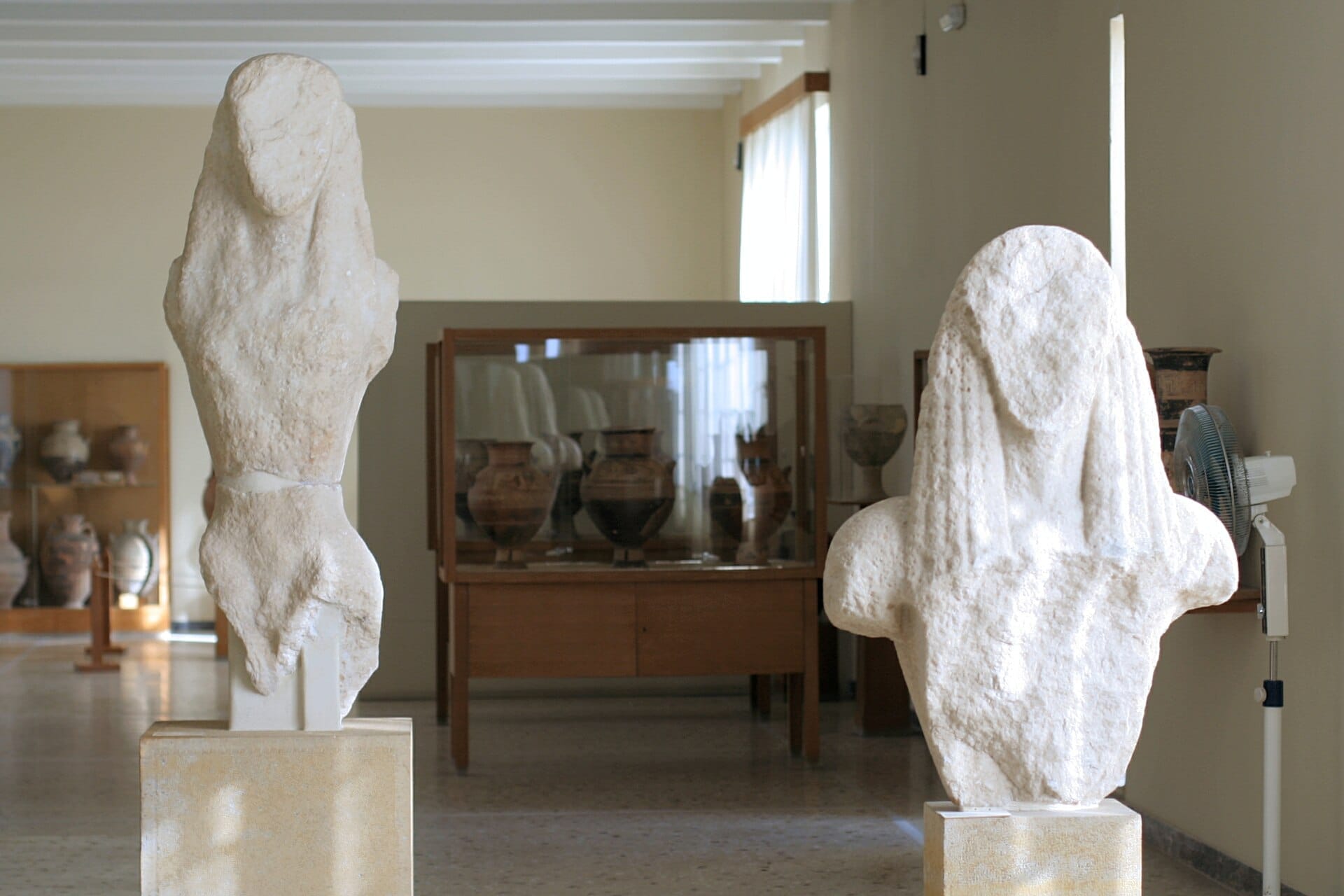
The Kore of Thera is the reason most archaeology-minded visitors make the trip to this museum. Standing 2.48 metres tall and carved from fine Naxian marble, it is one of the largest and best-preserved Archaic kore statues, dating to the 7th century BC in the Greek world. It was discovered in November 2000 during excavations at Sellada, the ancient necropolis of Ancient Thera on the ridge connecting the Mesa Vouno peak to the surrounding terrain. Despite its significance, the statue spent over two decades in storage before becoming the permanent centrepiece of the newly renovated museum.
Standing in front of it for the first time is genuinely arresting. The scale alone is unexpected, the figure rising well above eye level with the composed, faintly smiling expression that characterises the Archaic style. The white marble still carries a cool, almost luminous quality under the museum's overhead light. Unlike smaller objects displayed behind glass, the Kore is positioned so you can walk around it slowly, studying the carving of the hair, the rendering of the arms along the body, and the subtle forward positioning of the left foot that was a convention of the period.
To understand the site where the Kore was found, it helps to have visited or read about Ancient Thera, the cliff-top Hellenistic city above Kamari. The necropolis at Sellada was the burial ground serving that settlement for centuries, and objects from both the cemetery and the city itself are represented in the museum's collection.
Tickets & tours
Hand-picked options from our booking partner. Prices are indicative; availability and final rates are confirmed when you complete your booking.
Couples' Aromatherapy Massage in Santorini
From 210 €Instant confirmationFree cancellationLuxury Sunset Cruise in Santorini
From 120 €Free cancellationCruise of the volcanic islands around Santorini
From 45 €Instant confirmationFree cancellationGuided e-bike tour in Santorini
From 90 €Instant confirmationFree cancellation
The Broader Collection: From Geometric Pottery to Hellenistic Sculpture
Beyond the Kore, the museum displays material spanning a long arc of Theran history, from the Geometric and Archaic periods through the Classical and Hellenistic eras and into the Roman period. Grave goods, ceramic vessels, bronze objects, and inscriptions fill the cases, each tagged with its excavation context. The pottery is particularly well presented, with Geometric-period pieces showing the precise, almost mathematical patterning that preceded the more figurative styles of later centuries.
Sculptural fragments recovered from sanctuaries and public buildings on the island sit alongside funerary stelae that carry carved reliefs of the deceased. These smaller works reward slow looking. A carved marble relief of a young athlete, or a simply rendered face above a dedicatory inscription, carries more direct human weight than many grander monuments. The museum labels are available in both Greek and English, which makes independent navigation straightforward.
Visitors who want the full picture of Santorini's archaeological record should plan to combine this museum with the nearby Museum of Prehistoric Thera, which focuses on finds from the Bronze Age settlement at Akrotiri, including the famous Minoan-influenced frescoes. The two museums are genuinely complementary: one covers the prehistoric period, the other picks up from the Geometric era onwards.
Visiting by Time of Day: How the Experience Shifts
The museum opens in the morning, and the first hour after opening is consistently the quietest. Fira is not a town that wakes early in summer; the cruise ship passengers who dominate the central streets tend to arrive later in the morning, and the caldera-view seekers are rarely drawn to indoor museums before midday. Arriving close to opening gives you the main gallery almost to yourself, which makes a significant difference when examining the Kore without people clustering around it.
By late morning, group tours begin moving through, often with guides speaking in German, Italian, or English. The interior remains cool even on hot summer days, which is a genuine practical advantage in July and August when the temperature outside regularly climbs into the upper twenties. The skylights keep the space light without generating heat, and the stone floors and thick walls hold the cool air well into the afternoon.
💡 Local tip
Visit on a morning when cruise ships are in port and you will find the caldera paths and main shopping streets of Fira packed. Use that window to slip into the museum instead. The contrast is striking: near-silence inside while the town outside reaches peak noise.
Practical Walkthrough: Layout and Navigation
The museum is compact by mainland Greek standards. The gallery space is arranged to guide visitors chronologically, moving from earlier periods toward later antiquity, with the Kore positioned as an anchor point that draws the eye from across the room. First-time visitors often underestimate how much time the details reward. The instinct is to move quickly through smaller glass cases, but the grave goods in particular, miniature vessels, jewellery, and terracotta figures, deserve close attention.
Wear comfortable shoes; the floors are smooth stone, which is not slippery but is hard underfoot if you are used to carpeted museum floors. There are no cafes or food facilities inside the museum, but the central streets of Fira are directly outside with multiple options. Photography policy inside Greek state museums can vary; check at the entrance whether photography without flash is permitted, as it typically is for personal use.
The museum is situated within easy walking range of the main sights of Fira's town center, making it straightforward to combine with a morning exploring the caldera-edge paths or visiting the cable car area. It also fits naturally into a broader Santorini history and ancient ruins itinerary.
Accessibility and Who Should Reconsider
Specific verified information about step-free access, lift availability, or adapted facilities at the Archaeological Museum of Thera is not clearly published in available sources. Travelers with mobility requirements should contact the museum directly or consult the Hellenic Ministry of Culture before visiting. Greek state museums vary considerably in their physical accessibility, and Fira's terrain itself, with steep paths and uneven cobblestones throughout the town, presents challenges independent of the museum building.
The museum is not the right choice for visitors who are primarily on the island for beaches, sunsets, and caldera views and have only a day or two. It asks for focused attention rather than casual browsing, and someone without a prior interest in Greek archaeology or ancient history may find the experience flat. Children under ten are unlikely to engage with the collection for long, though the scale of the Kore tends to produce a reaction in visitors of any age. For families with older children who have studied ancient Greece at school, it can be genuinely exciting.
If your priority is covering Santorini's physical landscape rather than its historical one, the island's viewpoints and caldera walks will deliver more of what you came for. The museum is the better choice when weather limits outdoor plans or when the midday heat makes the idea of an air-cooled interior genuinely appealing.
Insider Tips
- Arrive as close to opening time as possible on days when cruise ships are docked in the caldera. The museum is routinely overlooked by cruise passengers, making it one of the calmest spaces in Fira during the busiest hours.
- Visit the Archaeological Museum of Thera first, then walk directly to the Museum of Prehistoric Thera a short distance away. Doing both in sequence, with the prehistoric Akrotiri material fresh in mind alongside the later Archaic and Hellenistic finds, gives you a full chronological sweep of the island's history in a single morning.
- Bring a small notebook or use your phone to photograph labels next to objects that interest you. The collection is dense, and the context for individual pieces is easy to forget by the time you are looking at photographs later.
- If you are visiting in September or October, hours and admission conditions may shift as the summer season closes. Always verify current schedules via the Ministry of Culture website rather than relying on third-party listings, which are frequently out of date.
- The museum shop, if open after the renovation, is worth a brief look for academic catalogues and publications on Aegean archaeology that are difficult to find outside Greece.
Who Is Archaeological Museum of Thera For?
- Archaeology enthusiasts who want to understand Santorini's ancient history beyond the Bronze Age
- Travelers combining the island's two main museums for a full picture of Theran civilisation across millennia
- Those seeking a calm, cool indoor alternative during peak midday heat in summer
- Visitors with an interest in Archaic Greek sculpture who want to see the Kore of Thera before it becomes more widely known
- Anyone extending a visit to Ancient Thera on Mesa Vouno and wanting the museum context to match the site
Nearby Attractions
Other things to see while in Fira:
- Fira–Oia Hiking Trail
The Fira–Oia Hiking Trail is Santorini's most rewarding walk: a 10-kilometre path along the caldera rim connecting the island's capital to its most photographed village. Free to walk, open at all hours, and lined with volcanic cliffs, whitewashed chapels, and sweeping Aegean views, it rewards those who go prepared and go early.
- Fira Town Center
Fira is the administrative and social heart of Santorini, built on the rim of the caldera at roughly 260 meters above the Aegean. Free to enter and walkable from multiple directions, it offers caldera views, museums, restaurants, and a cable car connection to the old port — all within a compact, cliff-top layout that rewards early risers and punishes late arrivals in summer.
- Firostefani
Perched on the caldera rim just north of Fira, Firostefani is a small whitewashed village that blends into Santorini's capital while offering noticeably calmer streets and sweeping volcano views. Its name translates literally as 'Crown of Fira,' and the elevated position earns that title. Entry is free, the caldera path is walkable from Fira in under 15 minutes, and the atmosphere is several degrees quieter than either Fira's main drag or Oia's famous sunset strip.
- Lost Atlantis Experience
The Lost Atlantis Experience in Megalochori is Santorini's only museum dedicated entirely to the Atlantis myth, using 9D simulation, holograms, and digital exhibits to explore the legend's possible link to the island's volcanic past. Opened in 2019 and spread across 700 square metres, it offers a rainy-day alternative and a genuinely different angle on the island's ancient story.