Ancient Thera: Santorini's Forgotten City Above the Sea
Perched on the rocky ridge of Mesa Vouno at 360 metres above sea level, Ancient Thera is one of Santorini's most historically significant open-air ruin sites. Founded by Dorian colonists in the 9th century BC, the city survived Hellenistic, Roman, and Byzantine periods before being abandoned to the wind and stone. It rewards visitors who make the climb with extraordinary views, genuine archaeological remains, and near-silence compared to the island's busier spots.
Quick Facts
- Location
- Mesa Vouno ridge, above Kamari, Santorini (elevation ~360 m)
- Getting There
- Drive or take a taxi up the narrow road from Kamari (~3 km); hiking trails also accessible from Kamari and Perissa
- Time Needed
- 2–3 hours including transit from Kamari; allow more if hiking up
- Cost
- €10 standard; €5 reduced
- Best for
- History enthusiasts, hikers, photographers, travellers who want context beyond Santorini's volcanic landscape
- Official website
- http://odysseus.culture.gr/h/3/eh351.jsp?obj_id=2454
What Is Ancient Thera?
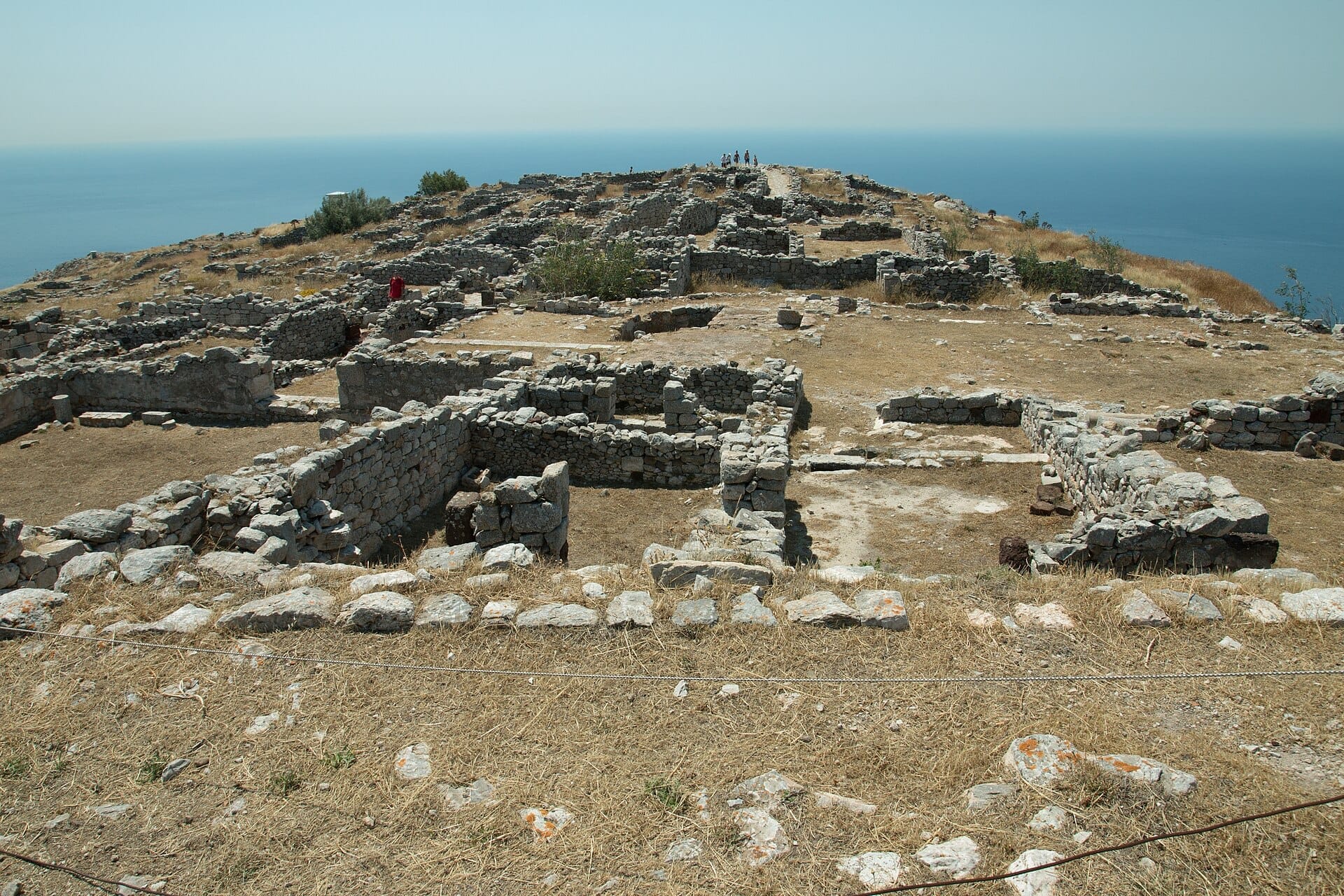
Ancient Thera is the Classical-era city that once governed the island of Thera (today's Santorini). It sits on Mesa Vouno, a narrow limestone ridge that divides the east coast beaches of Kamari and Perissa, and its ruins stretch along the spine of that ridge at an elevation where the wind rarely stops and the Aegean fills the horizon in three directions. This is not a reconstructed site or a museum replica: the streets, sanctuaries, baths, and inscriptions you walk among are the real thing, left largely in place since excavations began in the 1890s.
The city was founded in the early 9th century BC by Dorian (Lacedaemonian) colonists, traditionally associated with Sparta and led by a figure named Theras, from whom both city and island take their name. It remained inhabited and politically relevant through the Hellenistic period, when it served as a Ptolemaic naval base, through Roman rule, and into the early Byzantine era before finally being abandoned after the great volcanic eruption of AD 726. That long arc of occupation is legible in the ruins: different building styles and civic spaces overlap in ways that reward a slow, attentive walk.
ℹ️ Good to know
Hours: daily 08:30–15:30 (last admission 15:00), closed Wednesdays. Always confirm locally or via the Hellenic Ministry of Culture before visiting, as hours can change seasonally.
Getting There: Road, Trail, or Both
Most visitors arrive by driving or taking a taxi up the narrow, winding road from Kamari, a distance of roughly 3 kilometres from the beach resort. The road is paved but tight, with passing points, and the final approach becomes genuinely steep. Parking at the top is limited and fills quickly on summer mornings, so arriving before 09:30 is advisable in July and August. Taxis from Kamari can drop you at the site entrance; agree on a return pickup or plan to walk down.
The alternative is to hike. Two trails lead up: one from Kamari on the east side, and one from Perissa on the southwest. Both are around 3 kilometres and gain significant elevation, taking 45 to 75 minutes depending on fitness. The Kamari trail is more commonly used and easier to follow. The Perissa trail is slightly wilder and less marked. Either way, you arrive at the ridge and can descend the opposite side, making a satisfying point-to-point day if you arrange transport at both ends.
⚠️ What to skip
If you hike up in summer, start no later than 08:00. By 10:00, the ridge is fully exposed with zero shade and temperatures can exceed 35°C. Carry at least 1.5 litres of water per person; there are no refreshments on site.
Tickets & tours
Hand-picked options from our booking partner. Prices are indicative; availability and final rates are confirmed when you complete your booking.
Ancient Akrotiri E-ticket and Audio Tour
From 35 €Instant confirmationCouples' Aromatherapy Massage in Santorini
From 210 €Instant confirmationFree cancellationLuxury Sunset Cruise in Santorini
From 120 €Free cancellationCruise of the volcanic islands around Santorini
From 45 €Instant confirmationFree cancellation
The Site: What You Actually See
The ruins extend along the ridge for several hundred metres, and a clear path threads through the main excavated areas. The layout follows a roughly linear plan dictated by the narrow ridge, with the Agora (civic marketplace) forming the central spine. Stone-paved streets are still visible, as are the foundations and partial walls of houses, public buildings, and several religious sanctuaries. Inscriptions carved directly into the rock faces, some of them erotic in nature and likely associated with Hellenistic gymnasium culture, are among the more unexpected details that catch visitors off guard.
Among the most significant structures are the Sanctuary of Apollo Karneios, dedicated to the Dorian patron deity and still identifiable by its rock-cut elements, and the Gymnasium of the Epheboi, which dates to the Hellenistic period and reflects the Ptolemaic military presence on the island. The Basilike Stoa, a colonnaded hall, gives a sense of the civic scale the city once had. Roman-era baths and a small theatre are also visible. None of these buildings are tall or visually dramatic in the way that, say, the Parthenon communicates its purpose from a distance. Ancient Thera requires some imagination and ideally some background reading.
Visitors who have already been to the Museum of Prehistoric Thera in Fira will find this site puts the island's later history into useful perspective. That museum covers the Bronze Age Minoan-influenced culture; Ancient Thera picks up roughly where those centuries ended.
The Views: An Underrated Reason to Visit
Even visitors who have limited interest in ancient history tend to be stopped in their tracks by the panoramas from Mesa Vouno. To the east, Kamari beach stretches below as a thin dark line between the mountain and the sea. To the southwest, Perissa appears in a near-mirror image. On clear days, the islands of Anafi and Ios are visible on the horizon, and the volcanic islands within the caldera are visible to the west. The spatial relationship between the Aegean and the island becomes suddenly comprehensible from this height in a way it never quite is from sea level.
The ridge also offers a different perspective on Santorini's volcanic geology. The limestone of Mesa Vouno is part of the older geological foundation of the island, pre-dating the major eruptions that formed the caldera. If you want to understand the full picture of what shaped this landscape, pairing a visit here with a trip to the Nea Kameni volcano in the caldera gives a complete geological story from two very different vantage points.
When to Visit and What to Expect by Time of Day
Opening time (08:30) is far and away the best moment to arrive. The light is low and golden, the rock surfaces have not yet absorbed the day's heat, and the site is often empty enough that you can walk the main street without seeing another person for long stretches. By 10:30, tour groups and independent visitors begin to accumulate, and the narrow ridge path can feel crowded at popular junctions. By early afternoon in peak season, the combination of full sun, reflected heat from pale rock, and groups can make the experience notably less pleasant.
Spring (April and May) and early autumn (September and October) are the most comfortable seasons. Temperatures are mild, the site is drier and more stable underfoot than in winter, and the tourist volume is lower than July and August. Winter visits are possible on open days, and the solitude can be extraordinary, but the afternoon closing time (15:30 year-round) limits flexibility, and the access road can be slick after rain.
💡 Local tip
If you visit in September, the site is significantly quieter than August and the light for photography is softer. Pair a morning at Ancient Thera with an afternoon at Kamari beach directly below for an effortless two-part day.
Photography at Ancient Thera
The combination of ancient stonework and wide Aegean horizons gives photographers a great deal to work with. Early morning golden light falls across the ridge from the east, illuminating the carved inscriptions and the texture of the limestone particularly well. A wide-angle lens captures the sense of scale and isolation. Detail shots of the rock carvings and column bases work well in the flatter midday light when shadows are less harsh. For context on where to position yourself for the best island-wide perspectives, the Santorini photography guide has additional framing tips specific to the island's light conditions.
Do not expect polished restoration. Ancient Thera is an active archaeological site in the academic sense: partially excavated, partially conserved, and entirely honest about its state. The rough, unfinished quality is part of its character and, photographically, often more interesting than a tidied-up site would be.
Honest Assessment: Is Ancient Thera Worth It?
For travellers with a genuine interest in ancient history, Greek archaeology, or Aegean geography, Ancient Thera is one of the most rewarding stops on the island and consistently overlooked in favour of the caldera villages. The site offers something genuinely different from Santorini's standard itinerary, and the combination of authentic ruins and exceptional views makes the effort of getting here feel well-justified.
That said, visitors expecting dramatic standing architecture, guided interpretation, or the accessible presentation of a major mainland site will be disappointed. There is minimal on-site interpretation, little shade, and the ruins require contextual knowledge to fully appreciate. Families with young children may find the terrain challenging and the lack of facilities (no café, no toilets near the ruins) difficult to manage. Travellers who are primarily here for the caldera, the white architecture, and the sunsets should probably look at the Akrotiri archaeological site first: it is better preserved, covered, and interpreted, and sits closer to the island's other main attractions.
The combined ticket (€15) is good value if you plan to visit Ancient Thera, Akrotiri, and the Museum of Prehistoric Thera within the same three-day window. If Ancient Thera is your only archaeological stop, the standard €10 ticket is straightforward.
Insider Tips
- The path from Kamari to the site is well-worn but not always signposted. From the main Kamari beach road, look for the marked trailhead at the southern end of the beach promenade. The first 15 minutes are the steepest; the gradient eases once you reach the first ridge.
- Bring a printed or downloaded site plan. The on-site signage is sparse and does not always name individual structures clearly. A plan from the Ministry of Culture's Odysseus database helps significantly in identifying what you are looking at.
- The rock-cut inscriptions near the Gymnasium area are easy to walk past without noticing. Slow down on the eastern side of the ridge and look at eye level and below on exposed rock faces, not just on building surfaces.
- If you want total quiet and the best photography light, aim to be at the site entrance at opening time (08:30) on a weekday. Wednesday is the closure day, so Tuesday and Thursday mornings are reliably the least crowded.
- Descending to Perissa rather than returning to Kamari gives you a different perspective on the ridge and puts you at a quieter, darker-sand beach with good tavernas. Arrange a taxi pickup in Perissa or check the KTEL bus schedule back to Fira in advance.
Who Is Ancient Thera For?
- History and archaeology enthusiasts who want context beyond the island's Bronze Age Minoan story
- Hikers looking for a route that combines physical effort with a meaningful destination
- Photographers who want dramatic landscapes without the crowds of Oia or Fira
- Travellers on a longer stay (3+ days) who have covered the caldera highlights and want depth
- Anyone who wants to understand how the island's geography shaped its ancient settlement patterns
Nearby Attractions
Other things to see while in Kamari:
- Kamari Beach
Kamari Beach is Santorini's longest stretch of black volcanic beaches, running along the southeastern coast beneath the dramatic cliffs of Mesa Vouno. It offers a full range of amenities, a walkable seafront strip, and easy access from Fira, making it one of the most practical beach destinations on the island.
- Monolithos Beach
Monolithos Beach sits on Santorini's southeast coast near Kamari, offering a long stretch of fine volcanic black sand, gently shelving shallow water, and a noticeably calmer atmosphere than the island's more famous shores. Free to access, easy to reach by road, and equipped with a children's playground, it suits families and travelers who want the beach without the performance.