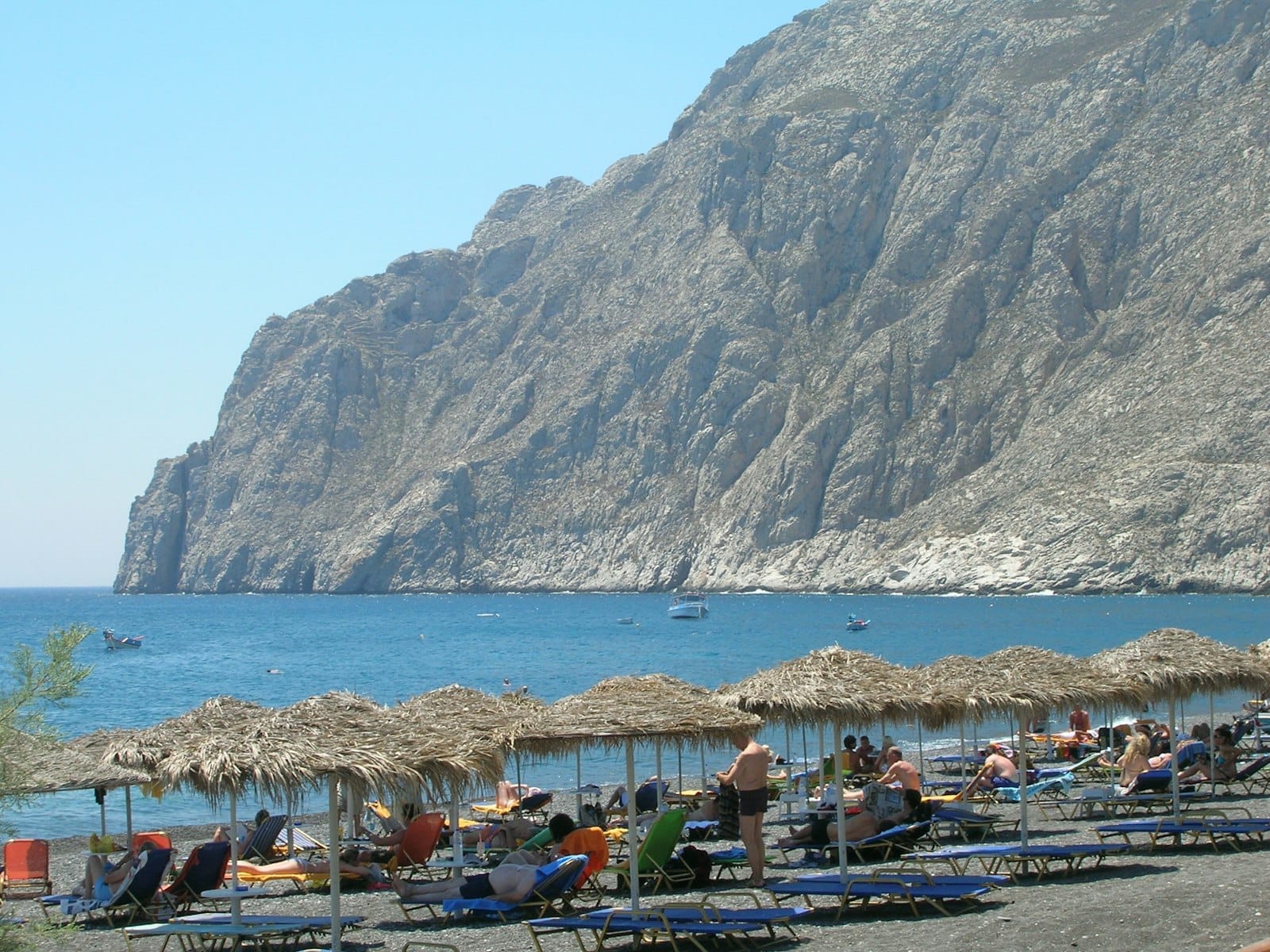
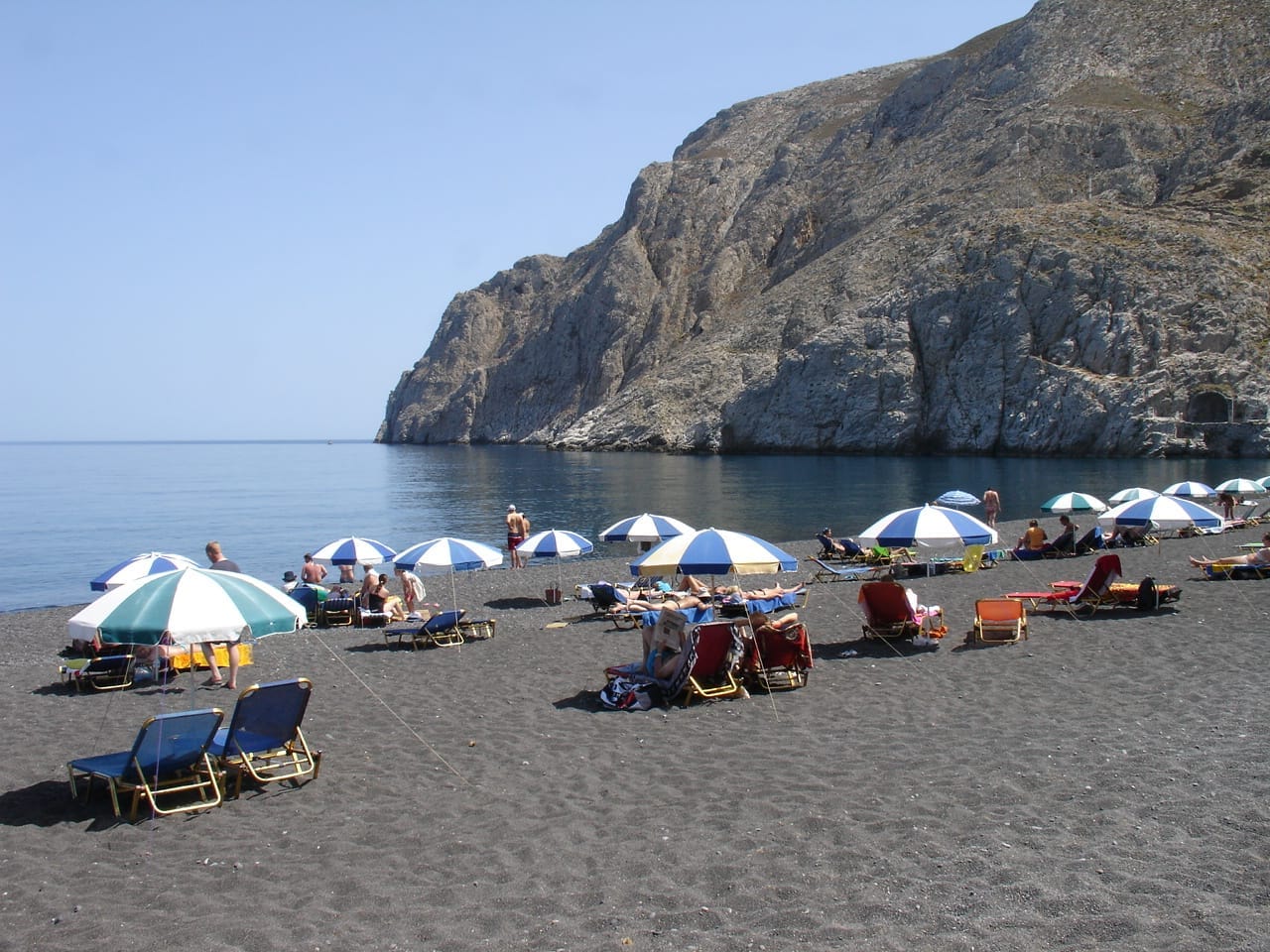
Kamari is a seaside resort village on Santorini's southeastern coast, built around one of the island's longest black-pebble beaches. Unlike the caldera villages, it trades cliff-edge drama for direct beach access, a well-developed promenade, and a more affordable, family-friendly atmosphere.
Kamari sits at the base of Mesa Vouno on Santorini's east coast, offering something no caldera village can: you walk out of your hotel and straight onto the beach. It is the island's most developed resort strip, with a long pedestrianized seafront, clear Blue Flag-awarded waters, and the ruins of Ancient Thera looming on the mountain above.
Orientation
Kamari occupies the lower eastern flank of Santorini (also known as Thira), roughly 7–8 km southeast of Fira, the island's capital. It stretches linearly along a northeast-to-southwest black-pebble beach, with Mesa Vouno, one of Santorini's higher peaks at around 365 meters, forming an abrupt natural wall at the southern end. That mountain is not just a scenic backdrop: it physically separates Kamari from the neighboring beach village of Perissa on the other side, which means the two share the same mountain but are entirely disconnected by road, requiring a detour inland via the village of Emporio to travel between them.
The core of Kamari is the seafront promenade, a pedestrianized strip running parallel to the beach for roughly 1 km. Hotels, tavernas, cafés, and souvenir shops line its inland side; the beach and sea are on the other. Behind the promenade, the village spreads back in a grid of quieter streets with more budget accommodation, supermarkets, and local services. The area of Monolithos marks the northern extent of the beach zone, while Mesa Vouno cuts things off to the south.
Kamari is about 5–6 km from Santorini Airport (JTR) and roughly 9–10 km from Athinios, the main ferry port. Fira functions as the island's bus hub, and the route between Fira and Kamari is one of the most frequently served on the KTEL network. For anyone using public transport as their primary way to see the island, Kamari's location makes sense. It also sits within practical striking distance of the archaeological sites in the southeast, including the ruins of Ancient Thera directly above the village and the Bronze Age settlement at Akrotiri further southwest.
Character & Atmosphere
Kamari is unapologetically a beach resort. Where Oia and Imerovigli attract travelers chasing caldera photography and honeymoon aesthetics, Kamari draws people who want sun, sea, and a cold drink in hand by 10am. That is not a criticism. It simply means the neighborhood has a different rhythm, one that is more relaxed and less performative than the western cliff villages.
In the early morning, the promenade is at its best. The black pebbles are cool underfoot, the Aegean light is soft and raking, and the few people out are either heading to the water or nursing coffees at the café tables that spill out toward the beach. The sea here faces east, so the mornings catch direct light in a way the caldera side never does. By mid-morning the sunbeds fill, beach bars crank up their music, and the promenade takes on the texture of a busy Mediterranean resort: lots of movement, plenty of noise, the smell of sunscreen and frying food mixing in the heat.
Afternoons are the hottest and most crowded part of the day, especially from June through August. The dark volcanic pebbles absorb and radiate heat aggressively, so midday on the beach is genuinely punishing without shade. Most people retreat to the beach umbrellas or the taverna awnings for a few hours, then return to the water in the late afternoon when things cool slightly. The village does not have the same sunset ritual that defines places like Oia; instead, evenings here are about long dinners, ice cream on the promenade, and the gradual move from tavernas to bars as the night progresses.
Kamari's tourist infrastructure is the most developed of any beach area on Santorini. That means convenience, but it also means noise after dark along the main strip. Travelers seeking quiet should look at streets set back from the promenade, or consider arriving in May or October when the resort operates at lower intensity.
⚠️ What to skip
The black volcanic pebbles get extremely hot under direct sun. Bring water shoes: bare feet on the beach between midday and mid-afternoon is genuinely uncomfortable, and wet pebbles near the waterline can be slippery.
What to See & Do
The beach itself is the primary draw. Kamari Beach has repeatedly held a Blue Flag award for water quality and cleanliness, and the sea is calm and clear enough for snorkeling. The water deepens quickly from the shore, which makes it less suited to young children paddling but good for confident swimmers. Sunbed and umbrella rental is available along most of the beach, and water sports operators offer pedal boats, jet skis, and similar activities through the summer season.
At the southern end of the beach, look for the Kamara arch, a small stone structure that is all that remains of an old customs house built between the 16th and 17th centuries. The arch gives the village its name, and it serves as the focal point for the local Epiphany ceremony each January, when the blessing of the waters takes place here. It is a modest landmark, but it anchors Kamari to a history that predates its life as a resort.
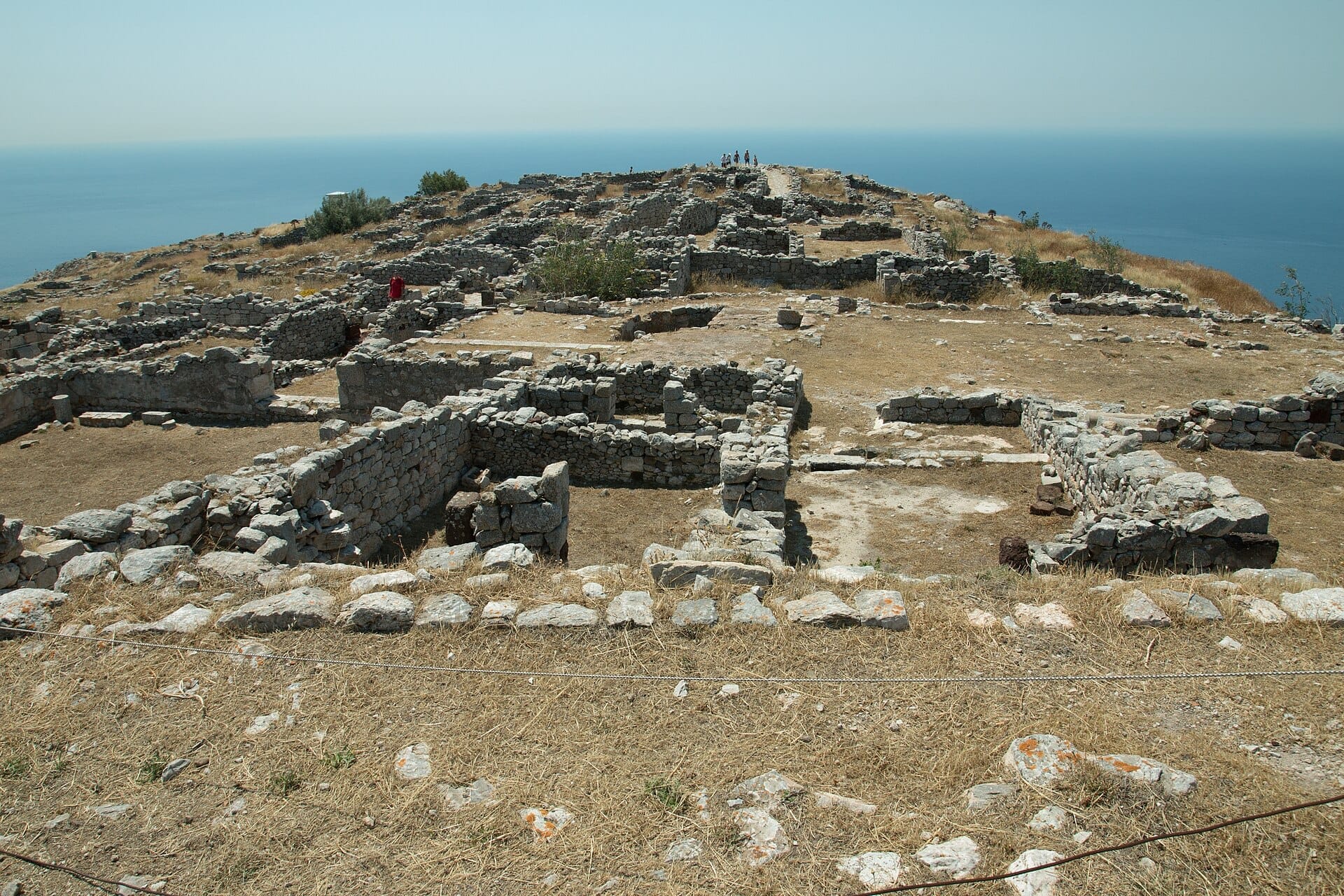
The most significant excursion from Kamari is up Mesa Vouno to Ancient Thera, an archaeological site perched at roughly 360 meters with remains spanning Hellenistic, Roman, and Byzantine periods. A road winds up from Kamari's southern edge (it also connects from the Perissa side), and while the drive is short, the site itself rewards a proper visit. The views from the ridge over both coastlines are extraordinary, and the scale of the ruins, including streets, temples, and cisterns, gives a grounded sense of how long this island has been inhabited.
Swim and sunbathe on the Blue Flag-awarded volcanic pebble beach
Walk the full length of the pedestrianized seafront promenade
Visit the Kamara arch at the south end of the beach
Hike or drive up Mesa Vouno to Ancient Thera
Take the seasonal water taxi around the headland to Perissa for a change of scene
Use Kamari as a base for day trips to Akrotiri, Pyrgos, and the southern wineries
Kamari's location on the eastern side of the island also makes it a practical base for exploring the southeast corner, which tends to be less covered in standard itineraries. The village of Pyrgos, the former medieval capital of Santorini, is a 20-minute drive inland and offers a very different atmosphere to anything on the coast. For those interested in Santorini's wine culture, the Koutsoyannopoulos Wine Museum is located in this part of the island and makes for an easy half-day addition.
💡 Local tip
The water taxi from Kamari to Perissa runs seasonally and saves a 20-minute inland detour by road. It departs from the south end of the beach near the Kamara arch and is a practical way to compare both beaches in a single day.
Eating & Drinking
The Kamari promenade is lined with restaurants for its entire length, ranging from sit-down tavernas serving grilled fish and traditional Greek dishes to more casual spots doing crepes, burgers, and fast food for families on the move. The density of options is genuinely impressive by Santorini standards, though quality varies significantly. The places closest to the beach and most prominently positioned toward the tourist foot traffic tend to be the most expensive and occasionally the most mediocre.
Better value is generally found by walking one or two streets back from the promenade, where smaller family-run tavernas serve fresh seafood and grilled meats at prices more in line with what the food actually costs to produce. Portions are typically generous, and the menus lean toward Cycladic standards: grilled octopus, fried calamari, tomato fritters (known locally as tomatokeftedes), and fresh catch of the day. These are not hard to find once you leave the main strip.
Kamari's café scene is strong in the mornings. Several spots along the promenade open early and serve proper Greek coffee alongside pastries and eggs. For a broader sense of what Santorini's food culture looks like beyond the resort strip, the guide to what to eat in Santorini covers local specialties worth seeking out across the island, many of which show up on Kamari menus in some form.
Bars and beach clubs operate throughout the day and into the late evening. The atmosphere shifts noticeably after 10pm, when music volumes increase and the promenade transitions from a family dining space into something closer to a bar strip. This is not Mykonos-level nightlife, but it is busy enough that travelers staying in beachfront accommodation should expect noise well into the night during peak season.
ℹ️ Good to know
Kamari is one of the more affordable places to eat on Santorini compared to the caldera villages, where restaurant markups are steep. A full taverna meal with wine here will typically cost noticeably less than an equivalent meal in Fira or Oia.
Getting There & Around
Kamari is one of the easiest parts of Santorini to reach by public transport. The KTEL bus network runs a regular service between Fira's central bus station and Kamari throughout the day in season, making it a viable base even for travelers who do not rent a car or scooter. Journey time from Fira is around 15–20 minutes. Check the KTEL Santorini schedule before travel as frequencies drop in the shoulder and off seasons.
From Santorini Airport (JTR), Kamari is approximately 6 km, a journey of around 10 to 15 minutes by taxi or pre-booked transfer. This is one of the shortest airport-to-accommodation transfers on the island, which makes Kamari particularly convenient for arrivals and departures. From Athinios, the main ferry port, the journey is roughly 9 km and typically takes 20 to 30 minutes depending on traffic.
Within Kamari, the pedestrianized promenade makes walking the primary way to get around the resort core. The beach road is flat and straightforward. For reaching other parts of the island, renting a scooter or ATV is popular and practical given the distances involved. The guide to getting around Santorini covers all transport options in detail, including bus routes, taxi availability, and car rental logistics.
The seasonal water taxi connecting Kamari to Perissa operates from the southern end of the beach near the Kamara arch. It is the fastest link between the two beaches and avoids the inland road detour. Schedules and pricing should be confirmed locally, as the service is weather-dependent and availability varies by season.
Where to Stay
Kamari has the widest range of accommodation on Santorini's eastern coast, from large beachfront hotels with pools to small family-run studios and apartments a few streets back from the water. It is one of the more budget-accessible areas on the island, making it a key stop in any budget-focused Santorini itinerary. There are also several mid-range boutique hotels that offer comfort without caldera-village pricing.
Travelers who want to be close to the beach and do not mind promenade noise should look at beachfront or promenade-facing properties. Those who want quieter nights should choose accommodation on the streets running inland from the seafront, which are typically less affected by bar noise after midnight. Families with children benefit from the flat, walkable layout and the proximity to the beach, which is far more practical for daily beach use than staying in a cliff village and commuting down.
Kamari is not the right choice for travelers primarily chasing caldera views, cliffside pools, or the classic Santorini aesthetic. For that, the villages along the western rim are the logical base. The full accommodation breakdown across the island is covered in the where to stay in Santorini guide, which compares Kamari directly with Fira, Oia, and Imerovigli to help match traveler priorities to the right area.
A Note on History
Kamari's existence as a resort town is a direct result of disaster. The 1956 earthquake that devastated much of Santorini largely destroyed the original hilltop village of Episkopi Gonias, which had occupied the higher ground above the current resort. Residents rebuilt lower down near the coast, and over subsequent decades the community rebuilt itself around tourism rather than agriculture or fishing. The result is a village with a relatively short resort history but one that has been shaped with some genuine local investment and identity rather than being purely an imported tourist construct.
That history sits in contrast to the ancient city on the ridge above. Ancient Thera on Mesa Vouno was occupied continuously from the 9th century BC through the Byzantine period, and the views from its streets down to the coastline where Kamari now sits underline how long this stretch of coast has served as an inhabited and strategically significant point on the island. For a broader sense of Santorini's layered past, the history and ancient ruins guide puts Ancient Thera and the island's other archaeological sites into context.
TL;DR
Kamari is Santorini's most developed beach resort, best suited to travelers who prioritize direct beach access over caldera views or cliff-village atmosphere.
The long black-pebble beach holds a Blue Flag water quality award; the volcanic pebbles get extremely hot in direct sun, so water shoes are practical rather than optional.
It is one of the more budget-friendly areas on the island for both accommodation and eating out, with a wide range of hotels and tavernas at varied price points.
Transport connections are strong: short distance from the airport, frequent KTEL bus service to Fira, and a seasonal water taxi to Perissa.
Ancient Thera on the ridge above Kamari is one of Santorini's most significant archaeological sites and is easily accessible as a half-day excursion from the village.
Santorini's beaches are unlike anywhere else in Greece. Volcanic geology means most are black or dark-pebbled, with a handful of dramatic color exceptions. This guide covers every beach worth visiting, from the popular to the genuinely quiet.
Santorini rewards visitors differently depending on when they arrive. This guide breaks down every season by weather, crowd levels, prices, and what's actually open so you can pick the timing that matches your priorities.
Santorini rewards visitors who look beyond the caldera rim. This guide covers the best day trips from Santorini, from hiking to Oia and cruising the volcanic islets to hopping across to Folegandros, with full logistics, seasonal notes, and practical booking advice.
Santorini has no metro, no trains, and surprisingly limited taxis. This guide breaks down every transport option on the island — KTEL buses, rentals, taxis, rideshare, and ferries — with real fares, route details, and practical advice on what works best by season.
Santorini polarises travellers. The caldera views are genuinely spectacular, the volcanic landscape is unlike anywhere else in Greece, and the archaeology rivals anything in the Aegean. But the crowds are real, the prices are steep, and the hype can outpace the reality. Here is what you actually need to know before you book.
Santorini's black sand beaches are unlike anything else in the Aegean. Formed by volcanic eruptions and shaped by centuries of erosion, they come with their own rules, quirks, and logistics. This guide covers the main beaches, practical access, seasonal timing, and what first-timers always get wrong.
Santorini is far more than the famous blue domes and caldera selfies. This guide takes you beyond Oia and Fira to the island's medieval villages, wild volcanic beaches, serious wine caves, and ancient ruins that most visitors walk straight past.
Santorini rewards hikers with caldera rim panoramas, ancient ruins, volcanic craters, and medieval villages. This guide covers the island's best trails, from the classic Fira–Oia walk to off-the-beaten-path routes most visitors never find.
Santorini's history stretches back more than 3,600 years, from a sophisticated Bronze Age city buried by volcanic ash to Hellenistic temples, Venetian fortresses, and Byzantine monasteries. This guide covers every significant historical site on the island, with practical advice on when to visit and what to expect.
Santorini's caldera views, volcanic beaches, and world-class sunsets make it one of the most sought-after honeymoon destinations in Europe. This guide breaks down exactly where to stay, what to do, and what to skip so you can plan a trip that lives up to the hype.
September is arguably the smartest month to visit Santorini. The sea is warm, the light is golden, the harvest is underway, and the worst of the summer crowds have thinned. This guide covers everything from weather and pricing to what actually changes as the month progresses.
Three days is enough to cover Santorini's essentials without burning out. This itinerary balances the iconic caldera villages, the volcanic south, ancient ruins, and the island's wine country — with specific timing, realistic costs, and straight talk on where the crowds aren't worth it.
Santorini's luxury scene runs deep, from cliffside suites with direct caldera views in Oia and Imerovigli to upscale beach resorts along the black-sand coast. This guide breaks down where to stay, when to book, what to expect across price tiers, and which high-end experiences are actually worth it.
Santorini has a reputation for luxury prices, and that reputation is partly earned. But with the right timing, accommodation choices, and a few practical strategies, the island is far more accessible than most people expect. This guide breaks down real costs and shows you where to cut spending without sacrificing the experience.
Santorini is one of the world's most photographed destinations, but knowing exactly where to stand, when to arrive, and which lesser-known angles to seek out separates good photos from great ones. This guide covers 23 of the island's best photography locations, from the iconic caldera rim to wild volcanic beaches and medieval hilltop villages.
From semi-private catamaran cruises to full-day private charters, Santorini's boat tour market is crowded and easy to overpay on. This guide breaks down every major format, what each actually includes, real price ranges for 2025-2026, and the questions to ask before you book.
Santorini's sunsets are legendary, but not all viewpoints are equal. This guide covers the best spots across the island, from the famous to the overlooked, with practical advice on when to arrive, how to avoid the worst crowds, and which locations suit different styles of traveler.
Santorini's caldera is one of the most dramatic natural amphitheaters on the planet, and knowing where to stand makes all the difference. This guide covers the island's finest vantage points, from iconic sunset spots to quiet hilltops most visitors never find.
The Santorini caldera holds one of the Mediterranean's most dramatic geological stories. This guide covers the volcano's history, how to visit Nea Kameni and the Palea Kameni hot springs, how to choose a boat tour, and what most visitors get wrong before they arrive.
Two of Greece's most iconic Cycladic islands, but they deliver very different trips. This guide breaks down the real differences between Santorini and Mykonos across beaches, atmosphere, costs, food, and logistics, so you can choose the one that fits your travel style.
Santorini's Mediterranean climate shifts dramatically across the year, from bone-dry summers with 12 hours of daily sunshine to mild, stormy winters. This guide breaks down Santorini weather by month, covering temperatures, rainfall, sea conditions, and crowd patterns so you can choose exactly the right time to visit.
Santorini produces some of Greece's most distinctive wines, shaped by volcanic soils, searing heat, and ancient vines trained in basket shapes against the Aegean wind. This guide covers every wine style, the best wineries to visit, how to book tastings, and what to order with your food.
Santorini is famous for romantic sunsets and honeymoon hotels, but it genuinely works for families too. This guide covers the best beaches for kids, family-friendly activities, where to base yourself, and the practical details that actually matter when you're traveling with children.
Santorini rewards visitors who go beyond the postcard shots. This guide covers the best things to do in Santorini across every interest and budget, from ancient ruins and caldera hikes to sailing tours and wine tasting, with candid assessments of what is actually worth your time.
Santorini's cuisine is shaped by volcanic soil, Bronze Age agriculture, and a seafaring tradition. This guide covers every local dish worth ordering, the ingredients that make them unique, how much to expect to pay, and when to visit for the freshest seasonal produce.
Santorini's accommodation landscape splits cleanly between cliffside caldera villages and laid-back beach towns on the east coast. This guide breaks down every major area by cost, crowd level, and practicality so you can match your base to your actual travel style.