Akrotiri Archaeological Site: Santorini's Bronze Age Pompeii
Buried by a volcanic eruption around 1600 BC and preserved beneath layers of pumice for over three millennia, the Akrotiri Archaeological Site offers a rare, immersive window into a sophisticated Bronze Age civilization. Walk elevated walkways above multi-storey stone buildings, intact staircases, and ceramic storage vessels still standing where ancient inhabitants left them.
Quick Facts
- Location
- Southwest coast of Santorini, ~700 m from the modern village of Akrotiri
- Getting There
- KTEL bus from Fira toward Akrotiri/Red Beach; taxi or guided tour transfer also available
- Time Needed
- 1.5 to 2.5 hours
- Cost
- Paid admission in euros; check official ticketing page for current prices (see website below)
- Best for
- History lovers, archaeology enthusiasts, families with older children, travelers escaping beach crowds
- Official website
- hhticket.gr/tap_b2c_new/english/tap.exe?PM=P1P&place=000000017
What Akrotiri Actually Is
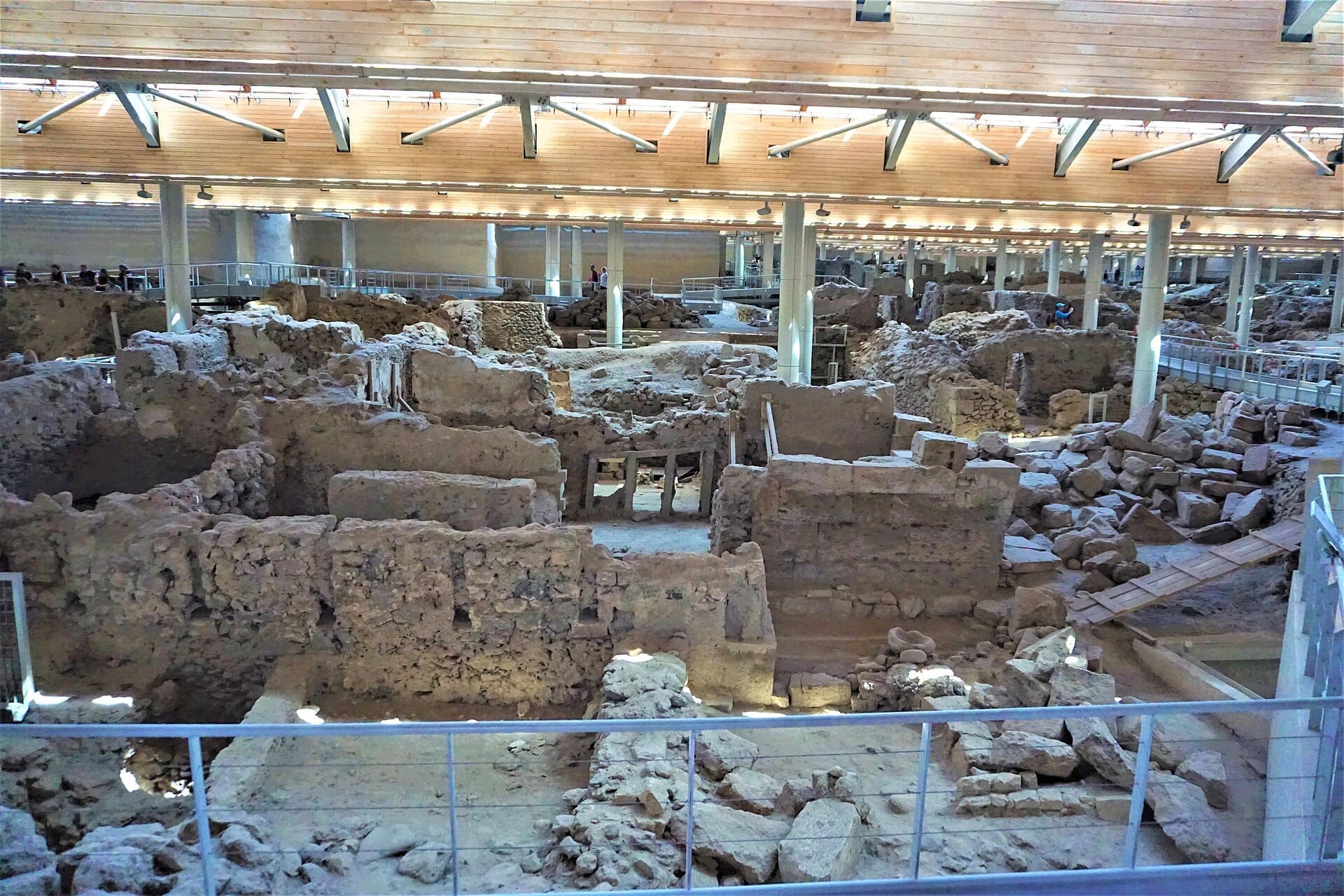
The Akrotiri Archaeological Site is not a ruin in the conventional sense. It is a Bronze Age town, preserved in extraordinary detail by a thick layer of volcanic tephra deposited during a catastrophic eruption of the Santorini volcano in the mid‑second millennium BC (commonly placed in the 16th century BC). The city was sealed almost intact: two and three-storey buildings with their walls and staircases standing, storage vessels in place, drainage systems intact. What makes Akrotiri exceptional, even by Aegean standards, is the completeness of the urban fabric and the absence of human remains, suggesting the population evacuated before the final eruption.
Systematic excavation began in 1967 under Greek archaeologist Spyridon Marinatos, who had long theorized a connection between the eruption and the decline of Minoan civilization in Crete. Decades of careful work have revealed a town with sophisticated infrastructure: ceramic pipes for hot and cold water, a paved street network, and large public spaces. Akrotiri is often compared to Pompeii, but it predates that Roman site by roughly seventeen centuries.
For broader context on where Akrotiri fits into Santorini's ancient history, the Santorini history and ancient ruins guide covers the island's full archaeological timeline from the prehistoric period to classical antiquity.
Inside the Site: What You Will See
The entire excavation is sheltered beneath a large bioclimatic roof structure, which means your visit proceeds indoors regardless of weather, and the light inside is diffused and consistent. Elevated wooden walkways carry you above and through the remains, giving an aerial perspective on the street grid below. From the walkways, you look down into roofless rooms, across preserved doorways, and along alleys where the original stone pavement is still visible.
The most striking features are the buildings themselves: their scale is surprising. Some structures rise two or three full stories, their ashlar masonry still straight. Look for the large ceramic storage jars, called pithoi, arranged in rows in what were likely storage rooms or ground-floor workshops. Their reddish-brown surfaces are patterned and surprisingly elegant for utilitarian objects. Window openings in the upper floors let you gauge the original ceiling heights, which in some rooms exceed three metres.
Many of the most celebrated frescoes found at Akrotiri, including the famous Boxing Children and the Spring Fresco with its red lilies and swallows, have been removed for conservation and are displayed in the Museum of Prehistoric Thera in Fira. The site itself contains reproductions in some areas, but serious visitors should plan a separate stop at the museum to see the originals. Do not treat the two as interchangeable.
The Museum of Prehistoric Thera in Fira holds the original frescoes and thousands of artifacts excavated here. Visiting both on the same day gives you the fullest picture of the civilization.
💡 Local tip
Arrive when the site opens. The interior walkways become congested when tour groups arrive mid-morning, and crowd noise echoes significantly under the roof structure. The first 45 minutes of opening hours are noticeably quieter.
Tickets & tours
Hand-picked options from our booking partner. Prices are indicative; availability and final rates are confirmed when you complete your booking.
Akrotiri self-guided audio tour
From 12 €Instant confirmationFree cancellationAncient Akrotiri E-ticket and Audio Tour
From 35 €Instant confirmationLuxury Sunset Cruise in Santorini
From 120 €Free cancellationCruise of the volcanic islands around Santorini
From 45 €Instant confirmationFree cancellation
The Sensory Experience of the Visit
Walking into the Akrotiri site is a physical shift. The air under the bioclimatic roof is cooler than outside on a summer day, which offers real relief from July and August heat. The smell is mineral: stone, fine volcanic dust, and the faint dampness that persists in covered excavations. It is quieter than the parking area suggested, at least early in the day. Sound travels oddly in the enclosed space, so the murmur of other visitors carries further than expected.
The ground-level lighting is adequate but not bright. Bring sunglasses to put away when you enter, because your eyes need a moment to adjust from the Aegean glare. Certain sections of the walkway pass close to original plasterwork and stonework, close enough to observe the texture of lime mortar and the hand-finished surface of walls. Photography is generally permitted inside. A wide-angle lens or a phone with a wide setting captures the building scale well; tight telephoto shots work for architectural details like the ceramic pipe sections embedded in walls.
ℹ️ Good to know
The site is covered and walkways are raised, but the terrain is not entirely flat and some surfaces can be slick. Wear flat, closed shoes. Sandals with grip are workable; flip-flops are not advisable.
When to Visit and Practical Logistics
The shoulder months of April, May, and October give you the best balance of comfortable temperatures and manageable visitor numbers. June and September are also reasonable. July and August bring concentrated tour group traffic, particularly between 10:00 and 13:00, when the walkways feel genuinely packed and the echo under the roof amplifies noise significantly. If you are visiting in high summer, the opening hour is your strongest tool.
Getting to Akrotiri from Fira is straightforward by KTEL bus, which runs the southern route through Megalochori and Akrotiri village. The journey takes approximately 20 to 30 minutes depending on stops. By taxi from Fira, the ride is around 15 to 20 minutes. Many organized island tours include Akrotiri as a half-day stop, which is efficient but leaves little time for independent exploration. If archaeology is your primary reason for visiting Santorini, book a private transfer or rent a car and allow a full morning.
The official ticketing page notes that arrival is allowed up to 20 minutes before closing time, so check current hours before planning a late afternoon visit. Ticket prices are in euros and are set by the Greek Ministry of Culture; the authoritative source for current pricing is the Hellenic Heritage e-Ticketing site linked in the facts above. Combination tickets covering multiple archaeological sites in the Aegean are sometimes available, worth checking if your itinerary includes other sites.
If you are planning a full day in the south of the island, consider combining Akrotiri with a walk along the cliff path to the Lighthouse of Akrotiri or a visit to Red Beach, which is a short walk from the site entrance.
Cultural and Historical Context Worth Knowing
The civilization that inhabited Akrotiri is referred to as Cycladic-Minoan or simply Minoan-influenced, though the precise cultural identity remains debated among scholars. The town shows strong commercial links with Crete and mainland Greece, visible in the pottery forms and fresco iconography, yet Akrotiri appears to have been a distinct and locally organized community rather than a colonial outpost.
The eruption that buried the town is estimated to have occurred sometime in the 16th century BC, with various proposed dates ranging from approximately 1627 BC to 1500 BC; the precise chronology is still a matter of active academic debate. What is agreed is that the eruption was one of the largest volcanic events in the past several thousand years and would have been audible and visible across the eastern Mediterranean. The ash layer it deposited has been identified in sediment cores across the region.
The volcano that destroyed Akrotiri is the same geological system visible today as the Santorini caldera. For travelers curious about that landscape, the Santorini volcano and hot springs guide explains the ongoing volcanic geology and how to visit Nea Kameni.
Who This Site Is For, and Who Might Skip It
Akrotiri works well for travelers with a genuine interest in ancient history, Aegean archaeology, or Bronze Age civilizations. It is also a strong choice for visitors who want depth alongside the island's scenic attractions, and for families with children old enough to sustain focus for roughly two hours. The covered format makes it practical on hot afternoons when outdoor sightseeing is uncomfortable.
Visitors with limited mobility should note that while some of the walkways are accessible, the site is not uniformly flat and some sections involve steps or uneven surfaces. Check current accessibility provisions with the site directly before visiting.
Travelers who are primarily interested in Santorini's caldera views, sunsets, or beach life may find Akrotiri a slow-paced diversion that does not suit their itinerary. That is a fair calculation. The site requires some patience and engagement with explanatory panels to get full value. Without context, it can feel like a series of old walls. With context, it is genuinely extraordinary.
⚠️ What to skip
The original frescoes are NOT displayed at the archaeological site. If you visit Akrotiri expecting to see the famous paintings in situ, you will be disappointed. Head to the Museum of Prehistoric Thera in Fira to see the actual artworks.
Insider Tips
- Download or photograph the site map from the official page before you go. The numbered building labels on-site are not always intuitive, and having a reference makes the spatial layout much clearer.
- The parking area fills quickly on summer mornings. If arriving by car or taxi, plan to arrive at opening time or expect to wait in a queue at the entrance.
- Combine your visit with the Museum of Prehistoric Thera in Fira on the same day. The frescoes in the museum make the empty wall spaces you saw at Akrotiri suddenly meaningful. Do the site first, the museum second.
- The bioclimatic roof traps heat on very warm afternoons. Even though it is technically indoors, summer afternoon visits can be warm. Morning visits are cooler and less crowded.
- There is a small shop near the exit. The published archaeological site guidebook sold there is more detailed than anything you will find at a general bookshop and is worth buying if you want deeper reading.
Who Is Akrotiri Archaeological Site For?
- Archaeology and ancient history enthusiasts
- Travelers wanting substance beyond Santorini's scenic highlights
- Families with older children (roughly 10 and up) who can engage with historical context
- Visitors escaping the heat, since the covered site is cooler than outdoor sightseeing in summer
- Photographers interested in textures, ancient architecture, and diffused indoor light
Nearby Attractions
Other things to see while in Akrotiri:
- Lighthouse of Akrotiri
Perched on the cliffs at Santorini's southwestern tip, the Akrotiri Lighthouse is a working 19th-century lighthouse with sweeping views of the Aegean and the caldera. Free to visit and far less crowded than the island's famous sunset spots, it rewards travelers willing to make the drive.
- Red Beach
Red Beach (Kokkini Paralia) sits at the southwestern tip of Santorini near Akrotiri, where iron-rich cliffs plunge into dark, rust-colored sand. It is one of the most geologically striking beaches in the Aegean, though ongoing rockfall hazards mean knowing what you're getting into before you arrive.
- Tomato Industrial Museum
Set inside a converted 1945 tomato-paste factory at Vlychada on Santorini's south coast, the Tomato Industrial Museum "D. Nomikos" tells the story of an industry that once defined island life. Expect machinery dating to 1890, filmed worker testimonies, and a surprisingly moving taste of what Santorini looked like before the tourists arrived.
- Vlychada Beach
Vlychada Beach sits on Santorini's southern coast near Akrotiri, where layers of volcanic pumice have eroded into chalky white cliffs that look more like abstract sculpture than natural rock. The dark sand and relative seclusion make it one of the island's more atmospherically distinct beaches.