Akrotiri Lighthouse: Santorini's Southernmost Viewpoint
Perched on the cliffs at Santorini's southwestern tip, the Akrotiri Lighthouse is a working 19th-century lighthouse with sweeping views of the Aegean and the caldera. Free to visit and far less crowded than the island's famous sunset spots, it rewards travelers willing to make the drive.
Quick Facts
- Location
- Southwestern tip of Santorini, near Akrotiri village
- Getting There
- No direct bus; take KTEL to Akrotiri village, then taxi or rental car (~5 km further)
- Time Needed
- 30–60 minutes on site
- Cost
- Free (grounds only; tower not open to public)
- Best for
- Sunset seekers, photographers, history enthusiasts, couples
What Is the Akrotiri Lighthouse?
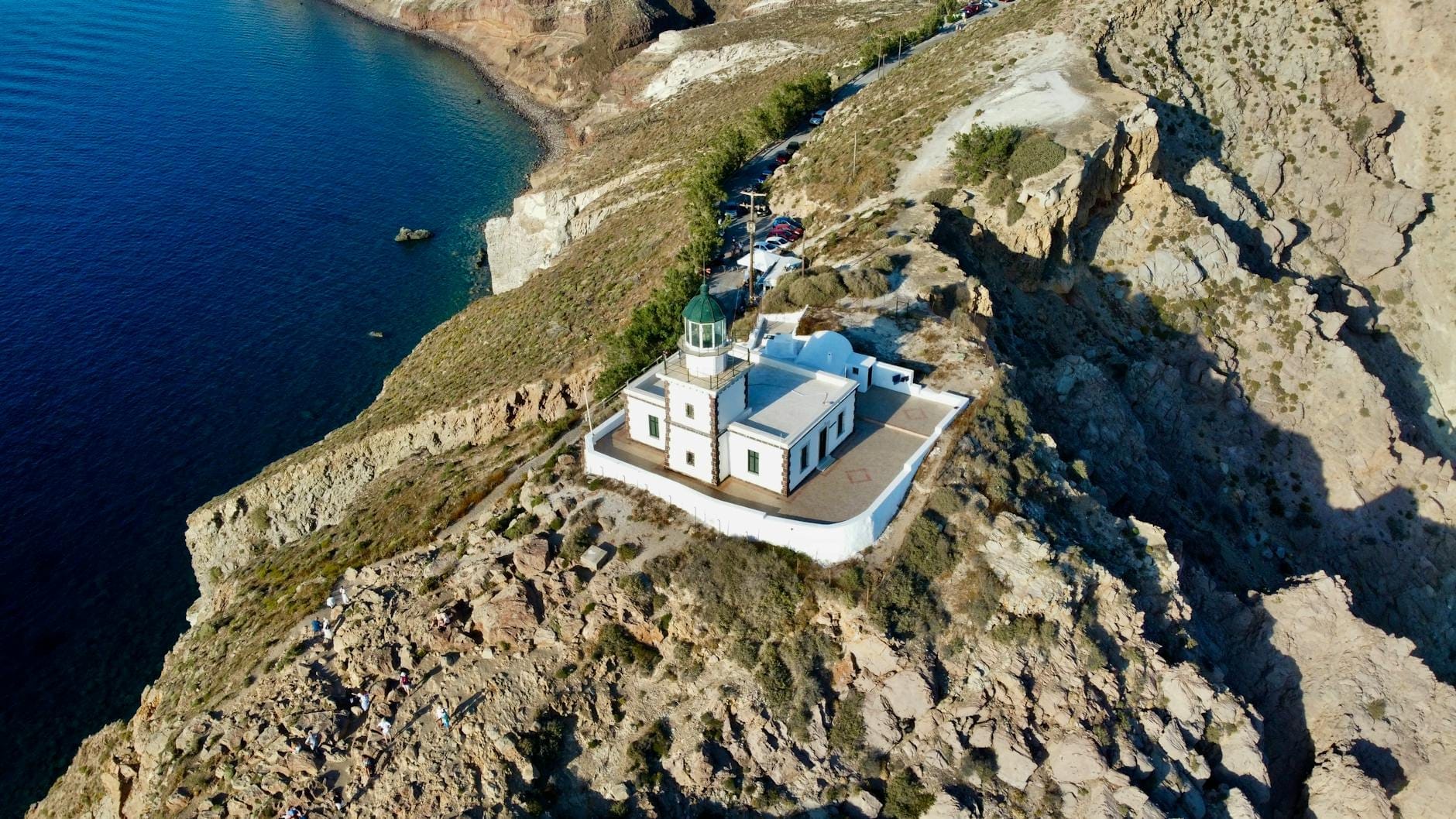
The Akrotiri Lighthouse, known in Greek as Φάρος Ακρωτηρίου Σαντορίνης, stands at the far southwestern edge of Santorini on a promontory of volcanic rock that drops sharply into the Aegean. It is a working lighthouse, not a museum or curated tourist site, and that distinction matters. What you get here is raw: wind off the sea, the smell of wild thyme and sun-baked stone, a compact whitewashed tower rising 10 meters above the keeper's house, and unobstructed views in every direction.
Built in 1892 by a French trading company, the lighthouse was among the earliest constructed in Greece. It was initially powered by petrol and operated by hand, then electrified in the mid-20th century. Operations halted during World War II before the Hellenic Navy repaired and reactivated it in 1945. Today it still operates, emitting a white flash every 10 seconds across the water.
ℹ️ Good to know
The lighthouse tower is not open to visitors on regular days. Access is limited to the surrounding grounds and exterior. On World Lighthouse Day (traditionally observed in mid-August), the grounds may be opened to visitors for limited daytime hours, though the tower interior remains off-limits.
The Experience: What You Actually See and Feel
The road to the lighthouse from Akrotiri village winds through scrubland and past low stone walls, the landscape getting progressively more exposed as you approach the cape. When you arrive, the first thing you notice is not the tower but the horizon: a broad, uninterrupted arc of deep blue Aegean that stretches southwest toward Crete. The caldera views here are different from those you get in Fira or Oia. Rather than looking inward at the volcanic crater, you are looking outward at open sea, with the jagged southern cliffs of Santorini flanking the scene on either side.
The lighthouse structure itself is modest and photogenic in a quietly functional way. The squat whitewashed tower emerges from a low rectangular keeper's house, the whole compound sitting behind a low wall. You cannot enter the buildings, but you can walk the perimeter, peer through the iron gate, and photograph the tower against sky or sea from multiple angles. The light mechanism is partially visible from outside. There are no explanatory panels or interpretive displays on site.
If you are also planning to visit the Akrotiri Archaeological Site, note that it is just a few kilometers away, making a combined half-day trip very practical.
Tickets & tours
Hand-picked options from our booking partner. Prices are indicative; availability and final rates are confirmed when you complete your booking.
Akrotiri self-guided audio tour
From 12 €Instant confirmationFree cancellationAncient Akrotiri E-ticket and Audio Tour
From 35 €Instant confirmationLuxury Sunset Cruise in Santorini
From 120 €Free cancellationCruise of the volcanic islands around Santorini
From 45 €Instant confirmationFree cancellation
How the Experience Changes by Time of Day
Midday visits in high summer are the most demanding. The promontory is almost entirely exposed, with no shade whatsoever, and the volcanic rock radiates heat noticeably. The light at noon is flat and harsh for photography, though the sea takes on an intense turquoise color that looks striking against the white structure. Crowds are also at their thinnest at midday, simply because most visitors avoid the heat.
Late afternoon and the hour before sunset are when the lighthouse earns its reputation. The low western light turns the whitewashed walls golden, the shadows elongate across the stone ground, and the sea shifts from turquoise to deep indigo. The sunset here is a genuine alternative to the famously packed scene at Oia. You will share the space with perhaps a few dozen other visitors rather than thousands. The atmosphere is noticeably calmer.
For a broader overview of where to catch the best light on the island, the Santorini sunset guide covers all the main viewpoints with honest comparisons of crowd levels and logistics.
Early morning visits, particularly in spring and autumn, offer a completely different mood. The sea is often glassy, the air cool and carrying the faint salt smell of low tide, and you may have the entire site to yourself. The lighthouse's white flash is still visible in the pre-dawn grey, which makes for an unusual long-exposure photograph if you are set up with a tripod.
⚠️ What to skip
Wind can be significant on this exposed promontory, especially in spring and when the meltemi blows in July and August. Lightweight items and unsecured equipment are at risk. Bring a layer even in summer if you plan to stay through sunset.
Historical and Architectural Context
The lighthouse was commissioned by a French trading company at a time when Santorini was an active commercial port, primarily exporting volcanic pumice and the locally produced wine made from the island's distinctive assyrtiko grape. Safe maritime navigation past the island's southwestern cape was economically important, and the lighthouse filled that role from the moment of its construction.
The architectural style follows the practical Greek lighthouse vernacular: stark whitewashing, minimal ornamentation, and a form designed to be visible rather than beautiful. The 10-meter tower is shorter than many comparable lights elsewhere, but the cliff elevation above sea level amplifies its effective range significantly. This design logic, building on natural topography rather than building height, is typical of Cycladic maritime infrastructure from the 19th century.
The southwestern quarter of Santorini has a layered history that extends well beyond the lighthouse. The nearby Akrotiri Archaeological Site preserves a Minoan-era settlement buried by the catastrophic volcanic eruption of the late Bronze Age, giving this corner of the island an unusual depth of human occupation stretching across millennia.
Getting There and Practical Logistics
The lighthouse sits roughly 15 km from Fira, translating to approximately 20–25 minutes by car. There is no direct public bus to the lighthouse itself. The KTEL network connects Fira to Akrotiri village, but from the village you still need a taxi or private vehicle to cover the remaining 3–5 kilometers to the cape. For most visitors, renting a car, scooter, or ATV for a half-day is the most practical approach, as it also allows you to combine the lighthouse with Red Beach and the Akrotiri archaeological site in a single circuit.
If you are navigating the island without a car, the getting around Santorini guide explains bus schedules, taxi availability, and rental options in detail.
Parking near the lighthouse is informal and limited, but the site receives relatively modest visitor numbers compared to the northern caldera villages, so finding a spot is rarely a problem outside of peak summer evenings. There is no café, shop, or toilet facility at the site, so plan accordingly before you make the drive.
💡 Local tip
Wear closed shoes or sturdy sandals. The ground near the cliff edge is uneven volcanic rock, and parts of the path beyond the immediate lighthouse area become rough quickly.
Photography Tips
The lighthouse photographs well from the road as you approach, with the structure framed against the sea below the cliff line. For a more composed shot, position yourself to the west of the compound, where the tower appears against the open horizon rather than against land. A wide-angle lens captures the relationship between the building and the dramatic drop to the sea beneath.
Sunset light from the southwest-facing cliff is particularly strong in the golden hour, turning the white walls amber. If you are serious about landscape and architectural photography on the island, the Santorini photography guide has detailed advice on timing, locations, and technique for different corners of the island.
The cliff edge itself provides vertiginous downward views to the sea, and on clear days you can see the outline of other islands on the horizon. These long-distance views require a telephoto lens to compress effectively. Drone operation is subject to Greek aviation authority regulations and should not be assumed permitted without checking current rules.
Who This Attraction Is and Is Not For
The Akrotiri Lighthouse suits travelers who appreciate the functional beauty of working maritime infrastructure, who want a sunset viewpoint without the dense crowds of Oia, or who are already visiting the southwestern part of the island for the archaeological site or the beaches. It is a natural add-on, not a destination in its own right if you are short on time.
Travelers who should think carefully before making the trip include those without private transport, those with significant mobility limitations (the terrain is uneven and there is no formal accessible path), and anyone expecting interpretive content, a café, or sheltered seating. The site offers none of those things. It is also a poor choice on overcast days when the sea view, the primary draw, loses much of its impact.
If dramatic cliff viewpoints are your focus, also consider Imerovigli's caldera viewpoints and Skaros Rock for a different perspective on the island's volcanic geography.
Insider Tips
- If your visit coincides with World Lighthouse Day in mid-August, check locally whether Akrotiri Lighthouse is participating that year, as some Greek lighthouses open their grounds to visitors for a few hours.
- The access road beyond the lighthouse is unpaved and rough; standard compact rental cars handle it fine, but check conditions after rain in the shoulder season.
- Combine the lighthouse with Red Beach and the Akrotiri archaeological site into a single half-day loop heading south from Fira — all three are within a few kilometers of each other.
- If you stay until after sunset, the lighthouse's operational white flash becomes visible against the darkening sky — a detail most visitors miss by leaving too early.
- The cliff edge to the right of the main compound, looking west, gives a better view of the lighthouse against the sea than the frontal approach, and it is less frequently used by other visitors with cameras.
Who Is Lighthouse of Akrotiri For?
- Photographers looking for a quieter sunset alternative to Oia
- History and maritime architecture enthusiasts
- Couples wanting a scenic but uncrowded late-afternoon stop
- Road-trippers already visiting the Akrotiri archaeological site or southern beaches
- Travelers in the shoulder season (April-May or September-October) seeking calm, atmospheric spots
Nearby Attractions
Other things to see while in Akrotiri:
- Akrotiri Archaeological Site
Buried by a volcanic eruption around 1600 BC and preserved beneath layers of pumice for over three millennia, the Akrotiri Archaeological Site offers a rare, immersive window into a sophisticated Bronze Age civilization. Walk elevated walkways above multi-storey stone buildings, intact staircases, and ceramic storage vessels still standing where ancient inhabitants left them.
- Red Beach
Red Beach (Kokkini Paralia) sits at the southwestern tip of Santorini near Akrotiri, where iron-rich cliffs plunge into dark, rust-colored sand. It is one of the most geologically striking beaches in the Aegean, though ongoing rockfall hazards mean knowing what you're getting into before you arrive.
- Tomato Industrial Museum
Set inside a converted 1945 tomato-paste factory at Vlychada on Santorini's south coast, the Tomato Industrial Museum "D. Nomikos" tells the story of an industry that once defined island life. Expect machinery dating to 1890, filmed worker testimonies, and a surprisingly moving taste of what Santorini looked like before the tourists arrived.
- Vlychada Beach
Vlychada Beach sits on Santorini's southern coast near Akrotiri, where layers of volcanic pumice have eroded into chalky white cliffs that look more like abstract sculpture than natural rock. The dark sand and relative seclusion make it one of the island's more atmospherically distinct beaches.