Skaros Rock: Imerovigli's Ancient Fortress Promontory Worth the Climb
Skaros Rock is a dramatic volcanic promontory jutting out from the caldera cliff at Imerovigli, once the medieval capital of Santorini and a Venetian fortress. The free, signposted hike rewards visitors with unobstructed 360-degree caldera views, far fewer crowds than Oia, and a tangible sense of the island's layered history.
Quick Facts
- Location
- Imerovigli, Santorini — caldera rim, approx. 2.5 km north of Fira
- Getting There
- KTEL bus to Imerovigli from Fira; trail starts near the Church of Agios Georgios in the village
- Time Needed
- 1.5 to 2.5 hours round trip depending on pace and how long you linger at the top
- Cost
- Free — no admission fee
- Best for
- Hikers, caldera view seekers, history enthusiasts, photographers wanting an alternative angle
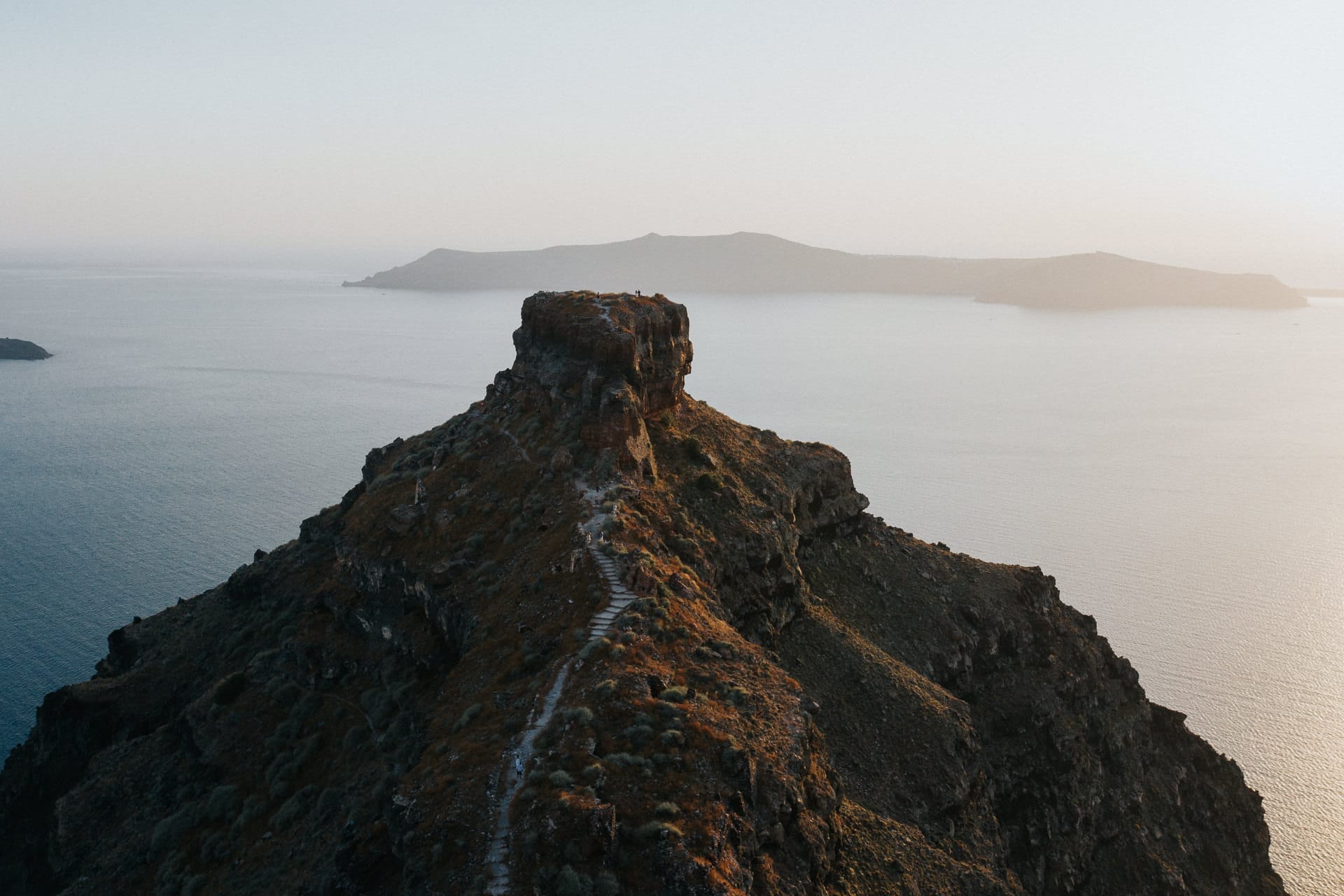
What Skaros Rock Actually Is
Skaros Rock is a solidified volcanic promontory that juts westward from the caldera cliffs of Imerovigli, sitting roughly 300 metres above the sea. It is not simply a scenic viewpoint — it is the remnant of what was once Santorini's most important medieval settlement. Established in the 13th century and later fortified under Venetian rule, Skaros served as the island's administrative and political capital for several centuries, housing a dense population within and below its fortified walls. Earthquakes, time, and the harsh Aegean climate have reduced nearly everything to rubble, but the rock's physical form remains extraordinary.
The promontory rises approximately 20 metres above the narrow saddle that connects it to the caldera rim, and the approach covers roughly 650 metres from the trail entrance near Agios Georgios Church to the small Theoskepasti Chapel at the tip. That chapel, built into the rock face and dedicated to Our Lady of the Rock, is the lone chapel still in use on the promontory today. At the very end of the promontory, the caldera drops away on three sides and the view opens to Nea Kameni, Palea Kameni, Thirasia, and on clear days, the outline of Ios to the south.
ℹ️ Good to know
There are no fixed official opening hours for Skaros Rock — the site is open-air and accessible from sunrise to sunset, but there is no official published schedule. Plan to be off the rock before dark; parts of the path have no barriers above steep drops.
The Hike: What to Expect on the Trail
The trail begins in Imerovigli village, starting from the area around the Church of Agios Georgios. The first section is straightforward: stone-paved caldera-rim path with whitewashed walls on one side and the open caldera on the other. This stretch is flat and easy, and it already offers some of the best caldera panoramas on the island without any real effort.
From there, the path descends steeply via a series of rough-cut stone steps down to the saddle connecting Imerovigli to the rock itself. This descent is where the 'easy-moderate' rating earns its moderate qualifier: the steps are uneven, the surface can be slippery when damp, and in summer the sun hits this section hard with no shade. The final ascent onto the rock involves scrambling over the actual volcanic surface. There are no railings, the ground is uneven, and the edges on both sides drop sharply into the caldera. This is not technically difficult, but it requires attention and appropriate footwear.
⚠️ What to skip
Wear closed-toe shoes with grip — sandals and flip-flops are genuinely hazardous on the rock surface. Bring water, especially between June and September when the exposed trail offers zero shade and temperatures commonly reach the upper 20s °C.
The round trip from the trailhead to the tip and back takes most walkers between 90 minutes and 2.5 hours, depending on how long you stop to photograph or rest. People with mobility limitations, knee problems, or a fear of heights should be aware that both the steep steps and the final exposed scramble are not avoidable if you want to reach the promontory's end.
Tickets & tours
Hand-picked options from our booking partner. Prices are indicative; availability and final rates are confirmed when you complete your booking.
Luxury Sunset Cruise in Santorini
From 120 €Free cancellationCruise of the volcanic islands around Santorini
From 45 €Instant confirmationFree cancellationGuided e-bike tour in Santorini
From 90 €Instant confirmationFree cancellationSantorini audio guide with TravelMate app
From 5 €Instant confirmation
The View From the Top — and Why It Differs From Oia
Standing at the tip of Skaros Rock, you are positioned farther out over the caldera than you can be from most standard caldera-rim paths in Fira or Imerovigli. The sensation is one of genuine exposure: water on three sides, the curved caldera wall stretching north toward Oia and south toward Akrotiri, and the volcanic islands sitting in the middle of the submerged crater below. The scale of the caldera — formed by one of the largest volcanic eruptions in recorded prehistory — is far easier to comprehend from this vantage point than from a terrace in Oia.
The view from Skaros also differs compositionally. You are looking at Oia from the south rather than being in it, which means you see the village as part of the caldera panorama rather than standing within its crowded lanes. For photographers, this angle is rare and underused. The Santorini photography guide covers the best light conditions island-wide, but Skaros specifically rewards early morning visits when the rising sun catches the caldera walls at a low angle and the cruise ships have not yet arrived.
Sunsets from Skaros are real and genuinely good, though the rock faces predominantly west and northwest. If you want to compare options across the island, the Santorini sunset guide breaks down which spots offer what depending on the time of year and your position on the caldera rim.
Historical Context: Santorini's Forgotten Capital
The name Skaros is associated in local usage with the rock or cliff on which the fortress stood. The settlement that grew here from the 13th century onward was not chosen for aesthetics — it was chosen for defence. Perched on an almost unassailable volcanic promontory with the caldera as a natural moat on three sides, Skaros was the seat of the Frankish lord of Santorini and later a key fortified position under Venetian administration. At its peak, the fortress town reputedly housed several thousand inhabitants, with a Catholic cathedral, multiple churches, and the infrastructure of a functioning capital.
It was eventually abandoned after a series of earthquakes in the 17th and 18th centuries made the rock increasingly uninhabitable. The population dispersed to nearby Fira and Imerovigli, and Skaros was left to erode. Today, the most prominent surviving structure on the rock is the small Theoskepasti Chapel at the promontory's tip — a quiet counterpoint to the dramatic landscape. For visitors interested in the deeper historical layers of the island, the Santorini history and ancient ruins guide provides useful context for how Skaros fits into the broader arc from Bronze Age Akrotiri through to the Ottoman and Venetian periods.
When to Go: Time of Day and Season
Early morning is the clear winner for visiting Skaros Rock, for several reasons. The trail is almost entirely in direct sun during summer, and the heat between 11am and 4pm makes the descent and ascent genuinely tiring rather than enjoyable. Early morning also means the path is quiet: most tourists in Imerovigli and Fira are either sleeping or eating breakfast, and the cruise ship passengers have not yet come ashore.
In terms of season, May, June, September, and October offer the most comfortable conditions for the hike. July and August are the hottest months, and while the trail remains manageable with appropriate preparation, the experience is considerably better outside peak summer heat. For a full breakdown of what each month looks like on the island, the Santorini weather by month guide is worth reviewing before you plan your itinerary.
Late afternoon visits, arriving around 4pm or 5pm in summer, work well if you want to catch the lower light and potentially stay for sunset. The rock cools somewhat in the late afternoon and the light on the caldera cliffs turns golden in the hour before the sun drops. Allow time to descend in daylight — navigating the steep steps in low light without a torch is inadvisable.
Getting There and Combining With Nearby Attractions
The KTEL bus network connects Fira with Imerovigli, making it straightforward to reach without a rental vehicle. From Fira's main bus terminal, buses run along the caldera road toward Oia and stop in Imerovigli — check the current KTEL Santorini timetable before travel, as schedules vary by season. A taxi from Fira to Imerovigli takes just a few minutes and is a reasonable option if you are travelling with luggage or during off-peak hours when buses are infrequent.
Skaros Rock sits at one end of the famous caldera-rim walking route. The full trail runs from Fira northward through Firostefani and Imerovigli toward Oia, and Skaros is a natural addition or alternative endpoint for anyone doing a partial version. The Fira to Oia hiking trail is the island's most celebrated walk, and combining a detour to Skaros with a section of that route makes for a full half-day itinerary. Many walkers stop at Imerovigli, do the Skaros detour, and then either continue to Oia or return to Fira by bus.
Imerovigli itself has other caldera viewpoints worth exploring before or after the Skaros hike. The Imerovigli caldera viewpoints page covers the different vantage points in the village, including those accessible without descending to the rock.
Honest Assessment: Who Should Skip It
Skaros Rock is not for everyone, and it is worth being direct about that. If you have significant mobility limitations, knee problems, or a fear of heights, the steep descent to the saddle and the exposed final scramble will be genuinely difficult or impossible to manage safely. The trail is not paved to resort standards, there are no handrails on the most exposed sections, and the volcanic rock surface is irregular underfoot.
Visitors who come primarily for the caldera-rim aesthetic — the terraced cafes, the whitewashed infinity pools, the effortless views from a lounger — may find the hike more demanding than expected for the payoff they are after. The views are exceptional, but they require physical effort to reach. If you are travelling with young children who are not confident on uneven terrain, or if you have limited time and want to cover multiple sites in a single day, the Skaros detour can eat more of your schedule than anticipated.
That said, for anyone who is reasonably fit, wearing appropriate shoes, and carrying water, the route is achievable. The label 'easy to moderate' is accurate for the majority of the path; it is only the final approach to the promontory that demands any real technical awareness.
Insider Tips
- Start at sunrise if you are visiting in July or August. The trail is in direct sun for almost its entire length, and by 9am in peak summer it is already uncomfortably hot. Dawn arrivals get golden light, empty paths, and temperatures low enough to actually enjoy the scramble.
- The Theoskepasti Chapel at the tip of the promontory is tiny and simple, but stepping inside for a moment changes the experience. The contrast between the ancient whitewashed interior and the sheer caldera drop outside is disorienting in the best way.
- For photography, the best composition of the Oia village from Skaros is actually during the descent back to the saddle, looking north-northwest. You get Oia framed against the caldera with Skaros itself in the foreground — a perspective almost no Oia photograph shows.
- There is no water or food available on the trail or at the rock. Fill your bottle before you leave Imerovigli, and bring more than you think you need if visiting in warm weather. The nearest cafe is back in the village.
- The path from the Imerovigli village edge to the saddle can feel less obvious than expected in spots — follow the main caldera-side path downward from Agios Georgios Church and keep the caldera to your left. If you are climbing upward away from the caldera, you are going the wrong way.
Who Is Skaros Rock For?
- Hikers and walkers who want a caldera experience that involves real physical engagement rather than a terrace view
- History and archaeology enthusiasts drawn to Venetian and medieval Cycladic heritage
- Photographers looking for caldera compositions that differ from the standard Oia and Fira angles
- Travellers on a budget who want dramatic scenery without paying for a caldera-view hotel or restaurant
- Visitors who find Oia's crowds overwhelming and want an equivalent or better view with a fraction of the foot traffic
Nearby Attractions
Other things to see while in Imerovigli:
- Imerovigli Caldera Viewpoints
Perched at one of the highest points on Santorini's caldera rim, Imerovigli offers some of the most expansive volcanic panoramas on the island. Access is free, the paths are walkable from Fira, and the views shift dramatically from dawn through sunset. Here is what to actually expect when you arrive.