Red Beach, Santorini: The Volcanic Shore That Earns the Trip
Red Beach (Kokkini Paralia) sits at the southwestern tip of Santorini near Akrotiri, where iron-rich cliffs plunge into dark, rust-colored sand. It is one of the most geologically striking beaches in the Aegean, though ongoing rockfall hazards mean knowing what you're getting into before you arrive.
Quick Facts
- Location
- Near Akrotiri village, southwestern tip of Santorini
- Getting There
- KTEL bus to Akrotiri, then a short walk to the parking area and a steep rocky path to the shore; also accessible by boat tour
- Time Needed
- 1 to 2 hours for the beach; allow extra time if combining with the Akrotiri archaeological site nearby
- Cost
- Free to access; sunbed and umbrella hire available at extra cost
- Best for
- Geology lovers, photographers, travelers combining a beach stop with the Akrotiri ruins
What Makes Red Beach Different
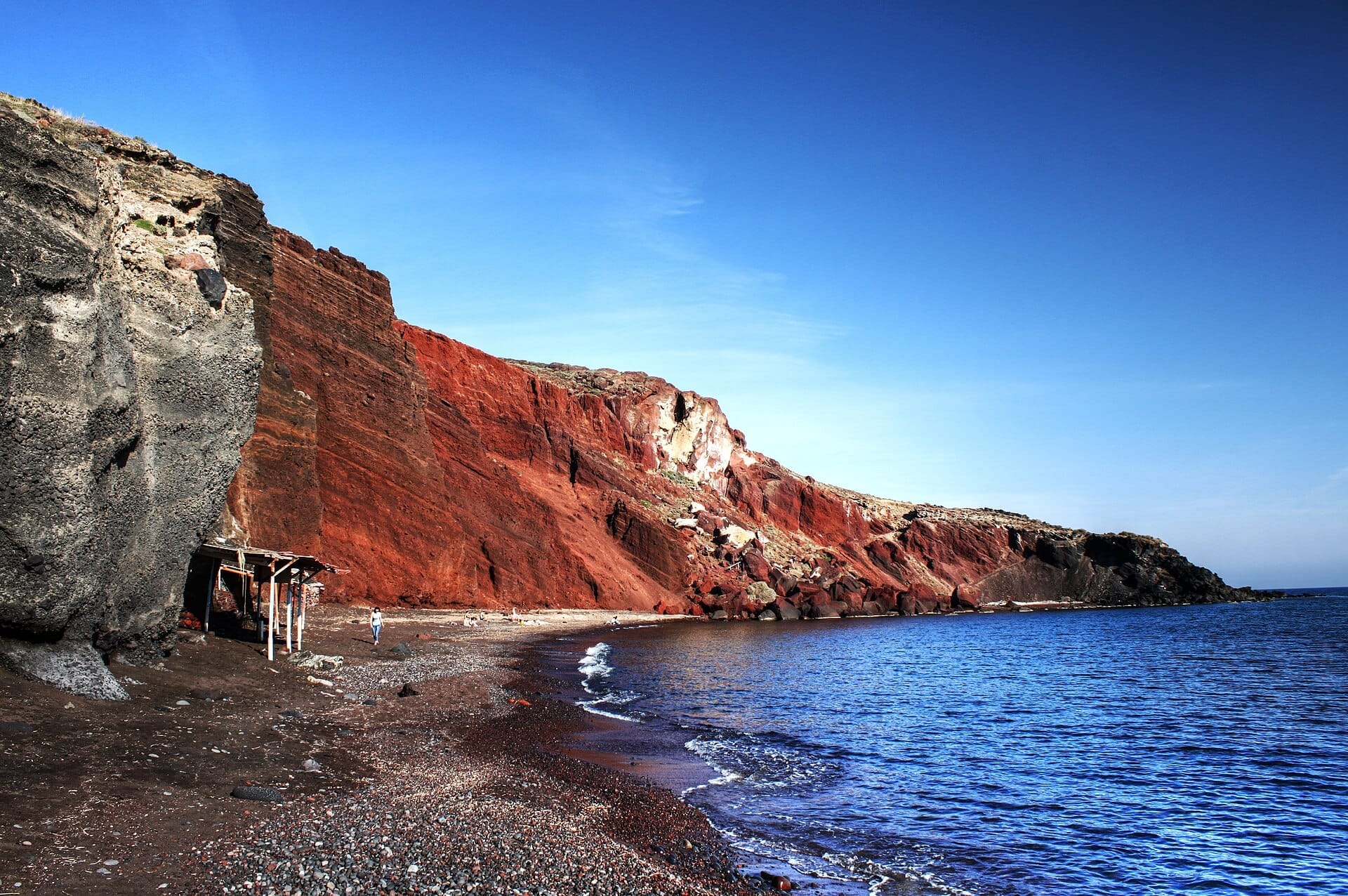
Most Santorini beaches are already unusual by Aegean standards. Red Beach (Kokkini Paralia in Greek) takes that further. The cliffs rising directly above the shoreline are a deep, saturated rust-red, streaked with black, formed from iron-rich volcanic minerals and oxidized lava that has been eroding into the sea for millennia. The sand itself is a mixture of crushed black and red volcanic rock, coarser than most Mediterranean beaches, warm underfoot in summer, and visually unlike anywhere else on the island.
The overall effect is raw and dramatic in a way that photographs don't fully capture. Standing at the water's edge, the cliff wall feels very close, very tall, and genuinely imposing. The color contrast between the red rock, the deep blue-green water, and the white of any boat anchored offshore is striking at almost any time of day.
⚠️ What to skip
Parts of Red Beach have been subject to closures since 2013 due to rockfall and landslide risk. Always check current conditions locally before your visit, and pay attention to any rope barriers or signage at the site. Do not approach the base of the cliffs.
The Geology Behind the Color
Santorini is a volcanic island complex, and Red Beach is one of the most visible expressions of that geology at sea level. The cliffs are composed of compacted volcanic ash, lava flows, and pumice layers laid down over successive eruptions. The red coloration comes specifically from iron-rich minerals that have oxidized within the lava rock over time, the same basic process that turns iron red when it rusts. Where the rock is newer or less oxidized, it appears darker, almost black, which explains the two-tone appearance of the cliff face.
The sand underfoot is the direct result of these cliffs slowly breaking apart. It is not soft or fine; it is gritty, angular, and mixed in color. Wearing water shoes is a good idea, both for the rocky path down and for the beach itself. For a broader understanding of how Santorini's volcanic history shaped every corner of the island, the Santorini volcano and hot springs guide gives useful geological context.
Tickets & tours
Hand-picked options from our booking partner. Prices are indicative; availability and final rates are confirmed when you complete your booking.
Santorini shared transfer from or to airport, port and accommodations
From 15 €Instant confirmationFree cancellationLuxury Sunset Cruise in Santorini
From 120 €Free cancellationCruise of the volcanic islands around Santorini
From 45 €Instant confirmationFree cancellationGuided e-bike tour in Santorini
From 90 €Instant confirmationFree cancellation
Getting There and What to Expect on Arrival
Red Beach is located at the southwestern edge of Santorini, just beyond the village of Akrotiri. Most visitors arrive by road to a small parking and drop-off area near Akrotiri, then walk a short but steep rocky path down to the shore. The descent is uneven and can be slippery, especially if the rocks are wet. It takes roughly five to ten minutes, but it requires reasonable balance and sturdy footwear. This beach is not accessible for visitors with limited mobility.
The KTEL public bus network serves Akrotiri from Fira, making this reachable without a car or scooter. Check current KTEL schedules before departure, as frequency varies significantly by season. Alternatively, Red Beach is a regular stop on many of the sailing and catamaran tours that circle the island. Arriving by boat gives you a completely different perspective on the cliffs and avoids the parking area congestion entirely. See the Santorini sailing and boat tours guide for options that include Red Beach as a stop.
💡 Local tip
If you're arriving by road in July or August, go before 9:30 AM or after 4:30 PM. The small parking area fills quickly and the path to the beach can become uncomfortably crowded during peak midday hours.
How the Experience Changes Through the Day
Early morning is the best time to visit, and the difference compared to midday is significant. Before 9 AM in peak season, you may have the beach almost to yourself. The light is softer and more directional, which is ideal for photography, and the air temperature is comfortable even in midsummer. The water is calm, the cliffs glow in the low angle light, and the only sounds are the water moving through the coarse sand and the occasional passing boat.
By late morning, the beach fills noticeably. Sunbeds appear quickly in the available space, and the path down sees a steady flow of tourists in both directions. Midday in July and August brings full sun with little shade, the cliffs provide no canopy, and the dark volcanic sand retains heat intensely. This is the hottest, most crowded window, and visitors without reserved sunbeds will find the remaining space limited.
Late afternoon shifts the light back to something photogenic. By around 4 PM the crowds thin as day-trippers return to Fira or Oia, and the sun drops toward the western horizon, casting warmer tones across the cliff face. This is also a quieter time for swimming. The beach does not face west directly, so you won't catch a full sunset from the shore itself, but the late-day light on the red cliffs is worth staying for.
Combining Red Beach with the Akrotiri Archaeological Site
One of the most logical pairings on Santorini is Red Beach with the Akrotiri Archaeological Site, which is only a short distance away by road. The ancient Minoan city buried under volcanic ash around 1600 BCE is one of the most significant prehistoric sites in the Aegean, and the contrast between the geological drama of Red Beach and the human history at Akrotiri makes for a compelling half-day itinerary.
If you plan to do both, visit the archaeological site first while it is still morning and cooler, then head to Red Beach afterward. The site has set opening hours and charges an admission fee; the beach has neither. Give yourself at least 90 minutes at Akrotiri before walking or driving the short distance to the beach for the afternoon.
Photography at Red Beach
Red Beach is one of the more photogenic spots in Santorini, but capturing it well requires some thought. The contrast between the rust-red cliffs and the turquoise water is the key compositional element, and it reads best in morning or late-afternoon light rather than the flat, bleached light of midday. A wide-angle lens or smartphone set to its widest field of view captures more of the cliff height. For detail shots of the sand texture and rock layers, a close perspective works well. If you're researching the island's most photogenic locations more broadly, the Santorini photography guide covers timing, locations, and equipment suggestions across the island.
From the water, looking back at the cliffs, the scale becomes clearer. Swimmers and snorkelers often find this reverse angle, from sea toward shore, more impressive than the view from the path above. The underwater visibility around Red Beach is generally good, and the rocky sea floor extends in both directions if you're comfortable in open water.
Honest Assessment: Is It Worth the Visit?
Red Beach is genuinely striking, and the geology is unlike anything else on the island. However, it comes with real limitations. The beach itself is small and the usable sand area is restricted by the safety perimeter around the cliff base. Facilities are minimal. There is no shade except what sunbeds provide. The water entry is rocky. And the ongoing landslide risk is not theoretical: parts of the beach have been closed due to actual rockfalls, and the cliffs continue to shed material.
For travelers primarily seeking a comfortable beach day, there are more practical options elsewhere. Perissa Beach on the southeast coast offers a much longer stretch of dark volcanic sand with better facilities, more restaurants, and easier access. But if the visual drama of the cliffs and the geological story behind them is what interests you, Red Beach delivers something specific that no other beach on Santorini can.
Visitors with mobility concerns, those traveling with young children, or anyone expecting a polished resort-style beach experience may find it frustrating. The path down is rough, the space is tight, and the hazard signage is a constant reminder that this is an active geological environment rather than a managed beach resort.
Insider Tips
- Wear proper footwear for the descent path and on the beach itself. Flip-flops work for the sand but the rocky path is steep and the volcanic rock has sharp edges in places. Water shoes are the most practical choice for both.
- Arrive before 9 AM in peak season (June through August) to avoid the worst of the crowds and to get the best light for photography. The beach is open at any hour, so there is no reason to compete with the late-morning rush.
- Book a catamaran or sailing tour that includes Red Beach as a stop. Arriving by sea gives you an unobstructed view of the full cliff height, better swimming access, and you skip the parking area entirely.
- The cliff base is off-limits for good reason. Do not cross rope barriers or approach the wall directly, even if no signage is visible. Loose rock falls regularly and without warning.
- Combine the visit with the Akrotiri Archaeological Site, which is only a few minutes away by car. Do the ruins first in the morning, then descend to the beach in the early afternoon when some of the midday crowd has already started to leave.
Who Is Red Beach For?
- Geology enthusiasts and travelers drawn to volcanic landscapes
- Photographers looking for dramatic natural color contrasts
- Visitors combining a half-day itinerary with the Akrotiri ruins
- Snorkelers who prefer rocky, less crowded water over long sandy shores
- Travelers arriving by sailing or catamaran tour who want a scenic anchorage stop
Nearby Attractions
Other things to see while in Akrotiri:
- Akrotiri Archaeological Site
Buried by a volcanic eruption around 1600 BC and preserved beneath layers of pumice for over three millennia, the Akrotiri Archaeological Site offers a rare, immersive window into a sophisticated Bronze Age civilization. Walk elevated walkways above multi-storey stone buildings, intact staircases, and ceramic storage vessels still standing where ancient inhabitants left them.
- Lighthouse of Akrotiri
Perched on the cliffs at Santorini's southwestern tip, the Akrotiri Lighthouse is a working 19th-century lighthouse with sweeping views of the Aegean and the caldera. Free to visit and far less crowded than the island's famous sunset spots, it rewards travelers willing to make the drive.
- Tomato Industrial Museum
Set inside a converted 1945 tomato-paste factory at Vlychada on Santorini's south coast, the Tomato Industrial Museum "D. Nomikos" tells the story of an industry that once defined island life. Expect machinery dating to 1890, filmed worker testimonies, and a surprisingly moving taste of what Santorini looked like before the tourists arrived.
- Vlychada Beach
Vlychada Beach sits on Santorini's southern coast near Akrotiri, where layers of volcanic pumice have eroded into chalky white cliffs that look more like abstract sculpture than natural rock. The dark sand and relative seclusion make it one of the island's more atmospherically distinct beaches.