Tomato Industrial Museum "D. Nomikos": Santorini's Forgotten Industrial Past
Set inside a converted 1945 tomato-paste factory at Vlychada on Santorini's south coast, the Tomato Industrial Museum "D. Nomikos" tells the story of an industry that once defined island life. Expect machinery dating to 1890, filmed worker testimonies, and a surprisingly moving taste of what Santorini looked like before the tourists arrived.
Quick Facts
- Location
- Vlychada, Santorini 847 03, Greece (south coast, near Vlychada beach)
- Getting There
- Private car or taxi recommended; local KTEL buses serve the Vlychada area — confirm current schedules before visiting
- Time Needed
- 1–1.5 hours for the full self-guided audio tour and film screening
- Cost
- Admission fee applies; exact prices not published online — check the official site or GetYourGuide before visiting
- Best for
- History enthusiasts, food culture travelers, families, off-the-beaten-path visitors
- Official website
- www.tomatomuseum.gr
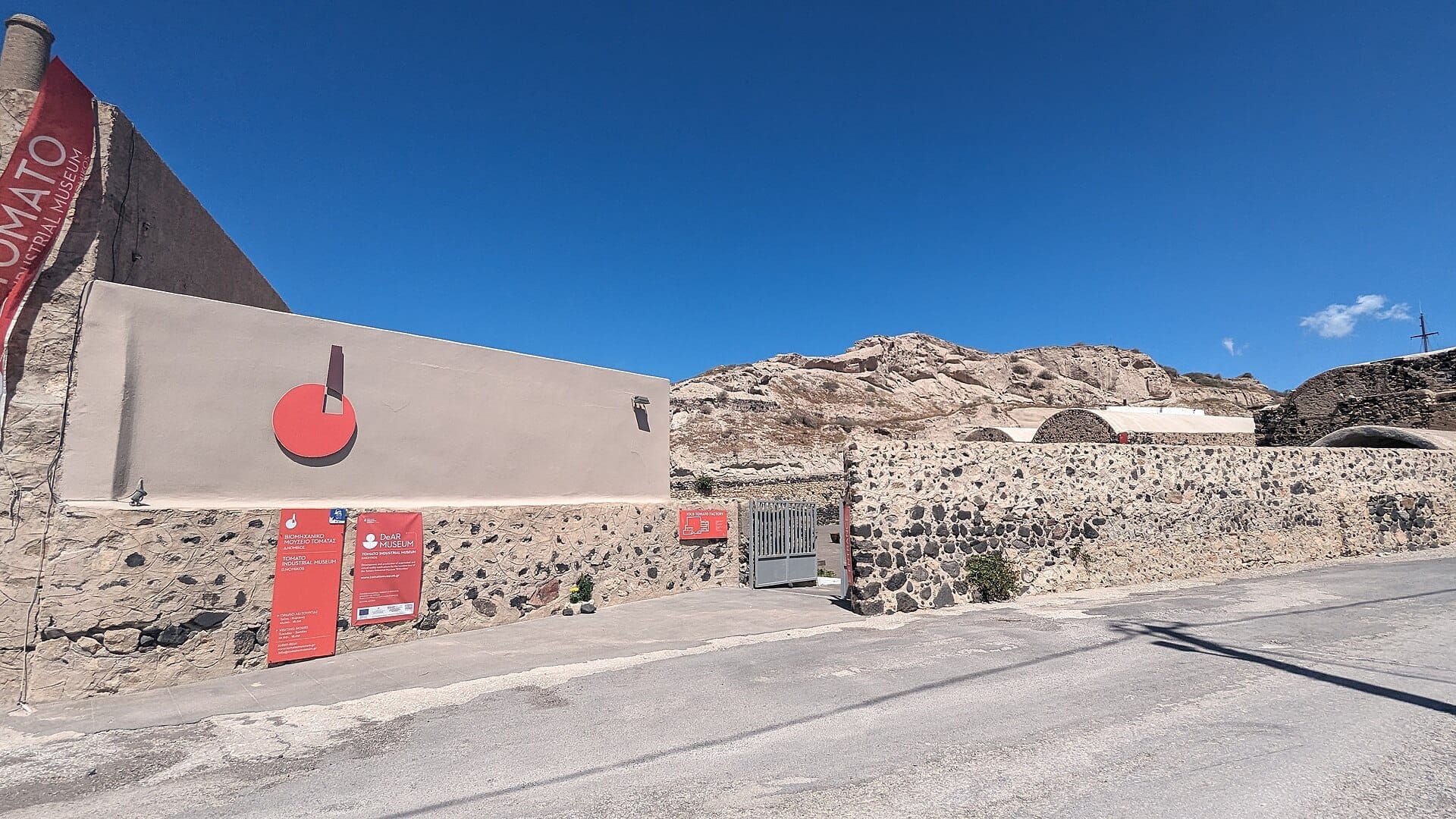
What the Tomato Industrial Museum Actually Is
The Tomato Industrial Museum "D. Nomikos" occupies a former tomato-paste processing factory on Santorini's quiet south coast, a few hundred metres from Vlychada beach. The factory was founded in 1945 as part of a once-significant Santorini industry, and its industrial bones — concrete floors, heavy metal machinery, loading bays baked by decades of Aegean sun — have been preserved rather than prettified. Converted into a working museum in 2014, it now offers one of the more genuinely interesting cultural experiences on an island where most visitor attractions revolve around scenery rather than substance.
This is not a polished heritage centre with slick interactive screens. It is a carefully curated industrial space that documents a chapter of Santorini's social history that few visitors know existed. For context, the same volcanic soil that makes Santorini's wines so distinctive also produced a small-fruited, intensely flavoured tomato that was processed here and exported across Greece and beyond. That tomato variety has held Protected Designation of Origin (PDO) status since 2013.
💡 Local tip
The museum is seasonal, generally open April through November, Tuesday to Sunday, 10:00–18:00, with the last tour starting around 17:30. Always confirm current hours directly with the museum before making the trip south.
Inside the Factory: What You'll See and Hear
The visit begins with an audio tour available in five languages, which walks you through the production process as it would have operated during the factory's active decades. The exhibits include processing machines dating from as far back as 1890 — some still visually intact — as well as old account books, product labels, workers' tools, and photographs from the industry's peak years. These are not replicas. The patina on the metal, the rust patterns on the gears, the worn edges of the weighing equipment: all of it is original.
Midway through, there is a film screening featuring testimonies from former factory workers. This is where the museum earns its emotional weight. Listening to older Santorinians describe the rhythm of the tomato season — the heat of summer processing, the smell of cooking paste, the sound of the machinery running through the night — reframes the island in a way no sunset view can. For visitors used to Santorini being presented purely as a postcard destination, this is a useful corrective.
The tour ends with a tasting of tomato paste and the opportunity to have a small souvenir can sealed for you on one of the original machines. It is a small theatrical touch, but it works. The paste itself is noticeably different from supermarket tomato paste — thicker, more mineral, with a sweetness that lingers.
Tickets & tours
Hand-picked options from our booking partner. Prices are indicative; availability and final rates are confirmed when you complete your booking.
Luxury Sunset Cruise in Santorini
From 120 €Free cancellationCruise of the volcanic islands around Santorini
From 45 €Instant confirmationFree cancellationGuided e-bike tour in Santorini
From 90 €Instant confirmationFree cancellationSantorini audio guide with TravelMate app
From 5 €Instant confirmation
The Building Itself: Industrial Architecture Worth Noticing
The factory structure is typical of mid-20th century Greek industrial architecture: functional, heavy, built to last rather than to impress. The high ceilings of the processing halls create a different kind of space from anything else you will find on Santorini. In the peak summer months, the interior stays several degrees cooler than outside — a practical benefit worth mentioning on a 30-degree July afternoon.
The exterior, facing toward the flat southern coast, lacks the drama of the caldera villages, but it has its own quiet character. The surrounding Vlychada area is far less visited than Fira or Oia, and the drive or taxi ride down through the agricultural interior of the island — past pumice quarries and low stone walls — gives a sense of how most of Santorini actually looked and functioned before mass tourism. If you are combining this visit with a beach stop, Vlychada beach is within easy walking distance and has a distinctive white pumice landscape that most visitors never reach.
When to Visit and How to Get There
The museum sits on the south coast, roughly equidistant from Fira and the Akrotiri peninsula, and is not on a main tourist circuit. That relative isolation is part of its appeal, but it does mean you need to plan transport deliberately. A private car or rental vehicle makes the visit straightforward; taxis from Fira are available but can be slow to return during peak season, so agree on a pickup time or use an app-based service.
KTEL buses serve the Vlychada direction, but schedules are seasonal and infrequent. Check the Santorini transport options carefully before building your itinerary around a bus connection here. If you are renting a quad or scooter — common on the island — the south coast roads are relatively quiet and the approach to Vlychada is easy to navigate.
In terms of timing within the day, mid-morning visits (around 10:30–11:30) work well: the museum has just opened, the film screening feels unhurried, and you can continue to Vlychada beach or the nearby Akrotiri archaeological site in the afternoon without the worst midday heat. Avoid arriving close to 17:30 if you want the full experience rather than a rushed walkthrough.
ℹ️ Good to know
The museum is closed on Mondays. If your Santorini itinerary is only a few days long, plan this visit for a Tuesday through Sunday and combine it with other south coast stops to make the journey worthwhile.
Cultural Context: The Santorini Tomato Industry
For most of the 20th century, tomato paste production was one of Santorini's primary economic activities alongside fishing and agriculture. The island's small, fleshy tomatoes — adapted to the dry volcanic soil and cultivated without irrigation — were prized for their concentrated flavour and thick flesh, which made them ideal for paste production. At its peak, the industry supported multiple factories and employed a significant portion of the local workforce during the summer harvest season.
The decline began with the growth of mass tourism in the 1970s and 1980s, which offered faster and more reliable income than seasonal agricultural work. By the time the D. Nomikos factory closed in 1981, the industrial tomato sector had essentially vanished from the island. The museum's value is precisely in documenting this transition — from a working agricultural economy to one almost entirely dependent on visitors. That context makes Santorini's longer historical arc feel more tangible and less abstract.
Honest Assessment: Who Will Get the Most From This
The Tomato Industrial Museum is not a spectacle. There are no sweeping views, no dramatic architectural flourishes, and nothing that will photograph well for social media. What it offers instead is depth: a specific, well-documented story about real people and a real place, told with care and without embellishment. Visitors who approach it with curiosity rather than expectation almost universally find it more engaging than anticipated.
It suits travelers who have already seen the caldera, ticked off the sunset, and are looking for something that explains why Santorini is actually the way it is. It is also genuinely good for children who are old enough to engage with the machinery and the film — the hands-on can-sealing moment at the end tends to land well with younger visitors.
Those who should probably skip it: visitors on a single-day itinerary who have not yet seen the caldera-edge villages or the Akrotiri archaeological site, travelers who find industrial history unrewarding regardless of quality, and anyone arriving by cruise with limited time ashore. The south coast location adds a logistical step that only makes sense if the museum genuinely interests you.
⚠️ What to skip
Specific wheelchair accessibility details are not listed on the official site. If accessibility is a consideration, contact the museum directly before visiting to confirm step-free access and toilet facilities.
Insider Tips
- Combine the museum with a stop at Vlychada beach immediately afterward — the white pumice cliffs there are visually striking and the beach is far less crowded than Perissa or Kamari. Walking distance from the museum is roughly 5–10 minutes.
- Pick up a spare souvenir can at the end of the tour. The tomato paste inside is made from PDO-certified Santorini tomatoes and is a more useful and authentic food souvenir than anything sold in Fira's gift shops.
- The film screening with worker testimonies is the emotional centrepiece of the visit. If you arrive when a screening is just finishing, ask staff when the next one starts rather than skipping it — it reframes everything else you have seen in the museum.
- The audio guide is available in several languages including English, Greek, German, French, and Italian. Pick it up at the entrance rather than trying to navigate the exhibits without context — the machinery is impressive but largely unlabelled for general visitors.
- If you are driving, the route from Fira through Megalochori and down toward Vlychada passes through some of the least-visited agricultural land on the island. Give yourself an extra 15 minutes and take the slower inland road rather than the coastal bypass.
Who Is Tomato Industrial Museum For?
- History and food culture travelers who want context beyond the postcard version of Santorini
- Families with children aged 8 and up who will engage with the machinery and the can-sealing demonstration
- Visitors on longer stays (4+ days) looking for a half-day itinerary on the south coast
- Photographers interested in industrial textures, light through factory windows, and documentary-style imagery
- Travelers who have already covered the main caldera villages and want something genuinely different on a second or third day
Nearby Attractions
Other things to see while in Akrotiri:
- Akrotiri Archaeological Site
Buried by a volcanic eruption around 1600 BC and preserved beneath layers of pumice for over three millennia, the Akrotiri Archaeological Site offers a rare, immersive window into a sophisticated Bronze Age civilization. Walk elevated walkways above multi-storey stone buildings, intact staircases, and ceramic storage vessels still standing where ancient inhabitants left them.
- Lighthouse of Akrotiri
Perched on the cliffs at Santorini's southwestern tip, the Akrotiri Lighthouse is a working 19th-century lighthouse with sweeping views of the Aegean and the caldera. Free to visit and far less crowded than the island's famous sunset spots, it rewards travelers willing to make the drive.
- Red Beach
Red Beach (Kokkini Paralia) sits at the southwestern tip of Santorini near Akrotiri, where iron-rich cliffs plunge into dark, rust-colored sand. It is one of the most geologically striking beaches in the Aegean, though ongoing rockfall hazards mean knowing what you're getting into before you arrive.
- Vlychada Beach
Vlychada Beach sits on Santorini's southern coast near Akrotiri, where layers of volcanic pumice have eroded into chalky white cliffs that look more like abstract sculpture than natural rock. The dark sand and relative seclusion make it one of the island's more atmospherically distinct beaches.