Firostefani: The Caldera Village That Rewards the Curious
Perched on the caldera rim just north of Fira, Firostefani is a small whitewashed village that blends into Santorini's capital while offering noticeably calmer streets and sweeping volcano views. Its name translates literally as 'Crown of Fira,' and the elevated position earns that title. Entry is free, the caldera path is walkable from Fira in under 15 minutes, and the atmosphere is several degrees quieter than either Fira's main drag or Oia's famous sunset strip.
Quick Facts
- Location
- Caldera rim, approx. 1 km north of Fira, between Fira and Imerovigli, Santorini
- Getting There
- 10–15 min walk north from Fira along the caldera path; KTEL buses on the Fira–Oia route stop nearby
- Time Needed
- 1–3 hours for a leisurely walk-through; longer if you stop for a meal or sunset
- Cost
- Free to enter and explore; individual cafes, restaurants, and the monastery museum have their own charges
- Best for
- Caldera views, quiet walks, photography, couples, travelers who want Santorini's scenery with fewer crowds
What Firostefani Actually Is
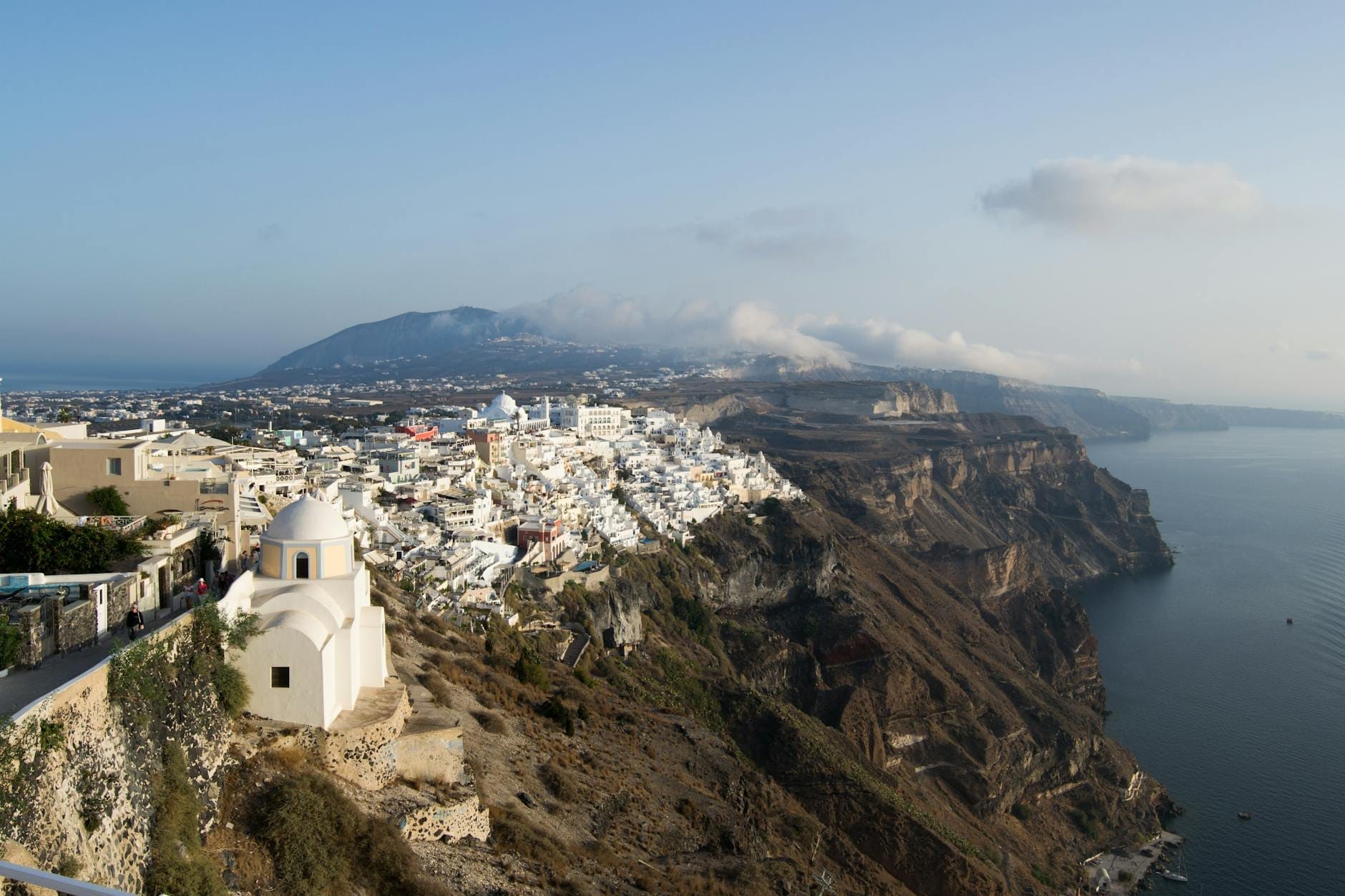
Firostefani is a caldera-edge village that has, over time, grown into a continuous urban stretch with Fira to its south. Administratively and visually, the two settlements now flow into each other, but Firostefani retains its own identity: narrower lanes, fewer souvenir shops, and a noticeably slower rhythm. Its Greek name, combining 'Fira' with 'stefani' (crown), describes its position precisely. It sits on the highest section of Fira's caldera rim, looking directly out over the submerged volcanic crater toward Nea Kameni and the open Aegean.
Unlike gated attractions, there is no ticket booth or entrance gate. Firostefani is a living village with year-round residents, and its streets, viewpoints, and caldera-facing terraces are freely accessible at any hour. The draw is the combination of architecture and topography: blue-domed churches, cave houses carved into the pumice cliff face, and unobstructed caldera panoramas that rival anything on the island.
💡 Local tip
If you are already in Fira and want caldera views without fighting through crowds, simply walk north along the caldera path for 10–15 minutes. You will cross into Firostefani before you realize you have left Fira.
The Walk In: Caldera Path from Fira
The most rewarding way to reach Firostefani is on foot along the caldera-edge pedestrian path that begins in central Fira. The path runs along the western cliff edge, with the caldera dropping away steeply to your left and the backs of cave hotels stacked above you to the right. The surface is paved in places and uneven in others, and the path passes cafes, small churches, and several open viewpoint platforms on the way.
In the mornings, this walk is largely quiet: light is soft and golden, the air smells faintly of sea salt and occasionally of fresh coffee drifting from terrace cafes, and the caldera below is often partially wrapped in low haze that burns off as the sun rises. This is prime time for photography and for getting a genuine sense of the village before day-trippers arrive. The same path connects northward to Imerovigli and beyond, forming part of a longer coastal walk that serious hikers can extend all the way to Oia.
By midday in peak season (July and August), the path becomes considerably busier, with couples, photography groups, and hotel guests from the cliff-side properties all moving in both directions. The path is narrow in sections and has no guardrails along parts of the cliff edge, so keep this in mind with young children. Sensible footwear matters: flip-flops are workable on the flat stretches but problematic where stone steps are steep and worn smooth.
⚠️ What to skip
The caldera path involves steps, uneven paving, and cliff-edge sections with no barriers. It is not accessible for wheelchairs or pushchairs, and even confident walkers should wear closed shoes with grip.
Tickets & tours
Hand-picked options from our booking partner. Prices are indicative; availability and final rates are confirmed when you complete your booking.
Luxury Sunset Cruise in Santorini
From 120 €Free cancellationCruise of the volcanic islands around Santorini
From 45 €Instant confirmationFree cancellationGuided e-bike tour in Santorini
From 90 €Instant confirmationFree cancellationSantorini audio guide with TravelMate app
From 5 €Instant confirmation
The Views: What You Are Actually Looking At
The caldera visible from Firostefani is the collapsed remnant of one of the largest volcanic eruptions in recorded geological history. The dark mass in the middle of the water is Nea Kameni, a volcanic island that has been growing through eruptions over centuries and remains geologically active. The reddish-brown island to its left is Palea Kameni. On clear days, the western rim of the caldera is visible as the long, low outline of Thirasia.
From Firostefani's higher elevation, you get a slightly different angle on this panorama compared to Fira's main town center. The village's caldera-facing terraces are less densely packed with bars and viewpoint platforms, which means you can often find a quiet stretch of wall or a church forecourt with the full view to yourself. The Monastery of Agios Nikolaos sits within the village and offers one of the more peaceful elevated positions, particularly in the quieter parts of the day.
Light conditions change the caldera dramatically. Early morning brings the most atmospheric shots, with shadow still lying across the water. Late afternoon shifts the caldera to amber and copper tones. Sunset here can be genuinely impressive, though it draws crowds: if watching the sun go down over the Aegean is a priority, read through Santorini's sunset viewing guide before deciding between Firostefani, Imerovigli, and Oia.
The Monastery of Agios Nikolaos
One of Firostefani's most distinctive stops is the women's Monastery of Agios Nikolaos (Saint Nicholas), a functioning Orthodox religious community within the village. The monastery complex includes two small museums: a folklore museum displaying everyday objects, tools, and traditional costumes from Santorini's past, and an ecclesiastical museum holding Byzantine icons and religious artifacts.
Both collections are modest in scale but offer a more grounded, less commercially packaged encounter with the island's history and religious culture than you find at larger sites. If visiting, dress conservatively: shoulders and knees should be covered as a matter of respect in an active religious community. Verify opening hours locally before planning your visit, as they vary by season.
How Firostefani Changes Through the Day
Early morning, roughly 7:00 to 9:30, is when Firostefani is closest to what a permanent resident experiences. Cats move between doorways. The smell of bread and coffee drifts from village kitchens. The caldera is lit from low on the eastern horizon, throwing long shadows across the white plaster walls. Almost no tourist foot traffic.
Midmorning through early afternoon brings day-trippers who have walked up from Fira, combined with guests from the cluster of caldera-view hotels. The village handles this better than Oia because its layout spreads foot traffic across several lanes rather than funneling everyone onto one main street. There are real cafes here with locals at the tables alongside tourists, which is less common the further north you go toward Oia.
Evenings, particularly from May through October, draw visitors for the caldera light. Firostefani's restaurants and terrace bars fill up, though not to the degree of Fira's main square or Oia's sunset point. If you want caldera-facing dinner with a view and do not want to book weeks in advance, Firostefani is often where you will find last-minute availability at a reasonable standard.
Practical Notes for Visitors
Getting here is straightforward from Fira. The caldera path on foot takes 10 to 15 minutes at a normal walking pace, less if you move quickly. KTEL buses running between Fira and Oia stop on the main road above the village; from the road, you descend into the village on foot. Driving and parking in Firostefani follows the same challenge as all caldera villages: road access is narrow and parking is genuinely difficult during peak season. Most visitors do better arriving from Fira on foot or by bus. For context on moving around the island more broadly, the getting around Santorini guide covers all main options.
Firostefani works well as a stopping point on a longer walk. The caldera path continues north from here to Imerovigli and Skaros Rock, and the full walk to Oia, while long, is manageable for fit walkers. Details on that route and distances are covered in the Fira to Oia hiking trail guide.
For photography specifically: the caldera path through Firostefani offers some of the cleaner foreground compositions on the island, with church domes and cave-house rooftops in the mid-ground and the volcano in the distance. The Santorini photography guide has detailed notes on timing and positioning for caldera shots.
Who This Suits and Who Should Skip It
Firostefani rewards travelers who want to move at their own pace rather than follow a marked route to a single Instagram photo. If the goal is to experience caldera architecture and volcanic scenery with space to actually stop and absorb it, this village delivers that more reliably than either Fira's main center or Oia.
Travelers looking for major archaeological content, evening nightlife, or a beach day will not find what they need here specifically. Firostefani is a caldera walk and village atmosphere, not a programmatic attraction. It also does not work well for visitors with limited mobility: the terrain is steep, the steps are numerous, and there are no accessible routes to most of the caldera viewpoints.
If Santorini's crowds have worn you down and you are wondering whether the island has anything left that feels genuinely unhurried, a morning walk through Firostefani is a reasonable answer to that question.
Insider Tips
- Walk north through Firostefani instead of heading back to Fira: the caldera path continues another 15–20 minutes to Imerovigli, which is even quieter and offers a different angle on the caldera and Skaros Rock.
- The monastery of Agios Nikolaos is easy to walk past without noticing. Look for the blue dome set back slightly from the main caldera path and the small signage near the entrance. The folklore collection is worth 20 minutes.
- Caldera-view hotels in Firostefani are generally priced lower than equivalent properties in Oia, with comparable or better views. If you are deciding where to base yourself, this is worth factoring in.
- The caldera path through Firostefani is busiest between 10:00 and 12:00 and again from 17:00 onward as sunset approaches. A mid-afternoon visit (13:00 to 16:00) gives you the path largely to yourself, though light is harsher for photography.
- Bring water. There are cafes and restaurants, but there are no public drinking fountains, and the walk along the cliff in summer sun is warmer than it looks from a map.
Who Is Firostefani For?
- Couples wanting caldera scenery without Oia's crowds
- Photographers seeking clean compositions with caldera and architectural foregrounds
- Walkers using Firostefani as a mid-point on the Fira to Oia trail
- Travelers staying in Fira who want a quieter extension of the day
- Anyone interested in Orthodox monastery culture and small-scale local history museums
Nearby Attractions
Other things to see while in Fira:
- Archaeological Museum of Thera
Set in the heart of Fira, the recently renovated Archaeological Museum of Thera brings together centuries of island history under one roof. The star exhibit is the Kore of Thera, a 2.48-metre Archaic statue carved from Naxian marble and hidden from public view for over two decades. For anyone serious about understanding Santorini beyond its postcard image, this is the clearest starting point.
- Fira–Oia Hiking Trail
The Fira–Oia Hiking Trail is Santorini's most rewarding walk: a 10-kilometre path along the caldera rim connecting the island's capital to its most photographed village. Free to walk, open at all hours, and lined with volcanic cliffs, whitewashed chapels, and sweeping Aegean views, it rewards those who go prepared and go early.
- Fira Town Center
Fira is the administrative and social heart of Santorini, built on the rim of the caldera at roughly 260 meters above the Aegean. Free to enter and walkable from multiple directions, it offers caldera views, museums, restaurants, and a cable car connection to the old port — all within a compact, cliff-top layout that rewards early risers and punishes late arrivals in summer.
- Lost Atlantis Experience
The Lost Atlantis Experience in Megalochori is Santorini's only museum dedicated entirely to the Atlantis myth, using 9D simulation, holograms, and digital exhibits to explore the legend's possible link to the island's volcanic past. Opened in 2019 and spread across 700 square metres, it offers a rainy-day alternative and a genuinely different angle on the island's ancient story.